Robotic Process Automation (RPA) is a strategic lever for unlocking operational excellence. By automating repetitive, rule-based tasks, businesses achieve higher data accuracy and free human capital for high-value work. This guide moves beyond theory to illustrate the most impactful use cases for robotic process automation across key industries, focusing on the measurable outcomes you can expect.
We will dissect specific business problems, map the automated workflows, and define the results. From invoice processing and supply chain management to customer onboarding and regulatory reporting, you will find a clear blueprint for implementation.
This article provides actionable insights to help you replicate these successes, including critical integration with data platforms like Snowflake and augmenting RPA with AI. For technology leaders, the goal is a clear roadmap connecting specific automation projects to measurable business value. Prepare to see how targeted automation redefines efficiency, improves data-driven decision-making, and drives your enterprise forward. We will cover ten powerful examples, including order-to-cash automation, claims processing, and HR data management, equipping you to select and execute the right projects for maximum ROI.
1. Accounts Payable Automation
Accounts Payable (AP) automation is a cornerstone use case for robotic process automation. It transforms a manual, error-prone back-office function into a streamlined, efficient, and accurate process. RPA handles the entire invoice lifecycle, from receipt and data entry to validation, approval, and payment.
The Business Problem
Manual AP processes lead to high processing costs, late payment penalties, missed early payment discounts, and a significant risk of human error. These inefficiencies drain resources and offer zero strategic value.
The RPA Workflow
RPA bots automate the end-to-end invoice management workflow to deliver speed and accuracy.
- Invoice Ingestion: Bots monitor inboxes or portals to automatically download new invoices.
- Data Extraction: Using Optical Character Recognition (OCR), the bot extracts key data like invoice number, date, vendor name, and line-item details.
- Data Validation & Matching: The bot performs a three-way match between the invoice, purchase order (PO), and goods receipt note in the ERP system.
- Exception Handling: If discrepancies arise, the bot flags the invoice and routes it to an AP clerk with pre-populated notes on the issue.
- Approval & Payment: Once validated, the bot routes the invoice for digital approval and enters payment data into the ERP for final processing.
Strategic Insight: AP automation's true power is data integrity. By enforcing business rules and validating against master data, RPA ensures financial data entering your ERP is clean and reliable from the start.
Measurable Benefits & ROI
- Cost Reduction: Lowers invoice processing costs by up to 80%.
- Increased Accuracy: Reduces data entry errors by over 95%, eliminating duplicate payments.
- Faster Cycle Times: Accelerates the invoice processing cycle from weeks to hours.
- Strategic Advantage: Enables businesses to capture early payment discounts and avoid late fees, directly improving the bottom line.
2. Customer Onboarding and KYC Verification
Customer Onboarding and Know Your Customer (KYC) verification is a critical use case for robotic process automation in regulated industries like finance. RPA transforms this high-stakes process from a manual, lengthy task into a rapid, secure, and standardized operation. It automates the entire client lifecycle initiation, from data gathering and document validation to background screening and final account setup.

The Business Problem
Manual onboarding and KYC processes are bottlenecks that frustrate new customers and expose firms to significant regulatory risk. They result in high operational costs, prolonged onboarding times, and the risk of human error leading to compliance breaches and fines.
The RPA Workflow
RPA bots orchestrate the complex, multi-system onboarding and verification journey for immediate results.
- Data & Document Collection: Bots extract customer data from application forms and collect submitted documents like passports.
- Identity Verification: Bots extract data from identity documents and connect via APIs to external government databases or third-party services to validate authenticity.
- Compliance Screening: The bot automatically screens the applicant's details against global watchlists and sanctions lists to identify risks.
- Exception Handling: If a document is unreadable or a red flag is raised, the bot automatically creates a case and routes it to a compliance officer.
- Account Creation: Upon successful verification, the bot creates the customer account in the core system and triggers a welcome notification.
Strategic Insight: Successful KYC automation creates a robust audit trail. RPA logs every action, check, and decision, providing regulators with a transparent, time-stamped record of the entire compliance process.
Measurable Benefits & ROI
- Cost Reduction: Reduces customer onboarding costs by over 70%.
- Increased Accuracy: Minimizes data entry and screening errors, significantly lowering compliance risk.
- Faster Cycle Times: Slashes onboarding time from days to minutes.
- Strategic Advantage: Enhances the customer experience with near-instant account activation, leading to higher conversion rates. Barclays, for instance, cut its account opening process time significantly with RPA.
3. HR Onboarding and Employee Data Management
Automating human resources functions is a prime example of high-impact use cases for robotic process automation. It transforms the administrative process of employee onboarding into a seamless, rapid, and consistent experience, while ensuring data accuracy across all corporate platforms.
The Business Problem
Manual onboarding is a disjointed process involving repetitive data entry into multiple systems (HRIS, payroll, IT). This leads to a high risk of errors that can delay payroll or system access and creates an inconsistent experience for new employees.
The RPA Workflow
RPA bots orchestrate the sequence of tasks required to bring a new employee into the organization efficiently.
- Initiation: A bot monitors the Applicant Tracking System (ATS) for a "new hire" status change, triggering the onboarding process.
- Data Collection & System Entry: The bot sends a welcome email with digital forms. Once completed, it extracts the information and populates profiles in HRIS, payroll, and benefits platforms.
- Access Provisioning: The bot creates tickets in IT systems to provision hardware, email accounts, and software access based on the employee's role.
- Documentation & Compliance: Bots manage background checks, collect required documents, and ensure all compliance tasks are completed and logged.
- Scheduling & Communication: The bot schedules orientation sessions, adds them to the new hire's calendar, and sends out introductory materials.
Strategic Insight: The value of automating onboarding extends beyond efficiency. A smooth, error-free day-one experience with immediate system access and correct payroll setup significantly boosts new hire satisfaction and retention.
Measurable Benefits & ROI
- Faster Time-to-Productivity: Reduces onboarding cycle times by over 60%, getting employees productive sooner.
- Enhanced Employee Experience: Delivers a consistent and welcoming first impression.
- Improved Compliance: Enforces procedural consistency, reducing the risk of compliance errors.
- HR Team Empowerment: Frees HR professionals from administrative tasks to focus on strategic initiatives like talent development.
4. Order-to-Cash Process Automation
The Order-to-Cash (O2C) cycle is the lifeblood of any business, and its complexity makes it a prime candidate for one of the most impactful use cases for robotic process automation. RPA streamlines the entire sequence from order placement to payment receipt, connecting disparate systems like CRM, ERP, and inventory management into a single, automated workflow.
The Business Problem
A manual O2C process leads to order entry errors, invoicing inaccuracies, and slow cash collection. These bottlenecks directly impact cash flow, increase Days Sales Outstanding (DSO), and can degrade the customer experience.
The RPA Workflow
RPA bots orchestrate the O2C cycle by automating critical touchpoints between systems and departments.
- Order Entry & Validation: Bots monitor portals and emails for purchase orders, extract details, and enter the information accurately into the ERP system.
- Credit Check: The bot automatically performs credit checks for customers based on predefined business rules.
- Fulfillment & Invoicing: Upon order approval, the bot sends fulfillment instructions. Once shipment is confirmed, it automatically generates and dispatches an accurate invoice.
- Payment & Collections: Bots monitor bank accounts for incoming payments and apply cash to open invoices. For overdue accounts, bots can automatically trigger reminder emails.
Strategic Insight: O2C automation is a customer experience play. By ensuring orders are processed flawlessly and billed correctly, RPA reduces friction, builds trust, and allows human teams to focus on high-value relationship management.
Measurable Benefits & ROI
- Accelerated Cash Flow: Reduces Days Sales Outstanding (DSO) by 20-40%.
- Enhanced Accuracy: Minimizes order entry and invoicing errors, reducing costly disputes.
- Operational Efficiency: Cuts order processing time by up to 70%, allowing for higher throughput.
- Strategic Advantage: Frees finance and sales teams from manual tasks to focus on strategic credit management and sales growth.
5. Claims Processing and Settlement
Automating claims processing is one of the most impactful use cases for robotic process automation within the insurance industry. RPA transforms the entire claims lifecycle, from submission and data verification to fraud analysis and final settlement, turning a cumbersome process into an efficient, accurate, and rapid workflow.
The Business Problem
Manual claims processing is notoriously slow, costly, and prone to error. Insurers face challenges with high operational expenses, prolonged settlement times, and the risk of inconsistent application of policy rules.
The RPA Workflow
RPA bots orchestrate the end-to-end claims journey, interacting with multiple systems to ensure a seamless flow.
- Claim Intake & Registration: Bots monitor intake channels for new claims, automatically initiating a new case in the claims management system.
- Data Extraction & Verification: Using Intelligent Document Processing (IDP), the bot extracts data from claim forms and other supporting documents.
- Policy & Eligibility Check: The bot validates the claimant’s policy details and confirms coverage against the core policy administration system.
- Fraud Detection: The bot runs claim data through a rules engine, flagging suspicious patterns for human review.
- Adjudication & Settlement: For standard claims that pass all checks, the bot calculates the settlement amount and triggers the payment process.
Strategic Insight: The real value here extends beyond speed to customer experience. By automating routine claims, RPA frees human adjusters to focus on high-empathy, complex cases, transforming their role from data processors to true customer advocates.
Measurable Benefits & ROI
- Drastic Time Reduction: Reduces claims processing time from weeks or days to hours or minutes. AXA, for instance, cut its processing time by 50%.
- Enhanced Accuracy: Minimizes human error in data entry and policy application, ensuring compliant settlements.
- Cost Savings: Significantly lowers the per-claim processing cost by reducing manual labor.
- Improved Customer Satisfaction: Faster settlement times and greater transparency lead to a better customer experience and higher retention rates.
6. Banking Reconciliation and Account Management
Financial reconciliation is a critical, yet highly repetitive task, making it an ideal use case for robotic process automation. RPA transforms this mandatory accounting function by automating the matching of transactions across different financial records, such as bank statements and general ledgers, ensuring accuracy and compliance with minimal human intervention.
The Business Problem
Manual reconciliation is slow, labor-intensive, and susceptible to human error. Accountants spend countless hours ticking and tying transactions, which creates bottlenecks during month-end closing and delays the delivery of accurate financial statements.
The RPA Workflow
RPA bots execute a systematic reconciliation process to accelerate financial closing cycles.
- Data Aggregation: The bot securely logs into banking portals and internal accounting systems to download necessary data.
- Data Consolidation & Formatting: It consolidates data from multiple sources into a standardized format for matching.
- Transaction Matching: The bot applies predefined rules to match transactions between statements and the ledger.
- Exception Identification: Any transactions that do not match are flagged as exceptions and compiled into a detailed report.
- Reporting & Escalation: The bot routes the exception report to the finance team for investigation and generates a final, reconciled report.
Strategic Insight: Automation in this area establishes a robust, auditable trail. Every action a bot takes is logged, providing transparent, verifiable proof of the reconciliation process, which simplifies internal and external audits.
Measurable Benefits & ROI
- Time Savings: Reduces month-end reconciliation efforts by over 60%, as seen in institutions like BBVA.
- Enhanced Accuracy: Eliminates human error in matching, leading to near-100% accuracy.
- Improved Compliance: Creates a complete, unalterable audit trail for every transaction.
- Strategic Focus: Frees skilled finance professionals to focus on high-value tasks like variance analysis and financial strategy.
7. Supply Chain and Logistics Automation
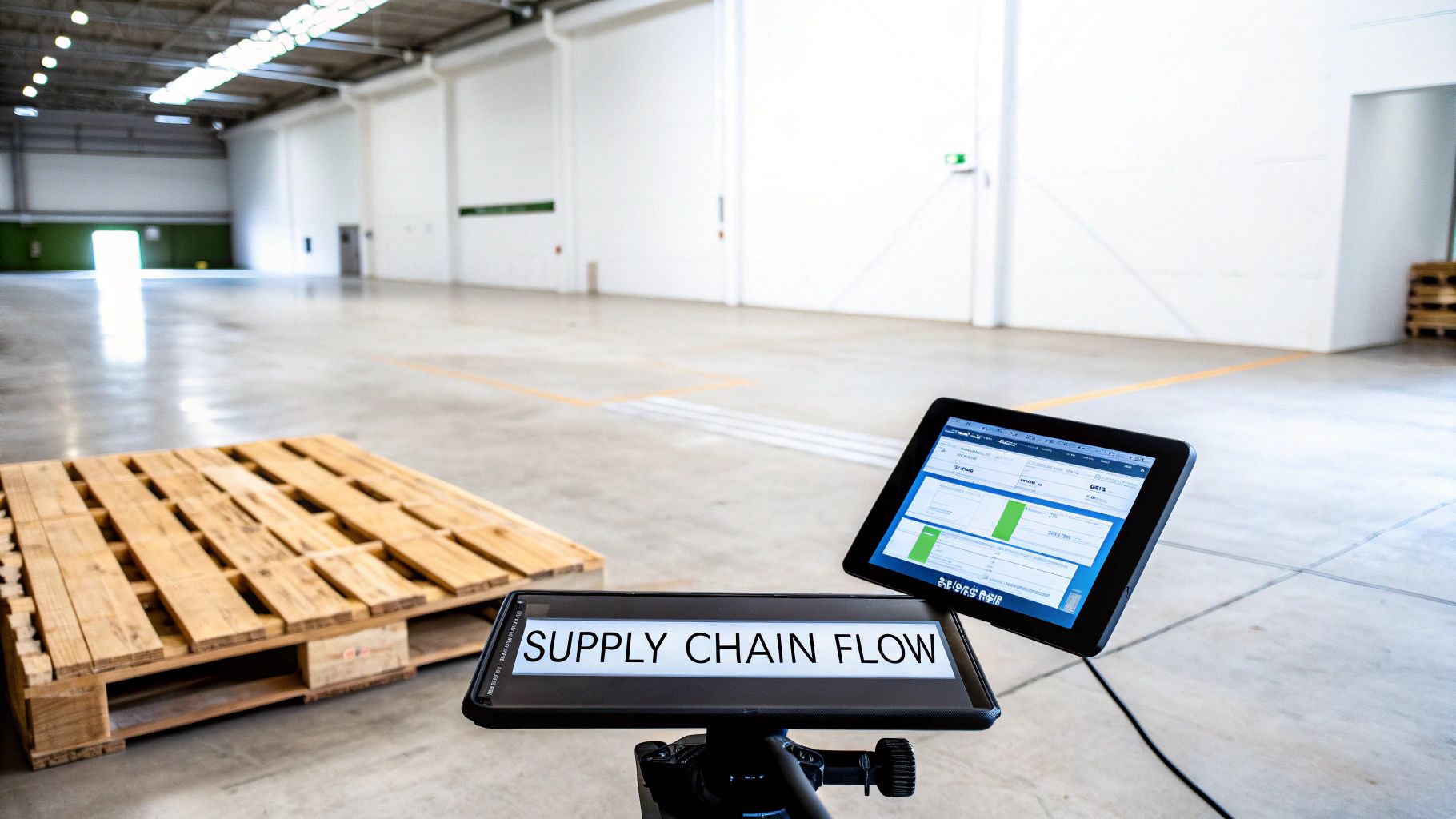
RPA serves as the digital backbone for modern supply chains, automating critical operations from procurement to final delivery. This use case for robotic process automation connects disparate systems like ERPs, WMS, and TMS to create a cohesive, automated, and highly visible logistics network. It tackles tasks such as purchase order creation, shipment tracking, and inventory management.
The Business Problem
Manual supply chain management suffers from data silos, communication delays, and a lack of real-time visibility. These issues lead to inventory inaccuracies, shipment delays, and increased operational costs.
The RPA Workflow
RPA bots orchestrate a seamless flow of information and actions across the entire supply chain.
- Order Processing: Bots monitor sales channels and automatically create purchase orders in the ERP system.
- Shipment Scheduling & Tracking: Bots access carrier portals to schedule pickups and continuously track shipment statuses, notifying stakeholders of any delays.
- Inventory Management: RPA automates inventory level monitoring, generating alerts for low stock and triggering re-order processes.
- Proof of Delivery (POD) & Documentation: Bots download POD documents from carrier websites and match them against shipments.
- Supplier Communication: Bots can automate routine communications, such as sending POs to suppliers or requesting status updates.
Strategic Insight: Automation in logistics builds resilience. By creating a real-time data feedback loop, RPA enables proactive exception management, allowing businesses to resolve potential disruptions before they impact the customer.
Measurable Benefits & ROI
- Operational Efficiency: Reduces order processing time by over 70%.
- Cost Savings: Lowers labor costs and minimizes expenses from errors and shipment delays.
- Enhanced Visibility: Provides real-time, end-to-end tracking of goods and information.
- Strategic Advantage: Improves key KPIs like on-time delivery, directly boosting customer satisfaction. For more insights, explore how organizations are enhancing logistics with Python and data analytics.
8. Regulatory Compliance and Reporting
Regulatory Compliance and Reporting is a critical use case for robotic process automation, transforming how organizations manage adherence to legal standards. RPA provides a systematic, auditable, and efficient method for monitoring activities, gathering evidence, and generating the necessary documentation required by bodies like SOX, HIPAA, and GDPR.
The Business Problem
Manual compliance processes are labor-intensive and dangerously susceptible to human error. A single oversight can lead to severe financial penalties and reputational damage. Teams spend countless hours manually collecting and validating data from disparate systems.
The RPA Workflow
RPA bots execute precise, rule-based tasks to ensure continuous compliance and streamline reporting.
- Data Aggregation: Bots access various systems to automatically collect and consolidate relevant data required for compliance checks.
- Compliance Monitoring & Validation: The bot systematically checks the aggregated data against a predefined set of regulatory rules.
- Evidence & Report Generation: Bots compile the validated data into standardized report formats, auto-populating control test sheets or compliance summaries.
- Exception Handling & Alerting: If a bot identifies a potential compliance breach, it immediately creates an exception ticket and routes it to the compliance team.
- Audit Trail Creation: Every action performed by the bot is meticulously logged, creating a comprehensive, immutable audit trail.
Strategic Insight: The key value of RPA in compliance is creating a system of provable governance. Bots can run continuous monitoring, ensuring that compliance isn't a periodic event but a constant state of operational readiness.
Measurable Benefits & ROI
- Risk Reduction: Drastically reduces the risk of non-compliance penalties and fines.
- Increased Accuracy: Achieves near-100% accuracy in data collection and reporting.
- Enhanced Auditability: Provides a complete and transparent digital audit trail for every automated process.
- Operational Efficiency: Frees compliance officers from repetitive tasks to focus on strategic risk management.
9. Customer Service and Support Ticketing
Automating customer service is one of the most impactful use cases for robotic process automation, directly enhancing customer experience while lowering operational costs. RPA bots manage the lifecycle of customer inquiries, from intake and classification to resolution, freeing human agents to focus on complex interactions.

The Business Problem
Manual support ticketing is a major bottleneck. Agents spend excessive time on repetitive tasks like password resets and order status lookups. This leads to longer response times, inconsistent service, and high agent burnout.
The RPA Workflow
RPA, often augmented with AI, automates high-volume, rule-based tasks within the support ecosystem.
- Ticket Creation & Triage: A bot monitors all incoming support channels and automatically creates a ticket in the helpdesk system.
- Intelligent Classification: Using NLP, the bot analyzes the ticket's content to determine its category and urgency, routing it to the appropriate queue.
- Automated Resolution: For simple requests like password resets, the bot executes a predefined script and sends a resolution email to the customer.
- Information Gathering: For complex cases, the bot gathers the customer's complete history and presents it within the ticket for the human agent.
- Status Updates & Closure: The bot can provide automated status updates and, once resolved, close the ticket and trigger a satisfaction survey.
Strategic Insight: The goal is not to replace human agents but to empower them. By providing agents with a 360-degree customer view in real-time, bots transform agents from ticket-solvers into proactive problem-solvers.
Measurable Benefits & ROI
- Faster Resolution: Reduces average handling time (AHT) for routine inquiries by over 90%.
- Cost Savings: Lowers cost-per-contact by automating first-level support tasks.
- Improved CSAT: Provides 24/7 instant responses, significantly improving customer satisfaction scores.
- Increased Agent Productivity: Frees up agent capacity by 30-40%, allowing them to handle more complex customer issues.
10. Data Extraction and Migration
Data extraction and migration is a powerful use case for robotic process automation, addressing the critical challenge of moving information between systems during platform upgrades or legacy system decommissioning. RPA bridges the gap between old and new technologies, automating the laborious process of extracting data and accurately populating modern systems.
The Business Problem
Manual data migration projects are expensive, slow, and prone to error. Teams spend countless hours manually copying and pasting information from disparate sources, introducing significant risks of data corruption and project delays.
The RPA Workflow
RPA bots execute a precise and auditable data migration strategy for faster, more reliable outcomes.
- Data Source Access: The bot logs into legacy systems or accesses folders containing documents.
- Intelligent Extraction: Using OCR and AI, the bot "reads" documents and extracts predefined data points.
- Data Transformation: The bot applies business rules to cleanse and format the extracted data to match the target system's requirements.
- System Population: The bot logs into the new target system and accurately enters the transformed data at high speed.
- Reconciliation & Reporting: After migration, the bot generates reconciliation reports, comparing source and target data to verify integrity.
Strategic Insight: For large-scale migrations, the goal is not just to move data but to enhance it. Integrating RPA with a modern data platform ensures the migrated data is clean, structured, and ready for advanced analytics. You can learn more about how a Snowflake Partner like Faberwork can assist with this.
Measurable Benefits & ROI
- Project Acceleration: Reduces data migration timelines by 60% or more.
- Enhanced Accuracy: Achieves near-perfect data accuracy, eliminating manual entry errors.
- Cost Savings: Drastically cuts down on the manual labor costs associated with large-scale migration projects.
- Strategic Advantage: Frees skilled IT personnel to focus on strategic system integration rather than tedious data entry.
Top 10 RPA Use Cases Comparison
Use CaseImplementation Complexity 🔄Resource & Data Requirements 💡Expected Outcomes ⭐📊⚡Ideal Use Cases 📊Key Advantages ⭐Invoice Processing and Payment AutomationMedium — ERP & OCR integration; exception handling neededOCR, ERP/PO integration, vendor templates, monitoring⚡ 80–90% faster processing; fewer duplicates; real‑time payables visibilityHigh‑volume, standardized invoices (finance teams)Cost reduction, error reduction, improved cash flowCustomer Onboarding and KYC VerificationHigh — secure integrations with government/credit sources; compliance updatesIdentity verification providers, compliance rule engines, audit trails⭐ Minutes vs days onboarding; better regulatory complianceBanks, fintech, regulated services needing fast KYCFaster account opening, lower compliance risk, 24/7 availabilityHR Onboarding and Employee Data ManagementMedium — multiple HRIS/IT system integrations; data privacy controlsHRIS, background check vendors, secure data handling⚡ New hire time reduced from weeks to days; consistent onboardingEnterprises scaling hires, global HR teamsImproved new‑hire experience, reduced admin workloadOrder-to-Cash Process AutomationHigh — cross‑department sync (ERP/CRM/WMS); master data criticalERP, CRM, WMS, credit & inventory data, analytics📊 50–70% faster cycles; lower DSO; fewer order errorsManufacturing, distribution, retail order flowsImproved cash flow, order accuracy, customer satisfactionClaims Processing and SettlementHigh — complex rules, fraud engines, policy integrationsClaims systems, policy databases, fraud detection tools⚡ 60–80% faster claims; better fraud reduction; 24/7 processingInsurers handling high-volume, standard claimsFaster settlements, lower costs, improved audit trailsBanking Reconciliation and Account ManagementMedium — needs reliable transaction data & GL mappingBank feeds, accounting systems, multi‑currency handling📊 30–50% faster month‑end close; higher record accuracyFinance teams doing regular reconciliationsReduced audit risk, faster reporting, staff reallocationSupply Chain and Logistics AutomationHigh — many systems (ERP/WMS/TMS) and suppliers to integrateERP/WMS/TMS, carrier APIs, master data governance⚡ 40–50% faster fulfillment; better inventory accuracyLogistics, retailers, distributors with high volumeImproved on‑time delivery, lower inventory costs, visibilityRegulatory Compliance and ReportingHigh — evolving rules; close work with legal/complianceRule engines, encrypted data stores, audit logs⭐ 70% faster reporting; fewer compliance errors; continuous monitoringFinance, healthcare, large regulated organizationsReduced penalty risk, consistent audit trails, workload reductionCustomer Service and Support TicketingLow–Medium — CRM/chatbot integration; NLP optionalCRM, ticketing system, chatbots/NLP, templates⚡ 40–60% lower handling time; higher first‑contact resolutionHigh‑volume support (telecom, retail, SaaS)24/7 support, cost savings, frees agents for complex issuesData Extraction and MigrationMedium — complex mapping & validation; OCR/ML tuningIntelligent OCR, data mapping tools, validation workflows📊 Up to 90% less manual entry; faster migrations; improved accuracyMigrations, digitization projects, legacy data consolidationFaster projects, consolidated data, reduced manual errors
Beyond the Bot: Your Next Steps in Strategic Automation
We have explored a comprehensive catalogue of use cases for robotic process automation, from financial reconciliation to supply chain logistics. These examples share a common denominator: they are all rooted in achieving measurable business outcomes. The true potential of RPA is unlocked not by simply automating a task, but by strategically re-engineering a process to eliminate friction, accelerate value, and empower human talent.
The core lesson is that successful automation is a strategic initiative. It’s about elevating human capabilities by delegating rule-based work to digital workers who execute tasks with perfect accuracy and relentless speed, 24/7. This frees your people to focus on strategic thinking, complex problem-solving, and building customer relationships.
Synthesizing the Strategy: Key Takeaways
As you consider how to apply these insights, remember the foundational principles that underpin the most successful RPA initiatives:
- Problem-First Approach: Start with the business pain point, not the technology. Is it slow invoice processing? Is it high error rates in data entry? A well-defined problem is the essential first step.
- Process Purity is Paramount: Automation is only as effective as the process it is built upon. Meticulously map, analyze, and optimize the existing workflow before deploying a single bot.
- Data is the Bedrock: Clean, structured, and accessible data is the fuel for intelligent automation. Integrating with a robust data platform like Snowflake is a strategic necessity for building scalable and reliable automations.
Strategic Insight: Treat RPA as a foundational layer in a broader intelligent automation ecosystem. The true transformation happens when you combine RPA’s execution power with the cognitive capabilities of AI and the analytical depth of a modern data cloud.
Your Actionable Roadmap to Intelligent Automation
Moving from understanding these use cases for robotic process automation to implementing them requires a clear, phased approach. Here are your immediate next steps to translate this knowledge into action:
- Form a Cross-Functional Automation Team: Assemble a dedicated team with representation from IT, the target business unit (e.g., Finance, HR), and operations to ensure initiatives are sound, practical, and aligned with business objectives.
- Conduct a Process Discovery Workshop: Identify and prioritize potential automation candidates. Score processes based on factors like volume, frequency, and potential business impact to find "low-hanging fruit" that can deliver a quick, demonstrable win.
- Develop a Pilot Project (Proof of Concept): Select one high-impact, low-complexity process. The goal is to test your governance model, measure KPIs before and after automation, and demonstrate tangible value to key stakeholders.
- Architect for Scale and Intelligence: Think beyond the first bot. Plan your technology stack to incorporate AI for decision-making and ensure seamless integration with your central data platform. This builds a foundation for a truly intelligent enterprise.
Mastering these concepts is no longer a competitive advantage; it is a baseline for operational excellence. In a world where speed, accuracy, and efficiency define market leaders, harnessing intelligent automation is essential. By thoughtfully applying the strategies and use cases for robotic process automation discussed here, you can build a more resilient, efficient, and innovative organization.


