
A release goes out on Friday. The checkout flow fails on an older Android version, support starts collecting screenshots, and nobody can tell whether the API change caused it. Your browser tests passed, but they didn't exercise the combination that broke.
Teams searching for test automation software are trying to prevent that kind of week. The useful question isn't which platform has the longest feature list. It's which one will reproduce your failure, explain it clearly, and keep checking for it without creating another maintenance burden.
Match the tool to the problem you have. A browser framework won't replace a real-device lab. A cloud device service won't design meaningful assertions. A low-code recorder won't decide whether an incorrect payment total should block a release.
Buy the missing capability, not a replacement for everything your team already does well.
The options below cover engineering services, code-first frameworks, low-code platforms, and execution infrastructure. They aren't interchangeable, and some work better together than alone. Each recommendation starts with a testing situation and includes the cost or limitation you should investigate before committing.
If your failure is visual rather than functional, find tools for cross-browser visual testing alongside these options. A checkout button can exist, accept clicks, and still be hidden beneath a mobile banner.
1. Services
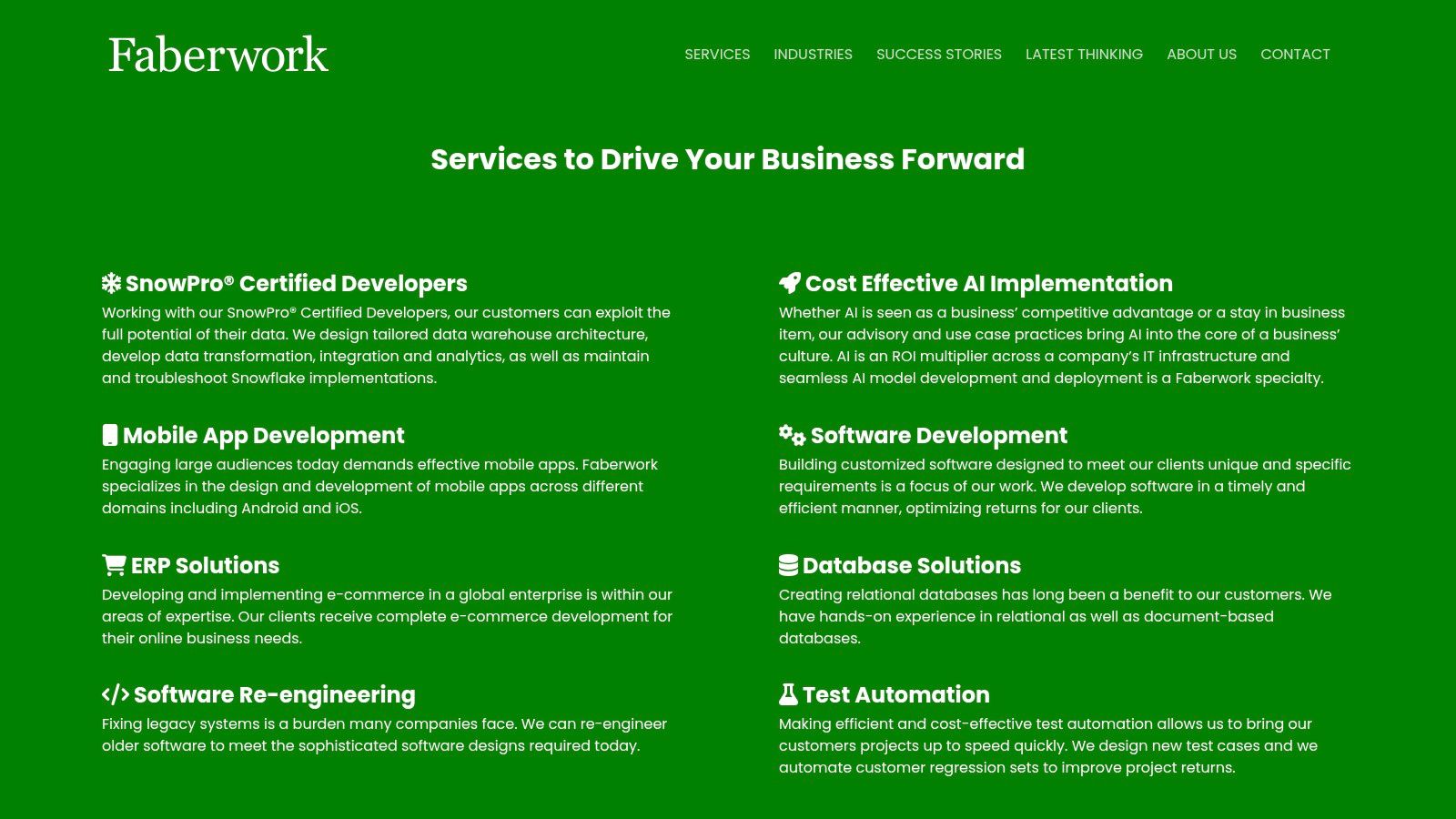
Best outcome, a maintainable automation system when the problem spans applications, APIs, and data. Faberwork's services fit organizations that need engineering ownership rather than another tool license. Its capabilities combine test automation, Agentic AI, custom application development, and Snowflake-centered data engineering.
Consider a logistics application where a driver's mobile update triggers an API event and eventually changes an analytics dashboard. Testing the screen alone won't establish whether the event arrived, the transformation worked, or the dashboard reflects the correct state. A services engagement can address test runners, data setup, reporting, and CI/CD integration as parts of the same delivery system.
Where the extra engineering helps
Faberwork describes more than 20 years of experience, 50 dedicated engineers, and over two million project hours. Its SnowPro Certified expertise and Snowflake Partner Network membership are relevant when application correctness depends on database architecture, analytics transformations, or time-series data.
- Breadth: Web, mobile, API, database, and AI capabilities reduce the need to coordinate separate specialists.
- Industry fit: Experience spans healthcare, finance, retail, manufacturing, energy, logistics, and telecom.
- Operational support: US headquarters, India operations, and ongoing support options suit distributed delivery teams.
The trade-off is engagement complexity. This isn't a self-service testing product, and the services information doesn't specify standard packages, pricing, or typical timelines. Confirm support coverage, response expectations, and which engineers will maintain the suite after delivery.
I'd request a scoped engagement around a failing business workflow. Require repository access, documented test-data setup, failure diagnostics, and a handover plan. The valuable deliverable is automation your team can operate, not scripts only the delivery partner understands.
2. Playwright
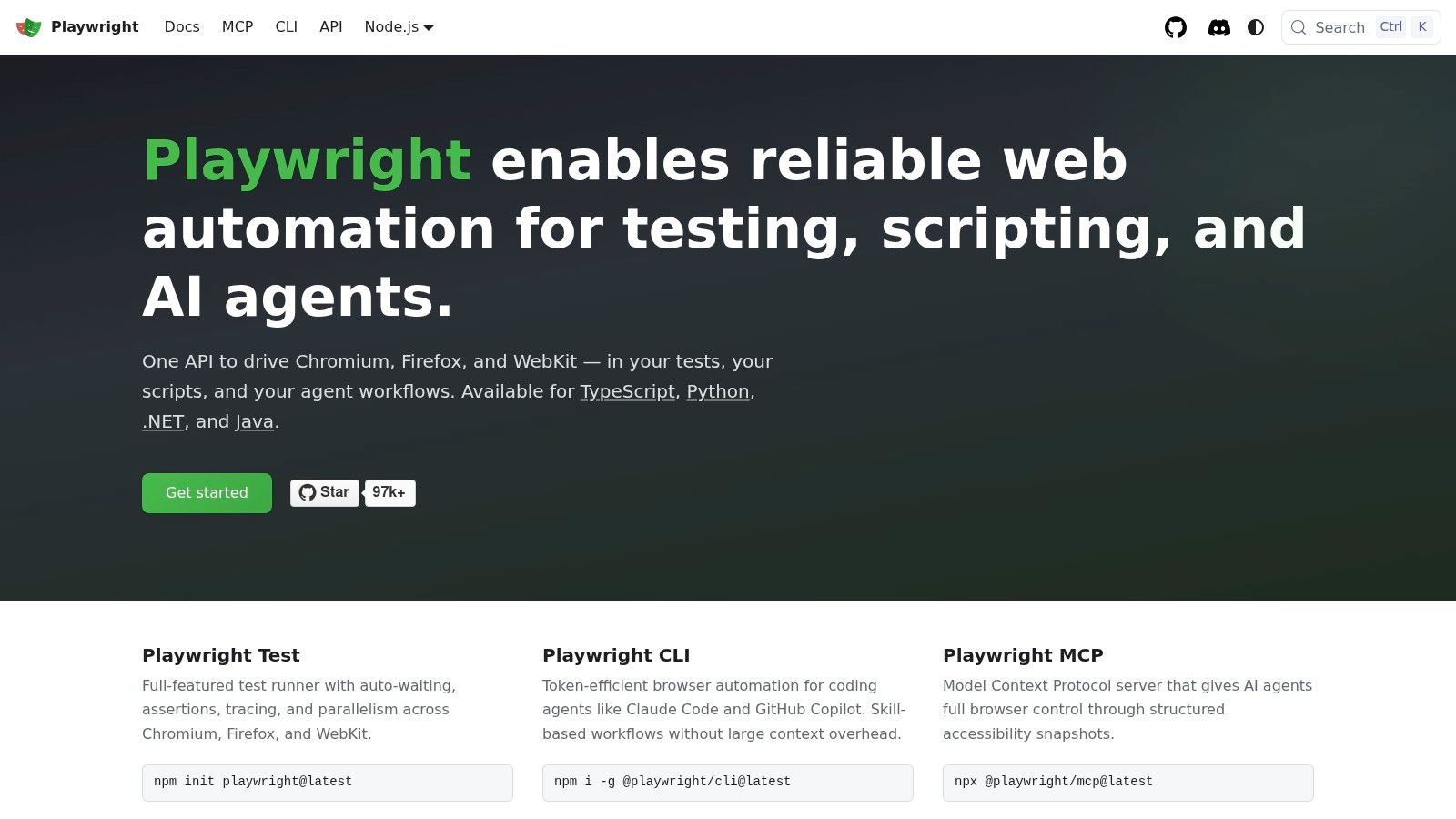
Your checkout works in Chromium but fails in WebKit after a frontend change. Playwright is a strong starting point when developers need reproducible browser failures inside their existing delivery workflow.
Playwright automates Chromium, Firefox, and WebKit across Windows, Linux, and macOS. Its test runner combines assertions, parallel execution, retries, and HTML reporting, while traces help engineers inspect actions and page state around a failure. Teams can use JavaScript or TypeScript, with language options also including Python, Java, and .NET.
Keep the browser suite focused
For checkout, create the cart through an API or fixture, then use the browser to verify shipping selection, payment submission, and the confirmation state. Don't repeat every setup action through the UI unless that interaction is what you're testing.
- What works: Code-reviewed tests, isolated test data, explicit assertions, and traces retained for failed CI runs.
- What doesn't: Treating retries as a fix for shared accounts, unstable environments, or timing assumptions.
The framework is free, but execution isn't costless. Your team owns CI capacity, artifacts, test-data provisioning, and framework maintenance. Browser emulation also doesn't establish that a native Android application works on an older physical device.
Choose Playwright when engineers can own the tests alongside application code. If nobody has time to diagnose failures or maintain fixtures, the free license won't solve that staffing problem.
3. Selenium
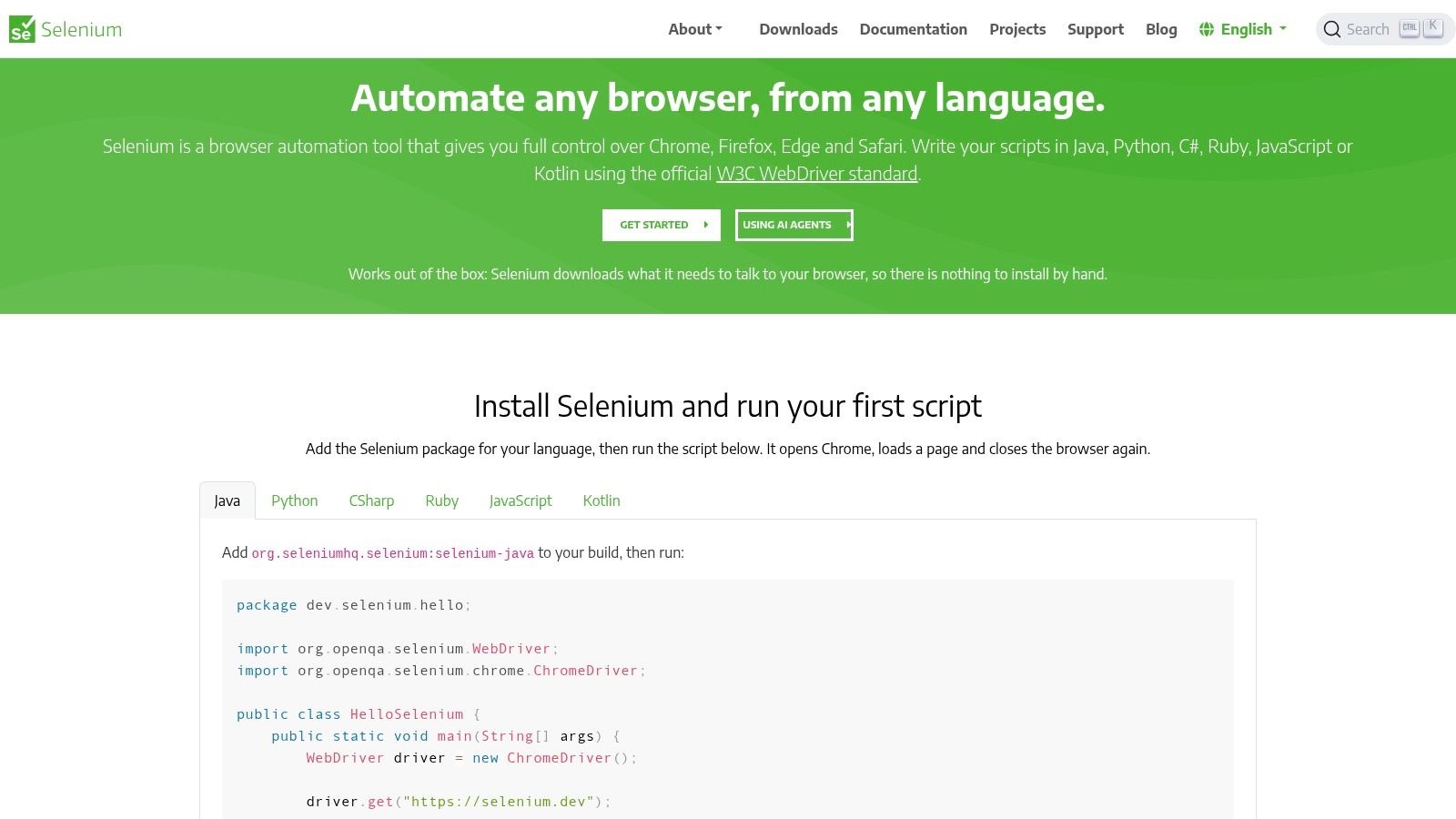
Keep Selenium when your existing investment is useful. Rewriting a working Java regression suite in a newer framework won't automatically improve release confidence.
Selenium provides open-source WebDriver browser automation and distributed execution through Selenium Grid. Its language bindings include Java, Python, C#, JavaScript, Ruby, and Kotlin. The core project uses Apache licensing without a software license fee, but you assemble the surrounding framework, reporting, and execution infrastructure.
For an enterprise portal with established browser tests, the better intervention may be stable locators and clearer page abstractions. In a software-maintenance study of Selenium WebDriver suites, the Page Object pattern reduced repair time by about a factor of three compared with an equivalent suite without it.
Repair the test architecture before assuming the browser driver is the problem.
Faberwork's browser testing using Wallaby example is another reference for discussing browser-testing architecture, rather than treating framework selection as the whole decision.
The hidden cost is infrastructure ownership. Grid nodes, browser updates, session cleanup, artifacts, and useful failure reports need engineering attention. A hosted grid can remove some operational work, but it introduces another bill.
Selenium fits custom frameworks and established suites. It's less attractive when a small team wants an integrated runner immediately, and native mobile automation generally requires a separate tool such as Appium.
4. Katalon Studio
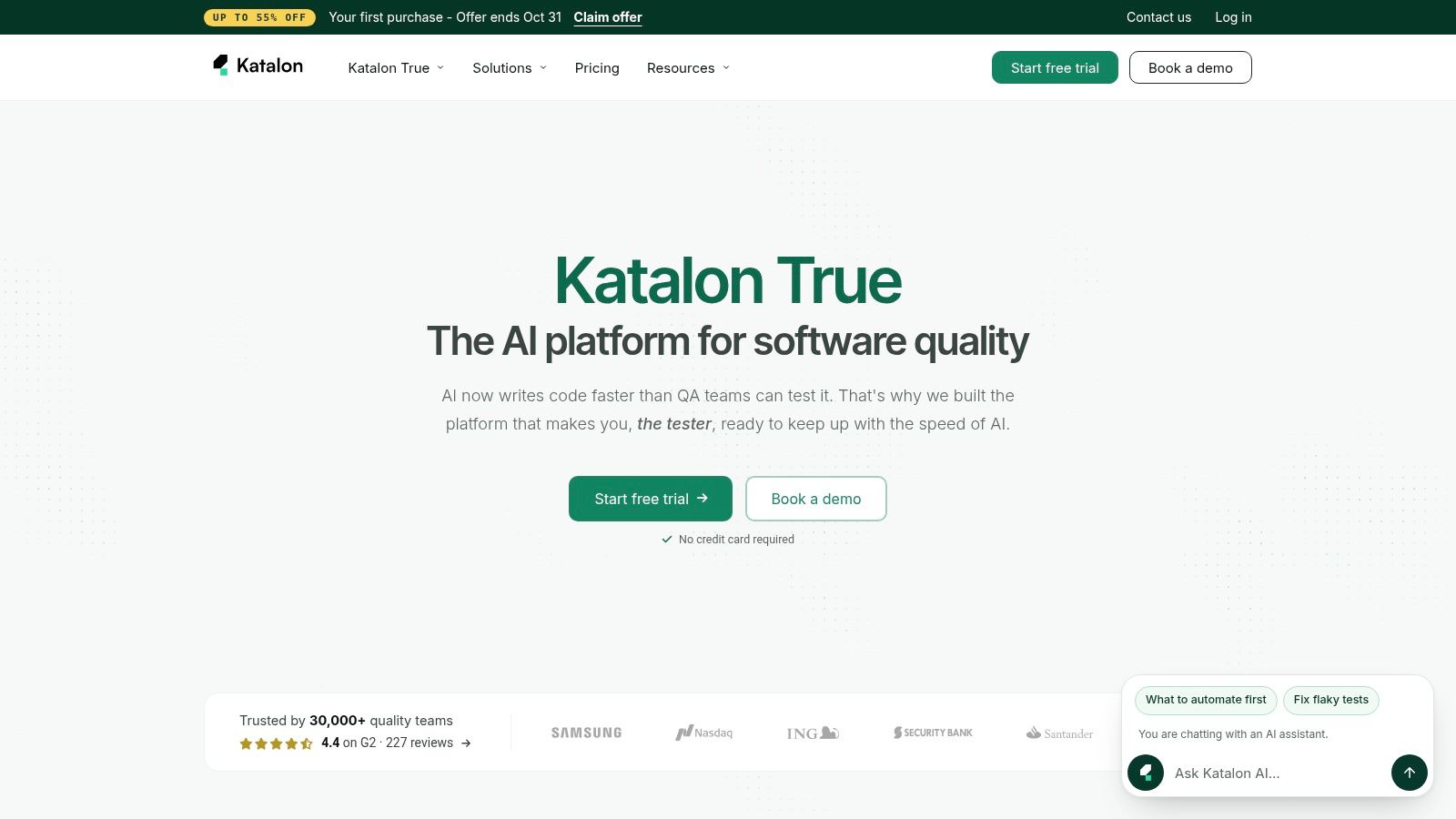
A QA analyst can describe the refund workflow precisely but doesn't want to build a browser framework. A developer needs to add custom API assertions. Katalon Studio offers a shared starting point for both people.
Katalon Studio combines record-and-playback with scripting across web, API, mobile, and Windows desktop applications; its listed Professional offer is $1,000 per seat annually for the first three seats, with a free plan and a 30-day trial also available. Paid capabilities include AI-assisted generation, failure analysis, self-healing, and parallel execution, depending on the product and plan.
Evaluate the complete execution path
Recording a refund is the easy part. The useful test must create an eligible order, verify the refund amount, confirm the backend state, and clean up its data.
- Good fit: Mixed-skill teams that want low-code authoring without ruling out custom scripts.
- Main limitation: Recorded actions still need reusable setup, meaningful assertions, and review.
- Cost trap: Authoring seats, CI execution, cloud runs, and enterprise controls may involve different licenses.
Don't approve the purchase after a successful desktop recording. Run the same test unattended in your pipeline, inspect its failure artifacts, and deliberately change an interface element.
Self-healing needs scrutiny. If the application contains similar refund buttons, check whether a recovered locator selected the intended control. A passing test is only useful when it still checks the original business requirement.
5. Cypress
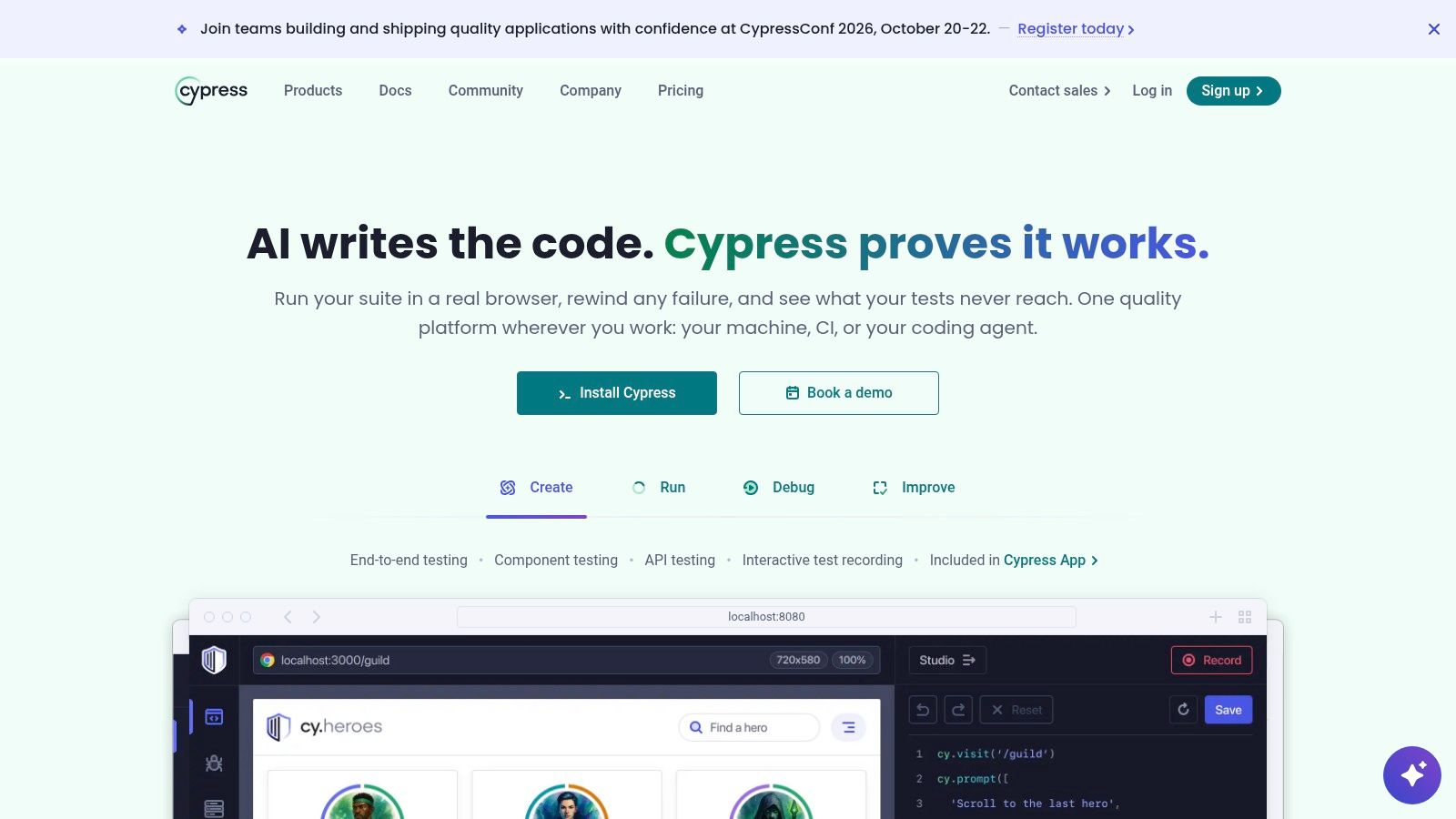
Cypress makes sense when frontend developers need to investigate failures where they already work. For a React checkout, that can mean testing the discount component separately before checking the complete purchase journey.
Cypress supports end-to-end and component testing through its free, open-source application. Cypress Cloud adds recorded runs, replay, parallelization, and analytics, with flake detection and integrations available according to plan. Its JavaScript and TypeScript orientation suits teams already using that ecosystem.
Separate UI behavior from integration risk
Use controlled network responses when testing how the interface handles an expired discount. Keep separate integration tests against the service so a convenient stub doesn't conceal an incompatible API change.
That distinction matters when tests pass locally but fail unpredictably in CI. First inspect shared data, asynchronous behavior, and environment differences. Cloud diagnostics can help investigate the failure, but they can't correct a badly isolated test.
- Useful outcome: Frontend engineers can reproduce and inspect broken UI behavior.
- Boundary: Cypress is primarily a web-testing choice, not general-purpose native mobile automation.
- Hidden expense: Cloud recording volume, retention, parallelization, and organizational requirements affect the eventual bill.
I'd choose Cypress when its debugging workflow fits the frontend team and component tests can reduce pressure on the end-to-end suite. Don't migrate just to obtain a dashboard if your current framework already produces actionable failures.
6. BrowserStack
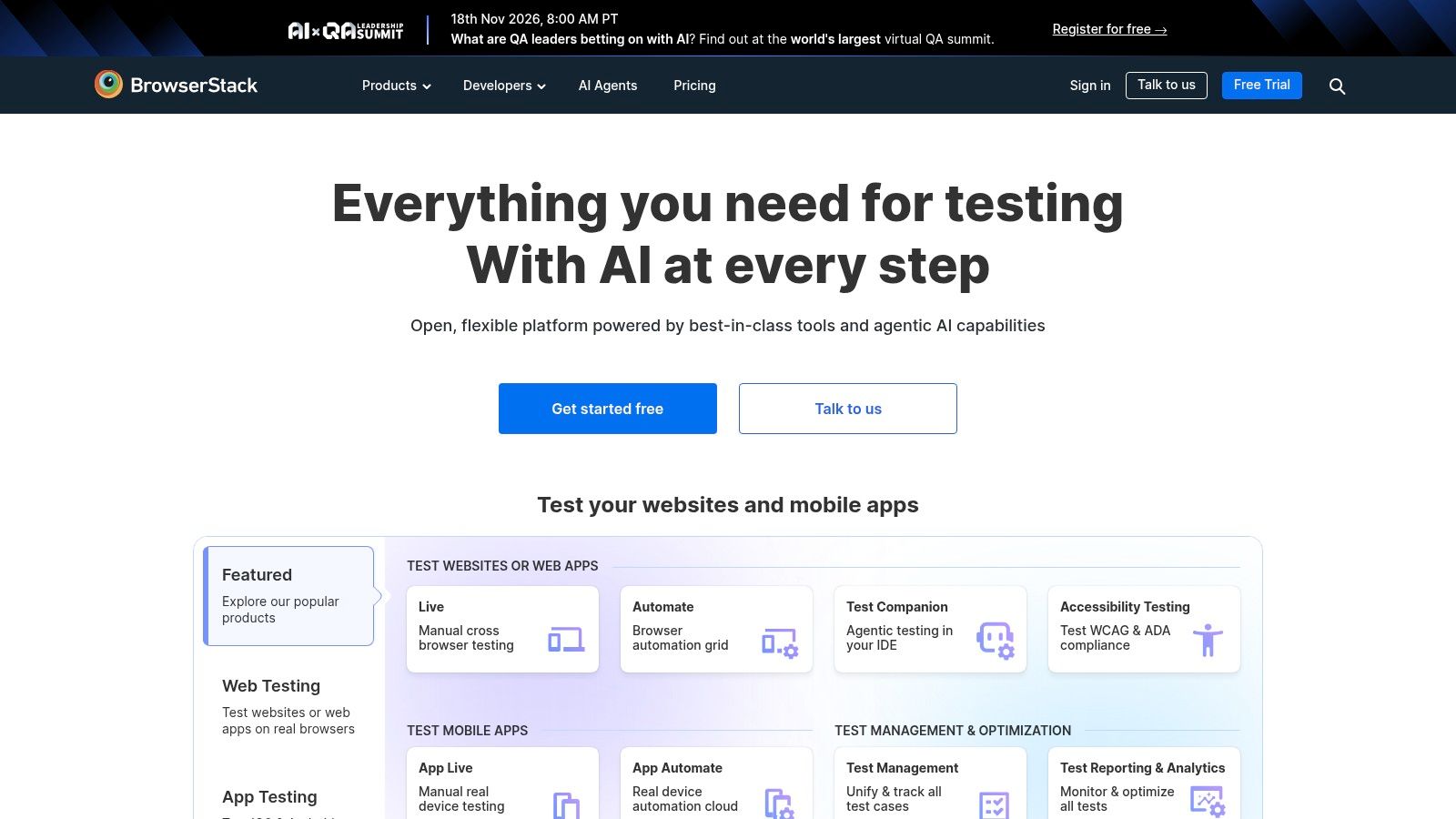
The checkout defect only appears on an older Android device. Your local browser emulator passes, and nobody on the team owns the affected handset.
BrowserStack addresses the execution gap, not the assertion gap. BrowserStack provides cloud access to desktop browsers and real mobile devices, with listed automated desktop-and-mobile plans starting at $175 per month, billed annually, for one parallel test. It supports frameworks including Playwright, Cypress, Selenium, WebdriverIO, Appium, and Robot Framework.
Use your existing test to reproduce the issue on the relevant device and operating-system combination. Local testing connectivity can expose private or staging applications without making them publicly accessible.
Capacity rule: Budget for the concurrency needed to finish before your release decision, not just access to the device catalog.
A broad catalog won't help if your required devices aren't available under the selected product or your sessions spend too long waiting. Validate the actual matrix before signing.
- What works: Reproducing browser-specific defects and expanding device coverage without maintaining a physical lab.
- What costs extra: More parallel sessions, additional products, and team-level requirements.
- What complicates debugging: Remote connectivity, tunnel configuration, and differences between local and cloud environments.
Keep sensitive test data masked and inspect what screenshots, videos, and logs retain. BrowserStack can provide the missing hardware, but your team still owns test design and failure triage.
7. Sauce Labs
Choose Sauce Labs when the testing job needs both virtual environments and real mobile hardware. A mobile banking team might use emulators for broad regression feedback, then verify critical sign-in and payment paths on physical devices.
Sauce Labs lists annual-billing starting prices of $149 per month for Virtual Device Cloud and $199 per month for Real Device Cloud, each with one parallel test. Its platform covers desktop browsers, mobile browsers, and native applications, with support for established mobile frameworks including Appium, Espresso, and XCUITest.
Make remote failures diagnosable
Videos, screenshots, and logs are useful when they let an engineer distinguish an application defect from a failed installation or disconnected session. During evaluation, deliberately trigger a known failure and check whether the available artifacts explain it.
Secure local tunneling and CI integrations help connect cloud execution to private environments. They also create configuration your team must maintain.
The main buying constraint is parallel-session capacity. A plan that runs a test successfully may still be too slow for a full release suite. Confirm session limits, target device availability, and the cost of the concurrency you need.
Enterprise requirements such as SSO, private device infrastructure, and premium support can require higher tiers or sales engagement. Compare Sauce Labs and BrowserStack using the same application build, device matrix, and failure scenario, not different vendor demonstrations.
8. Tricentis Tosca
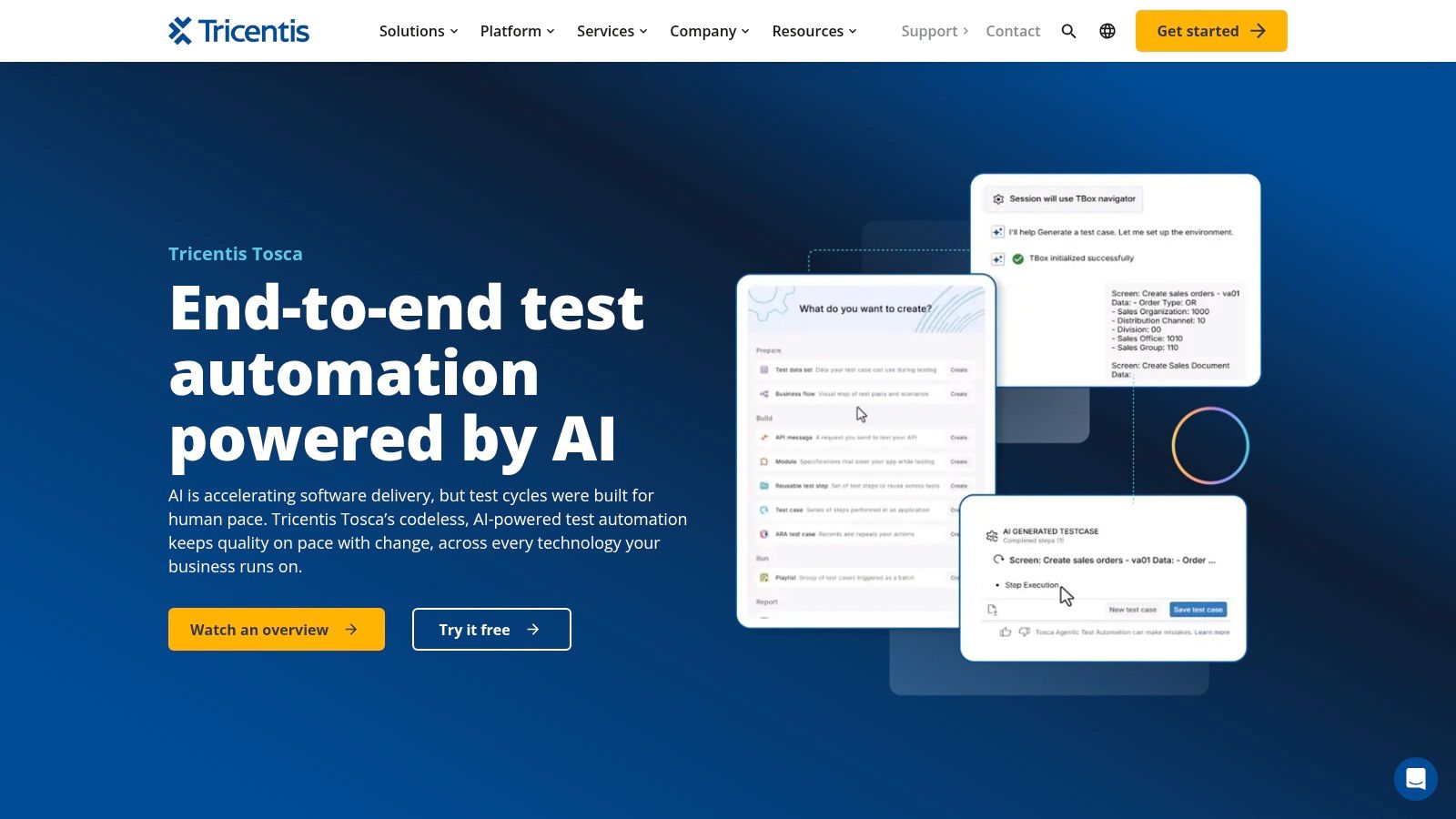
An order starts in Salesforce, moves through SAP, and appears in a customer portal. Each application passes its own checks, but the customer receives the wrong fulfillment status.
Tricentis Tosca targets these interconnected enterprise workflows through model-based, codeless test creation. Its capabilities include GUI and API testing, mobile coverage, risk-based prioritization, test-data management, service virtualization, and cloud execution through Elastic Execution Grid.
The useful outcome is business-process verification across application boundaries. That's a different job from checking whether a web button responds.
Model the business assertions
Define what must remain consistent as the order moves between systems. Check identifiers, monetary values, authorization, and final status rather than merely recording navigation.
Faberwork's healthcare test automation example offers a relevant reference when discussing maintenance and repair of established automation. In regulated workflows, that maintenance plan matters as much as initial authoring.
- Strength: Shared models can support reusable testing across business and technical teams.
- Limitation: Codeless authoring doesn't remove the need to understand integrations, asynchronous processing, or data dependencies.
- Hidden cost: Implementation, training, model governance, and commercial licensing require explicit budgeting.
Tosca promotes a trial, but production pricing generally goes through sales. Validate your exact application technologies in a proof of concept, including custom controls and the hardest integration step. Don't assume broad enterprise coverage guarantees compatibility with your configuration.
9. mabl
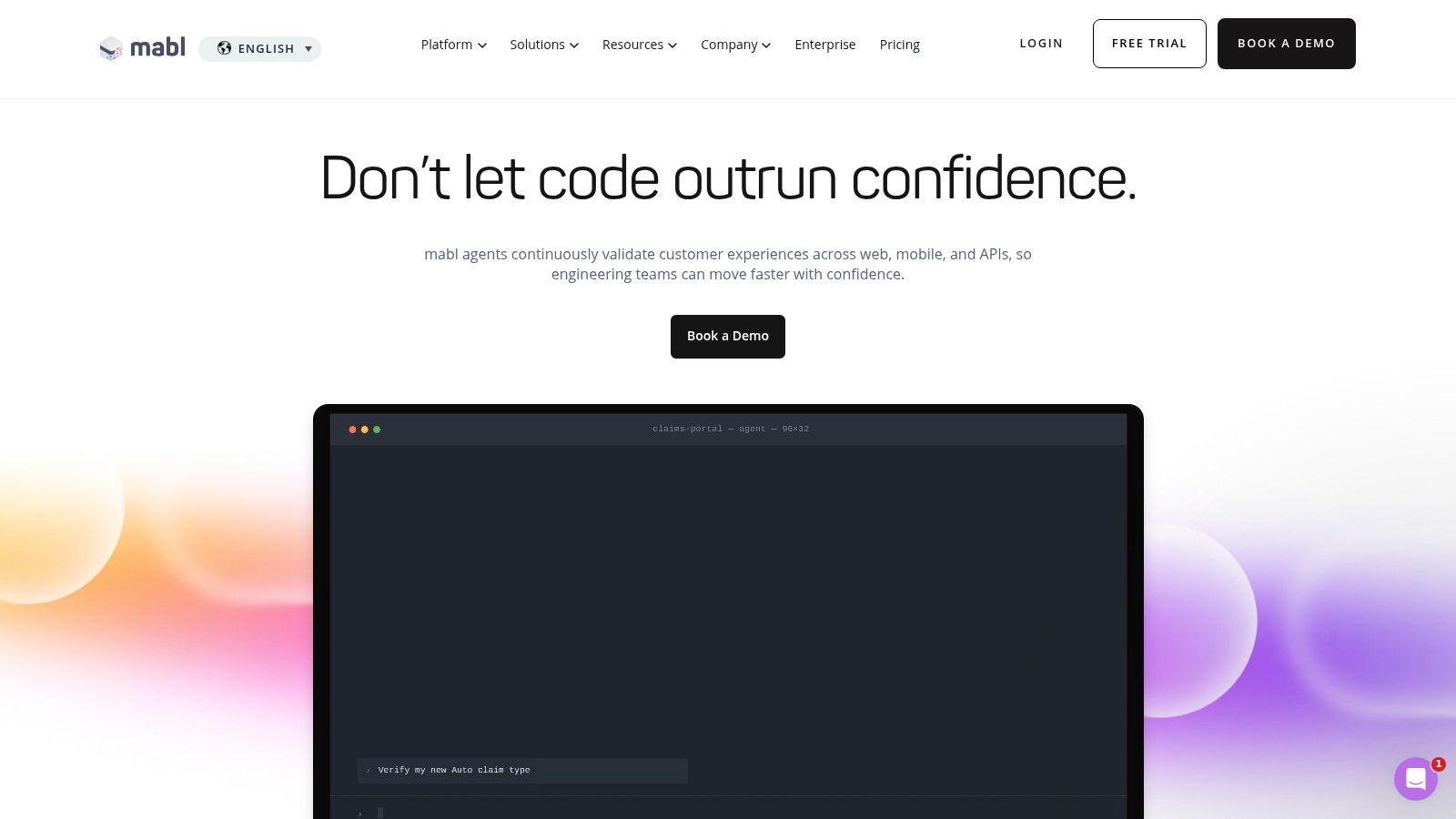
mabl fits teams that want managed execution and low-code authoring instead of a large custom framework. A useful evaluation scenario is account registration: create a user, check the API result, verify the browser state, and inspect accessibility problems along the way.
mabl combines browser, API, accessibility, and performance testing, with mobile app testing available as an add-on; it describes a 14-day trial and a starting allocation of 500 monthly cloud-run credits. Pricing is custom quoted, and its plans describe unlimited local and CI runs.
Test the recovery, not just the recording
AI-assisted creation, visual assertions, failure summaries, and recovery can reduce manual authoring and investigation work. Evaluate them against a changed interface and a deliberately incorrect business result.
A recovered locator should preserve the original test intent. It shouldn't turn a broken registration requirement into a passing run because a similar element remained available.
Keep human review over changed assertions and ambiguous recovery decisions, even when execution is automated.
Cloud consumption is the cost to model. Measure credit usage with your intended browser coverage, data variations, and reruns. Confirm how mobile, performance testing, support, and retention fit the quote.
Integrations with CI/CD, Jira, Slack, and Microsoft Teams help route results to the team. They don't establish ownership, so assign someone to investigate failures and approve changes to shared test flows before expanding the suite.
10. SmartBear TestComplete
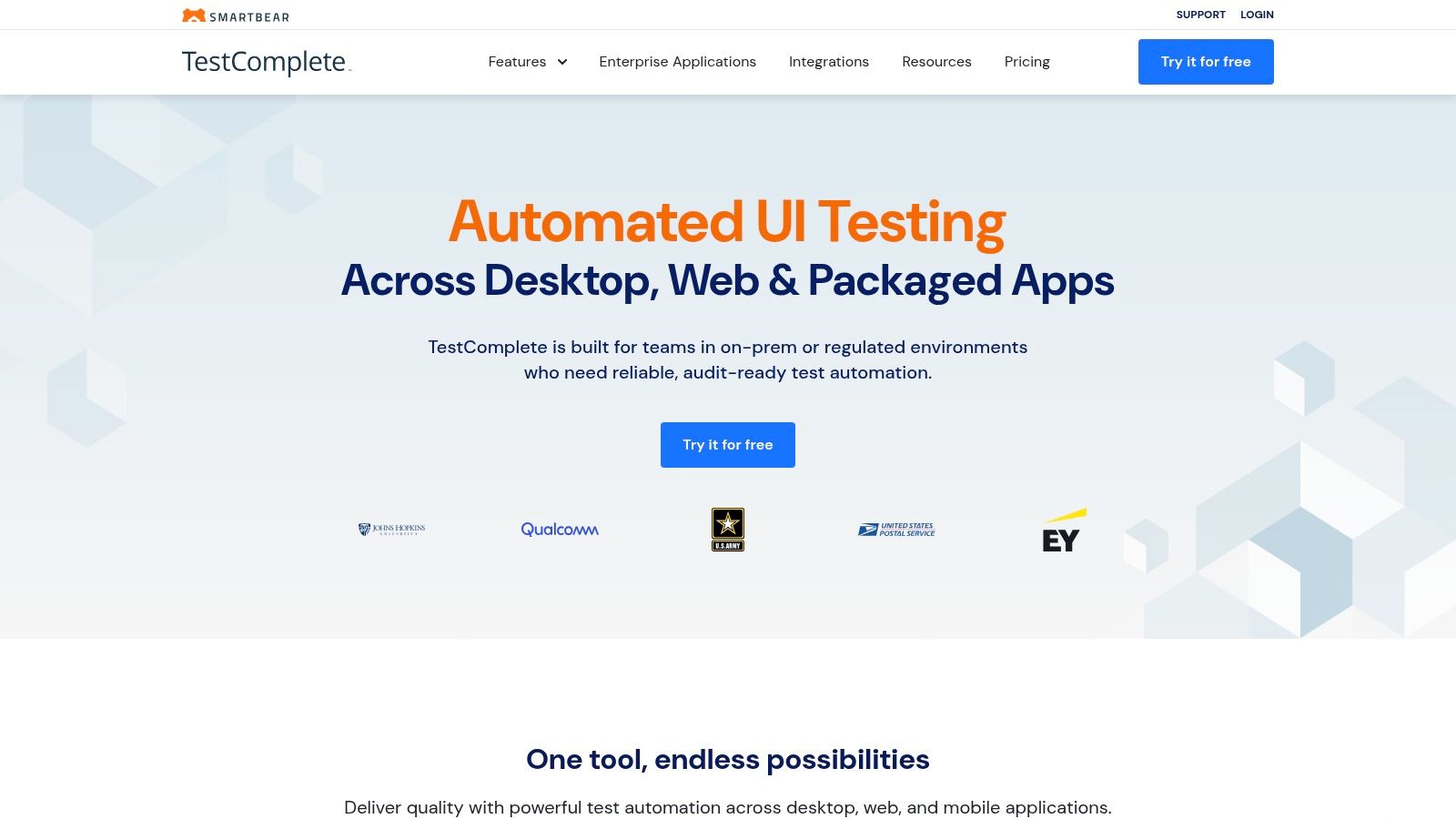
A warehouse operator uses a Windows desktop application while customers use a web portal. TestComplete deserves consideration when desktop UI coverage makes a browser-only framework insufficient.
SmartBear TestComplete combines scripted, keyword-driven, and record-and-replay authoring for desktop, web, and mobile testing, with a 14-day trial available. It supports reusable assets, data-driven testing, command-line execution, CI/CD integrations, and parallel testing across physical and virtual machines.
For a warehouse workflow, verify that the operator's dispatch action changes the order state and that the customer portal displays the correct result. Keep the business assertions separate from reusable UI interactions so interface changes don't require editing every test.
Prove object recognition early
Custom desktop controls are the practical evaluation target. Record the difficult screen, change its data, reopen the application, and run it unattended under the account your CI agent will use.
- Good fit: Mixed-skill QA teams that need desktop automation alongside web or mobile coverage.
- Platform constraint: TestComplete authoring and execution require Windows.
- Commercial constraint: Platform licensing, technology modules, execution components, and cloud add-ons need joint evaluation.
Recorded tests aren't maintenance-free. Inspect how reliably TestComplete identifies your actual controls after application updates and layout changes. Ask for a quote covering the authoring machines and unattended execution capacity you'll need, rather than comparing only the entry license.
How the leading test automation software compares on price, free options, mobile coverage, and best fit
ItemListed starting priceFree optionMobile coverageBest fitServicesContact for pricingNo free option listedMobile app development servicesBusinesses seeking end-to-end technology consultingPlaywrightFreeFree frameworkBrowser testing; device infrastructure is your responsibilityEngineering teams automating modern web appsSeleniumFreeOpen-source coreNative mobile testing generally requires other toolsTeams needing flexible browser automation or maintaining Selenium testsKatalon Studio$1,000 per seat per year for the limited first-three-seat offerFree planWeb and mobile testingTeams wanting low-code and scripted testing across application typesCypressFree application; Cloud pricing depends on planOpen-source applicationPrimarily web testing; limited native mobile coverageJavaScript or TypeScript web teamsBrowserStack$175 per month, billed annuallyNo free option listedReal mobile device testingTeams needing cloud-based browser and device coverageSauce Labs$149 per month for Virtual Device Cloud or $199 for Real Device Cloud, billed annuallyNo free option listedVirtual and real mobile devicesTeams needing cloud browser and mobile testingTricentis ToscaCustom pricing; contact salesFree trialMobile testing supportedEnterprises testing complex business workflowsmablCustom pricing; contact vendor14-day trialMobile app testing available as an add-onTeams seeking low-code web, API, and other testingSmartBear TestCompleteContact vendor for pricing14-day trialMobile application testing supportedQA teams needing UI automation across desktop, web, and mobile
For a checkout regression that stalls a release, compare tools by the coverage you need and the work required to keep tests running. Playwright and Selenium provide free frameworks, while device-cloud products add access to remote browsers or mobile devices at a recurring cost. Trial periods can help teams assess commercial tools, but confirm that the trial covers the workflows and execution capacity you need.
Choosing Your First Tool Without Overbuying
Start with the failure your team hits most often: browser regressions, device-specific bugs, API breakage, or slow pipelines. Choose the smallest intervention that lets engineers reproduce that failure and understand the result. You may need Playwright plus a device cloud, not a replacement enterprise platform.
Run a two-week proof of concept on your own application with realistic, masked test data. Track maintenance hours and cloud usage before comparing quotes. Include a deliberately broken build so you can judge diagnosis, not just successful execution.
Measure trusted results
Count the work needed to obtain a result someone can use for a release decision. A fast run that requires manual investigation every morning isn't necessarily cheaper than a slower, dependable suite.
- Diagnosis: Can an engineer distinguish an application defect from a data, environment, or test failure?
- Maintenance: How much work follows a normal interface or API change?
- Capacity: Does the suite finish within your delivery window at the quoted concurrency?
- Ownership: Can your team maintain the assets and retrieve useful results without specialist intervention?
- Coverage: Does the test exercise the device, integration, or business rule that previously escaped?
Don't use automation percentage as the purchasing target. In a cross-country survey of 151 practitioners from more than 101 organizations, in-house test teams conducted automation in 62.9% of organizations, while developers did so in 50.3%. Those overlapping responsibilities make shared engineering ownership worth planning explicitly.
Put limits around AI assistance
Let AI suggest tests, summarize failures, and propose locator repairs, but keep approval over business assertions and release decisions. Define which data can leave your environment, who reviews generated changes, and how the platform records automated recovery.
The governance concern is practical: the 2025 State of Testing report identified privacy and security as an AI-testing adoption barrier for 56% of respondents. Use masked data and require inspectable evidence before trusting automated decisions.
The cheapest tool on paper is rarely the cheapest once flaky tests and device coverage gaps are counted. Buy after the proof of concept establishes a reliable outcome, a maintainable suite, and an affordable execution pattern.
Bring Faberwork your failing workflow, current pipeline, and target browser or device matrix. Ask for a scoped automation assessment that identifies what to retain, what to repair, and what to add, with ownership and acceptance criteria agreed before implementation begins.


