The popular advice is simple: automate more tests, raise coverage, and let the pipeline decide. That approach creates impressive dashboards and unreliable release decisions when the suite is slow, brittle, or impossible to diagnose. A large test collection can still miss production risk while consuming the time engineers need to deliver and maintain the product.
A durable test automation architecture treats tests as an operational system. It defines where checks run, which risks they cover, how environments and data are controlled, who owns failures, and what evidence supports a release decision. Coverage matters, but only as one signal inside a broader model of reliability, feedback speed, diagnostic quality, and maintenance cost.
Rethinking Test Operability Beyond Coverage Metrics
Coverage percentage answers a narrow question: which code, paths, or cases did the suite exercise? It doesn't answer whether the result is trustworthy. A test that passes only after several retries, takes too long to provide feedback, or fails without useful evidence increases operational burden without necessarily reducing production risk.
Recent global survey evidence shows that 34% of software-delivery practitioners identify ongoing maintenance and unresolved technical debt as their largest quality obstacle, while 63% say their organizations deploy changes without completing all necessary testing. The quality transformation findings from Tricentis place the problem where experienced architects usually find it, in the relationship between delivery pressure, test debt, and incomplete confidence.
Replace script counts with operating measures
A test-operability architecture evaluates each test portfolio through questions that connect automation to delivery decisions:
- Reliability: Does the same test produce the same result under controlled conditions?
- Feedback time: Can a developer act on the result while the change is still fresh?
- Diagnostic value: Does a failure identify the affected behavior, dependency, and likely cause?
- Maintenance economics: Does keeping the test current cost less than the risk it controls?
- Release relevance: Is the test connected to a user journey, business invariant, or technical failure mode that matters?
This changes how teams interpret high automation. Broad automation can support maturity, but it doesn't prove maturity. The architecture is weak if a release gate contains redundant tests, hides original failures behind retries, or depends on a few people who understand its undocumented setup.
Practical rule: A test should earn its place by reducing a defined risk, not by increasing a dashboard percentage.
A critical payment workflow illustrates the difference. A team might report extensive UI coverage across checkout screens, yet still lack reliable checks for authorization contracts, duplicate transactions, idempotency, message delivery, and database state. A smaller portfolio with clear API, integration, and end-to-end responsibilities may provide stronger protection because each test has a distinct purpose and a failure path engineers can investigate.
Treat the suite as a product
The suite needs versioning, ownership, observability, and a retirement process just like the application. Store test code with the system it protects where practical, expose execution history, preserve failure artifacts, and review tests that no longer map to active behavior.
The most useful executive question isn't, “What percentage is automated?” It is, “After maintenance cost, does this portfolio reduce the risks that can hurt customers or operations?” That question naturally leads to layered design, dependable environments, targeted execution, and explicit accountability.
Designing Layers for Speed and Feedback
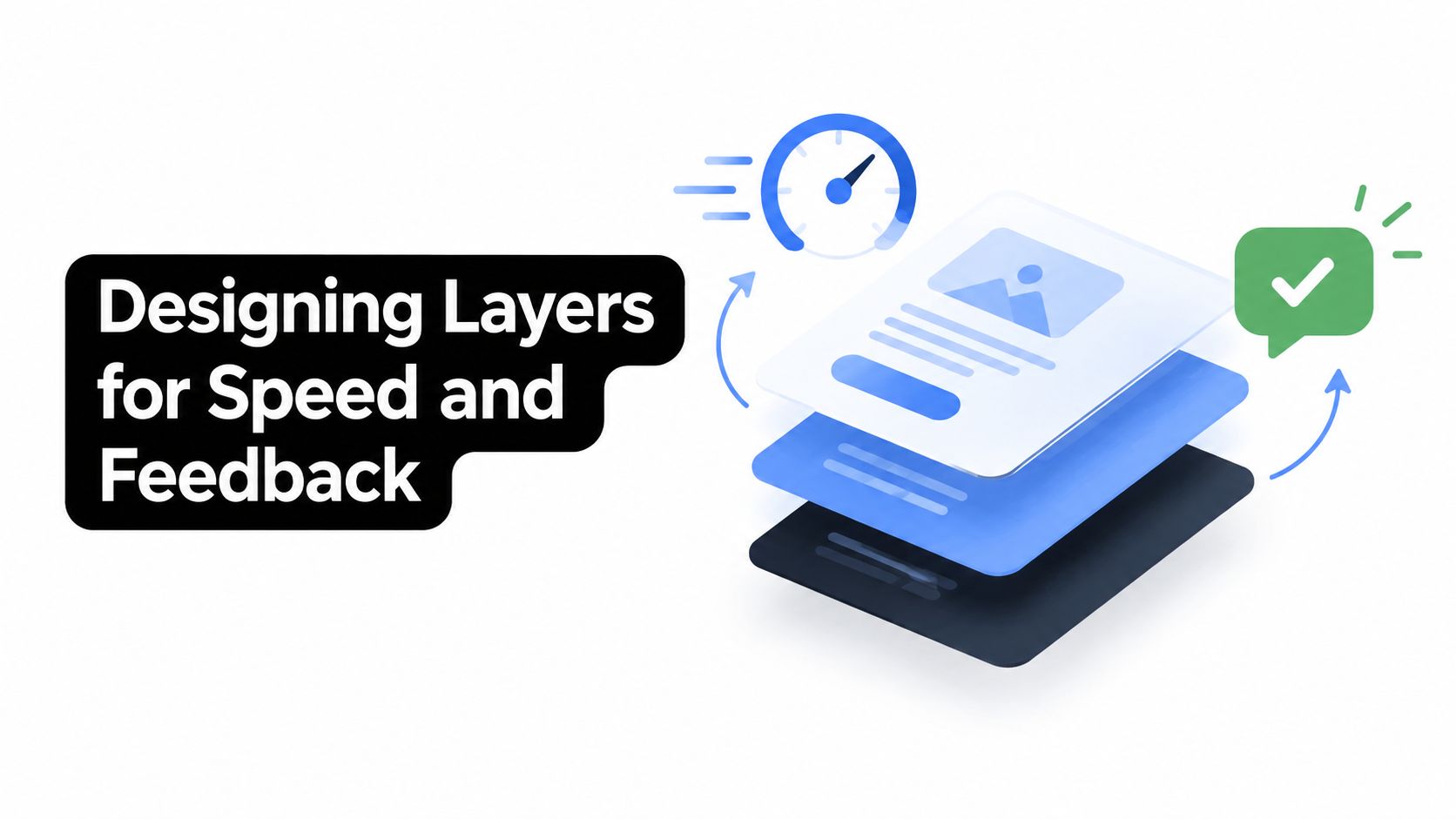
Pushing every scenario through the browser is one of the quickest ways to make a pipeline expensive and fragile. The browser should validate a limited set of critical journeys and presentation behaviors, not carry the entire burden of business-rule verification.
A practical layered design assigns each check to the lowest level that can prove the intended behavior:
- Unit tests verify calculations, transformations, validation rules, and isolated domain logic. They should give developers rapid feedback after a code change.
- Service and API tests validate contracts, authorization, schemas, error handling, and business operations without depending on visual layout.
- Integration tests exercise meaningful boundaries such as databases, queues, identity providers, and external services, using controlled dependencies where full production topology isn't necessary.
- Regression and end-to-end tests protect a focused set of high-risk workflows, such as creating a policy, processing a claim, or completing a payment.
- Exploratory and usability testing remain complementary manual activities because human judgment is valuable when behavior is ambiguous, highly dynamic, or experience-driven.
Separate intent from execution
A modular framework keeps business-readable scenarios, reusable components, test data, and runner configuration distinct. A page-object or screen-flow model can represent stable user actions, while API clients and domain fixtures handle faster checks below the UI. This separation prevents a small interface change from forcing engineers to rewrite assertions, setup logic, and reporting code together.
A 2025 research report comparing a modular automated-testing framework with traditional approaches reported a 15–20% improvement in defect detection across testing phases and a 33% reduction in maintenance effort. The modular framework research supports a practical design principle, reusable components should isolate change rather than spread it throughout the suite.
For teams defining a broader automation program, this guide for B2B growth teams offers useful context on framework planning and business-oriented automation. The architecture still needs to reflect the application's risks, ownership model, and delivery workflow.
Use a concrete enterprise flow
Consider a healthcare intake service. A unit test can verify eligibility calculations, an API test can check the intake contract and authorization, an integration test can confirm persistence and event publication, and a browser test can prove that an authorized user completes the primary workflow. Exploratory testing can then examine accessibility, confusing language, and unusual user behavior that scripted assertions won't understand.
Run the fast checks on every change. Select heavier integration and browser checks based on affected services, ownership, and risk. A focused browser suite can protect the customer journey without forcing every developer to wait for every possible permutation.
Teams evaluating browser-level strategies can also review Faberwork's browser testing success story for an example of how browser checks fit into an engineering delivery context.
Building Risk-Based Execution Pipelines
Running every test on every commit sounds safe until the queue becomes the bottleneck. Developers wait, rerun failures without understanding them, and eventually treat the pipeline as background noise. A risk-based pipeline spends its fastest feedback budget on the changes most likely to matter, while preserving broader analysis for scheduled or release-oriented work.
A useful execution model has two speeds. The first is change-aware and low latency. The second examines historical instability and broader system behavior without blocking every local change.
A practical pipeline sequence
- Start with fast unit and contract checks. Run deterministic validation for changed components and service boundaries on each change.
- Select impacted integration and end-to-end tests. Use dependency, coverage, ownership, and risk metadata to identify affected behavior instead of guessing from file names alone.
- Stress newly added or directly modified tests. Use repetition, controlled environment variation, and order randomization to expose instability where it enters the portfolio.
- Promote stable tests into release gates. A test should become a blocking control only after its setup, evidence, runtime, and failure behavior are understood.
- Run historical-flakiness analysis separately. Legacy tests need attention, but their investigation shouldn't make every developer wait for a full portfolio scan.
Large-scale longitudinal evidence found that detectors applied only to newly added tests would miss 25% of flaky tests, while including newly added or directly modified tests increased detection coverage to 85%. The longitudinal flakiness analysis supports targeted detection, but it doesn't justify ignoring older tests. The two-tier model handles both needs.
Measure the original failure
Automatic retries can provide diagnostic evidence, but they should not turn a failed gate into a pass. Record the first outcome, commit, environment, duration, failure signature, retry results, and final disposition. A dashboard should distinguish a clean pass from a retry-assisted pass.
Track operational measures such as:
- Flake rate: flaky outcomes divided by total executions.
- Repair time: elapsed time from confirmed instability to a verified fix.
- Quarantine age: how long a test remains outside the release gate.
- Failure concentration: which signatures, services, or environments create the most noise.
- Release impact: how often nondeterministic failures delay or alter deployment decisions.
Quarantine needs an owner, expiry date, and defect link. Without those controls, quarantine becomes permanent deletion from reality. For visual behavior, teams can supplement functional checks with practical visual testing for developers, especially where layout regressions carry user or compliance risk.
The pipeline should make the reliable path fast and the unreliable path visible. That balance improves confidence without pretending every test deserves equal execution priority.
Solving Environment and Data Dependencies
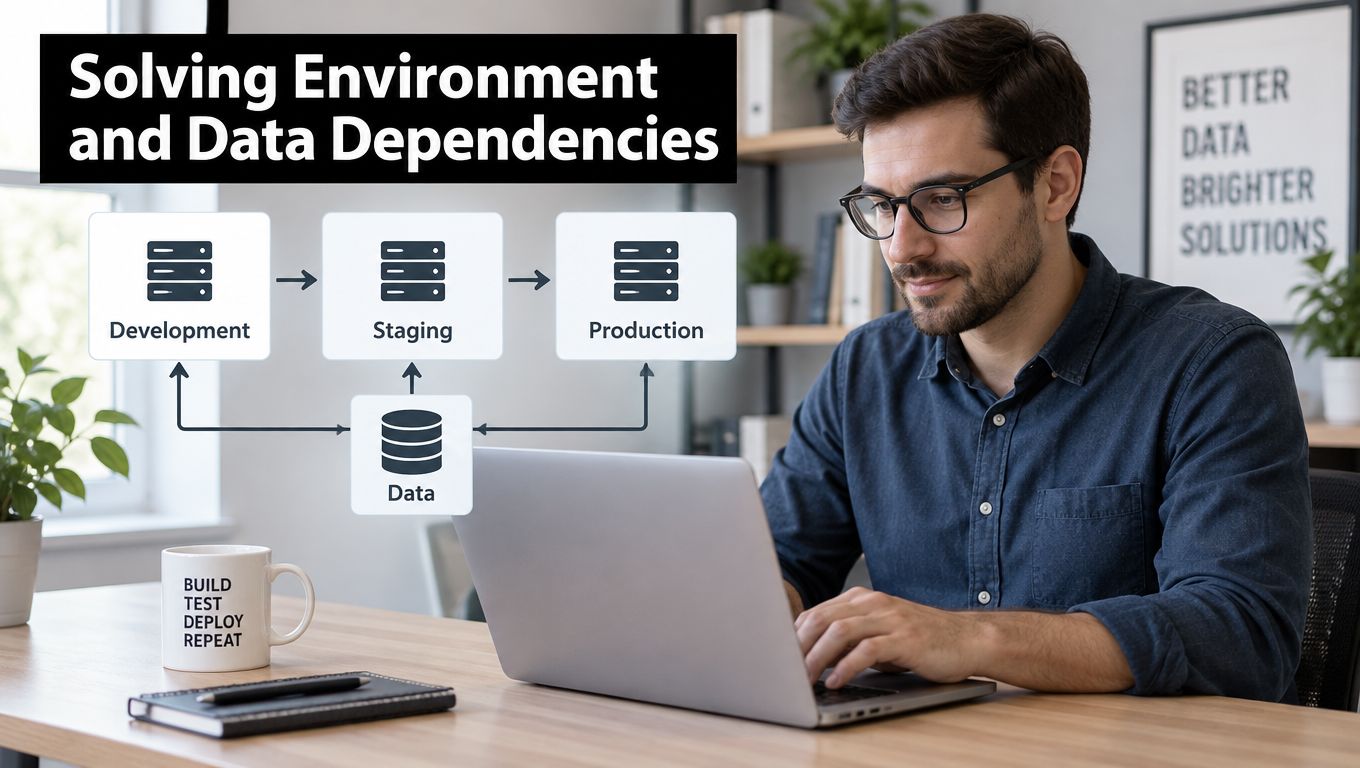
Many flaky tests aren't caused by incorrect assertions. They expose shared state, race conditions, asynchronous timing, or data that changes underneath the test. Treating the environment as a passive backdrop guarantees recurring failures in distributed applications and data pipelines.
Empirical analysis identifies asynchronous waiting, concurrency, and test-order dependency as the three leading categories of flaky tests, with 78% of studied flaky tests being flaky when first written. The analysis of flaky tests points to prevention through deterministic design, not endless downstream cleanup.
Make state explicit
Each test should declare what it needs and establish that state itself. Fresh fixtures, isolated containers, deterministic identifiers, and controlled service doubles reduce interference between workers. When a test depends on a shared database, the setup should define ownership and cleanup rather than assuming the previous test left the right records behind.
Use explicit synchronization for asynchronous workflows. Wait for a domain event, status transition, or observable condition instead of sleeping for an arbitrary duration. The test should fail with evidence when the condition doesn't arrive, including relevant logs, timestamps, correlation identifiers, and dependency responses.
Order-dependent failures deserve special attention. 74% of order-dependent flaky tests were fixed by cleaning shared state between test runs, according to the same empirical analysis. Randomized-order execution in CI can expose hidden coupling, while fresh fixtures or containers prevent one scenario from preparing another behind the scenes.
Design data as a managed dependency
Synthetic data should be generated from stable rules and linked to the business invariant under test. A pipeline validating a Snowflake-centered data flow might create a known source record, publish an event, wait for the expected transformation, and verify the resulting analytical state. That sequence is more trustworthy than querying whatever data happens to remain in a shared environment.
Teams modernizing data platforms can use resources such as compare data modernization costs to frame the broader dependency and migration conversation. Test architecture should account for schema evolution, delayed processing, replay behavior, and the difference between an empty result and a late result.
Faberwork's test automation in healthcare success story provides relevant context for environments where privacy, repeatability, and workflow correctness must coexist. In those systems, test data isn't a convenience. It's part of the control surface.
Governing AI-Assisted Testing in Enterprise Contexts
AI can draft test cases, generate fixtures, suggest assertions, and summarize failures. None of those capabilities proves that a test protects the right business risk. The dangerous implementation is to let generated output become executable policy before the organization controls data, environments, evidence, and approval.
The 2025 State of Testing report found that data privacy and security were the leading barrier to AI adoption in testing, cited by 56% of respondents, followed by a lack of skilled personnel at 33%. The State of Testing report reinforces a point that regulated teams already understand, faster generation doesn't remove governance obligations.
Put boundaries around generated behavior
Separate AI assistance into three distinct responsibilities:
- Suggestion: The system proposes scenarios, edge cases, or test code based on requirements and existing patterns.
- Execution: Approved tests run through controlled runners, environments, identities, and data policies.
- Evidence: The pipeline preserves traces, logs, screenshots where useful, inputs, outputs, and the relationship between the test and its requirement.
AI may accelerate the first responsibility. It shouldn't independently decide whether a critical healthcare authorization path, financial transaction, or telecom provisioning change can ship.
Every generated test needs a named risk and a human review. Validate assertions against requirements, domain invariants, authorization rules, and failure modes that matter in production. A test that merely repeats the implementation's current behavior can achieve broad code exercise while missing the rule the business actually cares about.
Protect sensitive systems
Don't send production-like records to an external model without an approved handling policy. Prefer synthetic or appropriately transformed data, log prompts and generated artifacts, and record the model-assisted origin of executable tests. Data residency, retention, access controls, and auditability belong in the architecture rather than in an informal team agreement.
Critical paths still need deterministic regression gates. AI-generated tests can supplement those gates, but an agent shouldn't approve its own output or erase an original failure because a rerun passed. Human reviewers need enough evidence to understand what ran, what data it used, which environment it touched, and why the result affects release risk.
For a Snowflake-centered data workflow, the same principle applies across ingestion, transformation, and consumption layers. AI can suggest cases for schema changes or late-arriving data, while deterministic checks verify contracts and business invariants. The architecture earns trust when generated assistance remains reviewable, traceable, and subordinate to explicit release policy.
Establishing Ownership and Maintenance Workflows
A suite becomes expensive when nobody owns the failure after the initial author moves to another project. Sustainable test automation gives every important check a responsible team, a runtime expectation, a diagnostic standard, and a decision path for repair, quarantine, or retirement.
A two-company industrial study found that test-script maintenance averaged 23 minutes per script in the best case and 110 minutes in the worst case, with maintenance consuming more than 60% of weekly automation time. The industrial maintenance study shows why maintenance can't be treated as occasional cleanup after feature work.
Create a working ownership model
Assign ownership at the level where someone can fix the underlying problem:
- Business-flow owner: Confirms that the scenario still represents a meaningful customer or operational risk.
- Service owner: Repairs contract, API, integration, or dependency failures.
- Platform owner: Maintains runners, containers, browsers, credentials, and environment orchestration.
- Quality owner: Reviews portfolio duplication, evidence quality, quarantine trends, and release-gate behavior.
Each test should also carry practical metadata, including its risk category, owning team, dependencies, expected runtime, required data, and release-gate status. Failure notifications should route to the owner with the original failure signature and artifacts, not just a link to a red dashboard.
Budget test debt deliberately
Quarantine is a temporary operating state. Require an owner, defect link, reason, and expiry date. If the expiry passes, the team must repair the test, replace it with a better control, or retire it with a documented risk decision.
Review the portfolio regularly for obsolete features, duplicate scenarios, tests that never fail meaningfully, and checks whose maintenance cost exceeds their protection. Small, frequent updates are safer than infrequent rewrites because modular tests limit the surface area of change. A team that waits for a large cleanup will eventually face a suite nobody trusts enough to modify.
Faberwork LLC offers engineering-led test automation that can include layered browser, API, and component testing, test runners, test-data layers, reporting, and CI/CD integration. Whether an organization builds those capabilities internally or uses a consulting partner, the operating model remains the same: clear ownership, trustworthy evidence, controlled flakiness, and a retirement policy.
The final measure is not the number of scripts retained. It's whether engineers can make changes with faster, clearer feedback and whether the test portfolio reduces production risk after its full maintenance cost is counted.
If your automation suite has become slow, flaky, or difficult to govern, assess it by risk ownership, layer placement, environment isolation, failure evidence, and maintenance cost before adding more tests. Faberwork can help enterprise teams design and integrate a maintainable test automation architecture across browser, API, CI/CD, healthcare, finance, telecom, and Snowflake-centered data workflows. Contact Faberwork to map your highest-risk journeys and turn unreliable automation into a release control your engineers can trust.


