
Your operations team gets a provisioning ticket at 9 a.m., checks three monitoring tools that don't agree, then waits for a vendor engineer to confirm whether the service activated. That's the daily reality for many operators, and it's why telecom software development has become an operations problem first and a coding problem second. The strategies that work in 2026 aren't about ripping everything out. They're about integrating AI and cloud-native software with legacy, multi-vendor systems in a controlled, measurable way.
Why Telecom Software Development Matters Today
A service launch that should take days stretches into months because billing, provisioning, and network inventory live in separate systems. Each team exports spreadsheets, reconciles them by hand, and hopes nothing changed overnight. When a fault hits, engineers bounce between fragmented monitoring tools instead of seeing one topology, one service state, and one customer impact view.
That scenario explains the shift in telecom software development better than any architecture diagram. Software used to support relatively stable voice networks. Now it operates globally distributed, data-intensive broadband platforms that have to handle subscriber identities, charging, provisioning, policy control, network performance, fraud detection, and customer applications across fixed and mobile infrastructure at the same time.
The Scale Behind the Strain
The user base keeps expanding, and every new user adds sessions, records, and support expectations. ITU estimates that approximately 6 billion people, representing 74% of the world's population, used the Internet in 2025, compared with 60% in 2020, which means roughly 1.3 billion people came online during that five-year period. Teams can't meet that demand with manual workflows and brittle integrations.
- Elastic architecture: Platforms need to scale with traffic peaks instead of failing during them.
- Automated testing: Releases can't depend on a few experts remembering every regression case.
- API-based integration: Systems have to exchange data without custom glue code for every vendor.
- Observability: Engineers need traces, metrics, and logs tied to the actual service, not just server health.
Telecom software isn't an auxiliary layer sitting on top of the network. It's the control and data-processing foundation connecting infrastructure, enterprise operations, regulators, and end users.
When software works, operators launch services faster, resolve incidents with evidence, and bill accurately. When it doesn't, every department invents its own workaround, and those workarounds become the system.
Understanding the Core Telecom Software Layers
Think of a city. Someone manages the roads, someone collects tolls and handles resident accounts, and someone controls each intersection. Telecom software layers follow a similar split, and most integration pain starts when teams confuse which layer owns which decision.
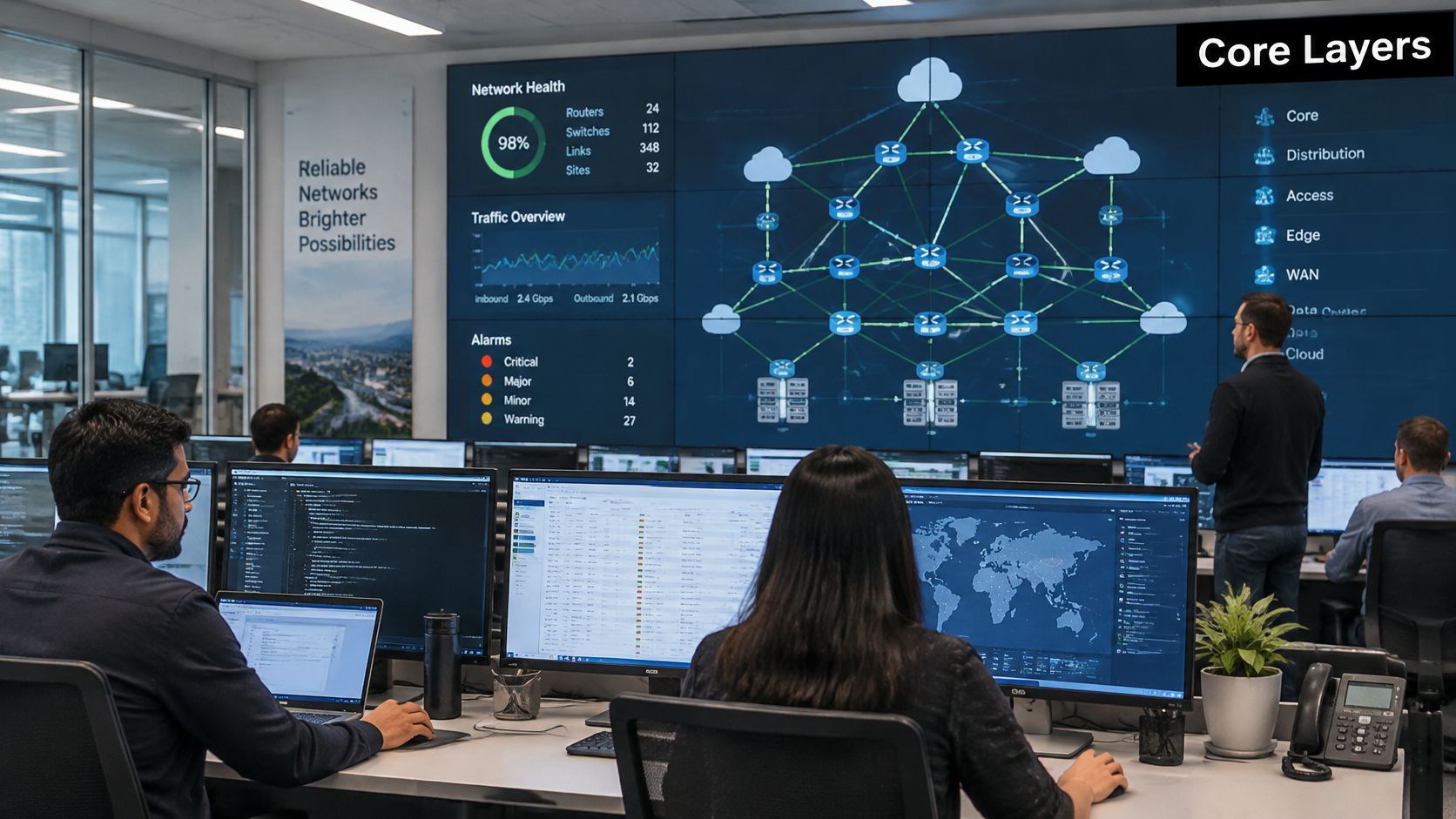
OSS, or Operations Support Systems, handles the network side. It covers inventory, provisioning, service activation, fault management, and performance monitoring. If OSS data is wrong, automation will faithfully automate the wrong action, which is why topology accuracy matters more than dashboard polish.
BSS, or Business Support Systems, handles the customer and commercial side. That includes CRM, product catalogs, ordering, charging, billing, and revenue management. A clean OSS can't save a BSS that can't model a new offer, and a flexible BSS can't deliver a service the OSS can't provision.
Where EMS and Network Functions Fit
EMS, or Element Management Systems, sits closer to individual devices and vendor domains. It configures elements, collects alarms, and exposes vendor-specific capabilities. Below and alongside those systems, network functions forward traffic, enforce policy, and manage sessions.
LayerPrimary question it answersBSSWhat did the customer buy, and what do we charge?OSSHow do we activate, assure, and repair that service?EMSHow is this specific element configured and performing?Network functionsHow does traffic move, and which policy applies now?
Historically, vendors sold these layers as monoliths with proprietary interfaces. Modern telecom software development breaks them into modular, API-driven components so teams can replace one capability without destabilizing the rest. Looking at how SnapDial delivers cloud communications capabilities is a useful reminder that customers experience these layers as one service, even though engineers maintain them as separate systems. Your architecture has to respect both views.
Key Technical Priorities in Modern Telecom Software
Traffic growth decides your engineering priorities whether you plan for it or not. The screenshot below captures the ordinary side of that work, code, configuration, and tests that have to hold up under network scale.

ITU estimates that mobile broadband Internet traffic exceeded 1 zettabyte in 2023 and reached approximately 1.5 zettabytes in 2025. Since 2021, mobile broadband traffic has grown by an average of 19% annually, compared with 16% annual growth for fixed broadband traffic. That gap pushes teams toward real-time telemetry, capacity forecasting, resilient orchestration, usage-based charging, and automated incident response.
Real-Time Processing and Reliability
Average latency hides the failures customers feel. Measure percentile latency, packet loss, jitter, error rates, retry amplification, and dependency saturation by network function. Benchmark under realistic packet sizes and concurrent flows, then test overload conditions, not just steady state. Inefficient virtual switching, extra inter-function hops, poor CPU pinning, or memory contention can raise tail latency while average CPU still looks acceptable.
Release gates should reflect that reality. If a build misses its loss or latency threshold at target throughput, it doesn't ship, even if functional tests pass. That's how you separate a software defect from an infrastructure bottleneck before customers find it for you.
The following walkthrough adds useful context on how these engineering choices play out in practice.
API Governance in the 5G Core
5G uses a Service-Based Architecture, where network functions expose services through standardized interfaces instead of tightly coupled point-to-point links. 3GPP TS 29.501 recommends RESTful API design, standardized HTTP methods, explicit response-code handling, version control, structured resource URIs, JSON representations, and OpenAPI 3 descriptions. Treat those contracts as normative artifacts. Generate models from OpenAPI, enforce backward-compatibility checks in CI/CD, and test authorization failures, unsupported versions, malformed payloads, and timeouts. Loose coupling helps, but it moves risk into identity, rate limiting, versioning, and observability.
Integrating IoT, Edge Computing, and Mobile Apps
IoT devices, edge nodes, and mobile apps don't care about your internal layer boundaries. They care whether identity works, data arrives on time, and the API behaves the same way tomorrow as it did today. Telecom software development has to expose network capabilities cleanly enough that external teams can build on them without learning every vendor's internals.
Edge computing sharpens that requirement. If an application needs low-latency decisions, sending every event to a distant central platform defeats the purpose. Teams need local processing for urgent actions, central pipelines for analytics and billing, and clear rules for what happens when connectivity drops. Geofencing for fleet management is a practical example, since location events only create value when they're timely, accurate, and tied to a workflow.
The Network API Trap
Publishing an API catalog is easy. Building a product developers trust is harder. GSMA reported that 72 mobile operators had committed to Open Gateway by March 2025, while an industry survey ranked monetizing network APIs and growth beyond connectivity only third among priorities at 15%. Ecosystem scale doesn't automatically create demand.
- Consent and identity: Location, device-status, and fraud-prevention APIs need explicit consent handling and strong identity assurance.
- Consistency: Quality-on-demand has to behave predictably across operators and countries, or developers will choose familiar cloud APIs.
- Commercial proof: Measure incremental revenue, fraud losses avoided, churn reduction, or conversion gains, not just API call volume.
- Abuse monitoring: Exposed capabilities need rate limits, anomaly detection, and clear revocation paths.
Risk grows as connected systems scale, which is why simulation approaches for growing IoT systems are worth applying before production rollout. Simulate device surges, edge failures, and delayed telemetry first. You'll find data-pipeline bottlenecks in a test environment instead of during a customer launch.
Practical rule: If you can't explain who pays, who consents, and who owns an API failure at 2 a.m., you don't have a network API product yet.
Regulatory and Security Considerations
Compliance isn't paperwork you add after the architecture review. Telecom platforms operate across more than 200 economies, handle sensitive subscriber data, and support services regulators treat as critical infrastructure. If your design can't prove who accessed what data, under which consent, and with what result, you've built a liability alongside the feature.
The barrier is measurable. A 2025 GSMA survey identified implementation cost, integration complexity, and security risk as the three leading barriers to AI and cloud-native adoption, reported by 31%, 29%, and 29% of respondents respectively. Security risk ties with integration complexity, which tells you teams aren't worried about theory. They're worried about exposing legacy systems that were never designed for open APIs or automated control.
Controls That Belong in the Design
Build these in from the first sprint. Retrofitting them costs more and usually leaves gaps auditors find quickly.
- Secure API design: Authenticate every caller, authorize by scope, validate payloads, and log decisions.
- Consent management: Record purpose, timestamp, and revocation for subscriber data use.
- Rate limiting and observability: Detect abuse patterns before they become outages or fraud.
- Automated incident response: Predefine containment actions so engineers aren't improvising during an attack.
Caller authentication for voice services shows the same principle in a narrower domain. Reviewing Stir Shaken basics for international calling helps teams understand why identity attestation has to be engineered into call flows rather than bolted onto reporting. Fraud detection, privacy, and network security mandates all reward that approach. You move faster later because you didn't skip the controls early.
A Practical Framework for Enterprise Migration
Most operators aren't starting from scratch. You're decomposing monoliths while customers are live, vendors use different data models, and some legacy process probably encodes a regulatory rule nobody documented. A migration framework has to protect service continuity first, then earn the right to replace components.
The incentive is real. Research summarized by EY reports that microservices-based BSS architectures can support 99.99% system availability while reducing the time required to bring new services to market by 60%, and 98% of telecom operators say BSS modernization is needed to enable new 5G-driven services. Those outcomes come from sequencing, not from a big-bang rewrite.
A Sequencing Framework That Holds Up
- Map dependencies first: Inventory services, data owners, vendor interfaces, and failure blast radius before choosing targets.
- Start at the edges: Replace reporting, catalog, or activation adapters before touching charging or core session control.
- Standardize event models: Normalize telemetry, configuration data, and service models so new and old systems describe the same event the same way.
- Run in coexistence: Route a narrow slice of traffic or one product through the new component while legacy remains authoritative.
- Require contract tests: Test every API and event contract in CI/CD, including negative paths and version mismatches.
- Define rollback in advance: Set measurable triggers, keep data reversible, and rehearse the rollback before cutover.
For test design, this software reliability strategy guide offers a useful enterprise testing perspective to adapt to telecom release gates. Pair it with operational KPIs from day one, including provisioning error rate, mean time to repair, and percentage of services managed end-to-end without manual intervention. If those numbers don't improve during coexistence, pause expansion and fix data quality. Scaling a flawed migration just distributes the flaw.
How to Choose the Right Technology Partners
Vendor demos rarely fail. Integrations do. Evaluate partners on how they'll behave inside your legacy, multi-vendor environment, not on how polished their reference architecture looks with sample data.
Standards compliance is a strong filter. A survey of 200 communications-service-provider decision-makers found that 71% required standards compliance when purchasing new OSS/BSS technology, and 96% were working to improve their BSS rather than discard it entirely. A partner who insists on total replacement hasn't understood your constraint.
Build a Scorecard Around Coexistence
- Integration evidence: Ask for examples of normalizing APIs, telemetry, and service models across competing vendors.
- Rollback guarantees: Require written triggers, data-reversal steps, and rehearsal plans, not verbal assurance.
- Delivery discipline: Check how they handle automated testing, release gates, and production observability.
- Communication quality: You need clear ownership when OSS, BSS, and network teams disagree on root cause.
Faberwork LLC is one example of a consulting and development partner that works across custom software, data platforms, and test automation, including telecom OSS modernization work. Reviewing documented delivery examples, such as telecom solution booster outcomes, can help you compare claimed capability against completed work. Score every candidate the same way, weight integration complexity heavily, and reject any partner who can't explain their coexistence strategy in concrete operational terms.
Measuring Success and Planning for the Future
Success isn't a completed migration diagram. It's fewer failed activations, faster repairs, accurate bills, and services your team can change without a weekend war room. Telecom software development should be judged on those outcomes from the first pilot onward.
The evidence shows what's achievable when automation targets a defined workflow. A case study involving a US Tier-1 operator reported up to a 90% reduction in mean time to repair for selected ticket categories after deploying machine-learning-assisted automated triage, and closed-loop automation handled most tickets and reduced engineering effort by 60%. That's not AI as a slogan. That's alarm classification, contextual diagnostics, and workflow orchestration removing manual investigation steps.
Cost outcomes follow the same pattern. Windstream Communications reduced the cost of network monitoring and troubleshooting by 82% through a programmable, scalable, autonomous network approach, with full automation of the order-to-activation lifecycle also reported. Connecting provisioning, assurance, and troubleshooting produced the gain, not automating each silo separately.
Your Next Steps
- Baseline now: Record provisioning error rate, mean time to repair, manual touchpoints per service, and release lead time.
- Pick one closed loop: Automate a bounded ticket category or activation flow where success is unambiguous.
- Expand by evidence: Add AI-driven orchestration only where telemetry quality and rollback controls are already proven.
- Review quarterly: Retire manual workarounds as automation earns trust, and stop initiatives that don't move the baseline.
Autonomous networks will keep advancing, but operators who win won't be the ones who adopted every tool first. They'll be the ones who modernized in sequence, measured carefully, and kept service continuity essential.
Start with an audit of your highest-friction OSS/BSS workflow this quarter. Baseline its error rate, repair time, and manual touches, then run one bounded automation pilot with contract tests and a rehearsed rollback. If you need an experienced engineering partner to design that pilot, evaluate candidates against the coexistence scorecard above and demand measurable outcomes before you expand.


