
The most popular advice about system reliability is also the least useful: keep servers up, and the system is reliable. That definition fails the moment a checkout page loads slowly, an AI response stalls, or a healthy application waits on an unavailable payment API. Users don't experience server status. They experience whether a task succeeds quickly and predictably.
Modern reliability engineering therefore has to measure perceived reliability, not just infrastructure availability. It has to account for partial failures, degraded performance, dependency cascades, and business outcomes. The practical question isn't whether every component stayed green. It's whether customers could complete the work they came to do.
Redefining System Reliability for Modern Operations
A service can maintain excellent uptime while delivering an unreliable product. A search endpoint that eventually returns results is technically available, yet it fails a customer making a time-sensitive decision. An AI feature can also expose this gap: if its model provider slows down, the rest of the application may remain healthy while the user experiences a stalled or broken workflow.
That distinction is entering mainstream SRE practice. In a 2026 SRE report on how reliability is being redefined, nearly two-thirds of respondents said performance degradations are as serious as outages, while only 26% consistently measure whether reliability improvements change business metrics such as revenue or NPS. Engineering dashboards often describe infrastructure conditions. Business leaders need to know whether customers can complete valuable tasks.
Availability is only one user signal
Uptime remains useful. It provides a shared target and exposes hard failures, but it says little about harmful latency, journey-specific timeouts, or responses from dependencies that are technically valid yet unusable.
Define reliability around the customer actions your business promises to support:
- Complete a purchase: The transaction should succeed or fail clearly, without duplicate charges or an indefinite spinner.
- Retrieve operational data: A dashboard should return sufficiently fresh information, or state that the data is delayed.
- Generate an AI answer: The product should return a bounded response, provide a useful fallback, or offer a clear retry path when the model provider is impaired.
- Submit a workflow: The system should acknowledge the request and process it safely, even when downstream work runs asynchronously.
Each action needs its own service indicators. One platform-wide uptime number conceals important differences between customer journeys.
Practical rule: If users can notice a failure, degradation, or confusing recovery path, include it in the reliability definition.
Third-party dependencies make server uptime an incomplete measure. A recent reliability dataset identified third-party cascade as the largest single failure pattern, accounting for 23% to 35% of incidents from 2023 through 2026 (2026 State of Reliability report). Your servers may operate normally while an external API creates queue growth, consumes worker threads, or causes failed requests throughout the application. AI providers add the same risk through latency, quota limits, model errors, and changing response behavior.
Set reliability at the boundary where customers use the product. Then trace backward through internal services and external dependencies, identifying which failures can interrupt each journey and which fallbacks preserve a usable experience.
Core Metrics That Drive Engineering Decisions
A service can report perfect uptime while customers cannot complete a purchase, receive a timely AI answer, or load current data. Reliability metrics matter only when they change an engineering decision and reflect the experience users have.
MTBF shows how often a repairable service fails. It is calculated as total operating time divided by the number of failures, as described in Atlassian's incident-management metrics guide. Use it to compare repeated failure patterns over a defined period, not to judge reliability alone. A high MTBF says little about the severity of an outage, its effect on a critical workflow, or the speed of recovery.
MTTR measures the time needed to restore service. A lower value may indicate better detection, safer rollback, clearer ownership, or more effective automation. It can also hide recurring design flaws if the team restores service quickly without removing the cause. Review MTBF and MTTR together with customer impact, failed actions, and dependency behavior.
For components that are replaced instead of repaired, MTTF is the better measure. IBM's explanation of mean time to failure defines it as the average operating time before failure, based on total operating time and failed assets. The distinction matters in mixed environments. A replaceable hardware component and a software service that is repaired repeatedly should not share the same reliability measure.
Start with the customer-facing SLI
An SLI, or Service Level Indicator, measures a user-relevant result such as latency, throughput, uptime, or error rate. An SLO, or Service Level Objective, sets the target for that indicator. AWS describes this connection between SRE practices and service quality in its overview of site reliability engineering.
Choose indicators that answer concrete customer questions:
- Did the request succeed?
- Did the response arrive within an acceptable time?
- Was the returned data fresh enough to use?
- Did the workflow finish without manual intervention?
- Did the AI response meet a defined quality or safety condition?
A platform-wide uptime figure can conceal failures in one high-value journey. Define separate indicators for actions such as loading a page, generating an AI response, retrieving current information, and submitting a workflow. Include the behavior users see when a provider is slow, rate-limited, unavailable, or returning unusable output.
Avoid turning every collected system metric into an SLO. CPU utilization can explain an incident, but customers care about a page loading, a report appearing, or a transaction completing. Trace each customer-facing SLI through internal services and external APIs so the team knows which dependency failures require a fallback, queue, retry, or degraded experience.
Use the error budget to govern change
An error budget is the gap between an SLO and perfect availability. A 99.9% monthly uptime target leaves a 0.1% error budget, or about 43.2 minutes of allowable downtime in a 30-day month, according to the Google SRE Workbook guidance on implementing SLOs.
The budget makes product and operations trade-offs explicit. If failed releases consume it, slow risky changes, improve rollback automation, or prioritize reliability work. If budget remains, the team can make room for experimentation without treating reliability as free.
Reliability TargetAnnual DowntimeMonthly DowntimeFour nines52.56 minutesQualitatively, a small but meaningful allowanceFive nines5.26 minutesQualitatively, a very narrow allowanceSix nines31.5 secondsQualitatively, an extremely narrow allowance
The annual downtime figures are documented in Uptime Institute's annual outage analysis. Do not select the highest target automatically. A tighter SLO raises operating cost, limits release freedom, and may push teams to ignore degradation outside the measured journey. Set targets around customer harm, including failures caused by third-party and AI-provider dependencies.
Architecture Patterns for High Availability
High availability starts with failure assumptions. List the components required for a critical user journey, then ask what happens when each one becomes slow, unavailable, inconsistent, or partially reachable. This exercise usually reveals that the most dangerous design isn't a single failed server. It's a shared dependency that every recovery path also needs.
Redundancy without shared failure
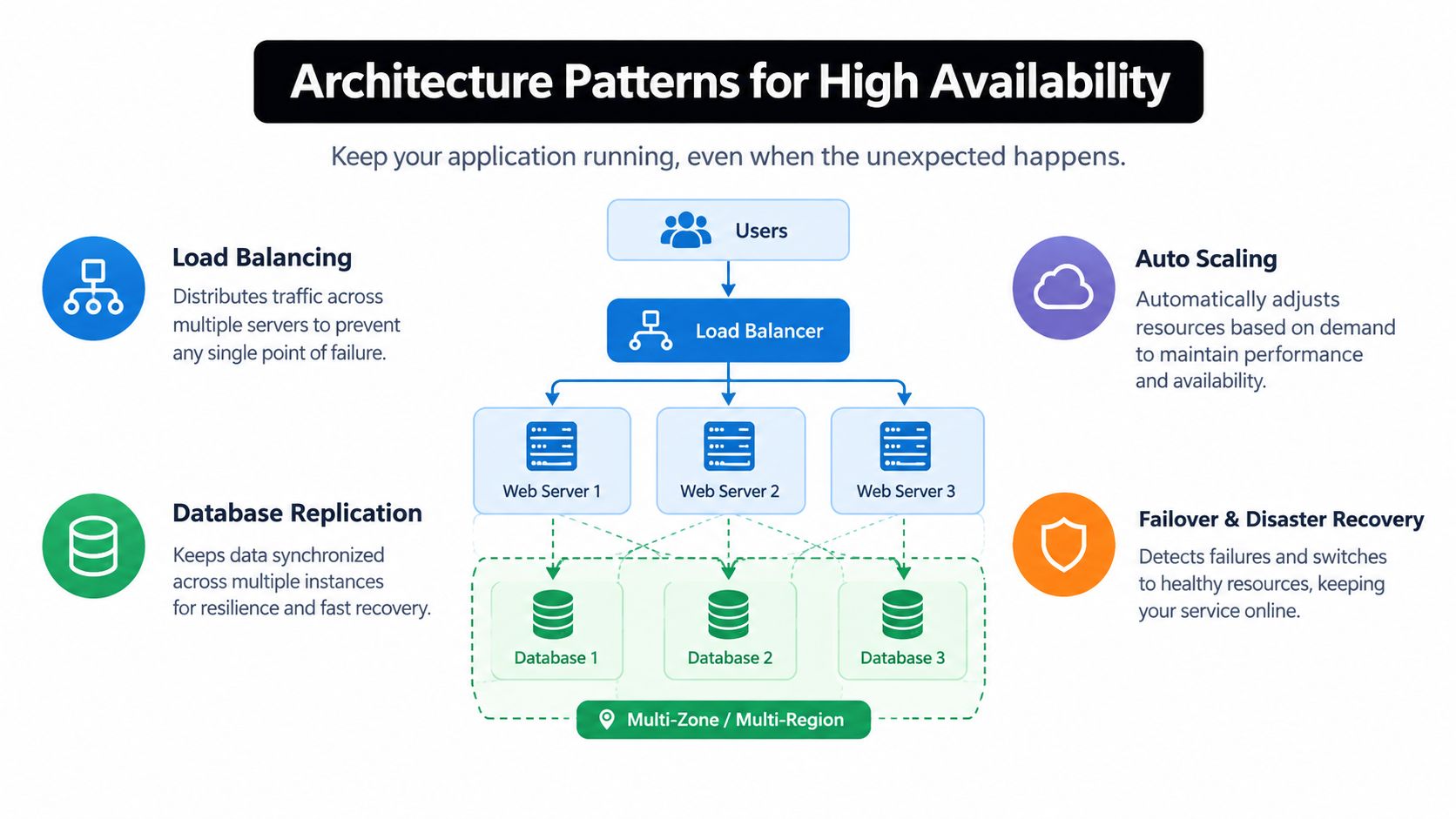
Redundancy helps only when the redundant components fail independently enough to protect the user. Run multiple application instances behind a load balancer, but check whether they share one database, one network boundary, one deployment pipeline, or one configuration store. Two instances that depend on the same fragile control plane provide less protection than the architecture diagram suggests.
Active-active designs can preserve capacity during a failure and avoid a cold-start delay. They also introduce harder problems, including data consistency, traffic steering, duplicate work, and split-brain behavior. Active-passive designs are often simpler to reason about, but the standby must be tested regularly or it may fail when promoted.
Isolate failure before adding complexity
Use bulkheads to limit how much damage one workload can cause. Separate connection pools for independent dependencies. Cap queue sizes. Give expensive AI requests their own concurrency limits so a provider slowdown can't consume resources needed by authentication or checkout. Apply timeouts at every network boundary, not only at the outer request.
Graceful degradation often produces a better customer outcome than indiscriminate retries. A product catalog might serve cached information while pricing refreshes. A reporting workflow might accept a request and complete it asynchronously. A recommendation panel can disappear without blocking the primary transaction.
Before investing in another replica, inspect the physical and operational failure domains. Data-center efficiency and sustainability decisions can affect cooling, power, capacity, and resilience planning, so this discussion of data-center sustainability and efficiency belongs in architecture reviews where infrastructure choices have long-term consequences.
A practical design review should record:
- The protected journey: Which customer action must continue?
- The failure boundary: Which component can fail without taking the journey down?
- The fallback: What useful result can the system return?
- The recovery test: Which automated or manual procedure proves the design works?
- The cost ceiling: Which resilience improvement justifies its operational and financial burden?
Don't build active-active infrastructure for a low-value internal tool because a reference architecture recommends it. Protect the workflows where interruption creates material customer or business harm.
Proactive Reliability Engineering Practices
Production incidents reveal gaps, but controlled failure tests can expose them before customers encounter them. The purpose is practical: verify isolation, alerts, recovery logic, and operator decisions against the user experience your system promises.
Chaos testing works when it starts with a specific hypothesis. If an order service loses access to its tax provider, the intended behavior might be queuing the order for later calculation instead of failing checkout. Inject that timeout in a controlled environment, verify what the customer sees, and confirm that queues, alerts, and runbooks respond as designed.
Make experiments safe and useful
Start with a narrow blast radius. Test one service, dependency, or failure mode, and define a stop condition before the run begins. The team also needs a reliable way to identify affected traffic. Staging can validate mechanics, while production traffic exposes interactions that staging cannot reproduce.
A practical progression is:
- Tabletop exercise: Operators and developers walk through a scenario, assign responsibilities, and record decisions the team cannot yet make.
- Game day: The team introduces a bounded failure and observes the full response, from detection through recovery.
- Automated experiment: A recurring test verifies that a known resilience property survives system changes.
- Production experiment: The team tests a narrowly scoped failure with explicit safeguards, affected-traffic visibility, and a rollback path.
Agentic systems increase the need for this discipline because a model or tool failure can affect user-facing workflows, queues, and shared capacity. Monitoring confidence remains low across many organizations, and only 17% regularly run chaos or resilience experiments in production. The figure is a warning against treating architecture diagrams or successful deployments as proof of resilience. High-risk services still require tighter safeguards before fault injection.
Failure rehearsal: A recovery procedure that has not been exercised is an assumption, not a control.
The strongest experiments measure user outcomes as well as component survival. Did the customer receive an accurate status? Did the queue preserve the request? Did the circuit breaker open early enough? Did operators understand the alert? The PushOps reliability engineering resource offers a practical structure for connecting engineering controls with operational response.
After each exercise, assign findings to owners and convert them into specific work. Replace “improve monitoring” with an added dependency timeout, a synthetic transaction, or an automated runbook containing the tested rollback command. Record what the experiment proved, what it did not test, and which remaining dependency or AI-provider failure still needs coverage.
Managing Third-Party and AI Dependencies
A service can be healthy while customers experience failure. An external provider may change its latency, response format, quota behavior, or availability, and the disruption can spread through your platform. Slow API calls occupy application threads, retries multiply traffic, queues grow, and user requests begin to fail.
AI providers create the same risk in less predictable forms. A model endpoint may support classification, summarization, search assistance, or agent decisions. If it slows down, synchronous requests keep users waiting, while agent loops can consume shared compute, connection pools, and queue capacity. Reliability therefore depends on controlling the boundary, not only keeping internal servers online.
Third-party cascades were the largest single failure pattern in a recent dataset, accounting for 23% to 35% of incidents from 2023 through 2026 (2026 State of Reliability report). Provider recovery has improved over that period, but your application still must detect the outage, tolerate the interval, and complete or safely abandon affected work.
Design for the dependency to fail
Set a deadline on every outbound call. Use a circuit breaker to stop requests after repeated failures or unacceptable latency, then retry only within a bounded budget with backoff and jitter. Unlimited retries turn a provider incident into resource exhaustion in your own system.
Cache responses when freshness permits. Keep the last known configuration, product information, or model-assisted result with an explicit freshness policy. For important workflows, separate acceptance from fulfillment: validate and persist the request, then complete the volatile external step asynchronously. Users receive a durable status instead of waiting on a provider that may already be failing.
AI integrations need additional controls. Abstract the provider so you can switch models or vendors without rewriting the workflow. Set request and token budgets, validate prompts and responses, and provide a deterministic fallback for decisions that must remain safe. Limit an agent's execution time, tool calls, and resource use. If automation cannot finish within those limits, return a clear status and preserve the request for review or retry.
Dependency ownership must include business impact. Record the customer journeys that rely on each provider, the degraded mode you will offer, the acceptable age of cached data, and the owner of each fallback. A dependency contract should define timeouts, error handling, data expectations, and recovery behavior. That contract belongs in the reliability design, not only in integration code.
Monitoring and Incident Response Strategies
Monitoring should expose what customers cannot accomplish, then help engineers locate the failing boundary. Host metrics, container health, and database saturation remain useful evidence, but page operators for failed transactions, rising latency, stale data, blocked workflows, and errors from external APIs or AI providers.
Start with synthetic checks for the highest-value customer journeys. Pair them with SLIs from real traffic to separate regional faults, customer-segment failures, and platform-wide incidents. Distributed tracing can connect a visible symptom to the service or dependency that introduced it. Structured logs should carry a request identifier, operation, outcome, dependency, timeout reason, and recovery action.
Alert design needs a sense of proportion. A single subsystem or dependency can account for a large share of outage risk, so give greater attention to boundaries that repeatedly create customer harm. A provider returning valid but degraded AI responses may require a different alert from a total timeout, while both can break the same workflow.
Make response repeatable
Incident response fails when one engineer must diagnose, communicate, coordinate, and document simultaneously. Assign clear roles:
- Incident commander: Sets priorities, approves mitigation, and prevents contradictory parallel work.
- Technical lead: Examines evidence, applies the safest mitigation, and records hypotheses.
- Communications owner: Reports impact, scope, and next actions to stakeholders.
- Scribe: Captures timestamps, decisions, alerts, and commands for later analysis.
Automated runbooks should handle reversible actions such as disabling a feature flag, shifting traffic, pausing a queue consumer, or rolling back a release. Manual procedures still have a place, but document and rehearse them so recovery does not depend on one person's memory.
A proactive system monitoring guide can help teams organize checks around early detection rather than reactive paging. The operating model matters as much as the tooling. Keep on-call rotations sustainable, route alerts by service ownership, suppress duplicate symptoms, and run blameless post-incident reviews that produce engineering changes instead of personal fault.
A useful post-mortem answers three questions: what did users experience, why did the system let the failure spread, and which control will prevent or limit recurrence? Record what worked as well. Effective recovery patterns should become standard runbooks, dashboards, or tested automation.
Building a Pragmatic Reliability Roadmap
Server uptime alone cannot define reliability. A system may report healthy while a customer cannot complete checkout, an AI provider returns unusable output, or a third-party API slows a critical workflow. Build the roadmap around user journeys and the dependencies that can disrupt them.
Reliability has been measurable longer than modern cloud platforms have existed. The discipline became formal during World War II, and by 1956 AGREE had published the first reliability handbook, defining reliability as the probability that a system performs its required function under stated conditions (NASA's history of reliability engineering).
Start with the journeys that matter most. Map internal, third-party, and AI dependencies, identify single points of failure, review incidents, and compare customer-visible indicators with infrastructure alerts. Rank work by expected reduction in user harm. A timeout and graceful fallback may protect a critical workflow more effectively than a costly platform redesign.
Turn reliability into an investment case
Report SLO performance beside revenue, retention, completed transactions, support demand, or NPS. Teams often fail to connect reliability improvements with business outcomes, leaving engineers to defend technical work in technical language. Define a small set of quarterly outcomes:
- reduce failure exposure for a critical dependency,
- shorten recovery through automation,
- validate a fallback with a controlled experiment,
- remove recurring operational toil,
- connect an SLO change to a customer or business result.
Technical debt belongs in the same decision process. The technical debt risk-control framework helps leaders describe deferred engineering work as exposure, such as fragile integrations, untested recovery paths, or unsupported components.
Keep the roadmap active through error-budget reviews, dependency tests, incident learning, and customer-impact reporting. Revisit priorities when traffic, vendors, AI providers, or product workflows change. Reliability becomes durable when product, engineering, operations, and executives agree that success means users can complete important work predictably, even when dependencies fail.
Audit critical customer journeys, choose a user-facing SLO for each high-value workflow, and run a bounded failure exercise. Document the fallback and connect the result to a business measure. Contact Faberwork to discuss enterprise software, automation, and reliability requirements.


