
Fewer than one-third of organizations formally assess scalability before launching an AI initiative. That makes governance and operating-model requirements critical architectural concerns from the start, not cleanup work after a prototype succeeds.
A prototype can classify claims, recommend maintenance actions, or route customer requests with impressive results in a controlled environment. Production adds identity systems, legacy databases, compliance obligations, unpredictable traffic, incomplete data, human approvals, and customers who expect the service to work when dependencies slow down.
That gap is where system architecture design earns its place as a business discipline. The architecture must connect technical choices to outcomes such as completed orders, safe automation, recovery time, operational cost, and customer experience. A model endpoint alone isn't an operating system for an enterprise.
Why System Architecture Design Matters Now
A healthcare team may prove that an AI assistant can summarize clinical records, then discover that production access requires patient-level permissions, traceable evidence, escalation to a qualified person, and reliable connections to several systems of record. A finance team may automate transaction review, only to find that an apparently helpful recommendation needs a policy decision, an audit trail, and a reversible action rather than a simple API call.
Logistics and energy teams face a similar transition. A prototype can identify a likely delivery delay or an abnormal equipment signal, but a production platform must decide which data is current, who can act on the recommendation, what happens when a source is unavailable, and how the business proves what the system did.
Fewer than one-third of organizations formally assess scalability before launching an AI initiative. The result is predictable. Teams address governance, accountability, integration, and operating costs only after a use case has demonstrated value, when changing the architecture is more disruptive and expensive.
The prototype is not the product
A successful prototype answers a narrow question: can the technology produce a useful result? Production architecture must answer harder questions:
- Who is allowed to invoke the capability?
- What data can it retrieve, and under which conditions?
- Which actions require approval?
- How can an operator inspect, reverse, or replay a decision?
- What does the system do when data is stale or a dependency times out?
These decisions belong in the architecture, not in a collection of undocumented application assumptions. Teams evaluating an AI initiative can also use Ekipa AI strategy services as a reference point for connecting use-case selection with operating and governance decisions.
The strongest architecture reviews therefore begin with business outcomes. A healthcare platform might measure safe case resolution and escalation quality. A logistics platform might measure completed deliveries and recovery from disruptions. Infrastructure capacity matters, but it's a means to those outcomes, not the outcome itself.
Core Principles of Effective Architecture Design
Architecture design grew out of a practical need: share computing resources without forcing every user or application to own a complete machine. During the 1960 to 1967 mainframe era, time-sharing systems let local clients, often teletype terminals, interact with a central computer. Client processes issued requests while server processes managed computation and multiplexed shared resources.
That pattern still appears in database services, application servers, cloud platforms, and enterprise data systems. The names have changed, but the architectural concerns remain familiar: resource sharing, interface boundaries, centralized control, and the consequences of contention.

From central machines to distributed systems
The creation of ARPANET in 1969 extended this model beyond one facility. Its architecture used Interface Message Processors at network nodes and leased 50-kilobit-per-second lines for packet-based, store-and-forward communication. By April 1971, it had expanded to 15 nodes and 23 host computers. By January 1973, it had reached 35 nodes, including 15 Terminal Interface Processors, and 38 hosts. These milestones are documented in the historical account of early distributed architecture and ARPANET.
The shift matters because distributed systems require architects to reason about communication links, intermediate components, independent failures, and network delay. Those same concerns shape cloud applications, AI platforms, analytics systems, and transactional workloads today.
Architecture as an explicit engineering discipline
Software architecture became a distinct discipline gradually. The term was used to describe software-system structure by at least the second NATO Software Engineering Conference in 1969, while systematic research began in the late 1980s. Carnegie Mellon's historical account describes architecture as the large-scale structure of a system, including abstract components, their relationships, and the principles that guide design and evolution.
The research community developed architecture views, architecture description languages, and architecture evaluation practices during the 1990s. A Defense Technical Information Center retrospective reports steady increases in citations to software-architecture papers published from 1991 through 1996, followed by a sharp increase for papers published in 1998, demonstrating the field's scholarly maturity.
The practical principles are straightforward:
- Make boundaries explicit: Define ownership, interfaces, data responsibilities, and failure behavior.
- Design for evolution: Assume requirements, teams, dependencies, and workloads will change.
- Treat quality attributes as constraints: Maintainability, interoperability, performance, security, and future change cost must influence structure.
- Prefer evidence over fashion: Choose a pattern because it fits the workload and operating model, not because it appears in a technology roadmap.
Common Architectural Patterns and Trade-offs
No architecture pattern wins in every situation. A client-server model provides a clear mental model and works well when a central service can coordinate requests and resources. A layered design separates presentation, business logic, and persistence, which can simplify maintenance, but changes that cross every layer can become slow and tightly coupled.
Microservices create opportunities for independent deployment and scaling. They also introduce network failure, eventual consistency, contract management, distributed tracing, and operational overhead. Event-driven architecture decouples producers from consumers and suits asynchronous workflows, but it makes causal reasoning and incident investigation harder.
Choose boundaries, not labels
A modular monolith can provide strong internal boundaries without immediately creating a distributed system. Microservices make more sense when domains need independent deployment, separate scaling characteristics, or distinct ownership. Event-driven components fit when the business process can tolerate asynchronous work and the team can operate reliable event delivery, replay, observability, and failure handling.
The useful question isn't “Should we use microservices?” It's “Does this boundary reduce coordination while preserving a coherent business capability?”
A practical boundary has:
- Cohesive responsibility: The component owns a meaningful business capability.
- Low coupling: Internal changes don't force unrelated teams to coordinate.
- Versioned contracts: Consumers can evolve without synchronized releases.
- Compatibility tests: Teams verify interface behavior before deployment.
- Clear ownership: Someone can operate and change the component independently.
A documented enterprise case found that restructuring applications around modular domains, while improving developer experience and matching team topology, produced a 60% reduction in average cycle time, an 18-fold improvement in development cost for integrating modular domains versus building from scratch, and an 80% reduction in team startup costs. The results are described in Martin Fowler's account of linking modular architecture and team structure.
The data trade-off
An event stream can reduce synchronous coupling and support real-time reactions, but it doesn't remove the need for authoritative data ownership. A service that publishes events without clear semantics can spread inconsistent state faster than a synchronous integration would.
Similarly, an API catalog doesn't solve freshness, lineage, or permission decisions by itself. Teams evaluating streaming and operational data designs can find useful context in SigOS data architecture insights, but the final choice should follow workload behavior, ownership, consistency needs, and operational maturity.
Practical rule: If a proposed service boundary creates more coordination, duplicated data, and distributed failure modes than it removes, the boundary is probably in the wrong place.
Step-by-Step Architecture Design Process
Start with the result the business needs, then work backward toward components and infrastructure. AWS Well-Architected guidance requires teams to define expected workload outcomes, determine how success will be measured, and select operational metrics tied to those calculations. Its operational excellence guidance supports a repeatable design-review process rather than a one-time diagram exercise.
Define the outcome
Write the customer or business result in operational terms. For an order platform, that could mean completed orders, checkout success, and recovery time. For an AI maintenance workflow, it could mean correctly prioritized interventions, human escalations, and safe completion of approved actions.
Don't start with “Which database should we use?” Start with “What must improve, for whom, and how will we know?”
Map constraints and responsibilities
Document regulatory requirements, data residency expectations, existing systems, team ownership, integration contracts, and acceptable operating cost. Identify which system owns each critical record and which component may modify it.
Then map synchronous calls, events, scheduled jobs, human approvals, and external dependencies. Include the failure path. A design that only shows the successful request path isn't an architecture, it's a feature illustration.
Select a pattern and test it against failure
Compare a modular monolith, service decomposition, event-driven workflow, or managed platform against the stated outcomes. Test the choice with questions about dependency failure, data inconsistency, deployment independence, recovery, observability, and access control.
Define measures and review them continuously
Choose metrics that expose customer impact and operational health:
- Availability: Can users complete the intended task?
- Deployment performance: Can teams release safely and recover from a bad change?
- Incident response: Can operators detect, understand, and resolve failure?
- Workload health: Are critical flows processing valid and timely data?
- Cost: Does the architecture remain viable as usage changes?
Use the design review to compare alternatives, record rejected options, and revisit assumptions when workload or business requirements change.
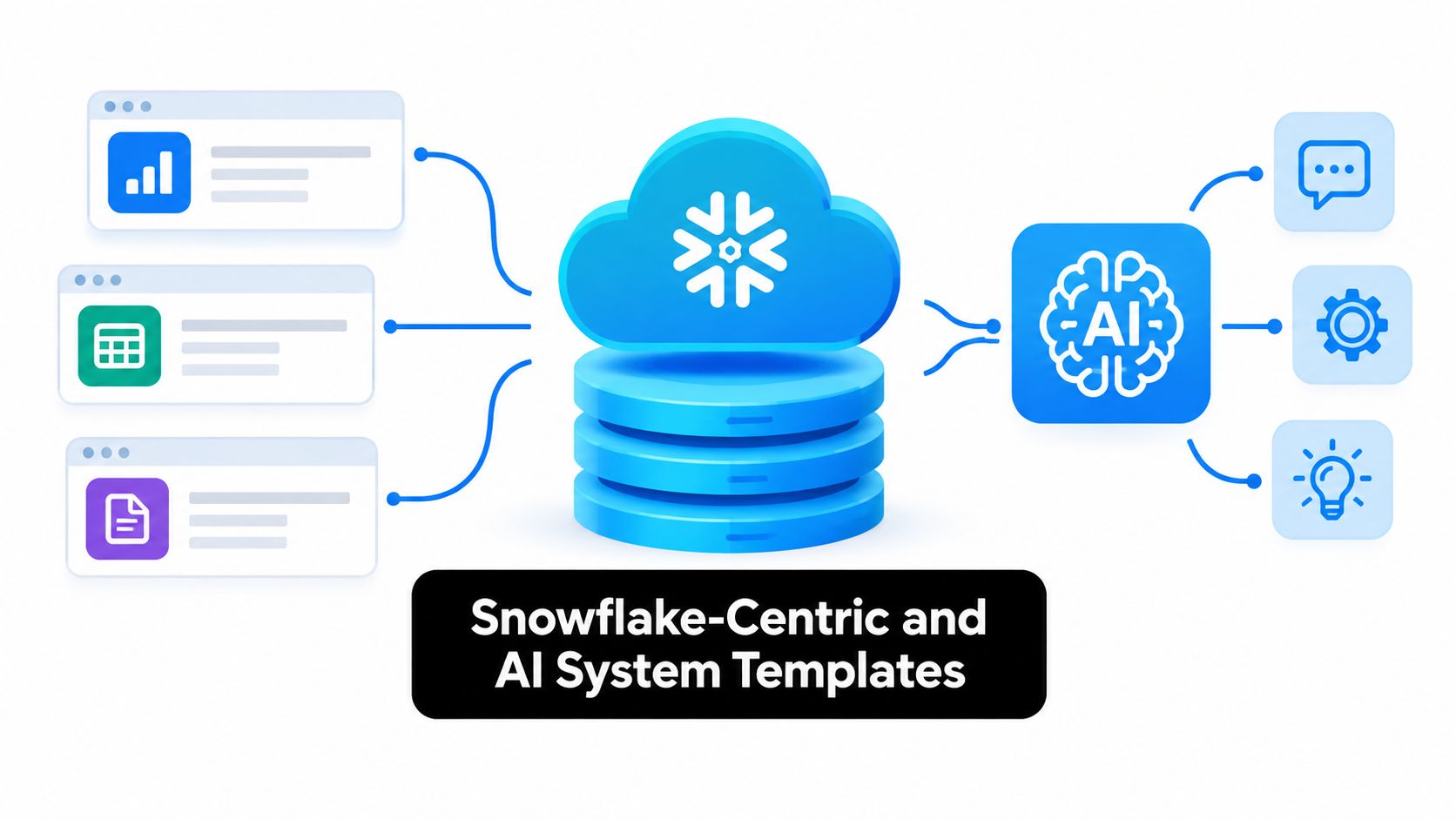
Snowflake-Centric and AI System Templates
A Snowflake-centered architecture can provide a governed foundation for analytics, time-series workloads, and IoT data. The useful design isn't a central repository. It combines ingestion, data contracts, transformation, access policies, lineage, workload-specific serving, and operational monitoring so teams can use shared information without creating uncontrolled copies.
Faberwork LLC works with organizations on scalable analytics, time-series, and IoT data platforms on Snowflake across healthcare, finance, retail, manufacturing, energy, logistics, and telecom. That range of use cases illustrates why the same platform still needs different domain boundaries, freshness expectations, and access rules.
A production template for AI agents
An autonomous agent needs more than a model endpoint and a retrieval layer. Its architecture should include:
- Identity boundaries: Authenticate the agent, its invoking user, and every connected tool.
- Permission enforcement: Apply resource-level policies before retrieval or action.
- Approval thresholds: Route sensitive changes to a human or a separate control service.
- Auditability: Retain prompts, retrieved evidence, tool calls, decisions, and outcomes.
- Rollback capability: Make actions reversible where the business process allows it.
- Cost limits: Restrict excessive tool calls, long workflows, and uncontrolled retries.
- Anomaly detection: Flag unusual access, volume, destinations, or decision sequences.
- Evaluation: Test multi-step decisions, not only individual model responses.
The design review should connect each control to an observable signal. A policy enforcement point should produce an access decision. A human escalation should record who approved the action. A rollback mechanism should prove whether the prior state was restored. Incident response should preserve evidence without exposing more sensitive data than necessary.
The agent's role also matters. A system that drafts a purchase order has a different risk profile from one that submits it. Keep recommendation, approval, execution, and reconciliation separate when the consequences justify that separation.
The Hidden Challenge of Agent-Ready Data Architecture
Many teams assume that a warehouse, ETL pipeline, and API catalog provide enough integration for autonomous software. That assumption fails when an agent needs current context, permissioned action, and a reliable understanding of business meaning.
Batch-oriented ETL and legacy systems create friction because an agent may act on information that has already changed. Enterprise analysis identifies data silos, informal process knowledge, privacy, intellectual property, security, missing communication standards, and compounding errors in multi-step tasks as unresolved obstacles. Those concerns are discussed in Deloitte's analysis of agentic AI strategy.
Freshness is a contract
An agent-ready data layer should state how fresh a dataset must be for each action, how freshness is measured, and what happens when the guarantee is missed. It should preserve lineage from the source through transformation and retrieval, apply permissions at retrieval time, and distinguish authoritative records from contextual material.
Event-driven updates can reduce delay, but events need durable semantics and ownership. A retrieval result should carry enough context for the agent to understand its source, scope, timestamp, and confidence. If two systems disagree, the agent needs a defined failure policy, not an invitation to choose whichever answer sounds plausible.
More access can create more risk
Adding retrieval-augmented generation or exposing more APIs doesn't automatically improve automation. An agent can amplify a bad record, combine unrelated permissions, or propagate an error across multiple systems through a chain of apparently valid actions.
A safer design separates context access from action authority. The agent may retrieve operational information, but a policy service decides whether it can invoke a tool. A reconciliation process checks the result afterward. Teams working with time-series and operational data can also examine this Snowflake time-series implementation example when considering how freshness and governed access should support real-world workloads.
The right question isn't how to give an agent more data. It's how to give it the minimum trustworthy context required for a reversible, attributable decision.
Non-Functional Requirements and Reliability Metrics
Average latency can hide the failure customers actually feel. At scale, a temporary slowdown in one component can dominate end-to-end performance, especially when a request fans out across several dependencies and waits for the slowest response.
Google Research's Tail at Scale findings show why percentile behavior belongs in architecture reviews. In a controlled Memcached study, a four-core system at 80% utilization measured 11 microseconds median latency and 32 microseconds at the 99.9th percentile. A naïve single-core deployment under the same utilization reached 100 microseconds median latency and 5 milliseconds at the 99.9th percentile.
Design for the slow request
Specify service-level objectives using percentile latency, not only the average. Instrument every dependency hop so operators can identify whether the tail originates in storage, scheduling, network contention, application work, or a downstream service.
Useful controls include:
- Bounded timeouts: Stop waiting when a dependency can no longer meet the request deadline.
- Deadline propagation: Pass the remaining time budget through each service call.
- Bulkheads: Prevent one overloaded dependency from consuming all shared capacity.
- Graceful degradation: Return a useful partial result when optional data isn't available.
- Request hedging: Send a carefully controlled alternative request when tail behavior justifies it.
- Load shedding: Reject work deliberately before overload causes wider failure.
These controls must be tested under realistic concurrency, scheduling, background load, and hardware topology. A benchmark that validates only median response time can approve an architecture that fails under the exact conditions customers experience.
Use error budgets to govern change
An error budget turns reliability into a release decision. Google's SRE guidance defines it as the difference between a service-level objective and measured performance. For a service with a 99.9% availability target, receiving 1,000,000 requests in four weeks, the allowed budget is 0.1% or 1,000 errors. If that budget is exhausted, a release policy can halt changes except for critical incidents or security fixes. If one incident consumes more than 20% of the four-week budget, the team must conduct a postmortem and include a high-priority root-cause action, as described in the Google SRE error-budget policy.
An SLO also needs a measurement definition. Google's example defines API availability as successful requests divided by all API requests, treating HTTP statuses outside the 500 to 599 range as successful. It sets a 97% API-success objective, which produces a 3% budget or 30,000 errors for 1,000,000 requests, while a web objective can be measured separately. The SLO documentation example shows why each service needs its own target and calculation.
Enterprise Case Examples and Practical Takeaways
Architecture becomes easier to judge when the business result is visible. In a smart-building workflow, a TensorFlow model may identify an optimization opportunity, but the system still needs trusted sensor data, safe control boundaries, and a way to verify that an automated adjustment produced the intended operational result.
An energy management system built on Snowflake has a different interaction pattern from a fleet-geofencing platform. The first may prioritize governed time-series analysis and cross-site reporting. The second may need current location context, event processing, mobile reliability, and carefully limited actions. High-performance browser testing adds another example, where architecture must support repeatable execution, useful diagnostics, and controlled resource consumption.
These examples span healthcare, finance, retail, manufacturing, energy, logistics, and telecom. They reinforce a practical point: a technology component matters only when its behavior connects to a measurable business or customer outcome. An enterprise evaluating transaction workflows can use an Amazon order management system overview as a useful comparison point, then adapt the architectural decisions to its own order ownership, fulfillment rules, and recovery requirements.
What to carry into the next design review
- Measure outcomes: Track completed business actions, customer success, recovery, and cost rather than infrastructure capacity alone.
- Align boundaries with ownership: A module should have a cohesive responsibility, a stable contract, and a team able to change it safely.
- Embed controls early: Identity, policy enforcement, auditability, observability, and rollback belong in the initial design.
- Treat data as operational infrastructure: Define freshness, lineage, semantic consistency, retrieval permissions, and stale-data behavior.
- Test the tail: Validate latency and failure behavior under realistic load, not just average performance in a quiet environment.
- Keep decisions revisable: Record assumptions and establish metrics that reveal when the architecture no longer fits.
System architecture design succeeds when it makes the desired business behavior easier to deliver, operate, govern, and change. The diagram is only the visible part. Architecture lives in the boundaries, contracts, controls, data guarantees, and operating decisions that determine what happens when production becomes more complicated than the prototype.
Bring your next AI or data initiative to a design review that starts with outcomes, maps every data and permission boundary, and defines reliability measures before implementation begins. Use that review to identify which prototype assumptions need production controls, then build a target architecture with explicit ownership, auditability, rollback, and agent-ready data contracts.


