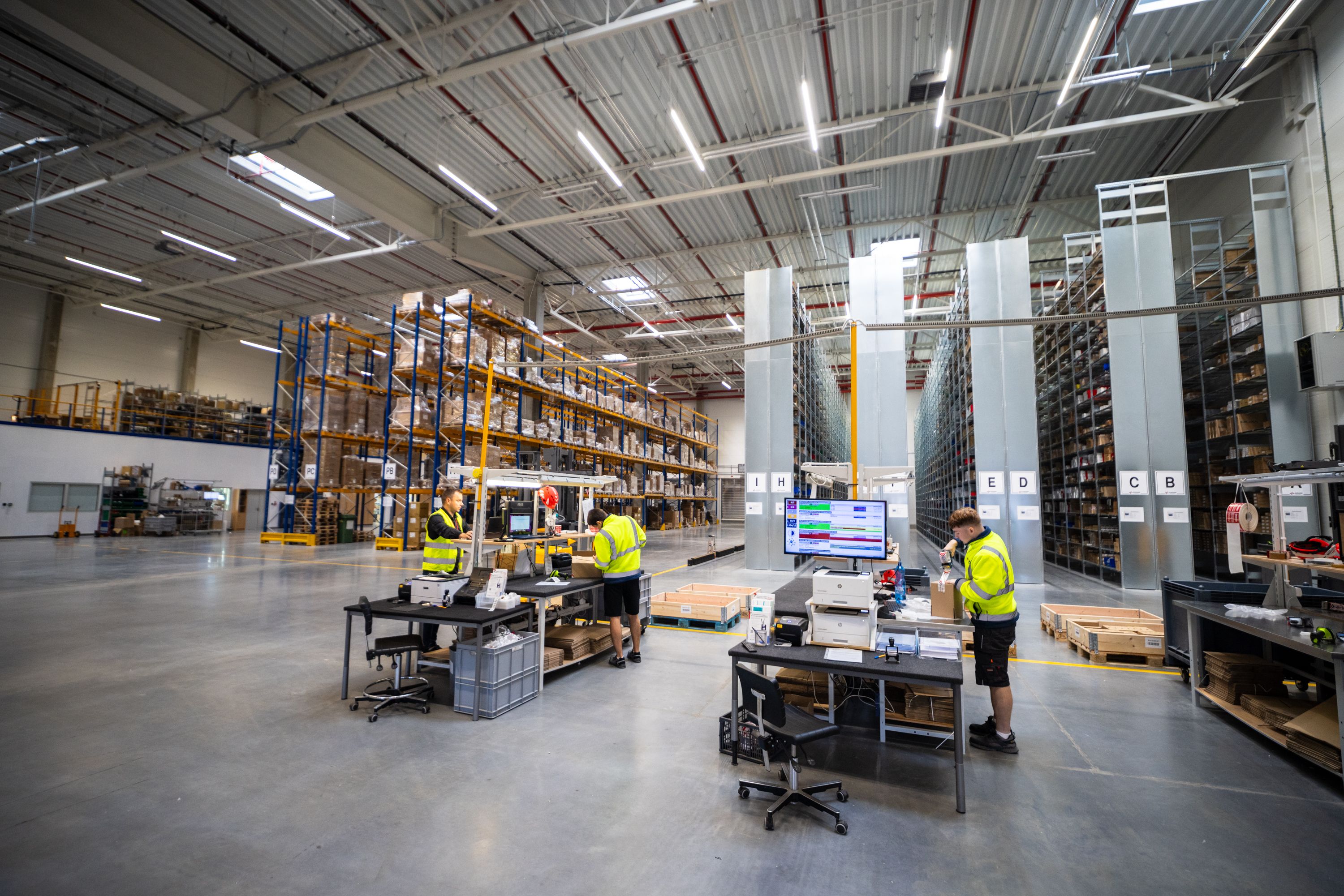
The International Federation of Robotics reported 541,302 industrial robots installed worldwide in 2023, with a global operational stock above 4.28 million units, a 10% rise from the year before. Since 2018 that stock had grown by an average of 12% a year. In 2024 about 102,900 robots were sold for transportation and logistics tasks, 14% year-over-year growth and more than half of professional service-robot sales. About 81,800 of those units were mobile robots for intralogistics. Roughly 84% of those intralogistics mobile robots were sold in Asia-Pacific, 11% in Europe, and 5% in the Americas.
That volume looks like a finished shift. It isn't. Most of the value in supply chain automation still sits in software, sensors, and decision rules, and most sites haven't connected those layers. The bottleneck is rarely "can we buy a robot." It's whether planners, warehouse leads, and dispatchers know which decisions the system may take, how exceptions get logged, and how you'll prove resilience as well as labor savings.
What Supply Chain Automation Covers and Where Adoption Stands
Supply chain automation is the use of software, sensors, and machines to run repetitive planning, movement, and record-keeping with less manual work, and, in tighter cases, to take bounded decisions. Robots are one layer. The family also includes warehouse management software, barcode and RFID tagging, automated storage and retrieval, conveyors and sortation, automated guided vehicles (AGVs), autonomous mobile robots, and data-driven planning.
A manual warehouse is a kitchen where every cook walks the pantry for each ingredient. Automation is the prep station that puts the right items in front of the cook at the right time. The cook still seasons, still rejects a bad cut, and still owns the plate.
The gap between the market and the floor
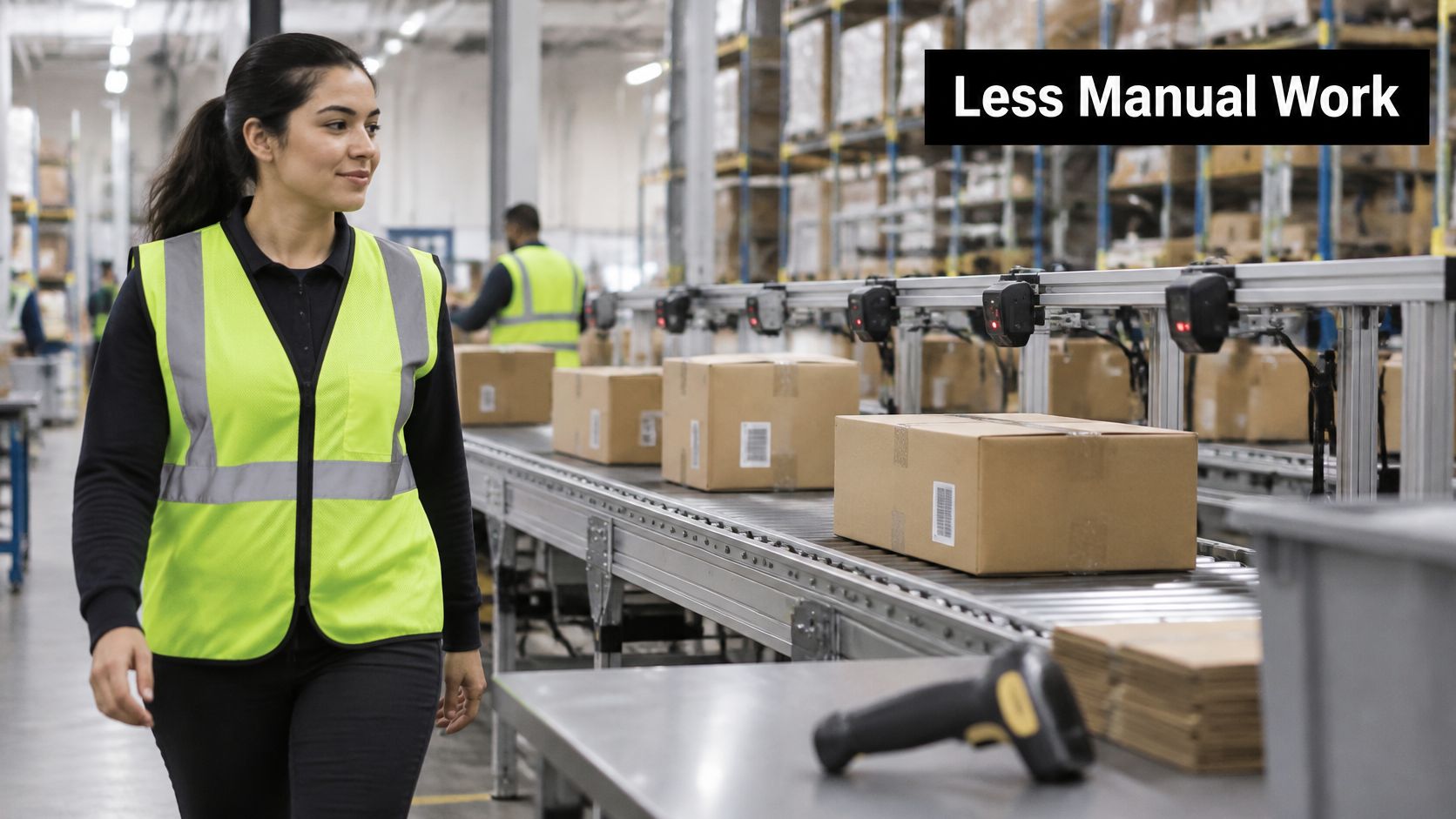
A 2020 survey by the U.S. National Center for Science and Engineering Statistics, summarized in an ITIF warehouse automation review, found that 85% of transportation and warehousing companies neither used nor tested robotics, and 83% did not use AGVs. More recent industry analysis in that same review estimated that more than 80% of warehouses worldwide still had no automation, while only about 5% used advanced automated tools.
Adoption has usually started with repetitive, high-volume work, then moved into software-coordinated operations. Most networks are still early in that sequence, especially outside highly digitized or labor-constrained markets.
The useful question isn't whether automation exists in the market. It's which layers you already run, and which ones you still do by hand.
Upstream of the warehouse, the same pattern shows up in buying. Teams that still chase quotes in email lose the audit trail before a pallet ever moves. A practical companion is automating sourcing from draft to award, which shows how a bounded buying workflow can be scripted without pretending the rest of the chain is already autonomous.
For a technology leader, the inventory of layers matters more than a vendor shortlist. If you have barcodes and a warehouse system but no event feed into planning, you don't have an automation program yet. You have islands.
Core Technologies and When Each One Fits
Match the tool to the break in the process, not to the slide that looks newest. The six layers below cover the problems a planner encounters, in roughly the order they appear.
TechnologyBest forTypical exampleMain limitRobotic process automation (RPA)Rule-based, repetitive data entry across systemsCopying carrier invoices into a transport systemBreaks when screens or file formats changeAgentic AIMulti-step decisions inside defined guardrailsDetecting a stock imbalance and proposing a transferNeeds clean data and clear escalation rulesIoT sensors and telematicsLive location, condition, and temperature dataReefer temperature alerts from trailersCreates high data volume that needs filteringEvent-driven platformsReacting instantly to order, shipment, or stock eventsRerouting when a shipment is delayedRequires agreed event formats and ownersSnowflake data platformOne governed view for analytics and model trainingOne inventory figure shared across warehousesValue depends on pipelines feeding itWarehouse robots and AGVsMoving goods between receiving, storage, and picking zonesGoods-to-person pickingHigh capital cost and dependence on layout
Execution first, then sensing, then a shared number
RPA is the clerk who never gets bored, as long as the form doesn't move. It fits carrier invoices, order copies, and status updates between systems that lack APIs. Change the screen layout and the bot fails without warning. Treat it as a bridge, not as the operating system.
Agentic AI is a junior planner with a written playbook. It can notice a stock imbalance, propose a transfer, update the record, and stop when the value or the exception is outside the playbook. Without clean inputs and a named escalation path, it will act on a bad count with perfect confidence.
IoT and telematics are the thermometer on the trailer, not the decision. A reefer alert is useful only if someone, or a rule, filters noise and owns the response. Raw pings will bury a control tower.
Event-driven platforms replace the nightly batch. A late shipment publishes a fact, and a reroute starts before the morning meeting. That only works when every system agrees what "delayed" means and who may consume the event.
Snowflake is the single chalkboard. Forecasting, warehouse, and finance stop arguing over three inventory figures because pipelines land one governed history. If those pipelines are late or partial, the platform just makes the wrong number official faster. We've seen fleet and warehouse programs stall for exactly that reason until field apps and the warehouse record described the same move. Our work on mobile apps in logistics is one place that handoff shows up in practice.
What the physical layer actually returns
Warehouse robots and AGVs move goods between receiving, storage, and picking so people stop walking the aisle. A review cited by the Information Technology and Innovation Foundation found that workers in Kiva Systems-enabled distribution centers achieved two to three times the productivity of pick-to-conveyor warehouses and five times the productivity of manual pick-to-cart or pick-to-pallet operations, with less than half as many pickers. Treat that as a 2012 operational benchmark, not a promise for every SKU mix.
Identification has to keep up with the robot. A report summarizing University of Arkansas research, covered by Programming Insider, stated that an RFID-based system improved inventory accuracy by approximately 13% versus traditional methods, because tagged cases and pallets update the record as they pass receiving, storage, picking, and shipping.
No single technology covers the chain. Most programs that hold together combine one execution layer, one sensing layer, and one data layer.
Architecture Patterns and Integration Strategies
Automation breaks at the seams between ERP, warehouse management, transport management, IoT feeds, and analytics. A clever robot writing into a stale order status creates confident errors.
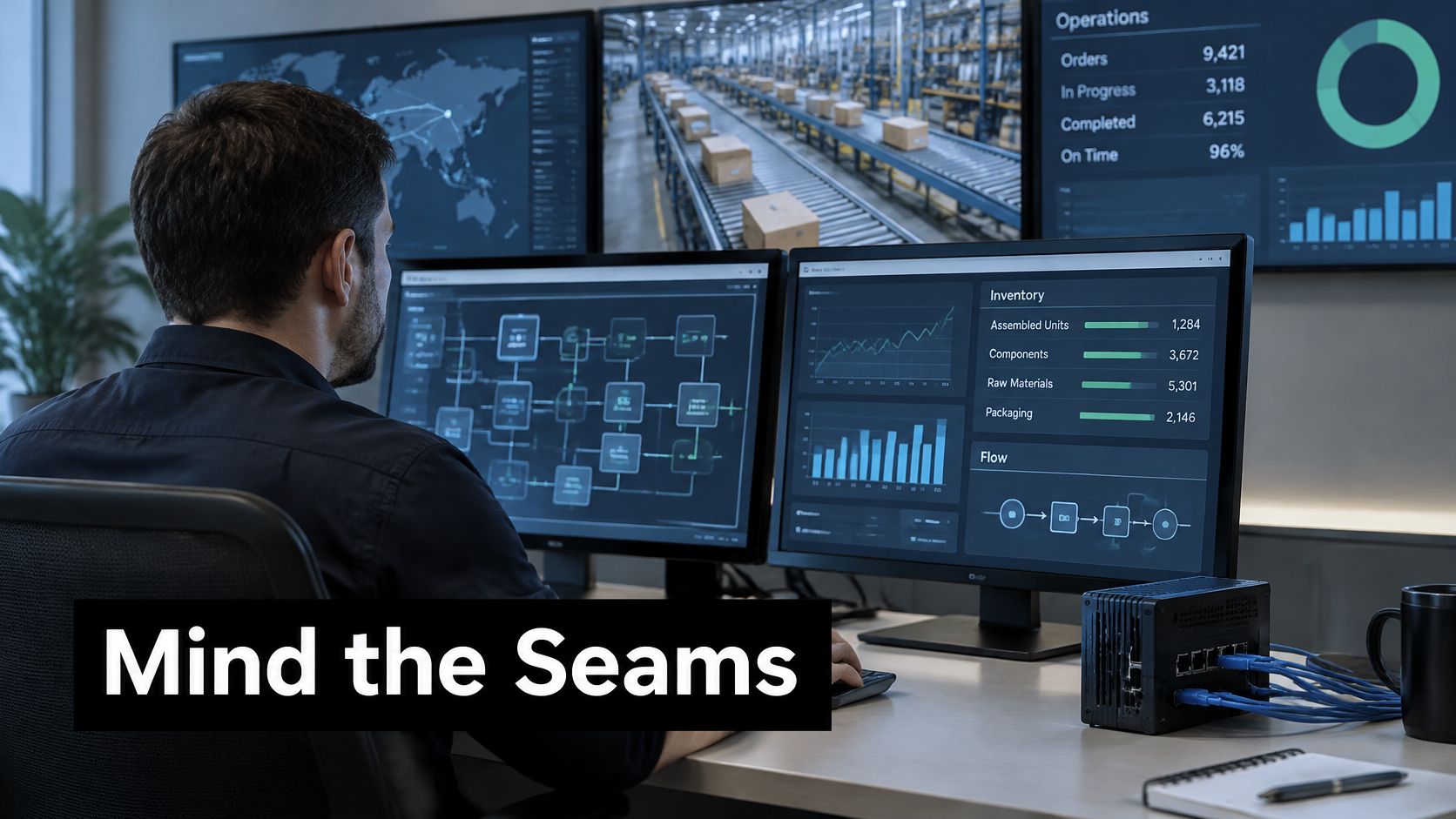
Start with the pattern you probably already have, then decide what you're willing to rebuild.
PatternHow data movesSuitsWatch forPoint-to-point integrationDirect links between two systemsTwo systems with few changesLinks multiply and become fragileMiddleware or integration hubA central hub translates and routes messagesMixed ERP, warehouse, and transport estatesThe hub becomes a bottleneck if overloadedEvent-driven streamingSystems publish and subscribe to eventsReal-time exceptions and shipment trackingNeeds event governance and replay handlingData platform with agents on topUnified data is read by agents, which write actions backAnalytics-led planning and replenishmentWrite-back paths need strict logging and controls
From a spiderweb to a published fact
Point-to-point is a phone call between two clerks. ERP talks to the warehouse system, the warehouse system talks to the carrier portal, and each new app adds another private line. Two systems with a stable contract can live this way. Ten systems cannot. One field rename takes the web down.
A middleware hub is the switchboard. It translates formats and routes messages so each system keeps one connection. Mixed estates, the normal enterprise picture, fit this pattern. The risk is load and ownership. If every project dumps logic into the hub, the hub becomes the outage.
Event-driven streaming is a radio channel. A delayed inbound container publishes an event. Subscribers update the promised ship date, an inventory check compares safety stock, and a planner sees the exception instead of the whole feed. You need owners for each event type, a replay path for when a subscriber was down, and a rule for duplicates.
A data platform with agents is the ledger plus a clerk who may post entries. Agents read one governed store, often Snowflake as the analytical hub, and write actions back through an API or queue. History then supports forecasting and control checks. Write-back without a log is how you lose the ability to undo a bad transfer.
Three rules before you pick a pattern
Draw the current map first. Count the links. The number of existing connections tells you how much rework a new pattern will cost.
- Name a system of record: Stock on hand, order status, and promised date each live in one system. Everyone else copies.
- Agree formats and owners before you build: An event without an owner is a log line, not a decision.
- Route every automated write through an API or queue: Log it, so the action can be audited and reversed.
If you can't name who may change available-to-promise, don't add an agent on top of the mess.
How to Roll Out Automation Without Losing Control
A supply chain can have ambitious automation targets and still be early in adoption. Research summarized by Accenture puts median maturity across supply chain activities at 16% on an index from 0% fully manual to 100% fully autonomous. The same research reports that 66% of surveyed organizations planned to advance autonomy by 2035, while about 40% aspired to systems handling most operational decisions. More advanced operating models were associated with a 27% reduction in order lead time and a 25% increase in labor productivity.
Those results depend on more than software. They require clear decision rights, reliable process data, and teams prepared to change how work gets done. Forecasting and warehouse operations may be easier starting points than supplier-facing processes, but each candidate needs a defined boundary and a way to measure risk avoided as well as labor saved.
Six steps with a checkpoint each
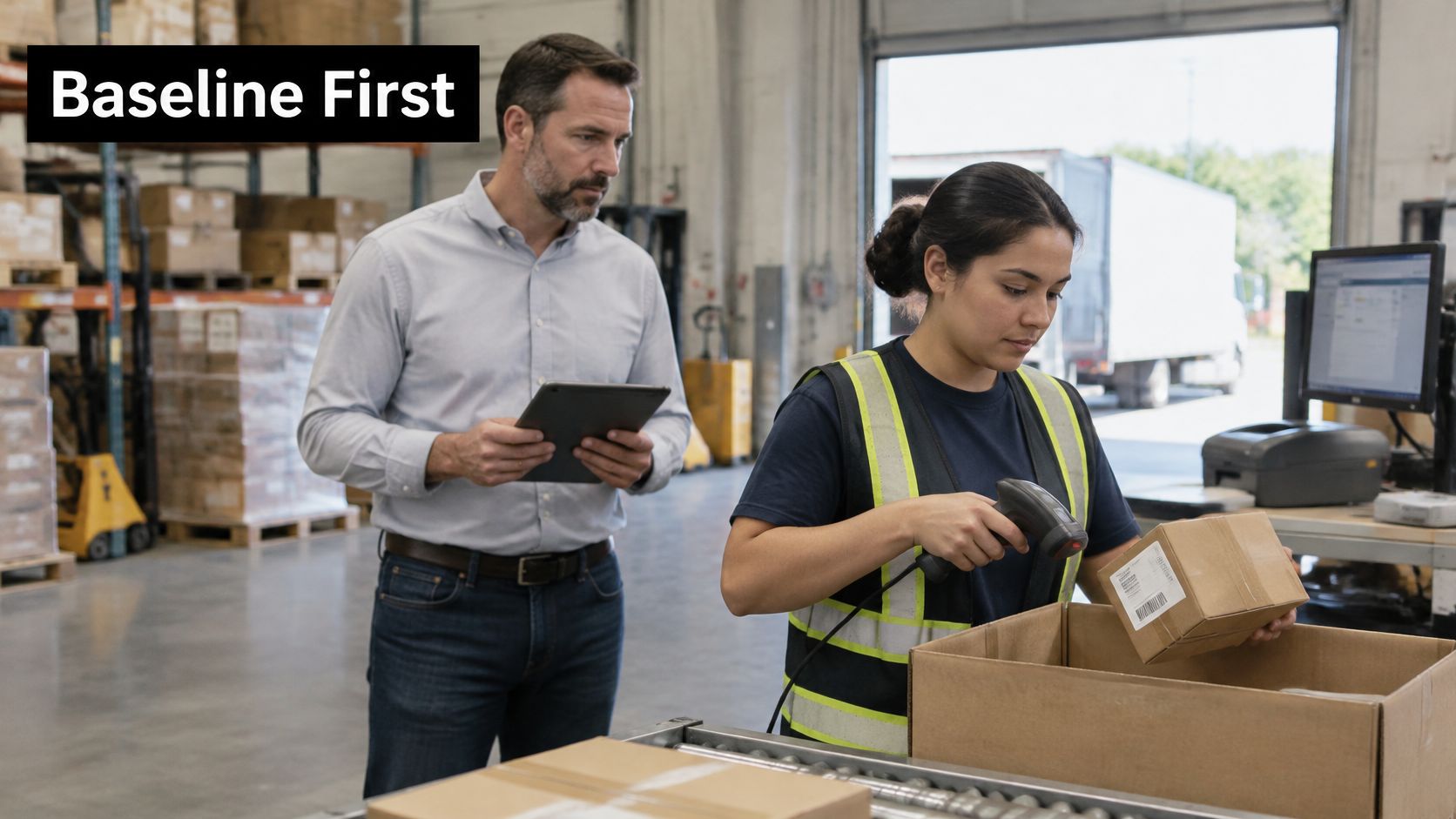
- Baseline the process. Record orders per hour, cycle time, on-time completion, utilization, and exception rates before changing the workflow. A baseline makes later comparisons possible; a new dashboard alone cannot show improvement. Checkpoint: a signed baseline pack that defines the measures and period covered.
- Instrument the data. Ensure forecasting, inventory, warehouse, transport, and order workflows capture consistent event records. A transfer that never appears in the warehouse system cannot be monitored or evaluated. Checkpoint: event records cover the objects in scope without silent gaps.
- Automate one bounded decision. Stock transfers between locations can provide a contained starting case when quantity, lanes, and cut-off rules are explicit. Keeping the decision narrow limits the consequences of a bad rule. Checkpoint: a supervisor can explain the rule from a short written specification.
- Set exceptions and approval thresholds. Define which decisions run automatically, which need approval, and who handles each escalation. Human review can contain the impact of a poor recommendation before it becomes a shipment. Teams that want a worked view of supervised analytics can read about human-in-the-loop AI analytics and adapt the same idea to warehouse exceptions. Checkpoint: every exception type has an owner and a response time.
- Scale only after the pilot beats its baseline. Compare results across a suitable period rather than relying on one unusually strong average. Checkpoint: the agreed measures show improvement beyond normal variation, with risks and exceptions still within the limits set for the pilot.
- Review governance at each gate. Examine data quality, override rates, unresolved exceptions, and decision rights across teams before extending automation. Checkpoint: document a go or no-go decision and the reasons for it.
What each phase must pass
- Data: The system of record and event feed agree on the objects in scope.
- Control: Override rates and exception backlogs remain within limits set before go-live.
- Ownership: A business owner can explain the rule, its limits, and how to reverse an action.
These gates test whether the operating model can absorb automation, not just whether the software runs. Track avoided errors, service disruption, and recovery from exceptions alongside labor savings; those benefits matter, but can be harder to prove without a baseline and clear definitions.
KPIs and ROI Examples Worth Tracking
A 2026 peer-reviewed warehouse experiment, published in Springer Nature, is a useful scoreboard because it reports a benchmark next to the automated run, not a lone "after" number.
KPIWhat it measuresManual benchmarkAutomated systemOrders per hourThroughput of completed orders105120Resource utilizationShare of available capacity in use85-88%94-96%Task completion efficiencyShare of tasks completed as planned91%About 98%Order completion timeTime to complete an orderNot published4.2 minutesOn-time deliveryShare of orders delivered on timeNot published98.8%Batch efficiencyShare of batches processed efficientlyNot published98.2%
Read the first three rows as paired comparisons. Throughput moved from 105 to about 120 orders per hour. Utilization moved from 85–88% to 94–96%. Task completion moved from 91% to about 98%. The last three rows show what the automated system achieved, 4.2 minutes, 98.8% on-time delivery, and 98.2% batch efficiency, without a published manual twin. Don't invent the missing baseline. Measure it on your floor before you claim the lift.
Five benefit types, not one number
Labor savings are the line finance already knows how to audit. They are not the whole case.
- Direct savings: Fewer hours on the automated task, after you subtract licenses, maintenance, and integration.
- Capacity released: The same team clears a peak without overtime or a temp agency. That's throughput, not a headcount cut, until you remove the role.
- Service-level improvement: On-time completion and fewer shorts. Put a cost on the penalty or the lost order, or leave it as a service metric.
- Inventory-risk reduction: Fewer emergency buys, less obsolete stock, tighter safety stock because the count is trustworthy.
- Continuity and compliance value: Avoided downtime, a reversible write, an audit trail. This is the bucket most business cases skip, and the one a disruption makes obvious.
A 2025 briefing from the Economist Intelligence Unit and GEP found that six in ten firms report difficulty quantifying operational benefits such as reduced downtime or faster decision-making, and a similar share say intangible gains such as risk avoidance are even harder to track. The same briefing found integration with existing systems was the leading barrier for 40.9% of organizations, and lack of internal expertise affected 40.1%. The economics often look weak because the hard benefits aren't in the spreadsheet yet, and the integration cost shows up first.
Run a counterfactual. Keep an automated lane next to a manual lane, or compare a matched period, and log overrides and exceptions the whole time.
Set a time-to-value gate, such as a payback review at six months, before the pilot starts. Report each benefit as a range with a confidence interval, and give each range a named owner. A shared KPI with no owner becomes a slide.
In that experiment the throughput gap was 15 orders per hour. Multiply added orders by your labor cost per order, subtract run costs, and stop. Don't fold service and risk into the same dollar so the total looks cleaner. If you want a structured prompt for the cost side, the ROI calculator from Material Handling USA is a practical worksheet. For the statistical side, our note on enhancing logistics with Python data analytics walks through how to keep the comparison honest instead of averaging away the bad weeks.
Security and Change Management for Automated Operations
Buying the model doesn't close the operating gap. In a supply chain technology survey published by ABI Research, 71% of respondents ranked the absence of clearly defined standard operating procedures among the top three barriers to acting on real-time supply chain data. Staff or driver resistance and training costs were also major obstacles.
The limit isn't usually the algorithm. It's whether the person on the floor knows what to do when a recommendation conflicts with experience, policy, or a safety rule.
Decision rights before headcount stories
Write three things down before an agent posts a transaction.
- Which decisions stay human-approved: High-value transfers, customer promises, and anything that touches a regulated shipment.
- How exceptions are logged and learned from: An override without a reason code is a lost lesson. Review the top codes every week and change the rule or the training, not both in silence.
- What authority the frontline has: A picker who can't stop a bad wave will work around the system. A picker who can stop it, and who isn't punished for a justified stop, will use the tool.
Planners shift from building the plan by hand to challenging exceptions. Dispatchers shift from retyping status to owning reroute thresholds. Warehouse workers shift from walking to exception handling and quality. Managers shift from counting hours to owning override rates and safety stops. Tie pay and recognition to those new decisions, or people will keep optimizing the old scoreboard.
A 2025 industry survey in that same ABI Research set found that 99% of GenAI users saw potential to ease labor shortages, while only 20% expected workforce reduction. The honest message is redeployment and fewer unfilled shifts, not a blanket cut. If you lead with headcount, resistance is rational.
Controls before an agent writes to production
Security is the other half of the operating model. An agent with broad write access is an unattended user.
- Scope access per agent: Role-based rights for the one object it may change, not a shared admin login.
- Log every automated write, and make it reversible: If you can't undo it, you don't understand it.
- Separate test and production: A bad rule should fail on a copy of yesterday's orders.
- Test vulnerabilities both ways: We run automated and manual testing for vulnerabilities before go-live, because scanners miss business-logic holes and manual reviews miss scale.
- Name an owner for each security exception: A permanent exception with no name is a standing breach.
Verify those four conditions, scoped access, logged reversible writes, a tested override path, and a named exception owner, before any agent touches production stock or a customer promise.
Pick Your First Automation Pilot and Set Go or No-Go Criteria
A pilot should test whether automation improves a decision, not merely whether software can execute it. A study from the MIT Center for Transportation & Logistics and Mecalux, reported by IT Brief, found that 57% of organizations expect AI to make or execute more than one-quarter of warehouse operational decisions autonomously by 2028. Inventory movements were the most common area permitted without human approval, at 51% of agentic AI use cases. Data corrections followed at 42%.
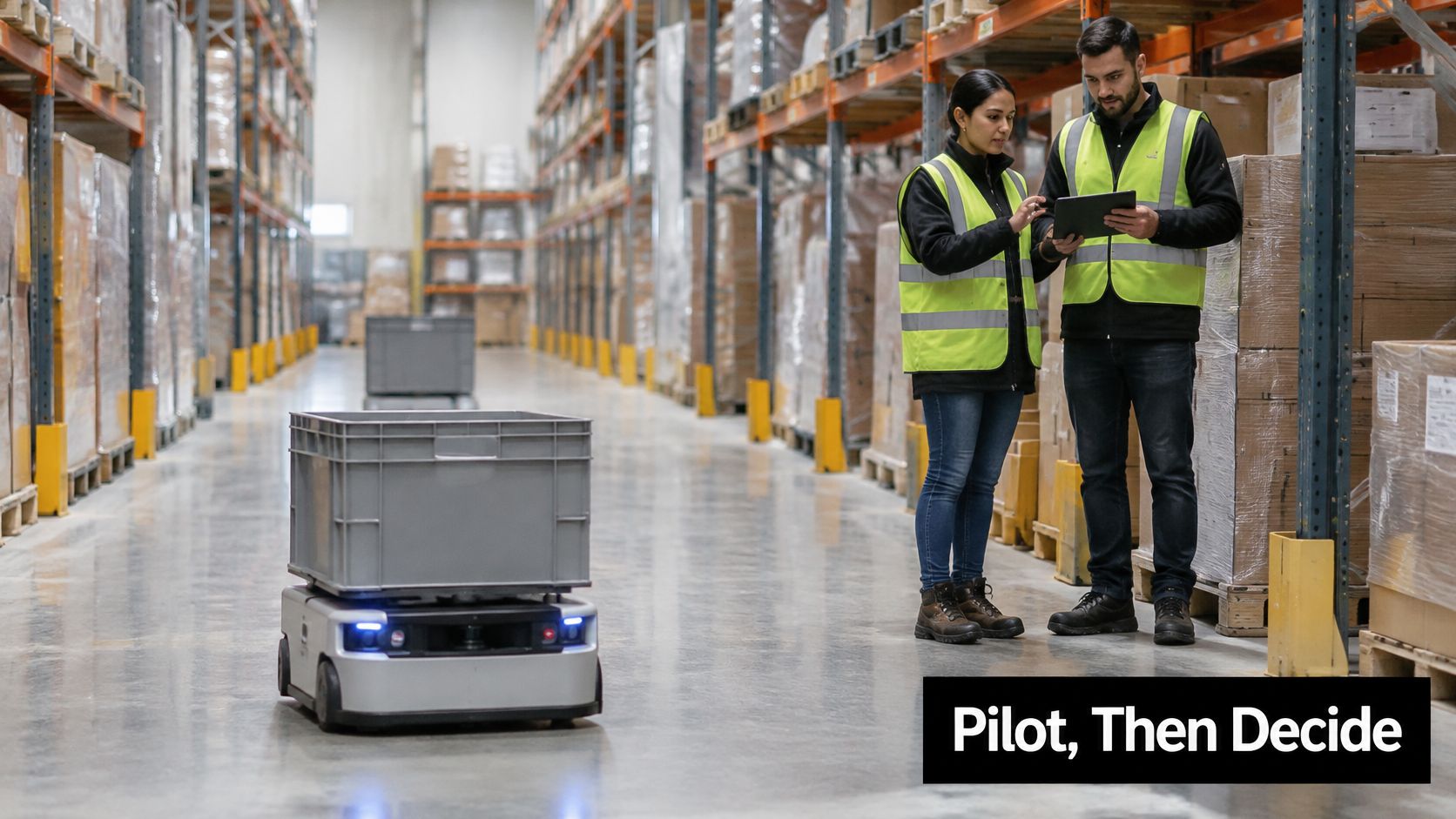
The study also found that 81% of agentic AI applications produced at least moderate improvement in their target metrics, while 36% delivered significant gains that were both quantified and documented. Those results make measurement a pilot requirement: define the baseline and the decision rule before the system acts.
What connected operations look like before the agent
An agent depends on reliable operational signals. Mobile apps Faberwork built for several large trucking concerns enhanced their operations by connecting dispatch and driver workflows. Faberwork also improved a fleet management company's geofencing applications. These are examples of connected operational data: a transfer decision is only as sound as the location, inventory and status records it can use.
Faberwork has also built an energy management system, iDDL logistics and mSFA sales automation. Together, these examples span operational and sales workflows. For a pilot, map where each relevant event is recorded, who owns the record, and how staff correct errors before granting an agent authority to act.
The short film below shows goods moving with a person still in the loop. Treat that as a design constraint, not as a picture of a finished dark warehouse.
A 90-day stock transfer pilot
Choose one repetitive, high-volume decision with a trusted baseline. Inter-location stock transfers are a practical candidate: the agent detects an imbalance, executes a transfer within set quantity and value limits, updates the record, and escalates unusual or high-value cases.
Run the pilot for 90 days against the pre-pilot baseline. Set go criteria in advance: orders per hour and task completion should improve against the baseline, while exception and override rates remain within agreed limits. Track resilience as well as labor savings: record feed gaps, reversals, delayed transfers and whether staff can keep the process running when automation is paused. These measures show whether the pilot reduces operational risk, rather than shifting work out of sight.
Set a no-go decision if overrides rise because the rule is wrong, event feeds are incomplete, or a bad write cannot be reversed. Assign one business owner to report results to the steering group. The steering meeting should decide against these criteria, not turn into a platform shortlist.
If you want the pilot designed around your warehouse and transport links, Faberwork can help scope a stock-transfer trial, including baseline measures, exception rules and the Snowflake history the agent will read. Bring orders-per-hour and override figures. The readiness question is whether the decision and operating model are stable enough to automate.


