
Before a single line of code is written, a software project’s fate is often sealed. Software project planning is the strategic blueprint that turns business goals into technical reality. It defines objectives, scope, timelines, and resources to ensure the final product delivers tangible value.
Why Traditional Planning Fails Modern Software Projects

Today's enterprise software projects are complex, but many organizations still use rigid, waterfall-style planning. These outdated methods can't handle the dynamic requirements of modern development, such as building an Agentic AI solution or a scalable Snowflake data platform. These projects demand an upfront understanding of data governance, infrastructure scaling, and API integrations. When these architectural decisions are deferred, the project starts on a weak foundation.
The Real Cost of Flawed Planning
Poor planning directly impacts the bottom line. It's the primary reason projects fail, with 39% of all failures traced back to inadequate planning. Furthermore, 55% of project managers cite poor planning as the cause of budget overruns.
A flawed plan creates a domino effect. Unclear scope leads to constant requirement changes, causing development rework, team burnout, and a final product that fails to meet the core business need.
Use Case: The Misaligned Fleet Management App
A logistics company invested heavily in a new fleet management app. Because the operations team and developers didn't align on core problems early on, the final product had impressive features but couldn't solve basic routing challenges. The outcome was a total write-off of the investment.
Common Planning Pitfalls and Their Business Impact
Planning PitfallCommon SymptomBusiness OutcomeVague or "Moving Target" ScopeFrequent requests for "just one more feature."Scope creep that blows budgets and misses deadlines.Ignoring Technical ArchitectureThe team hits a major scaling wall six months in, requiring a costly re-platform.Massive delays, unforeseen costs, and potential for complete project failure.Lack of Stakeholder AlignmentThe sales team sees the final product and says, "This isn't what we needed."Low user adoption and wasted development resources on the wrong problem.Unrealistic TimelinesDevelopers are overworked from week two just to keep up.Team burnout, poor code quality, and high employee turnover.
A plan that only exists on paper is a recipe for disaster.
Moving Beyond Task Management
Successful software project planning shifts the focus from managing tasks to delivering tangible outcomes. A good plan is a living, strategic framework that guides the team while remaining flexible enough to adapt.
This requires getting three things right from the start:
- Deep Stakeholder Alignment: Get universal agreement on what a "successful" outcome looks like.
- Realistic Scoping: Define what will be built and, just as importantly, what will not be built.
- Architectural Foresight: Make major technical decisions early to ensure the system can scale and perform long-term.
To understand how these pieces fit into the larger process, reviewing a complete guide to software development lifecycle phases provides a valuable framework.
Aligning Stakeholders and Defining Success Metrics
A project’s success is often determined by early stakeholder alignment. The goal is to translate vague business hopes into a unified, concrete vision. Effective software project planning focuses on understanding why stakeholders are asking for something, not just what they want. This ensures you build software that moves the needle for the business.
Uncovering The Real Business Drivers
Stakeholder interviews should uncover the core business drivers behind a project. Ask open-ended questions that focus on outcomes, not features, to reframe the conversation from a technical wishlist to a strategic planning session.
Use Case: Customer Data Platform
The marketing team requests a new Customer Data Platform (CDP). Instead of discussing technical specs, a project manager should ask:
- "What specific business challenge will the CDP solve?"
- "If this project is a success in one year, what key metric on your dashboard will have improved?"
- "Which decision-making process is currently broken that this platform will fix?"
These questions might reveal the true goal: reducing customer churn by 15% through better personalization. This specific, measurable target becomes the project's focus.
A project without a shared vision is like a ship without a rudder. Everyone rows hard, but in different directions, leading to wasted effort and an unintended destination.
Crafting Your North Star: The Project Charter
A Project Charter solidifies these core drivers. It's a concise summary that serves as the project’s north star, keeping everyone aligned on strategic goals.
A solid Project Charter includes:
- The Business Problem: A one-sentence summary of the pain point.
- Tangible Business Goals: Specific, measurable outcomes (e.g., "Increase user engagement by 25%").
- Key Performance Indicators (KPIs): The metrics used to track progress toward goals.
- High-Level Scope: A clear definition of what is in and out of scope to prevent future misunderstandings.
This document becomes the source of truth for evaluating new requests.
Clarifying Roles With a RACI Matrix
A RACI (Responsible, Accountable, Consulted, Informed) matrix eliminates confusion over ownership. It maps out roles for every major task, ensuring clear lines of communication and decision-making.
The roles are:
- Responsible: The person or team doing the work.
- Accountable: The single individual who owns the final outcome.
- Consulted: Subject matter experts providing input.
- Informed: People kept up-to-date on progress.
Defining these roles early prevents delays and ensures that when a decision is needed, everyone knows who has the final say.
Translating Business Needs Into Technical Blueprints
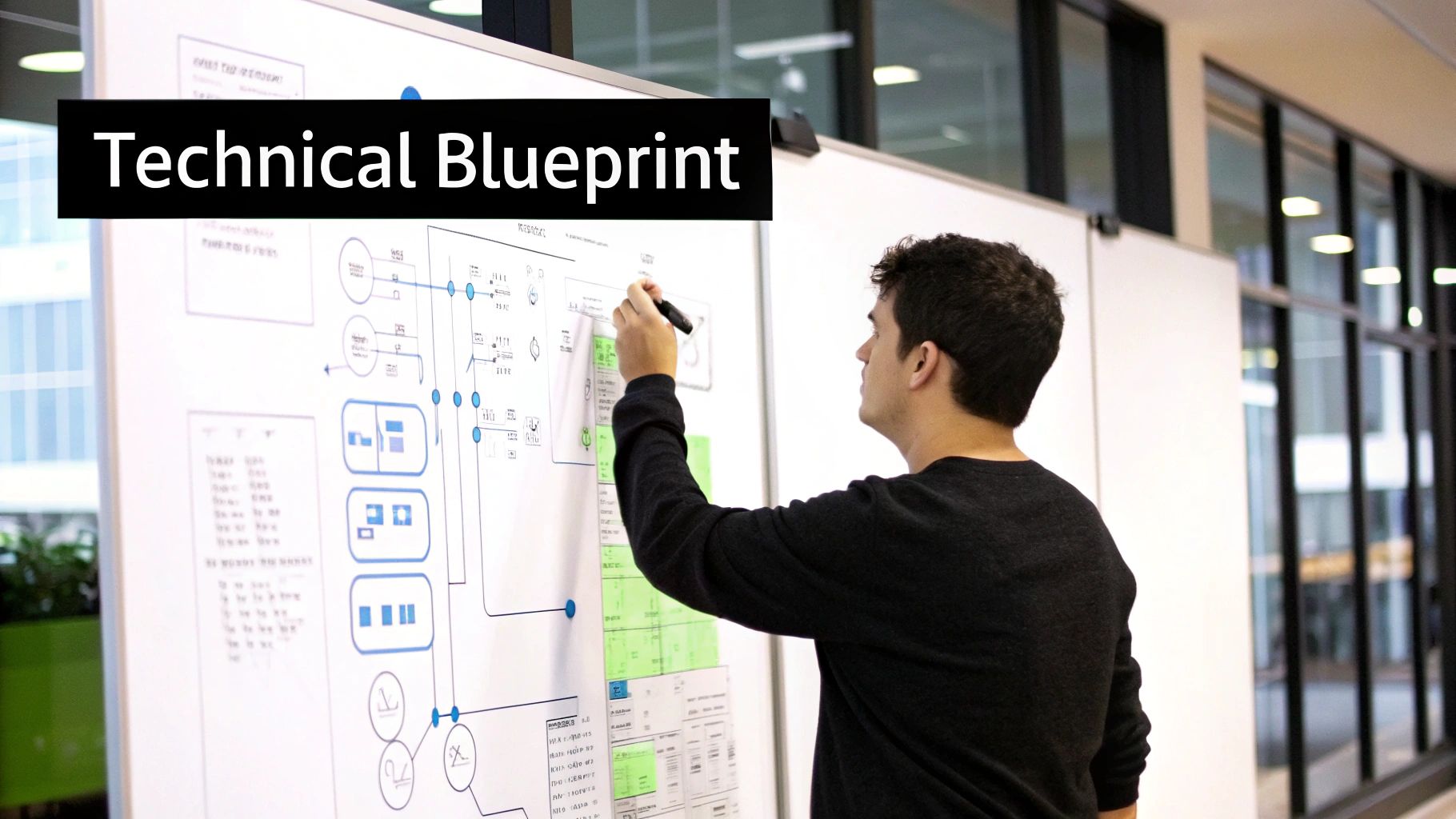
This stage translates the "why" into the "what" and "how." A successful software project plan hinges on turning business goals into a detailed technical blueprint that engineers can execute. This process begins with a clear distinction between the system's features and its performance.
Functional vs Non-Functional Needs
Every software project has two types of requirements that must be defined early.
- Functional Requirements: Define what the system does. These are specific user actions, like "A user must be able to filter the dashboard by date range."
- Non-Functional Requirements (NFRs): Define how well the system performs. These cover quality attributes like speed ("The dashboard must load in under two seconds"), security ("All data must be encrypted at rest"), and scale ("The system must support 10,000 concurrent users").
Ignoring NFRs is a critical error. A feature-rich system that is slow or insecure is a failure.
From Requirements to a Prioritized Backlog
User stories reframe requirements from the end-user’s perspective, typically using the format: "As a [user type], I want [an action] so that [a benefit]." This keeps the team focused on delivering value.
These stories are organized into a product backlog—a master list of all work, ranked by priority. The most impactful items are placed at the top. For more guidance, explore how to write product requirements that get results.
An unprioritized backlog is just a wish list. A well-prioritized backlog is a strategic roadmap ensuring your team is always working on the most important thing first.
Modern Architectural Decisions in Practice
Early architectural decisions have massive downstream effects on scalability, performance, and cost. Visualizing this structure is key; a guide on wireframes and the path from concept to completion can help.
Use Case: Designing an AI-Powered Logistics Optimization Engine
Scenario A: Snowflake Data Foundation
To analyze fleet data for route optimization using Snowflake, you must answer critical questions upfront:
- Data Ingestion: How will real-time data from truck sensors stream into Snowflake?
- Data Governance: How will column-level security be implemented to protect sensitive driver data?
- Cost Management: How will virtual warehouses be configured to separate workloads and manage costs effectively?
Answering these questions early prevents expensive re-architecting later.
Scenario B: An Agentic AI Solution
If the engine uses an Agentic AI model for autonomous rerouting, the infrastructure planning is different:
- Compute Power: What are the latency requirements for real-time decisions, and what cloud GPU setup is needed?
- Model Observability: How will AI decisions be monitored for drift, with a human-in-the-loop review process?
- API Design: How will the AI agent deliver optimized routes to other systems without creating bottlenecks?
These architectural choices are a core part of software project planning, turning a business idea into a robust, scalable technical reality.
A realistic timeline is a strategic forecast based on complexity, team capacity, and potential roadblocks. The goal is to create a project roadmap with achievable milestones. This requires breaking down work, estimating effort, and assigning the right people to the right tasks. Get this right, and you build trust and predictability.
Demystifying Estimation Techniques
Accurate forecasting can be achieved with proven estimation techniques.
- T-Shirt Sizing (XS, S, M, L, XL): Ideal for early-stage planning to gauge the relative size and complexity of major features or epics.
- Story Points (Fibonacci Sequence): Used in sprint planning, teams assign points (1, 2, 3, 5, 8, 13) to user stories based on complexity, risk, and effort.
By tracking team velocity—the average number of story points completed per sprint—you can reliably predict how long it will take to clear the backlog.
Assembling Your A-Team
A plan is worthless without the right people. Building a team means strategically matching skills to the project's technical needs.
Use Case: Building a Snowflake Data Platform
To create a data analytics platform on Snowflake, your resource plan needs specific roles:
- SnowPro Certified Data Architect: To design data models and overall architecture.
- Data Engineer (ETL/ELT Specialist): To build data pipelines.
- BI Developer (Tableau/Power BI): To create dashboards that turn data into insights.
- QA Automation Engineer: To build tests ensuring data accuracy and pipeline stability.
Failing to staff any of these roles creates a bottleneck that puts the project's success at risk.
A classic mistake is underestimating dependencies between teams. If the mobile app team is blocked until the backend team delivers an API, that API delivery date is a critical, high-priority milestone.
The Strategic Value of Buffer Time
No project plan is perfect. Unexpected issues will arise. Building a 15-20% buffer into your timeline isn't padding; it's a strategic contingency that allows the plan to absorb shocks without breaking. This buffer provides breathing room to handle challenges, conduct robust testing, or manage minor scope changes, transforming a fragile plan into a resilient one.
Integrating Risk Management and Compliance
Effective planning anticipates what can go wrong. Proactive risk management is the firewall that protects a project from unforeseen trouble. The goal is to identify, assess, and mitigate potential threats before they impact the timeline and budget. This requires a culture where team members feel safe flagging problems early.
Identifying and Assessing Potential Threats
Begin with a brainstorming session involving the entire team to identify potential risks across key areas:
- Technical Risks: Will a third-party API be reliable? Can the database handle the projected load?
- Resource Risks: What if a key team member leaves?
- Scope Risks: How likely are major change requests after development starts?
- External Risks: Could new data privacy laws affect the compliance strategy?
Score each risk based on its likelihood and impact. This matrix highlights where to focus your mitigation efforts.
A common mistake is focusing only on technical risks. A project is just as likely to be derailed by communication breakdowns or team burnout.
The Role of a Centralized Risk Register
A Risk Register is a living document that tracks every identified threat and its mitigation plan. It should be reviewed in every major project meeting. This register transforms abstract risks into manageable problems with pre-defined solutions. As you learn about managing technical debt in risk control, you can integrate those strategies directly into your plan.
Use Case: Sample Risk Register for a Snowflake Data Platform Project
Risk CategoryRisk DescriptionLikelihood (1-5)Impact (1-5)Mitigation StrategyTechnicalSnowflake query performance degrades under peak IoT data ingestion, causing dashboard latency.35Conduct performance testing with simulated peak loads. Pre-optimize warehouse sizing and query structure.SecurityA data breach exposes sensitive customer PII stored in the data warehouse.25Implement column-level security and dynamic data masking in Snowflake. Conduct a third-party security audit before launch.ResourceThe sole SnowPro Certified Architect resigns, creating a critical knowledge gap.24Document all key architectural decisions. Cross-train at least one other senior engineer on the core Snowflake design.
Integrating Compliance from Day One
In regulated industries like finance or healthcare, compliance cannot be an afterthought. It must be integrated into project milestones from the beginning. For example, a healthcare app requires a formal HIPAA compliance review as a deliverable for any milestone involving patient data. This approach ensures the final product is secure, functional, and legally sound.
Turning Your Software Project Plan Into Action
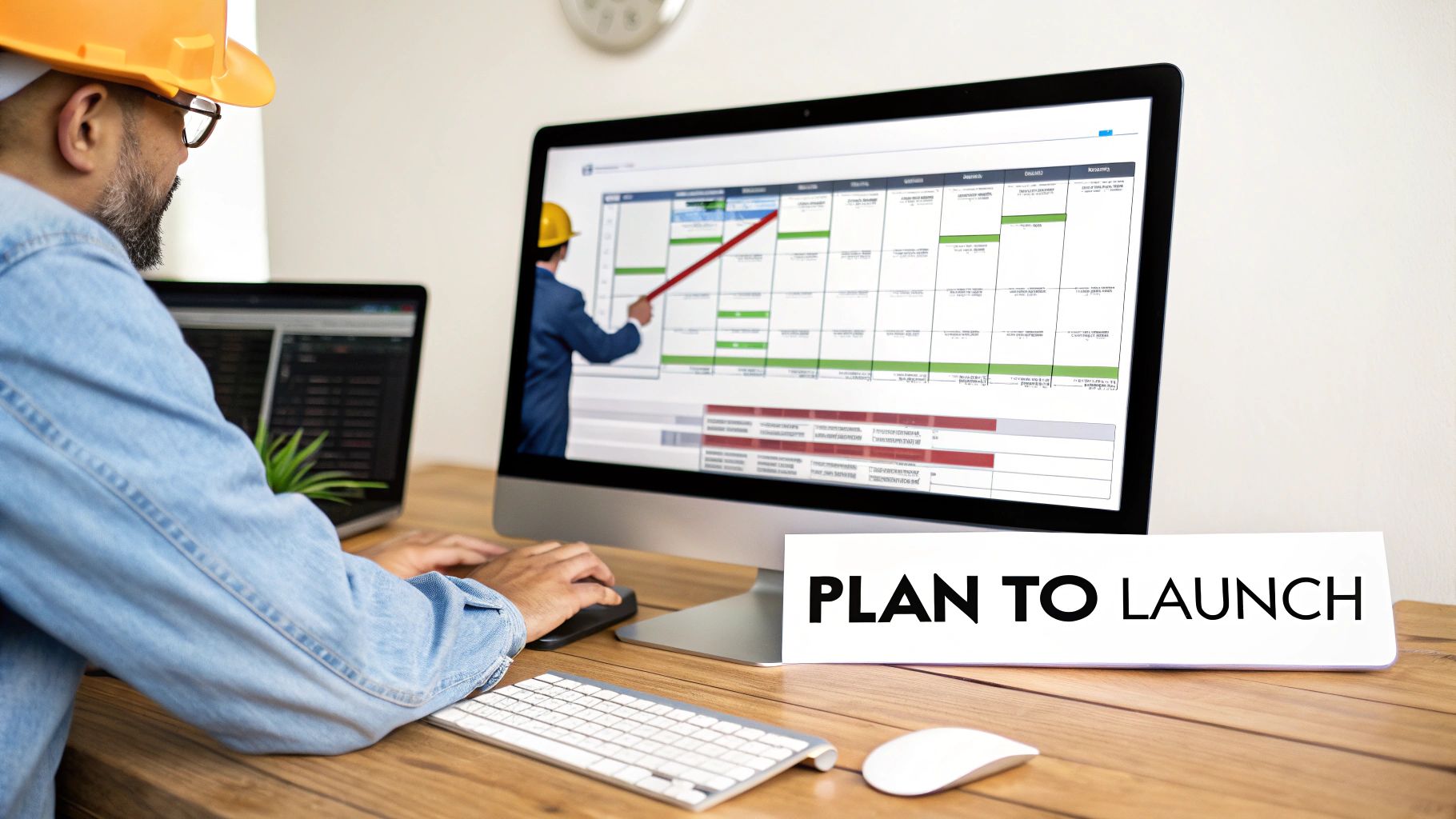
Execution turns a plan into a product. This phase shifts the focus from "what" and "why" to the "how" of building, testing, and shipping. The global project management software market, which hit USD 7.38 billion in 2023, is projected to exceed USD 17 billion by 2030. You can review the project management software market size to see how critical execution frameworks have become.
From Development to Deployment
A Continuous Integration/Continuous Deployment (CI/CD) pipeline is essential for a smooth handoff from development to operations. It automates the build, test, and release process, ensuring all new code is validated before reaching users.
Once the software is live, post-launch monitoring provides critical feedback.
A project isn't "done" at deployment. True success is measured by the software's stability and performance in the hands of real users.
A solid plan includes tools and protocols for tracking application performance, error rates, and infrastructure health. This feedback loop enables proactive issue resolution and informs the future product roadmap, ensuring the software delivers long-term value. This playbook provides an enterprise-grade framework for predictable, transparent, and successful delivery.
Frequently Asked Questions
A rigid planning process is ineffective. This playbook is designed to be methodology-agnostic, providing a strategic foundation for both Agile and Waterfall projects. Your approach should adapt to your team, not the other way around.
How Does This Planning Process Work with Agile Methods?
For Agile teams, the initial planning stages—stakeholder alignment, success definition, and high-level architecture—establish the product vision and initial backlog. These steps define the "why" and "what" before development begins.
Once sprints start, daily estimation and scheduling become more fluid. However, core principles like architectural foresight and risk management remain relevant throughout the lifecycle, ensuring each sprint contributes to the strategic goal.
A good upfront plan provides an Agile team with a clear destination, while sprints offer the flexibility to find the best path to get there.
What Are the Most Important Metrics for Project Success?
Beyond being "on time and on budget," true success metrics connect technical work to business impact.
Prioritize tracking indicators like:
- Business Value Delivered: Did a new feature drive a 10% revenue increase? Did an automation project cut operational costs by 20%?
- User Satisfaction: Use Net Promoter Score (NPS) or Customer Satisfaction (CSAT) to measure the user experience.
- Cycle Time: Track the time from idea to deployment. Shorter cycle times indicate an efficient development process.
How Do You Estimate Projects with New Technology Like AI?
Estimating projects with new technologies like Agentic AI is challenging due to the many unknowns. Traditional models often fail. The best approach is a time-boxed proof of concept (PoC) or technical "spike."
Allocate a short, fixed period—typically two to four weeks—for the team to explore the technology. The goal is to answer feasibility questions and learn, not to ship a polished feature. The insights gained from the PoC provide the concrete data needed to create a more reliable and defensible estimate for the full implementation.


