
The Snowflake data warehouse architecture is built on a powerful cloud-native concept: it separates data storage from computing power. This design means you can scale each independently, paying only for what you use while achieving blazing-fast performance, even with numerous simultaneous users. The direct outcome is a highly efficient, cost-effective data platform that adapts to your business needs.
Why Snowflake's Architecture Is a Game-Changer
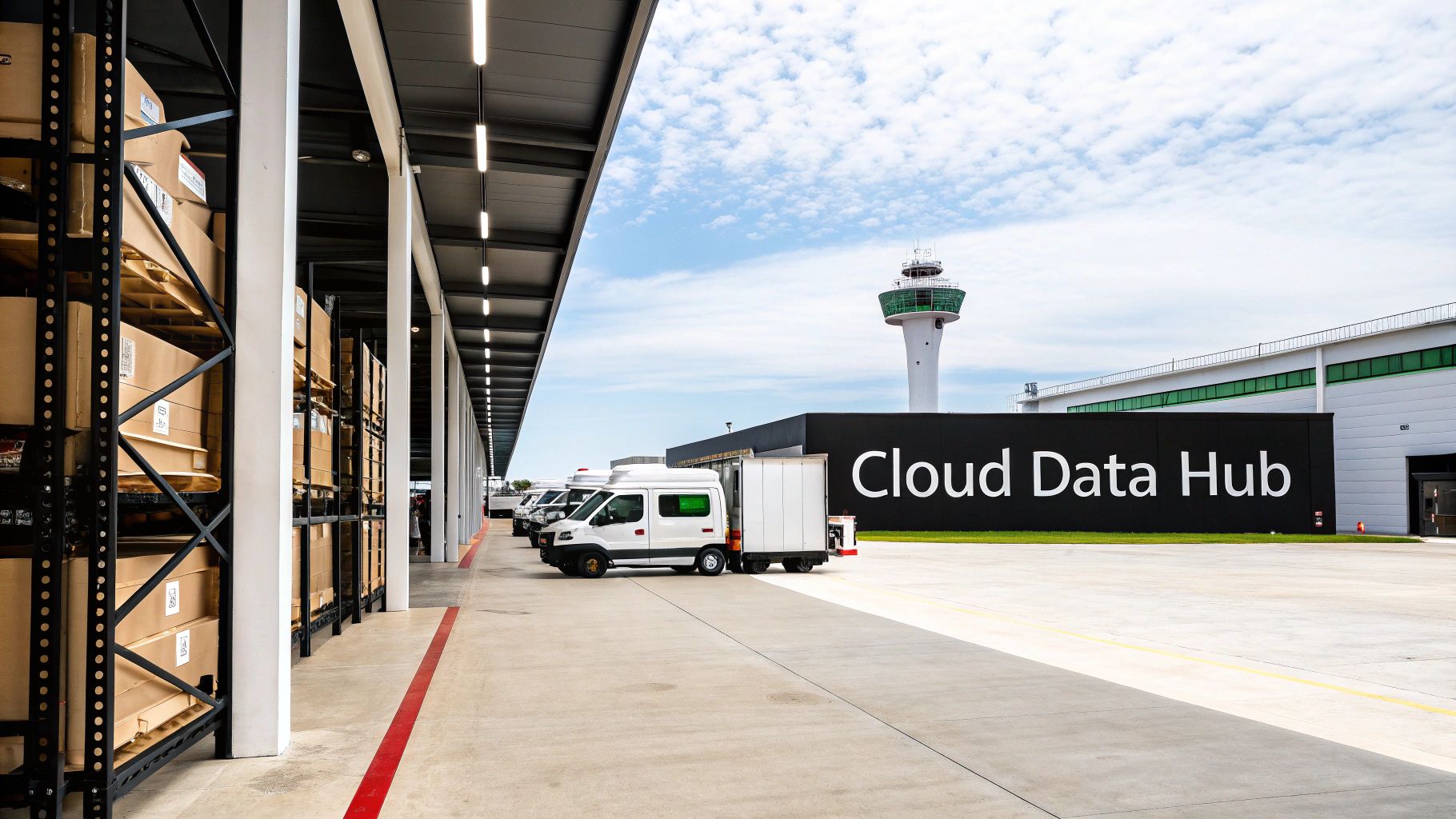
Imagine a modern logistics hub where the warehouse (storage), delivery fleet (compute), and control tower (management) are separate but perfectly coordinated units. This is the essence of the Snowflake data warehouse architecture. It’s constructed on three distinct, decoupled layers that deliver flexibility and speed traditional systems can't match.
Unlike legacy platforms that bundle storage and compute, Snowflake splits them apart. This fundamental design shifts data management from rigid, expensive infrastructure to a dynamic, on-demand model with clear business outcomes.
The Core Principle: Decoupled Resources
The key benefit of this architecture is workload isolation, which eliminates performance bottlenecks. Different teams can run intensive operations simultaneously without competing for resources.
Here are some real-world use cases:
- Data science teams can train complex machine learning models without slowing down other operations.
- BI analysts can run intricate dashboards for executives at the same time.
- ETL/ELT pipelines can load massive volumes of new data into the warehouse without interruption.
Each task uses a dedicated compute cluster (a "virtual warehouse"). A sudden spike in one activity, like a massive data load, won't impact critical business reporting.
This separation is the key to both performance and cost-efficiency. You can spin up a compute cluster for a demanding job and then scale it down to zero when finished, ensuring you never pay for idle capacity.
Built for the Modern Cloud
Snowflake's architecture is cloud-agnostic, a major reason for its leadership position in the cloud data market. Current statistics show Snowflake holds about 20.26% market share, surpassing competitors like Amazon Redshift and Google BigQuery.
By running seamlessly on AWS, Microsoft Azure, and Google Cloud, it gives organizations the freedom to operate without vendor lock-in. You can find more insights about Snowflake's market position and its strategic advantages online.
This architectural approach delivers measurable benefits: faster insights from uninterrupted queries and a lower total cost of ownership since you only pay for the compute resources you consume. The result is a data platform that adapts to your needs, not the other way around.
Understanding Snowflake's Three Architectural Layers

The unique three-layer design of the Snowflake data warehouse architecture is what delivers its impressive performance and efficiency. Each component operates independently but works in perfect sync, allowing multiple teams to work concurrently without interference while keeping costs under control.
Let's examine how each layer contributes to these outcomes.
The Foundation: Centralized Data Storage
The data storage layer is a massive, infinitely expandable repository for all your company's information. When you load data into Snowflake—from structured SQL tables to semi-structured JSON files—it is automatically compressed, encrypted, and organized into optimized micro-partitions.
This process happens behind the scenes, storing all data efficiently in a columnar format that makes queries incredibly fast. Because this storage layer is completely separate, you can grow your data to petabytes without being forced to pay for more computing power.
The Engine: Multi-Cluster Compute
The compute layer provides the processing power for all data-crunching tasks. Instead of a single, fixed-size server, Snowflake uses independent compute clusters called Virtual Warehouses. These are on-demand engines you can activate and size for specific jobs.
For instance, a small virtual warehouse can handle routine data cleanup, while a massive one can be instantly provisioned for a complex data science model and then shut down immediately after use.
The biggest outcome here is workload isolation. Your data loading (ETL) jobs can run on their own virtual warehouse while your business intelligence team runs complex reports on another. Neither slows the other down, eliminating the resource bottlenecks that plague traditional systems.
This complete separation of compute and storage is Snowflake's defining feature. It combines the best of shared-disk and shared-nothing architectures for maximum scalability, as detailed in this overview of Snowflake's hybrid design from Aegis Softtech.
The Brain: Cloud Services
The Cloud Services layer is the "air traffic control" of the entire platform, coordinating everything transparently in the background. It is the intelligence behind the Snowflake data warehouse architecture.
When you run a query, this layer handles:
- Authentication: Verifying your identity and access permissions.
- Query Optimization: Analyzing your query to find the fastest way to retrieve data.
- Infrastructure Management: Managing metadata and ensuring virtual warehouses run smoothly.
- Transaction Management: Protecting data integrity and ensuring operational consistency.
This layer automates complex management tasks, making Snowflake feel effortless to use.
A Quick Look at Snowflake's Architecture Layers
Architectural LayerCore FunctionPrimary OutcomeData StorageStores all data in an optimized, compressed, and columnar format.Infinite, low-cost scalability. Pay only for storage used, independent of compute.Compute (Virtual Warehouses)Provides dedicated, on-demand processing power for queries and data loading.No resource contention. Teams work simultaneously without impacting each other's performance.Cloud ServicesManages and coordinates the entire system, from security to query optimization.A simple user experience that automates complex data management, allowing teams to focus on insights.
The cloud services layer handles the complexity, letting your teams focus on what matters most: deriving value from your data.
How Businesses Use Snowflake's Architecture

Understanding the theory behind the Snowflake data warehouse architecture is one thing; seeing it drive business results is another. The platform's decoupled design is a powerful engine for solving real-world challenges, from optimizing supply chains to accelerating medical research.
The key is workload separation, which allows different teams to operate at full capacity without impacting one another. Here are a few use cases illustrating this in action.
Logistics and Real-Time Supply Chain Visibility
In logistics, timely information is critical. Companies need a live view of their supply chain, but streaming massive amounts of data can easily overwhelm the analytics dashboards managers rely on. Snowflake’s architecture solves this.
A logistics company can set up separate virtual warehouses for specific jobs:
- An ingestion warehouse runs 24/7, continuously loading tracking and inventory data.
- An analytics warehouse powers dashboards for the operations team, allowing them to query live data to optimize routes or predict delays.
The outcome is true real-time visibility. The data loading process is completely isolated from analysis, enabling managers to make instant decisions based on up-to-the-minute information.
Telecom and Predictive Churn Analysis
Telecommunications companies analyze vast amounts of Call Detail Records (CDRs) to predict which customers might leave. This churn analysis is computationally intensive.
With Snowflake, a telecom provider can spin up a massive virtual warehouse specifically for its data science team. This cluster can process terabytes of historical CDRs to train machine learning models that identify at-risk customers.
Once the model training is complete, the warehouse can be scaled down or shut off. The company pays for massive computing power only when needed, making large-scale analytics financially viable.
Energy and IoT-Driven Predictive Maintenance
The energy sector uses Internet of Things (IoT) sensors to monitor equipment like wind turbines and oil rigs. Analyzing this constant stream of data is key to predicting failures. The Snowflake data warehouse architecture is ideal for this scenario.
- Continuous Ingestion: A dedicated virtual warehouse handles the high-speed stream of sensor data.
- On-Demand Analytics: Engineers can instantly activate a separate, powerful warehouse to run predictive maintenance models on historical data.
- Cost Control: The analytics warehouse runs only when needed, dramatically reducing compute costs.
This separation enables energy companies to prevent expensive downtime while affordably managing huge volumes of IoT data.
Healthcare and Secure Clinical Research
Analyzing sensitive patient data for clinical trials requires strict privacy controls. Snowflake’s Secure Data Sharing feature lets organizations share data without physically moving it.
A research hospital can grant a pharmaceutical partner secure, read-only access to an anonymized dataset. The partner queries the data using their own virtual warehouse, ensuring their analysis has zero performance impact on the hospital's systems. The data never leaves the hospital's secure environment. For more information about how different industries are adopting these solutions, you can check out this guide on collaborating with Faberwork, a Snowflake partner.
Globally, Snowflake has become a major player, holding between 19.5% and 21% of the market share and serving over 3,000 corporate domains. Its strong adoption in sectors like finance and retail is driven by this need for secure, flexible analytics.
Choosing Your Data Ingestion and Modeling Strategy
The value of a data warehouse depends on how data is brought in and organized. With Snowflake, choosing the right ingestion and modeling strategies is the difference between sluggish queries and rapid insights.
Think of data ingestion as a shipping operation. A massive, planned shipment requires a different logistical approach than a constant stream of small packages.
Picking the Right Ingestion Method
For large, one-time data transfers like migrating historical sales records, bulk loading is the best approach. Snowflake’s COPY INTO command is designed to pull terabytes of data from a staging area, like an Amazon S3 bucket, at incredible speeds. It's ideal for initial migrations or large, infrequent updates.
For continuously generated data, Snowpipe provides an automated pipeline. It monitors your cloud storage and automatically loads new files into Snowflake within minutes. This is perfect for streaming data from IoT sensors, application logs, or website clickstreams, enabling near real-time analytics. Your dashboards can reflect events that happened moments ago, allowing for faster decision-making.
Structuring Data for Maximum Performance
Once data is in Snowflake, it needs to be modeled—organized in a way that’s easy to query. The star schema is a proven approach that organizes data into a central "fact" table surrounded by "dimension" tables.
- Fact Table: Contains core business metrics like sales totals or transaction counts.
- Dimension Tables: Provide descriptive context, such as customer details, product information, or store locations.
This structure is intuitive for analysts and performs exceptionally well for BI queries. However, Snowflake's architecture also offers powerful flexibility beyond traditional models.
Embracing Semi-Structured Data Natively
A key advantage of Snowflake is its native handling of semi-structured data like JSON, Avro, and Parquet. Historically, this data required complex transformations to fit into rigid columns. Snowflake eliminates this step.
You can load raw JSON directly into a VARIANT data type column and query its nested fields using simple SQL dot notation. This drastically simplifies the data engineering workflow. For example, a retailer can load raw JSON event data from its mobile app and immediately join it with structured sales data from its ERP system.
This capability is a game-changer for managing complex datasets from sources like IoT devices. We’ve seen this firsthand, and you can learn more about how Faberwork helps clients build powerful analytics platforms for time-series data with Snowflake. Combining the structure of a star schema with the flexibility of native JSON support creates a powerful and adaptable data model.
Optimizing Performance and Controlling Costs

The pay-as-you-go model of the Snowflake data warehouse architecture is powerful, but it requires smart management to prevent costs from spiraling. Effective cost control isn’t about limiting usage; it’s about ensuring every credit spent delivers value.
A well-run Snowflake environment is both fast and cost-effective. This requires a proactive strategy to align compute resources with business needs, ensuring you have enough power for critical tasks without paying for idle capacity.
Right-Sizing Your Virtual Warehouses
Using a single, oversized virtual warehouse for all tasks is inefficient and costly. The goal is to match the warehouse size to the workload complexity. For routine BI queries, a smaller X-Small or Small warehouse is often sufficient. For heavy data loading or complex analytics, you might temporarily scale up to a Large or X-Large warehouse.
A practical strategy is to create workload-specific warehouses:
- A dedicated warehouse for data loading (ETL/ELT) to isolate ingestion from analytics.
- A warehouse for BI and reporting, sized for typical user query loads.
- A warehouse for data science, which can be scaled up and down on demand.
This approach prevents a single demanding query from monopolizing resources and driving up costs.
Managing Concurrency and Preventing Runaway Bills
When many users query data simultaneously, performance can degrade. Instead of simply making a warehouse bigger (vertical scaling), Snowflake’s multi-cluster warehousing automatically adds new clusters to meet demand and removes them as it subsides (horizontal scaling).
For example, during month-end reporting, a multi-cluster warehouse can spin up extra clusters to ensure fast results for everyone. Once the peak period is over, it scales back down, instantly cutting costs.
Proactive cost control is essential. Use Snowflake's Resource Monitors to set credit quotas on warehouses or the entire account. These can automatically suspend activity or send alerts when a threshold is hit, preventing a single runaway query from draining your budget.
Tuning Queries for Peak Performance
Inefficient queries can burn through credits even with perfectly sized warehouses. Use the Query Profile tool to visualize a query's execution plan and identify bottlenecks like:
- "Exploding" Joins: Joins that create massive intermediate datasets.
- Full Table Scans: Queries that read an entire table instead of using micro-partition pruning.
- Inefficient Data Spilling: Processes that run out of memory and write temporary data to disk.
For frequently run, complex queries, Materialized Views can be a game-changer. These pre-computed views store query results, so data is returned almost instantly without re-computation. This dramatically reduces both query time and compute costs.
By combining smart resource management with targeted performance tuning, you can create a highly efficient Snowflake data warehouse architecture that delivers necessary insights without breaking the bank.
Your Top Questions About Snowflake's Architecture, Answered
As you explore the Snowflake data warehouse architecture, several key questions often arise. Understanding the specifics of its design clarifies why it has become a leading platform for modern data analytics. Here are straight answers to some of the most common inquiries.
We'll focus on what these architectural choices mean for your business outcomes, without the deep technical jargon.
How Is Snowflake’s Architecture Really Different From Traditional Data Warehouses?
The fundamental difference is resource management. Traditional data warehouses bundle compute and storage, forcing you to scale them together. This is inefficient—you might need more processing power for a query but not more storage, yet you pay for both. This model creates performance bottlenecks and inflates costs.
Snowflake’s architecture completely decouples them. This separation is its core advantage. It allows you to scale compute resources (virtual warehouses) independently from data storage.
For example, a retailer can use a massive virtual warehouse on Black Friday to analyze sales data. The next day, they can shrink that warehouse or turn it off completely. Their stored data and its cost remain unchanged. This elasticity provides superior performance, isolates workloads, and enables a more intelligent, cost-effective model.
Is Snowflake a Good Fit for Small Businesses?
Absolutely. While Snowflake offers immense power for large enterprises, its pay-as-you-go model is perfect for small and medium-sized businesses. The barrier to entry is extremely low, with almost no upfront cost. Data storage is inexpensive, and you only pay for compute credits when your virtual warehouses are running.
A small e-commerce startup can run its daily sales reports on an X-Small virtual warehouse, paying only for the few minutes it's active. For a more intensive quarterly analysis, they can instantly scale up the warehouse for a few hours and then scale it back down.
This on-demand model eliminates the need for large investments in hardware or software licenses. It levels the playing field, making enterprise-grade data analytics accessible and affordable for businesses of any size.
What Does "Cloud-Agnostic" Actually Mean for Snowflake?
"Cloud-agnostic" means Snowflake runs identically on all three major public clouds: Amazon Web Services (AWS), Microsoft Azure, and Google Cloud Platform (GCP). This provides incredible flexibility and prevents vendor lock-in.
If your company acquires a business that operates on a different cloud, integrating systems is not the technical and financial nightmare it would be with other platforms. With Snowflake, the user experience, features, and performance are consistent regardless of the underlying cloud provider.
This freedom allows you to:
- Choose the best cloud provider for your needs, pricing, or existing relationships.
- Implement a multi-cloud strategy with unified data in Snowflake.
- Migrate between clouds with minimal disruption if your business strategy changes.
This flexibility is a core tenet of the Snowflake data warehouse architecture, ensuring your data platform can adapt as your business evolves.
How Does Snowflake Deal With Data Like JSON?
Snowflake was designed to handle semi-structured data—like JSON, Avro, and Parquet—as a first-class citizen. This is a significant advantage over older systems that require you to flatten this data into rigid rows and columns before loading.
Snowflake uses a special data type called VARIANT, which allows you to ingest, store, and query semi-structured data natively without a predefined schema. You can load a JSON file directly into a VARIANT column.
Once loaded, you can use simple SQL dot notation to query nested fields and arrays as if they were standard columns. This radically simplifies data engineering for modern sources like APIs and IoT sensors. An analyst can directly query JSON data from a mobile app and join it to structured sales data in a single query, making complex data instantly accessible to anyone who knows SQL.


