
Software defects cost the U.S. economy an estimated $59.5 billion annually, about 0.6% of GDP at the time, according to a 2002 National Institute of Standards and Technology study. Users bore roughly 64% of that cost, while developers and vendors bore 36%. That split reframes professional software design: poor engineering isn't just an engineering expense. Customers and operators pay for it too.
Why Professional Software Design Pays Off
Say a logistics team needs to change a pricing rule. The implementation looks small, but pricing logic also lives in the driver app, invoicing service, and dispatch dashboard. Engineers coordinate a release, operators prepare workarounds, and an ordinary business adjustment becomes a weekend risk.
Another team makes the same change behind a stable interface, checks its behavior automatically, and releases it without interrupting dispatch. Both teams can write code. Only the second has designed for the cost of changing it.
Finding a crack in a blueprint is cheaper than jacking up a finished building. Software has a similar problem: an incorrect assumption becomes harder to remove once customers, integrations, and operating procedures depend on it.
Design protects the business after launch
Professional software design is the set of decisions that keeps a system maintainable, scalable, usable, and tied to a business result after its first release.
Those decisions include where business rules live, who owns data, how failures appear, and how operators recover. They also include deciding what not to distribute. A modular application can be easier to operate than a collection of services that must always change together.
Investment test: Can the team change an important business rule safely, or does every change require an exceptional effort?
A feature-count dashboard won't answer that question. A useful review follows a real change from request through production, including testing, approvals, recovery preparation, and operator adoption.
For the operating habits that support this approach, Fivenines' DevOps team practices for 2026 offers a complementary resource. Use process guidance to assign ownership, not to substitute ceremony for evidence.
The practical deliverables are straightforward:
- An outcome scorecard that makes design weaknesses visible before a rewrite.
- Changeability practices and release targets that turn architectural claims into observable behavior.
- Operational use cases and agent controls that connect implementation choices to business constraints.
The payoff isn't a more impressive diagram. It's a system the business can keep changing without repeatedly interrupting the work it supports.
The Outcome Scorecard Leaders Can Use
Outcome scorecard for professional software design
OutcomeHealthy signalMeasure to watchCost when it slipsMaintainabilityA small change ships without a coordinated releaseShare of engineering time spent on rework and debtTechnical debt estimated at 21%–40% of total IT spending, according to Software Improvement Group's benchmarkingScalabilityPeak load stays inside the availability targetError budget remaining under peak trafficReleases pause and capacity work displaces featuresUsabilityA real role finishes the task without a workaroundSupport tickets and abandoned flows for that taskTraining, rework, and shadow processes growBusiness alignmentThe requirement maps to a test and a KPIKPI movement after release, not feature countFeatures ship that operations never useSecurity responseDetection and containment are designed inTime to identify and contain, and breach costIBM's 2025 breach research reported average costs of $5.52 million without extensive security AI and automation, versus $3.62 million with it
Score a live workflow, not an architecture presentation
Take a shipment-exception system. Dispatchers use it to resolve missed collections, customers check its status, and finance uses its records when issuing credits. Score each outcome as healthy, constrained, or unsafe, with evidence and a named owner.
Start with maintainability. Follow a recent exception-rule change through the code and deployment history. If unrelated teams had to synchronize releases, mark the boundary as constrained even if the code looks tidy.
For scalability, replay representative peak traffic and inspect the customer-visible result. A successful load test must preserve the agreed service behavior, not merely keep servers running while requests queue indefinitely.
Usability needs an actual dispatcher. Ask them to resolve an exception without coaching, then record where they leave the application, copy information, or ask a colleague for help. A polished screen can still conceal a broken workflow.
Business alignment comes next. Connect the exception requirement to an acceptance test and the sponsor's existing measure, such as cost per shipment. GoReplay's guide to moving beyond vanity engineering metrics is useful context for distinguishing delivery activity from operational improvement.
Turn the weakest outcome into an investment decision
For security response, inspect whether responders can identify the affected account, contain its access, and preserve evidence without improvisation. Treat the IBM comparison as a benchmark for judgment, not a forecast of what any particular organization will save.
Each proposed intervention should carry:
- A baseline: What currently happens, supported by tickets, telemetry, or observed work.
- A bounded change: The interface, workflow, or operational control being improved.
- A decision threshold: What evidence would justify continuing, changing direction, or stopping.
Don't average away an unsafe result. Strong usability doesn't compensate for uncontrolled access, and cheap infrastructure doesn't compensate for a workflow employees can't complete.
Score the current system before funding a rewrite. The strongest investment may be a narrow correction that removes a recurring constraint rather than a replacement program that delays every benefit until migration finishes.
Practices That Keep Systems Changeable
A changeable system needs explicit boundaries and tests that prove those boundaries hold. Begin with the workflow that scored poorly, then use these practices in order.
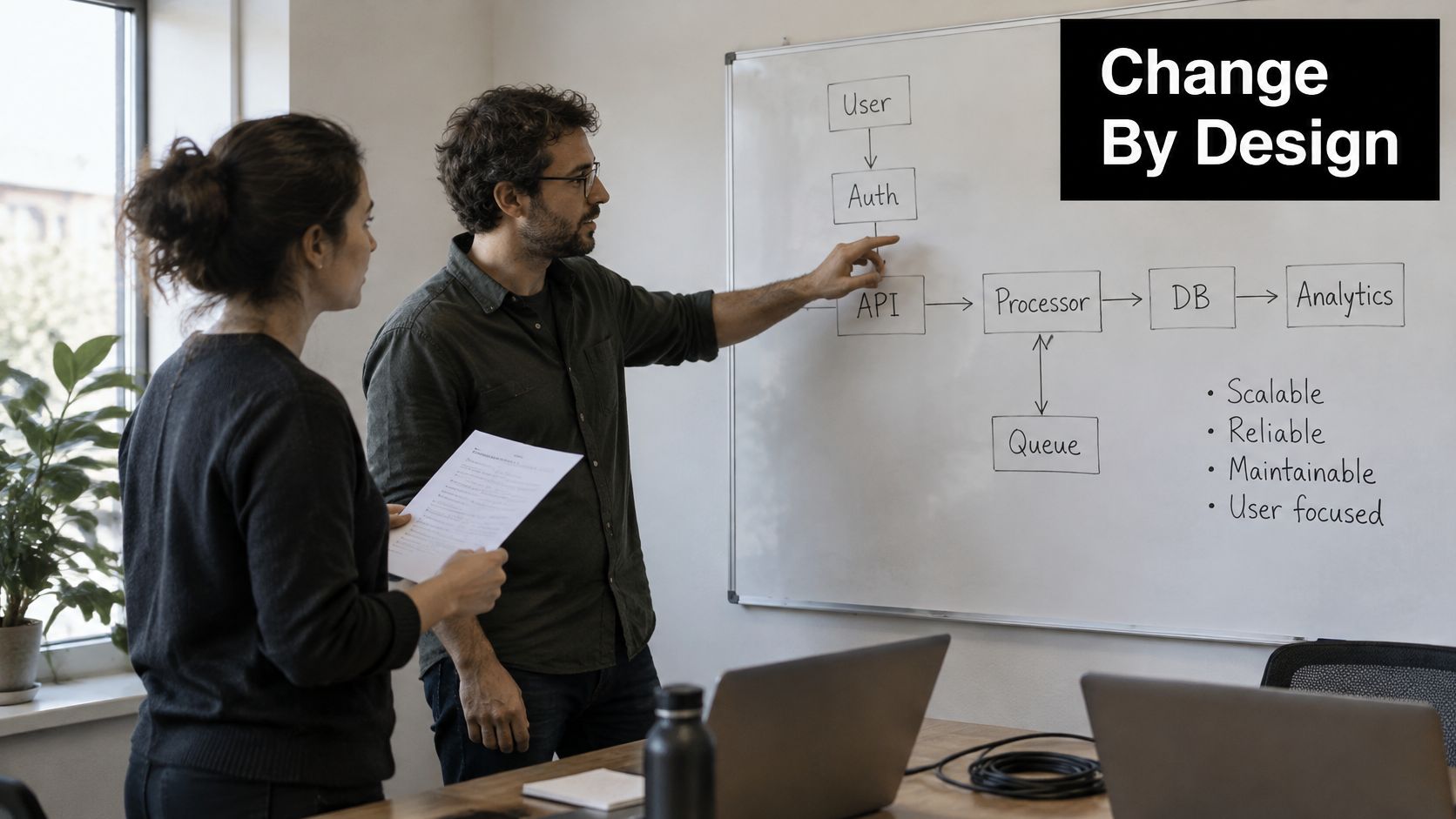
Establish behavior and ownership
- Write observable requirements before implementation. Replace “support flexible pricing” with a scenario: a dispatcher changes a surcharge, eligible shipments receive it, and existing invoices remain unchanged. Attach an acceptance test and connect the behavior to a business KPI. This prevents engineers and sponsors from accepting different interpretations of “done.”
- Make boundaries explicit and independently changeable. Keep data ownership, API schemas, security assumptions, and recovery instructions beside the code they govern. DORA's research program reports that user-centricity predicts 40% higher performance and that high-quality documentation amplifies technical capabilities. Clear interfaces are the streets in a city block: engineers should be able to rebuild a building without closing the neighborhood.
Independent deployment isn't a mandate to create microservices everywhere. If a small team owns a tightly connected workflow, modules inside a shared application may offer clearer ownership with less operational overhead.
Choose the smallest effective intervention
- Refactor when the change path is understood. Extract a business rule, remove a shared database dependency, or introduce a compatibility layer around a troublesome interface. Reserve a modular rewrite for a boundary that repeatedly blocks necessary changes and can be replaced without recreating the entire estate.
- Automate the regression set around that boundary. Include normal behavior, rejected inputs, authorization failures, and recovery after partial completion. The reason is practical: engineers need evidence on every change, not reassurance from a late testing phase.
- Review the workflow with the person doing the job. Watch a claims analyst resolve an exception or a plant operator record a failed check. Remove steps that exist only because they match the internal data model. Automated tests can confirm expected behavior while missing that the expected behavior is inconvenient.
Fund the practice that changes an unsafe outcome, not the practice that makes the architecture look fashionable.
We re-engineer older software and legacy systems to meet contemporary software designs, and we design new test cases and automate customer regression sets. Our expertise can affect a customer's process at any stage of the Software Development Life Cycle, so the intervention needn't begin with replacement.
If staffing is the constraint, resources such as Hire Developers can support the capacity discussion. Define the boundary, ownership, and acceptance evidence before adding implementation capacity.
Targets That Make Reliability Real
An availability objective of 99.9% over a 30-day month allows approximately 43.2 minutes of unavailability, as illustrated in Google's Site Reliability Engineering guidance. That allowance is an error budget. Unlike “high availability,” it gives engineering and business owners a concrete release control.
Reliability and release targets
TargetWhat it countsWeak bandStrong bandMonthly error budget at 99.9%Allowed unavailability over 30 daysBudget ignored and risky releases continueAbout 43.2 minutes, then reliability work comes firstChange failure rateDeployments that degrade service, cause an outage, require rollback, or need an emergency patchAbout 40%About 5%Recovery timeTime to restore service after a failed deployment1 week to 1 monthLess than 1 hour
The release-performance bands come from AWS guidance on measuring developer experience, which contrasts approximately 40% change failure and recovery taking one week to one month for low performers with approximately 5% change failure and recovery in less than one hour for elite performers.
Use the budget to make release decisions
Say a logistics platform enters its peak season. Engineers can continue routine route-rule releases while the service remains inside its budget. If an incident exhausts the allowance, they pause a risky pricing deployment and prioritize the failure mechanism.
That policy needs an owner and a precise definition of unavailable service. A healthy homepage doesn't prove dispatchers can assign routes. Measure the workflow customers and operators rely on, including critical dependencies.
The table is a control, not a leaderboard. Don't encourage teams to improve their category by relabeling emergency patches or excluding difficult services.
Release rule: When the service exhausts its error budget, pause risky changes until the team has addressed the reliability constraint.
Read delivery speed beside stability
DORA's metrics guidance treats change lead time, deployment frequency, failed-deployment recovery time, change-failure rate, and deployment rework rate as complementary signals. Deployment frequency tells you how often changes reach production; lead time tells you how long a code change takes to get there.
Collect these signals from version control, CI/CD, deployment records, and incident management. Segment them by service and change type so a fast-moving internal tool doesn't conceal a fragile customer workflow.
If release frequency improves while failures or recovery worsen, the team is transferring work to operations. Pause the troublesome class of change and inspect its boundary, test coverage, and rollback path.
The engineering consequences are concrete:
- Keep releases small: Limit the behavior changed so responders can identify and reverse it.
- Test recovery: Exercise rollback and confirm data compatibility, rather than assuming the previous application version will work.
- Expose release evidence: Put service health, remaining budget, and regression results where release owners make decisions.
For browser-facing workflows, browser testing using Wallaby provides a relevant example to examine when planning regression coverage. Select checks around the operator's critical journey, not merely the pages that are easiest to automate.
Use Cases Across Enterprise Operations
Enterprise design decisions become clearer when the sponsor names an operational constraint. These scenarios start with the work that must improve, not a preferred architecture.
Route planning illustrates why those boundaries matter.

Logistics and fleet operations
Outcome: A fleet operator needs to change a geofence or route rule without waiting for a map-service release and a driver-app update. The sponsor already reports on-time stops, so that is the business measure.
Design move: Separate rule publication from map rendering and mobile presentation. Version the rule contract, preserve compatibility with deployed apps, and let dispatchers preview affected routes before activation.
Result to watch: Track failed route updates and restoration time during peak operation alongside on-time stops. This proves the maintainability row only if the rule can ship independently without making dispatch less reliable. Limit the next build to that dependency rather than rebuilding the entire fleet application.
Healthcare or finance operations
A financial incident-response team needs a shorter incident, not another portal. Build account context, detection, monitoring, and controlled containment into the workflow responders already use.
The sponsor's measures are time to identify and contain and unresolved audit findings. Test whether responders can suspend access, preserve transaction evidence, and restore legitimate activity without losing the investigation trail.
That demonstrates the security-response outcome. Automation should handle explicitly authorized steps; ambiguous or consequential decisions should reach a responsible human.
Operational demonstrations should also be reviewed for their handoffs and recovery behavior.
Manufacturing and semiconductor workflows
Say engineers copy layout-check results between tools before approving production changes. The target outcome is a reproducible approval path with fewer manual handoffs, measured against the sponsor's existing cycle-time report.
Create a versioned pipeline that records inputs, runs regression checks, and preserves approval evidence before a change reaches the line. The business-alignment row improves only when operators stop maintaining a parallel spreadsheet.
We helped automate a semiconductor pipeline process with PCB layout using Python. That is a concrete application of designing around the handoff rather than replacing a screen.
Where shared operational data is the constraint, we customize systems to current customer demands using Snowflake's data warehousing capabilities. Keep that investment tied to the actual bottleneck, such as inconsistent quality records or delayed exception reporting, rather than treating a data platform as the outcome itself.
Governance Built Into Agentic Software
74% expected to deploy agentic AI within two years, but only 21% reported mature governance for autonomous agents, according to a Deloitte survey of 3,235 business and technology leaders across 24 countries. The deployment intention is a survey finding, not proof that those deployments will happen safely.
The fastest safe path is often a narrow agent, not an autonomous employee. A route-suggestion agent can provide useful assistance without gaining permission to dispatch crews or modify customer commitments.

Define authority before selecting autonomy
- Separate permitted actions from approval-required actions. Drafting a ticket or suggesting a route may proceed without approval. Moving money, changing a clinical order, or dispatching a crew should escalate to an authorized person. Enforce that distinction at the tool boundary, not only in the prompt.
- Make authority immediately revocable. Use the same identity and access controls that govern human users. Give the agent a distinct identity, narrowly scoped credentials, and a stop mechanism that prevents further actions even if a task is already underway.
- Preserve a reconstructable audit trail. Record relevant inputs, tool calls, policy checks, approvals, and resulting decisions. Protect sensitive information and define retention deliberately. A reviewer needs to understand what the agent was allowed to do and what happened.
- Test complete sequences before release. Script situations involving stale data, unavailable tools, conflicting instructions, duplicate requests, and revoked permission. Test compensation or rollback that restores data and workflow state, not merely a previous model prompt.
Make stopping part of the design
In healthcare, finance, energy, logistics, and telecom, an apparently correct recommendation can still trigger an unacceptable action. Model quality doesn't answer who authorized the action, whether the user had permission, or how operators recover.
An agent that can't be stopped fails maintainability and business alignment even if its demonstration looks advanced. Operators need a controlled handoff, a visible action history, and a known recovery procedure.
Autonomy is a permission decision before it is a model capability.
Tie the agent's scope to an operational KPI, such as exception-resolution time, while retaining explicit safety constraints. Don't reward faster completion if the agent bypasses approval or leaves records inconsistent.
Expand autonomy only after the narrow agent stays inside its error budget and its approval policy. Broader authority should follow demonstrated control, not enthusiasm after a successful demonstration.
Fund the Red Row First
Mark the scorecard with the people accountable for the workflow. Then fund the weakest outcome whose failure would block safe, useful operation. Don't spread the budget evenly across architectural improvements merely because each team has a reasonable request.
Match the intervention to the constraint
- If maintainability is red, isolate a troublesome change boundary and protect it with automated regression before committing to a larger feature program.
- If scalability or reliability is red, establish a service objective and release policy, then address the exhausted capacity or failure mechanism before adding risky changes.
- If usability is red, observe the operator completing the task and remove the workaround that creates the most rework.
- If security response is red, build detection and containment into the workflow rather than postponing the response design until after go-live.
- If business alignment is red, tie the next release to a KPI the operational sponsor already reports. Remove requirements nobody can connect to a useful result.
If an agent is planned, write its approval list before choosing the model. That makes authority a design input rather than an incident-response discovery.
Size discovery around a real decision
Bring the operator, service owner, engineering lead, and sponsor into a focused discovery discussion. Examine a recent change, a difficult exception, and the evidence that would demonstrate improvement. Leave with a bounded intervention and a named acceptance owner.
For legacy systems, managing technical debt in risk control offers relevant context for connecting remediation to operational exposure. A re-engineering slice may be enough when the current system can't change safely; an enterprise redesign is justified when the constraint crosses the portfolio.
We work closely with clients to understand their challenges and needs, then design and implement customized software for their specific requirements. We can also facilitate an enterprise-wide redesign for long-term growth when the problem extends beyond a single service.
Pick one system, score its outcomes, and identify the weakest row with your operational owner. Schedule a discovery discussion with Faberwork LLC around that constraint, bringing a recent change request, incident, or manual workaround. Use those artifacts to define the change you can validate within the next release cycle.


