
Predictive analytics in retail is the practice of using data, algorithms, and machine learning to forecast future outcomes. It’s how leading retailers move from reacting to past sales figures to proactively shaping their future. This guide illustrates how to use predictive analytics to achieve tangible business outcomes, from optimizing inventory to delivering hyper-personalized customer experiences.
The Shift from Reactive to Predictive Retail

For years, retail operated by looking in the rearview mirror, analyzing last quarter's sales to understand what happened. Predictive analytics changes the game by providing a forward-looking view. It's like upgrading from a simple map to a sophisticated GPS with live traffic and weather data, enabling smarter, proactive decisions that anticipate market shifts and customer needs.
From Hindsight to Foresight
Instead of just answering, "What did we sell?", predictive analytics addresses the critical questions: "What are customers likely to buy next?" and "Which customers might leave?" This shift is powered by analyzing vast datasets—including sales history, web traffic, social media trends, and even local weather forecasts—to uncover patterns that predict future behavior. The outcome is a direct, positive impact on the bottom line.
By anticipating a surge in demand for a specific product, a retailer can stock up to capitalize on the trend, preventing lost sales and gaining a competitive edge.
The Business Outcomes of a Proactive Stance
Adopting a predictive strategy delivers measurable value. Retailers using these capabilities see significant improvements across their operations. A report from McKinsey & Company highlights that businesses can increase profitability by up to 10%. For example, Target used demand forecasting to reduce out-of-stock incidents by 21% while cutting excess inventory costs by 15%. You can explore more details on how predictive analytics drives retail success.
A proactive approach delivers three key outcomes:
- Reduced Costs: Accurate demand forecasting means less overstock, fewer profit-killing markdowns, and lower inventory carrying costs.
- Increased Revenue: Having the right product in the right place at the right time directly prevents lost sales from stockouts.
- Enhanced Loyalty: Anticipating customer needs enables personalized offers and experiences that build lasting relationships.
Ultimately, predictive analytics in the retail industry is no longer a luxury but an essential tool for any retailer focused on growth and profitability.
Core Applications Driving Tangible Results
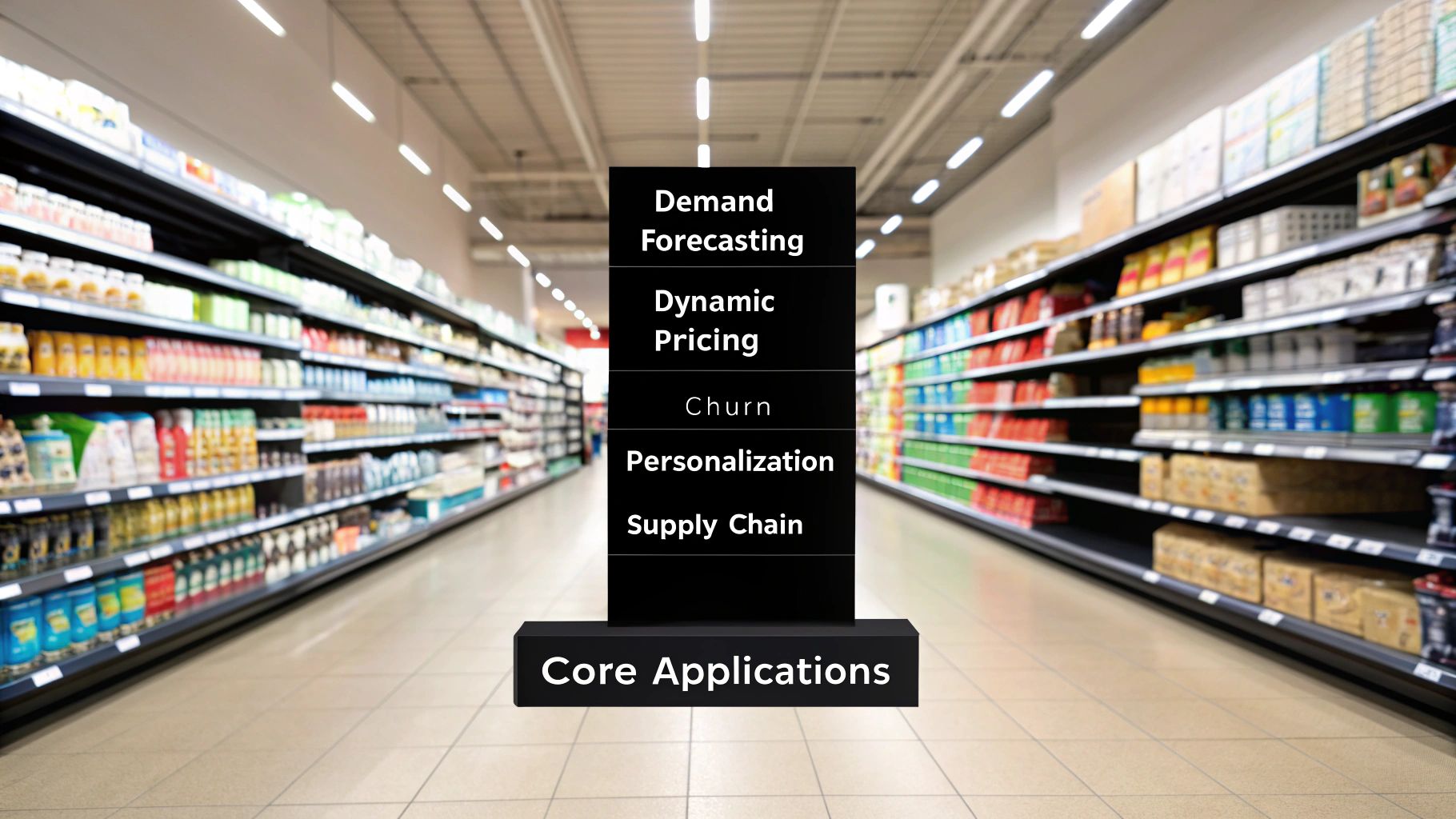
The true power of predictive analytics in the retail industry is demonstrated through its practical applications. These are not abstract concepts but targeted tools designed to solve long-standing retail challenges and deliver a measurable competitive advantage.
Accurate Demand Forecasting
Guesswork leads to costly overstocks and frustrating stockouts. Predictive demand forecasting replaces this uncertainty with data-driven precision. By analyzing historical sales, seasonality, and external factors like weather, retailers can optimize inventory, slash carrying costs, and prevent lost sales.
Dynamic Pricing Strategies
Static pricing leaves money on the table. Predictive analytics enables dynamic pricing, allowing prices to adjust in real-time based on competitor pricing, demand, and inventory levels. This strategy maximizes revenue and margin on every single item, whether it's raising the price during a demand surge or discounting slow-moving stock.
Use Case: A major electronics retailer uses dynamic pricing during holiday sales. By tracking competitor stock and web traffic, their system automatically adjusts prices on popular items. This led to a 7% increase in gross margin during their busiest season.
Proactive Customer Churn Prediction
Acquiring a new customer is far more expensive than retaining an existing one. Churn prediction models act as an early warning system, identifying customers showing signs of disengagement—like reduced purchase frequency or ignoring emails. Armed with this insight, retailers can launch targeted retention campaigns, such as special offers or personalized outreach, to keep valuable customers loyal. For a closer look, you can see how our work with time-series data with Snowflake builds the foundation for these kinds of powerful predictive models.
Hyper-Personalized Marketing
One-size-fits-all marketing is obsolete. Predictive analytics powers hyper-personalization by analyzing a customer's browsing habits and purchase history to predict their next likely purchase. This allows retailers to deliver timely, relevant offers that resonate with individual shoppers, boosting conversion rates and strengthening relationships. Retailers using this technology have seen an average sales increase of 10% and a 12% reduction in customer churn.
Supply Chain Optimization
A resilient supply chain is critical. Predictive analytics provides foresight into potential disruptions, allowing for optimized delivery routes, warehouse staffing, and inventory management based on future demand. The result is a more efficient, cost-effective supply chain that ensures products flow seamlessly from supplier to customer.
Here's a summary of how these use cases translate into business results.
Table: Predictive Analytics Use Cases and Their Business Impact
Use CaseBusiness OutcomeExample Metric ImprovementDemand ForecastingReduced stockouts and overstock, lower inventory costs15-30% reduction in inventory holding costsDynamic PricingIncreased revenue and profit margins2-5% increase in overall revenueChurn PredictionImproved customer retention and lifetime valueUp to a 15% reduction in customer churn ratePersonalized MarketingHigher conversion rates and campaign ROI10-20% uplift in marketing campaign response ratesSupply Chain OptimizationLower operational costs, faster delivery times5-10% reduction in transportation and logistics costs
Each application is tied to a clear, measurable improvement that directly impacts the bottom line.
Building Your Analytics Engine for Success

Accurate predictions are the output of a well-designed analytics engine—a technical foundation built to transform raw data into actionable insights. The goal is a reliable data pipeline that automates the collection, processing, and activation of data to fuel predictive models.
Gathering the Raw Ingredients for Insight
An analytics engine runs on data from all corners of the business. A strong platform must unify these streams to create a complete picture.
Key data sources include:
- Point-of-Sale (POS) Systems: Core transaction data for demand forecasting.
- E-commerce Platforms: Clickstream data for understanding online behavior.
- Customer Relationship Management (CRM) Tools: Customer profiles for personalization and churn prediction.
- Supply Chain and Inventory Systems: Logistics data for operational optimization.
Fusing these sources into a single view is the critical first step.
Understanding Batch vs. Real-Time Data
The speed at which you need insights determines your processing approach. Batch processing is like a daily sales report—ideal for strategic planning like monthly demand forecasting. Real-time processing is like a live stock ticker—essential for immediate actions like adjusting prices during a flash sale or showing a personalized offer to a website visitor. Most retailers use a hybrid approach, combining both methods for maximum impact.
The Power of a Centralized Data Platform
Managing multiple data sources requires a centralized data platform to act as a single source of truth. This is where data is stored, cleaned, and prepared for analysis, and where machine learning models are built and deployed.
Modern cloud platforms like Snowflake are designed for this purpose, offering the scalability to handle massive retail datasets. They break down data silos, enabling richer insights by combining previously separate information streams. A unified platform dramatically shortens the time it takes to get from raw data to a valuable business prediction.
To see how this works in practice, you can learn more about collaborating with Faberwork, a Snowflake partner. Such a partnership ensures your predictive analytics in the retail industry is built on a solid, scalable foundation.
Translating Analytics into Measurable ROI
An investment in predictive analytics is only valuable if it delivers measurable business results. The key is to connect every project directly to key performance indicators (KPIs) that matter to leadership, ensuring your analytics initiatives drive tangible growth.
Identifying KPIs That Drive Business Results
To prove the value of predictive analytics in the retail industry, focus on metrics that reflect operational improvements and financial gains. Translate technical wins into tangible business outcomes.
Essential KPIs include:
- Gross Margin Return on Investment (GMROI): Measures the profitability of your inventory. Improved demand forecasting directly boosts GMROI by reducing overstock.
- Customer Lifetime Value (CLV): Tracks the total revenue expected from a single customer. Churn prediction and personalization models are designed to increase this number.
- Markdown Rate Reduction: Monitors revenue lost to price cuts. Accurate forecasting minimizes the need for profit-eroding markdowns.
- Forecast Accuracy: A 10% improvement in forecast accuracy can lead to a 5% reduction in inventory costs and a 3% increase in sales by preventing stockouts.
Concrete ROI Examples in Retail
The financial upside of predictive analytics is well-documented. The market for predictive AI in retail is projected to grow by $8.3 billion between 2025 and 2029, underscoring its strategic importance. With over 60% of retailers already using these solutions, the pressure to adopt is mounting. You can find more details about the rapid growth of predictive AI in retail in this market report.
Let's look at real-world outcomes.
Use Case 1: Slashing Markdown Costs
A fashion retailer implemented a demand forecasting model incorporating sales data and social media trends. Outcome: They improved forecast accuracy by 25%, leading to a 20% reduction in markdown costs and adding $2.2 million to their annual profit.
Use Case 2: Boosting Customer Retention
An online subscription service used a churn prediction model to flag at-risk subscribers and trigger targeted retention offers. Outcome: They cut their monthly churn rate from 8% to 5.5%, which increased their average Customer Lifetime Value by 18%.
These examples show that successful analytics projects solve specific, costly business problems and deliver a clear return on investment.
A Practical Roadmap from Pilot to Full Scale
Adopting predictive analytics is a journey, not an overnight switch. A structured roadmap minimizes risk, builds momentum with early wins, and ensures the solution is integrated into daily operations. The key is to start small, prove the concept, and scale strategically.
Stage 1: Start with a High-Impact Business Problem
Resist the urge to solve everything at once. Instead, focus on a single, high-value business problem with a clear financial upside. For example, instead of a vague goal like "improve inventory," aim for a specific objective like, "reduce stockouts on our top 20 best-selling products by 15% in six months." This sharp focus makes success easy to measure.
Other strong starting points include:
- Reducing churn for a high-value customer segment.
- Improving forecast accuracy for a single, volatile product category.
- Optimizing markdown timing for seasonal items.
Stage 2: Assess Your Data Foundation
A predictive model is only as good as its data. Before starting, conduct an honest assessment of your data readiness. Ensure you have access to clean, reliable, and sufficient historical data for your chosen problem. For example, demand forecasting typically requires two to three years of consistent sales data. Addressing data quality gaps upfront is essential.
Stage 3: Launch a Focused Pilot Project
With a clear problem and solid data, launch a pilot project to prove the concept quickly. The goal is not to build a perfect system but to develop a core model that demonstrates value. During this phase, you will build a baseline model, measure its performance against current methods, and validate the results with business stakeholders.
A successful pilot serves as a powerful internal business case. Demonstrating that a model improved forecast accuracy by 25% in a controlled test makes securing buy-in and budget for scaling much easier.
Stage 4: Integrate and Scale Strategically
Once the pilot proves its value, integrate the model into daily operations so its predictions guide real business decisions. This is where the true value of predictive analytics in the retail industry is realized. After successful integration, you can scale the solution—for example, by expanding a forecasting model to an entire product category or applying a churn model across your entire customer base.
Navigating Common Implementation Pitfalls
Even with a solid plan, challenges can arise. Being aware of common pitfalls can help you avoid them. Many projects fail due to organizational hurdles or unclear goals, not technology.
Here's a guide to frequent mistakes and how to sidestep them.
Common Implementation Pitfalls and How to Avoid Them
Common PitfallWhy It HappensProactive SolutionUnclear Business GoalsThe project focuses on the tech ("let's use AI") instead of a specific business outcome.Define a measurable, high-impact business problem from day one (e.g., reduce stockouts by X%).Poor Data QualityThe team dives into model building without first cleaning and validating the underlying data.Conduct a thorough data readiness assessment before the pilot begins. Budget time for data cleansing.Lack of Team Buy-InBusiness users who will rely on the model's output aren't involved in the process.Involve key people from relevant departments (like merchandising or marketing) from the very start.Trying to Boil the OceanThe initial project scope is too broad, attempting to solve too many problems at once.Start with a tightly focused pilot project to prove value quickly before you try a large-scale rollout.
By following this roadmap, you can guide your organization from a simple idea to a fully scaled, value-generating predictive analytics capability.
Common Questions About Predictive Retail
As retail leaders explore predictive analytics, several key questions often arise. Addressing these directly can help demystify the process and build a confident strategy.
How Much Data Do We Really Need to Start?
You likely need less data than you think. You don't need a massive data warehouse to begin. The key is having enough clean, consistent historical data for your first specific problem. For a demand forecasting pilot, you typically need:
- Two to three years of sales transaction data to capture seasonality and trends.
- Basic product information (SKUs, categories, pricing).
- A promotional calendar to link sales spikes to marketing activities.
The focus should be on data quality, not sheer volume. A smaller, well-organized dataset is far more valuable for a pilot project than a massive data swamp.
What Skills Are Essential for Our Team?
An effective analytics team blends technical expertise with deep business knowledge. You don't need to hire a dozen data scientists immediately.
Key skills include:
- Data Engineering: To build the data pipelines that clean and organize data.
- Data Science / Analytics: To build the models and interpret the results.
- Business Acumen: The crucial ability to connect a model's output to a smart, real-world business decision.
Many retailers begin by partnering with an external expert to handle the technical aspects while developing their in-house talent.
Can Small and Mid-Sized Retailers Benefit?
Absolutely. Predictive analytics is no longer just for large corporations. Cloud platforms and user-friendly tools have made this technology accessible to businesses of all sizes. The key for smaller retailers is to be focused and practical.
Instead of a complete supply chain overhaul, a mid-sized retailer could start with a highly targeted project, such as building a churn prediction model for their top 5% of customers. Such a project can deliver a significant ROI without a massive upfront investment. The principles are the same regardless of scale; it's about applying them smartly.


