Imagine knowing not just what your customers bought last week, but what they’ll buy next week. That’s the core outcome of predictive analytics in retail. It’s a strategy that shifts businesses from reactive guesswork to proactive, data-informed growth.
Instead of relying on past sales reports—essentially driving while looking in the rearview mirror—retailers can now anticipate future trends, customer needs, and market shifts before they happen.
From Reactive Guesses to Proactive Growth
Predictive analyatics uses the data you already collect to build a forward-looking guide for your business. It’s about moving from reacting to the market to shaping your own success. This pivot enables smarter inventory management, personal marketing, and dynamic pricing that directly boosts the bottom line.

This data-driven approach is a necessity for staying competitive. The modern retail environment is too complex for traditional forecasting, which often relies on historical averages and gut feelings. These outdated methods can't keep up with sudden shifts in demand driven by a viral social media trend, a local event, or supply chain disruptions.
The Power of Forward-Looking Data
Predictive analytics in retail transforms scattered data into clear, actionable insights that help you forecast future customer behavior and optimize every corner of your operations. Leading retailers already depend on integrated models that combine sales history, customer interactions, and external factors like seasonality to answer critical questions.
These strategies enable precise inventory and pricing management, which boosts your return on investment and cuts down on wasted resources. You can explore more about the impact of retail predictive analytics on Shopify to see it in action.
By anticipating demand, retailers sidestep costly mistakes like overstocking winter coats during an unusually warm season or underpricing a hot item as demand spikes. This foresight leads to tangible, bottom-line results.
Predictive analytics introduces a powerful, data-driven alternative that uses advanced algorithms and machine learning to guide decision-making. The payoff? Higher margins, less waste, and stronger customer loyalty.
Key Outcomes for Your Business
When you put predictive models to work, you'll see measurable improvements across the retail value chain. Instead of analyzing what happened yesterday, you can influence what happens tomorrow.
- Improved Inventory Accuracy: Reduce costly overstocks and frustrating stockouts. Aligning inventory with forecasted demand cuts storage costs and prevents lost sales from empty shelves.
- Enhanced Customer Personalization: Deliver targeted promotions and product recommendations that resonate with individual shoppers, increasing conversions and customer lifetime value.
- Optimized Pricing Strategies: Adjust prices dynamically based on real-time demand, competitor pricing, and customer behavior to maximize profit margins on every sale.
- Stronger Customer Loyalty: Anticipating customers' needs creates a seamless shopping experience that encourages repeat business and builds lasting brand affinity.
To give you a clearer picture, here’s a quick rundown of the most common applications and how they translate into direct business value.
Key Use Cases and Their Business Impact
Use CaseCore FunctionPrimary Business OutcomeDemand ForecastingPredicting future product sales based on historical data and external factors.Optimized inventory, reduced stockouts, improved supply chain efficiency.Customer PersonalizationAnalyzing individual behavior to deliver tailored product recommendations and marketing.Increased customer lifetime value, higher conversion rates, and stronger engagement.Inventory OptimizationDetermining the optimal quantity and location of stock across the supply chain.Lower carrying costs, minimized waste from overstocking, and improved margins.Dynamic PricingAdjusting prices in real-time based on demand, competition, and inventory levels.Maximized revenue and profit margins, improved competitive positioning.Churn PredictionIdentifying customers at high risk of leaving to enable proactive retention efforts.Reduced customer attrition, increased loyalty, and protected revenue streams.
Each of these use cases tackles a core retail challenge, turning complex data into a strategic advantage that drives real growth and profitability.
Driving Real Results with Predictive Analytics
Theory is great, but the real magic of predictive analytics happens on the shop floor and in the warehouse. It’s about turning streams of data into tangible results that move the needle on sales, efficiency, and customer happiness. By weaving predictive models into core retail operations, businesses get ahead of the curve, shifting from reactive problem-solving to proactive, strategic moves.
Instead of talking in abstracts, let’s look at how this technology solves real-world headaches for retailers. Each application is a clear business win, whether it’s about boosting revenue, slashing costs, or forging a stronger connection with your customers.
Sharpening Demand Forecasting Accuracy
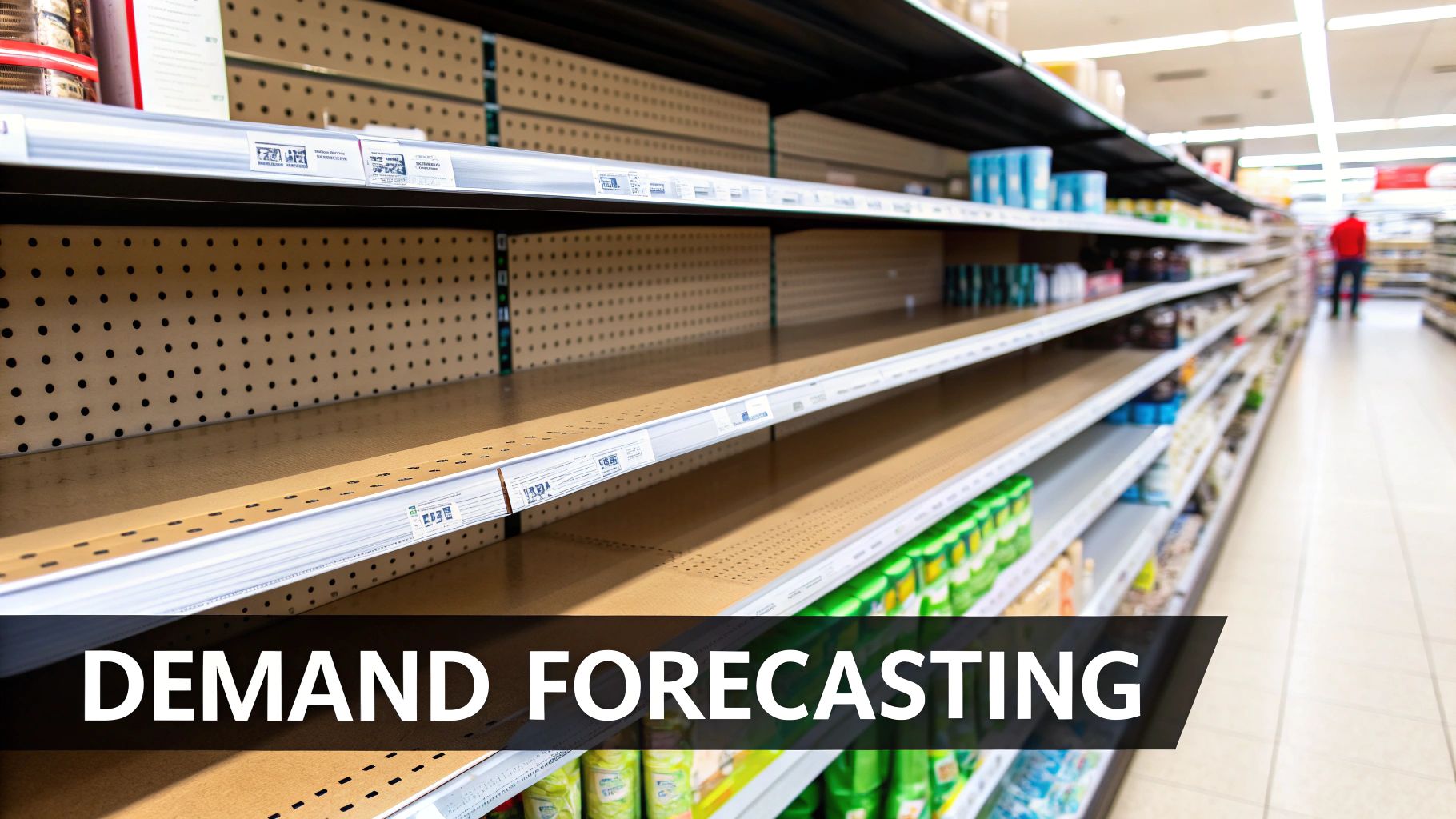
An accurate demand forecast is the bedrock of any solid retail operation. Predictive analytics changes the game by creating forecasts that are alive and constantly looking forward.
Use Case: A fashion retailer heading into winter. A predictive model analyzes long-range weather forecasts, social media trends, and competitor actions. If it flags an unusually warm season, the retailer can pull back on heavy parka orders and stock up on lighter jackets instead. Outcome: This single insight helps dodge a mountain of costly, end-of-season markdowns and aligns inventory with actual demand. Experts report retailers adopting these technologies see an average sales increase of 10%.
Crafting True Customer Personalization
Generic marketing blasts are dead. Customers today expect you to know them and want offers that feel made just for them. Predictive analytics makes this one-to-one personalization possible, even with millions of customers.
Use Case: An online grocer. A predictive model looks at a customer's entire digital footprint—past orders, browsing habits, and shopping times. The model can accurately predict when they’re about to run out of milk or coffee. Outcome: It triggers a perfectly timed email with a discount on those exact items. This isn't just marketing; it’s being genuinely helpful, which builds loyalty, drives higher conversion rates, and increases customer lifetime value.
By understanding not just what a customer has bought, but what they are likely to buy next, retailers can create a shopping experience that feels uniquely tailored and incredibly convenient.
Achieving Superior Inventory Optimization
Demand forecasting tells you what customers want. Inventory optimization figures out the smartest way to get it to them. It’s a constant puzzle of stock levels, warehouse allocation, and replenishment schedules.
Use Case: A national hardware chain preparing for a big holiday weekend. A predictive model crunches historical sales data, local event calendars, and weather reports to pinpoint demand for grills and gardening tools, down to the specific store. Outcome: The system recommends optimal stock levels, shifts inventory from a region expecting rain to one forecasted to be sunny, and automates replenishment orders. This prevents out-of-stock moments during the busiest hours and maximizes sales. For a technical deep dive, see our guide on enhancing logistics with Python data analytics.
Implementing Dynamic Pricing Strategies
Price is one of the most powerful levers you have. Predictive analytics unlocks dynamic pricing, allowing you to adjust prices in real-time based on market signals.
Use Case: An electronics retailer with a new, in-demand gaming console. A predictive pricing engine constantly monitors demand, competitor inventory levels, and social media chatter. Outcome: If demand spikes and other stores sell out, the system nudges the price up slightly to maximize margin. If hype dies down, it introduces a small discount to keep sales moving. This ensures pricing is always perfectly tuned to the market, capturing every last dollar of potential revenue.
Building Your Retail Analytics Engine
Knowing what you want to achieve is one thing; building the technical foundation to do it is another. It's about assembling a modern, scalable architecture—your store's central data engine.
At the heart of this engine sits a cloud data platform. This isn't just a database. It's the central hub where all your retail data converges, from point-of-sale transactions and e-commerce clicks to supply chain updates and customer loyalty info. Platforms like Snowflake are built for this job, giving you the scale and speed to handle massive retail data volumes.
This centralized approach breaks down the data silos that get in the way of smart analysis. When your inventory data can talk to your marketing data seamlessly, you uncover a much deeper layer of insight.
The Core Architectural Components
To get a robust predictive analytics capability off the ground, you need a few key components working together. Think of it like a high-performance race car: you need a powerful engine (the data platform), a well-organized pit crew (MLOps), and a perfectly mixed fuel formula (the feature store). A modern stack for predictive analytics in retail usually boils down to these three things:
- A Cloud Data Platform: Your single source of truth. It pulls together data from across the business, making it clean, accessible, and ready for your team to use.
- A Feature Store: This component standardizes and manages the data inputs (or "features") used to train your models. It's all about ensuring consistency and quality.
- An MLOps Framework: This is the operational backbone. It automates the deployment, monitoring, and upkeep of all your predictive models.
Get these elements right, and you’ve created an efficient, reliable, and scalable analytics powerhouse.
The Feature Store as Your Data Pantry
Imagine your data scientists are expert chefs. To create amazing models, they need consistent, top-shelf ingredients (data features). A Feature Store is their perfectly organized pantry. It’s a central place where pre-processed, validated data features are kept, ready to be used.
Instead of every data scientist prepping their own "ingredients" from scratch, they pull what they need from the feature store. This delivers:
- Consistency: It guarantees a feature like "customer lifetime value" is calculated the same way across all models, preventing inconsistencies that throw off predictions.
- Efficiency: It massively speeds up model development, as data scientists aren't reinventing the wheel with data prep for every new idea.
- Collaboration: It lets teams share and reuse features, encouraging teamwork and allowing new projects to build on previous work.
This component is critical to scaling your analytics efforts without creating a mess.
MLOps: The Assembly Line for Models
So, you've built a model. How do you get it into production and make sure it stays accurate? That's where MLOps (Machine Learning Operations) comes in. If the feature store is the pantry, MLOps is the automated assembly line, quality control system, and delivery fleet rolled into one.
MLOps provides the framework for taking a model from a data scientist's laptop and turning it into a live, operational system. For many companies, getting a handle on time-series data is a huge part of this puzzle, a challenge we've helped clients solve by handling time series data with Snowflake.
MLOps is the bridge between data science and IT operations. It ensures that predictive models aren't just one-off projects but are reliable, scalable, and continuously monitored assets that deliver real, ongoing value.
A solid MLOps practice automates testing, deployment, and—crucially—monitoring. It watches for "model drift," which happens when a model's performance gets worse as the real world changes. When that happens, it alerts the team that it's time for a retrain. This operational discipline is what turns predictive analytics from interesting experiments into a dependable part of your retail strategy.
Your Roadmap to Predictive Success
Successfully rolling out predictive analytics is a strategic journey. By breaking the process into clear, manageable phases, you can build momentum, prove value early, and set yourself up for long-term success.
Think of it like building a flagship store. You wouldn't put up the roof before laying a solid foundation. In the same way, a successful analytics program needs a methodical approach.
Phase 1: Get Your Data House in Order
Before you can predict anything, you need data you can trust. This first stage is about making sure your data is clean, accessible, and ready for analysis. The classic case of "garbage in, garbage out" applies—many projects fail here because the underlying data is a mess.
The goal is to create a single source of truth. This means pulling data from all your systems—POS, e-commerce, inventory, and CRM—into one centralized data platform. You want high-quality, reliable data your teams can depend on.
Key steps include:
- Data Audit: Figure out where all your data lives and assess its quality, completeness, and consistency.
- Data Consolidation: Set up pipelines to move data into a central spot, like a cloud data warehouse.
- Data Governance: Create clear rules for data quality, security, and access to keep things tight over time.
Phase 2: Launch a High-Impact Pilot Project
Once your data foundation is solid, it’s time to show what predictive analytics can do with a focused pilot project. Start small and aim for a quick win. Pick a use case with a clear, measurable impact on the business. This approach keeps risk low and helps get crucial buy-in from across the company.
A great starting point is often demand forecasting for a single, high-volume product category. This lets you test your models in a controlled setting and directly compare the results to your old forecasting methods. The goal isn't perfection; it's to demonstrate a real, tangible improvement.
A successful pilot project is your proof of concept. It turns abstract ideas into concrete results, which makes it much easier to justify a bigger investment in predictive analytics down the line.
When your pilot model is running, you can show stakeholders exactly how it leads to better outcomes, like fewer stockouts or lower inventory costs for that category.
Phase 3: Scale Your Solution Across the Business
After a successful pilot, the next step is to scale up. This means rolling out your predictive models across more product categories, regions, or different parts of the business. This is also when you start to deeply weave the analytics solution into your core operations.
For example, your demand forecasting model shouldn't just spit out a report. It should automatically feed its predictions into your inventory replenishment system, triggering purchase orders without manual intervention. That kind of integration turns predictive insights into automated, smart actions that drive efficiency at scale. The result is a more agile, data-driven operation where predictive intelligence is part of your decision-making fabric.
Phase 4: Drive Continuous Improvement
Predictive analytics isn't a one-and-done project; it’s an ongoing program. The retail market is always shifting, and your models need to evolve with it. This final phase is about setting up a cycle of continuous monitoring, refining, and improving to ensure your models stay accurate and effective.
This means you need to regularly track model performance against key business metrics. If a model’s accuracy starts to slip—a problem known as "model drift"—it’s a sign that underlying market patterns have changed. When that happens, the model needs to be retrained with fresh data. By treating predictive analytics as a living part of your retail strategy, you create a powerful engine for a sustained competitive advantage.
Measuring Success and Proving ROI
So, you're investing in predictive analytics. The big question is always: what’s the financial impact? How do you prove this is paying off?
The trick is to move beyond fuzzy benefits and get to concrete metrics that draw a straight line from your models to the bottom line. Without a solid way to measure success, even the most sophisticated predictions feel like a science experiment, not a strategic business driver.
A critical first step is to establish a baseline. Before deploying a model, you have to know where you stand today. This "before" picture is your anchor; it's what you'll use to show the "after" impact and build a rock-solid case for more investment.
Defining KPIs for Key Use Cases
To measure success, align your key performance indicators (KPIs) with the specific retail problem you’re solving. Generic metrics won't cut it. Your measurement needs to be tailored to the use case.
For supply chain optimization:
- Inventory Optimization: Watch the inventory turnover rate, stockout frequency, and carrying costs. A working model boosts turnover while ensuring shelves aren't empty.
- Demand Forecasting: The main event is forecast accuracy. A jump from 70% to 90% accuracy isn't just a number—it translates directly into smarter stock management and less waste.
This targeted approach gives you quantifiable proof of the value your models are creating.
For customer-focused initiatives:
- Personalization Engines: Monitor conversion rates from recommendations, average order value (AOV), and customer lifetime value (CLV). The goal is to prove these tailored experiences create more valuable customers.
- Customer Churn Prediction: The most important metric is the customer retention rate. By spotting at-risk customers and stepping in, you can directly measure the drop in churn and the revenue saved.
The Financial Impact of Getting It Right
The financial stakes here are massive. The retail analytics market is expected to balloon from $7.56 billion in 2023 to $31.08 billion by 2032, as retailers scramble to fix hugely expensive operational headaches.
Consider this: global inventory distortion—overstocks and stockouts—costs retailers nearly $800 billion every year. By applying predictive analytics, retailers are hitting forecasting accuracies around 90% and slashing site evaluation times by 80%. This turns data from a cost center into a powerful financial lever. You can dig into more insights about the growth of retail analytics at GrowthFactor.ai.
Proving ROI isn't just about showing that a model is accurate. It's about demonstrating how that accuracy translates into saved costs, increased revenue, and a stronger competitive position in the market.
Ultimately, your goal is to build a clear story backed by hard data. By setting baselines, defining specific KPIs, and constantly tracking performance, you can confidently prove the financial wins from predictive analytics in retail and lock it in as a core part of your growth strategy.
Common Pitfalls and How to Avoid Them
Bringing predictive analytics into your retail operation is a game-changer, but the path isn't always a straight line. It's rarely complex algorithms that cause projects to fail; it's foundational issues that were overlooked from the start.
The good news? Most of these problems are entirely avoidable. With foresight and a clear focus on both the technology and the people who will use it, you can navigate these challenges and make sure your investment pays off.
Overlooking Data Quality
This is the big one. The most common point of failure is poor data quality. You’ve heard the saying, "garbage in, garbage out," and it has never been more true. If your data is a mess—inaccurate, incomplete, or locked in separate systems—your predictions will be unreliable. At best, they're useless; at worst, they'll lead to expensive mistakes.
To get this right, data readiness has to be priority number one. That means:
- Run a thorough data audit: Before building a model, get a clear picture of what you're working with. Find inconsistencies, gaps, and fragmentation.
- Establish solid data governance: Set up clear rules for how data is entered, managed, and secured. This isn't a one-time fix; it's about building a system that keeps your data clean and trustworthy for the long haul.
Lacking Clear Business Objectives
Another classic mistake is jumping into a project without a well-defined business problem to solve. It's easy to get swept up in the technology, but remember: predictive analytics in retail is a tool, not the goal itself. A project without a specific outcome—like cutting stockouts by 15% or boosting customer retention by 5%—is spinning its wheels.
A model that is technically brilliant but doesn't solve a real-world business problem is ultimately worthless. Start with the business need, then find the right analytical approach to meet it.
Always start with a clear "why." Define the exact challenge you're trying to solve and set up measurable KPIs to see if you're actually succeeding. This keeps every effort tied to a tangible business result.
Failing to Secure User Adoption
Finally, you can build the most accurate model in the world, but if the people on the ground don't use it, it’s a failure. If your store managers or marketing teams don't trust the new tools or see how they fit into their work, they’ll fall back on old habits. This resistance usually comes from feeling left out of the process.
The solution is to get your end-users involved from day one. Ask for their input. Listen to their feedback. Show them exactly how this new system will make their jobs easier and help them hit their goals. When your team sees analytics as a tool that helps them win, adoption becomes a non-issue.
Frequently Asked Questions
Getting started with predictive analytics always brings up practical questions. Here are some of the most common ones we hear from retail leaders, with straight-to-the-point answers.
How Much Data Do I Need to Start?
You probably need less data than you think. While more high-quality data is always better, you don't need a petabyte-scale data lake to get going. A well-designed pilot project can often get off the ground with just six to twelve months of clean sales and customer data. The real key is the quality and consistency of that data, not just the sheer volume.
Is Predictive Analytics Only for Large Retailers?
Not anymore. While large enterprises were the early adopters, that's changed. Cloud-based platforms and user-friendly machine learning tools have brought predictive analytics in retail within reach for ambitious mid-sized businesses. The fundamental goals—forecasting demand, personalizing offers—are universal, no matter your scale.
The focus should always be on the business value, not the size of your operation. A project with a clear, measurable ROI can deliver a huge impact for retailers of any size.
Can We Use Our Existing Team?
It depends on their current skillset. A successful predictive analytics program needs a blend of expertise: data engineering to build the pipelines, data science to create the models, and sharp business analysis to translate insights into action.
Many retailers find the sweet spot by partnering with a specialist team like Faberwork. We help build that initial foundation and get the first models into production quickly, all while upskilling your internal team so they can take the reins for the long haul. It's a great way to accelerate your time-to-value and build a sustainable, in-house capability.


