Jumping into development without a solid plan is the fastest way to a costly failure. Properly planning a software development project is what separates predictable success from chaos. It’s how you turn a high-stakes gamble into a strategic initiative that delivers measurable business outcomes.
Why Planning Is Your Project's Strongest Foundation
Many teams rush into coding, viewing planning as a delay. This mindset leads directly to blown budgets, missed deadlines, and a final product that fails to solve the actual business problem. Good planning isn't bureaucracy; it’s a strategic tool for achieving specific outcomes and gaining a competitive edge.
The Real Cost of Skipping the Blueprint
Use Case: An e-commerce company rushed an app to market, skipping deep planning. The development team, working on assumptions, built a complex recommendation engine. However, no one validated if this was a customer priority.
The outcome? The app launched to minimal engagement and flat sales. The project went 45% over budget to deliver 56% less value than promised. The real business goal—a simpler, faster checkout—was missed entirely because the technical work was disconnected from the desired outcome.
Industry reports show a staggering 70% of all projects fail outright. A primary culprit? Misalignment. A massive 44% of projects flop simply because there's a disconnect between the business objectives and what the project team is building.
Turning Chaos into Predictable Success
Effective planning prevents this misalignment. It forces stakeholders to agree on what "successful" looks like before a single line of code is written. Understanding the Software Development Life Cycle provides a logical framework for mapping each phase to a specific goal.
When you align business goals with technical requirements upfront, you create a unified vision. This empowers your team to make smarter decisions, anticipate roadblocks, and build a product that solves the right problem. The outcome is a shift from merely building features to delivering tangible business value.
Ultimately, meticulous planning isn't just about avoiding failure—it's about engineering success from day one. It ensures every dollar and developer hour is aimed squarely at achieving a specific, measurable outcome, turning high failure rates into repeatable wins.
Aligning Stakeholders and Defining Project Outcomes
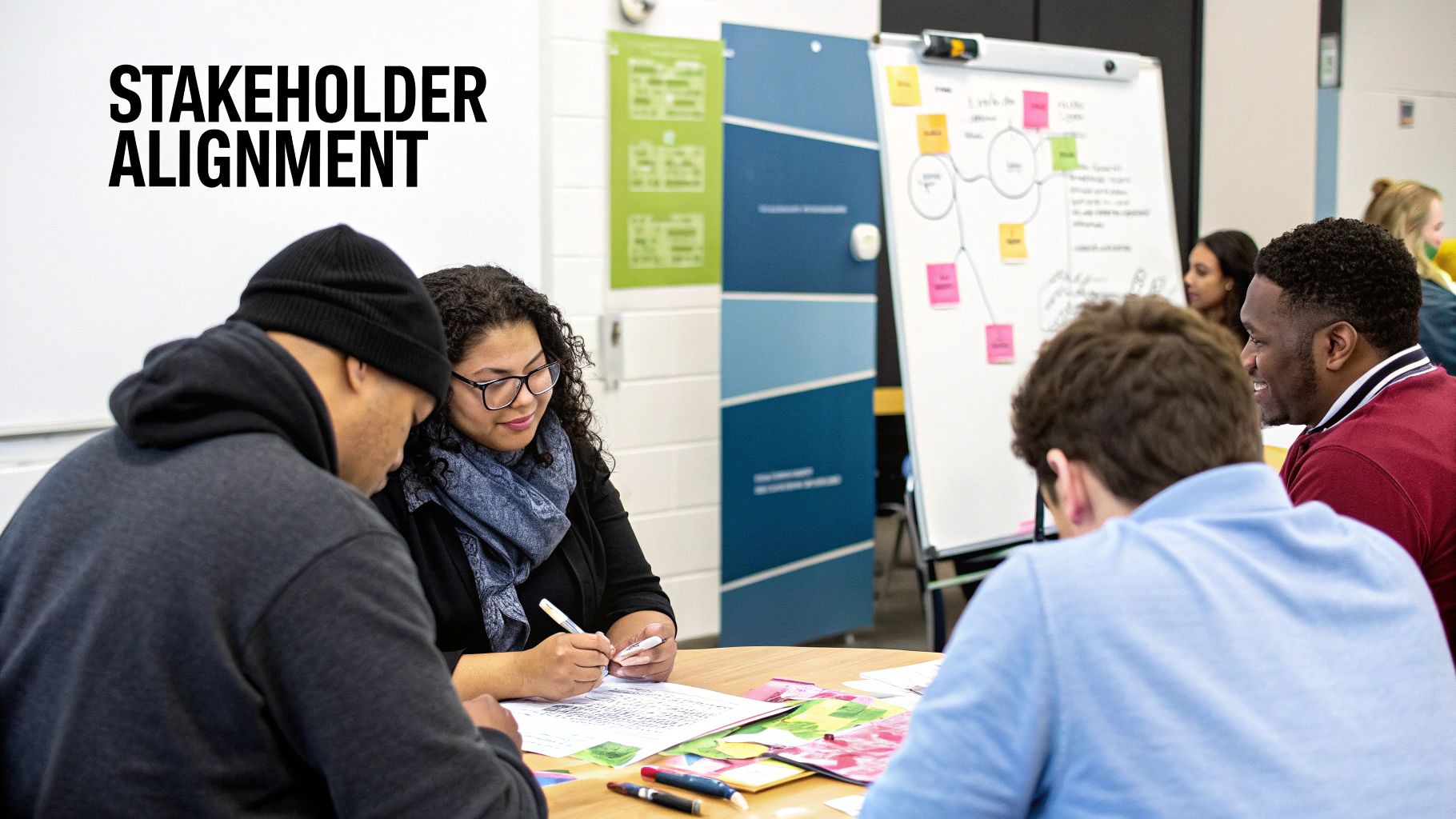
Great projects begin with conversations, not code. The discovery phase is your best opportunity to achieve total stakeholder buy-in, ensuring everyone from the CIO to end-users is working from the same playbook. This process translates a high-level vision into concrete, measurable outcomes that an engineering team can build. Using project overview example templates can structure these critical conversations for clarity and consensus.
From Vision to Actionable Plan
Early workshops must close the gap between executive vision and technical execution. A CIO might say, "We need to modernize our Operations Support Systems (OSS)," but an engineer can't build a vague mandate.
The key is to ask outcome-focused questions to uncover the "why":
- What specific operational problem will this modernization fix?
- How will we prove we've achieved a 15% reduction in manual provisioning errors?
- Which user group is most impacted by the current system's failings?
These questions shift the conversation from a fuzzy goal to a well-defined business problem, revealing the real metrics for success.
A project plan is only as strong as the shared understanding it's built on. The primary goal of stakeholder alignment is to eliminate ambiguity and ensure every single person agrees on what "success" looks like before development begins.
A Telecom OSS Modernization Case Study
Use Case: A major telecom client was hampered by an archaic OSS. Provisioning new fiber services took weeks, leading to customer churn and lost revenue. The high-level goal was to "make it faster."
Our discovery workshops defined what "faster" meant in tangible terms. By mapping the entire customer journey, we pinpointed every manual bottleneck. This led to creating specific user personas with clear needs:
- The Field Technician: Needed a mobile-first way to update work orders instantly, eliminating return trips to the depot.
- The Provisioning Manager: Required a dashboard to flag any order stuck for more than 24 hours.
- The Customer Service Rep: Needed a unified view of service status to provide accurate information.
The CIO's vision became actionable user stories. For the Field Technician: "As a Field Technician, I want to close out a work order from my tablet so that I can immediately move to the next job." The acceptance criteria demanded the system update in under 30 seconds. Visualizing these flows with tools like wireframes and their role in concept completion was crucial.
This persona-driven approach ensured we built the right system to solve their core business problem: inefficient service delivery. The outcome was a crystal-clear path for the engineering team, aligned around measurable goals.
Architecting for Tomorrow: Your Data and AI Strategy
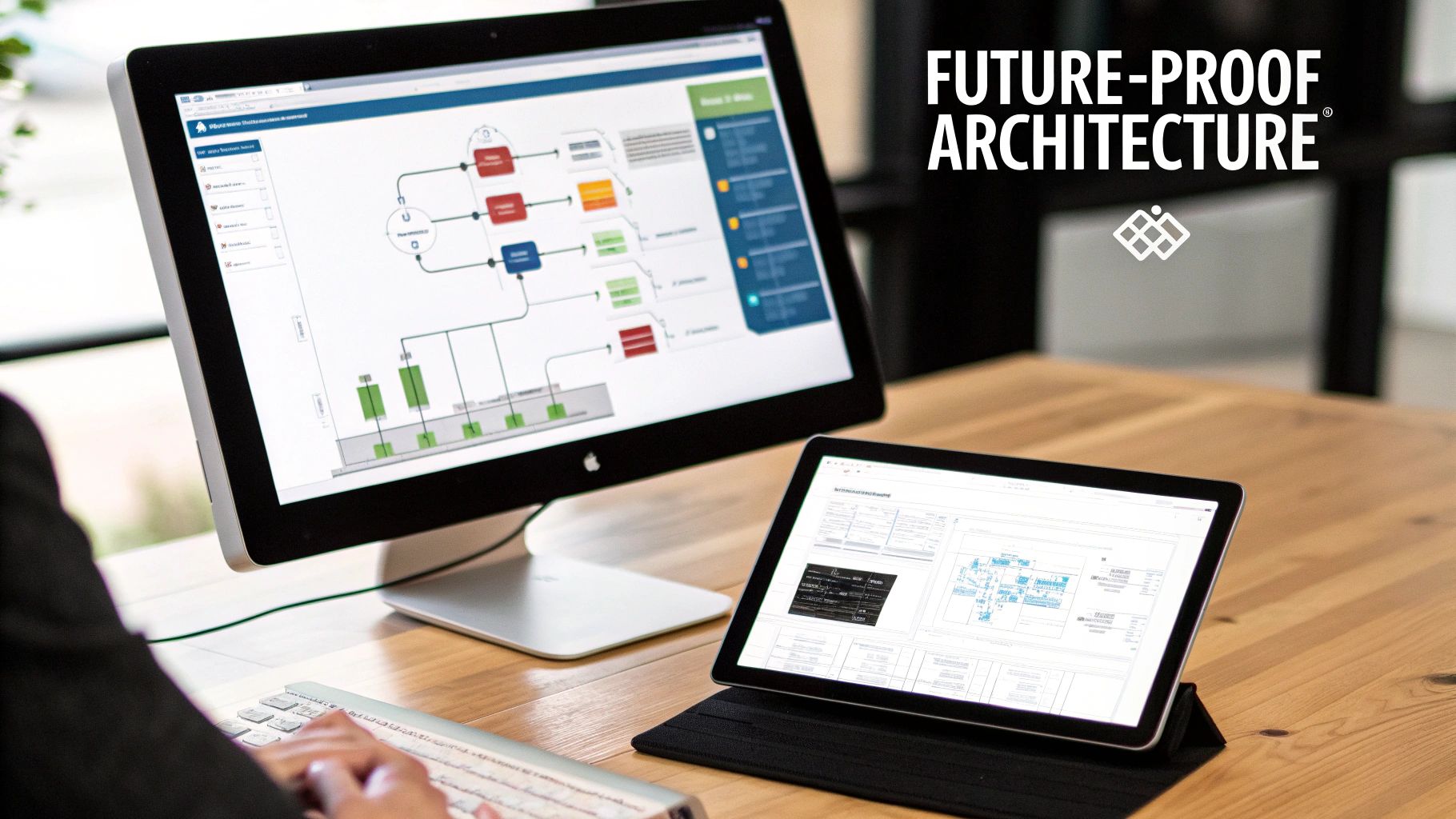
Your architecture is a blueprint for your project's future capabilities. It’s about designing a system that not only solves today's problems but can also scale, adapt, and get smarter over time. A common misstep is treating AI and analytics as add-ons, which leads to expensive refactoring or a system that can't meet future business demands. Future-proofing means weaving your data and AI strategy into the core architecture from day one.
Building a Modern Data Foundation
Your AI's effectiveness is limited by the quality and accessibility of your data. For enterprise applications handling massive data volumes (e.g., IoT, time-series data), a modern data platform like Snowflake is essential. These platforms are designed for speed and scale, enabling real-time data processing and analysis critical for applications like fraud detection or dynamic pricing engines.
When planning, consider the entire data lifecycle:
- Ingestion: How will you efficiently pull data from all sources (IoT, user logs, APIs)?
- Storage and Processing: Can your architecture handle diverse data types and scale with volume spikes?
- Accessibility: How easily can analytics tools and AI models access data without slowing down the core application?
Choosing a modern data platform ensures your system can grow without hitting a data-driven wall.
Integrating Agentic AI from the Ground Up
Agentic AI—autonomous agents that can perform tasks—is becoming a business reality. These systems don't just analyze data; they act on it. For example, an agent could detect a supply chain disruption and automatically re-route shipments.
To enable this, your architecture must be built for automation with robust APIs, event-driven workflows, and a clean separation of services. This design creates a safe and effective environment for AI agents to execute complex jobs.
Your project's architecture should be a launchpad for innovation, not a cage. By designing for scalability and intelligence from the start, you create a system that can evolve with your business, turning future challenges into opportunities for growth.
Use Case: Smart Building Optimization
Use Case: A client aimed to develop a smart building management system to reduce energy consumption. The goal was proactive optimization based on real-time occupancy, weather forecasts, and energy prices.
The architectural decisions made during planning were critical to the outcome.
The Data Strategy:
We built the data pipeline on Snowflake to handle high-velocity time-series data from hundreds of IoT sensors. This allowed the system to ingest and query temperature, light, and motion data in near real-time.
The AI Integration:
We integrated a machine learning model built with TensorFlow to predict energy usage patterns. The architecture was designed so the model could communicate directly with the building's control systems via secure APIs.
The Outcome:
The system became an autonomous agent. The TensorFlow model could detect an empty floor and proactively adjust climate controls. This resulted in a 22% reduction in energy costs within the first six months—a direct consequence of embedding the data and AI strategies into the core architecture during the planning phase.
Assembling Your High-Performing Development Team
A flawless plan is useless without the right team to execute it. Assembling a high-performing team means building a cohesive unit designed for speed, collaboration, and efficiency. The first major decision when planning a software development project is your resourcing model, which sets the tone for communication and knowledge sharing.
Choosing the Right Resourcing Model
You have two primary options: a dedicated team or staff augmentation. A dedicated team is a self-contained unit, often from a partner like Faberwork, that handles the project end-to-end. Staff augmentation involves hiring individual specialists to fill skill gaps in your existing team.
- Dedicated Team: Ideal for complex projects requiring a focused group that can ramp up quickly and take unified ownership of the outcome.
- Staff Augmentation: Best when you have a strong internal team but need specific expertise, like a senior Snowflake architect or a TensorFlow expert.
For most large-scale enterprise projects, a dedicated team provides a significant advantage in alignment and development velocity.
The real goal is to create a structure that fosters rapid, transparent decision-making. A well-defined governance framework prevents bottlenecks and empowers the team to solve problems without endless rounds of approval.
Governance and Communication Cadence
Once you have your team, establish a clear operating system. A governance framework creates clarity, ensuring everyone knows their responsibilities and how decisions are made. Define key roles with zero ambiguity.
RoleKey ResponsibilityPrimary OutcomeProduct OwnerOwns the product backlog and prioritizes features based on business value.Ensures the team is always building the most impactful features.Tech LeadGuides the architectural direction and unblocks technical challenges.Maintains technical integrity and developer productivity.Scrum MasterFacilitates agile ceremonies and removes impediments for the team.Maximizes team velocity and protects them from distractions.
With roles defined, set a firm communication cadence (e.g., daily stand-ups, weekly sprint planning, bi-weekly demos). This predictable rhythm keeps the project moving forward efficiently.
A Real-World Use Case: EMS on Snowflake
Use Case: We were tasked with building a large-scale Energy Management System (EMS) on Snowflake, involving real-time IoT data and complex analytics. The client had deep energy sector expertise but lacked the specific Snowflake and data engineering skills.
We implemented a hybrid model, pairing the client's subject matter experts with our dedicated team of SnowPro Certified engineers. This structure was highly effective. The client’s experts provided crucial domain knowledge, while our specialists built the scalable data pipelines on Snowflake.
The key outcome was a powerful synergy that accelerated the development timeline by an estimated 30%. The clear governance model allowed our specialists to integrate seamlessly, creating a single, high-functioning unit focused on one goal. This ensured the final product was both technically robust and perfectly aligned with strategic business objectives.
Mastering Timelines, Risk, and Compliance
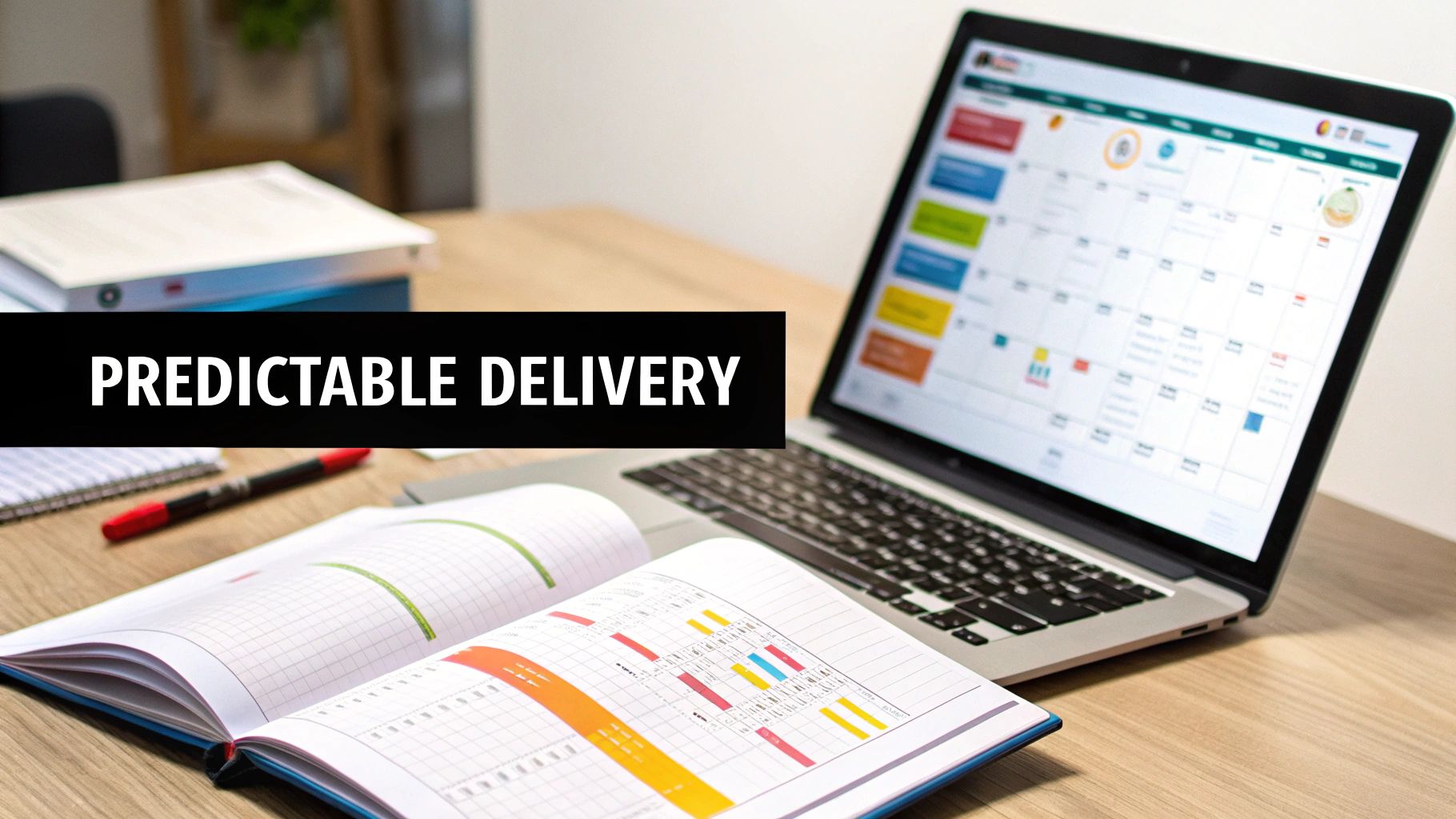
This is where your plan becomes a predictable schedule. Turning goals into a concrete timeline—complete with risk mitigation and compliance—requires moving beyond guesswork to embrace techniques that account for development uncertainty. The goal is to deliver value on time and within budget, even when the unexpected happens.
From Estimates to Realistic Forecasts
Traditional time-based estimates ("this will take 40 hours") are notoriously unreliable. A more pragmatic approach is story point estimation. This technique focuses on the relative effort, complexity, and uncertainty of a task rather than hours. A simple bug fix might be a "1," while a complex feature could be an "8."
After a few sprints, you can calculate your team's average velocity (the number of story points completed), which provides a data-driven method for forecasting future work with far greater accuracy.
Foresight in software planning is non-negotiable. Shocking statistics show that only 48% of organizations consistently baseline schedules to track progress, and 1 in 6 IT projects overrun costs by an incredible 200%. Yet, structured practices can save 28 times more money. This highlights the immense value of moving from simple estimates to robust forecasting. You can find more project management insights at saaslist.com.
Proactive Risk Identification and Management
A plan without a risk assessment is a wishlist. Identifying potential roadblocks before they appear is a high-value planning activity. Create a risk register to track potential threats, their likelihood, their impact, and your mitigation plan.
For example, a logistics company building a geofencing app might face these risks:
- Technical Risk: The third-party mapping API has unexpected downtime.
- Resource Risk: The lead mobile developer leaves the project.
- External Risk: A new mobile OS update breaks key functionality.
Identifying these early allows you to build contingency plans, such as vetting a backup API or ensuring knowledge is shared across the team. This turns potential crises into manageable issues. It's a continuous process that includes strategies like managing technical debt as part of your risk control strategy.
Common Project Risks and Proactive Mitigation Strategies
Risk CategorySpecific Risk ExampleMitigation StrategyTechnical RisksA core technology proves unstable or fails to meet performance requirements.Conduct a proof-of-concept (PoC) early. Identify and vet alternative technologies. Build in time for performance tuning.Scope RisksThe project scope continuously expands without adjusting the timeline or budget ("scope creep").Implement a formal change control process. Ensure all new requests are evaluated for impact on schedule, cost, and resources.Resource RisksKey team members become unavailable due to illness, resignation, or being pulled to other projects.Promote knowledge sharing and cross-training. Document critical processes and system knowledge. Identify potential backup personnel.Dependency RisksA deliverable from another team or a third-party vendor gets delayed.Establish clear communication channels and SLAs. Build buffer time into the schedule for external dependencies.
Embedding Compliance from the Start
For many applications, compliance is a foundational requirement, not an afterthought. A logistics company's geofencing app handles sensitive location data, implicating regulations like GDPR and CCPA. Compliance must be built into the architecture from day one.
Ask critical questions during the design phase:
- How will we obtain and manage user consent for location tracking?
- How will data be anonymized to protect privacy?
- What is our process for handling a user's "right to be forgotten" request?
Addressing these needs in the initial plan avoids costly refactoring later. The outcome is a final product that is not only functional but also legally sound and trustworthy—a hallmark of mature, enterprise-grade software planning.
Got Questions About Software Development Planning?
Even the best plans raise questions. Clear answers are crucial for keeping a project on track. Here are straightforward answers to common queries from tech leaders.
How Do I Choose Between Agile and Waterfall?
The best approach matches the methodology to your project's needs.
Waterfall is a linear approach where you complete one phase before starting the next. It works best when requirements are fixed and well-understood, such as developing firmware for a medical device where deviation from a pre-approved plan is not an option.
Agile is iterative and built for change. It thrives in uncertainty, making it ideal for projects like new customer-facing apps where user feedback is vital. Agile allows you to deliver value in small increments (sprints) and adapt based on what you learn.
For most modern software projects, a hybrid approach is effective. Use an initial planning phase to define the high-level architecture and key business goals (like Waterfall), then switch to Agile sprints for development. This provides a stable foundation with the flexibility to adapt.
What Is the Best Way to Manage Scope Creep?
Scope creep is the silent killer of timelines and budgets. Your best defense is a formal change control process. This system ensures that any new request is properly evaluated.
- Document the Request: All change requests must be submitted in writing.
- Assess the Impact: The product owner and tech lead analyze the request's effect on the timeline, budget, and current work.
- Prioritize and Approve: Stakeholders decide if the added value justifies the cost and potential delay.
This process transforms a casual idea into a formal business decision, protecting your team from disruption and keeping the project focused on its core objectives.
Is Project Management Software Really Necessary?
Yes. The data is clear: project management software is a core driver of success.
Statistics show that while only 23% of companies use project management software, 77% of high-performing projects rely on it. Without these platforms, 54% of teams cannot track their KPIs in real time. The financial and operational benefits are significant: companies using this software see 66% of their projects finish within budget, compared to 47% for those without. Similarly, 61% of tool-users finish on time, versus only 41% of non-users. These tools also save the average employee 498 hours per year.
For any tech leader, investing in the right software is a direct way to reduce risk and avoid the estimated $109 million lost for every $1 billion invested due to poor project management. You can find more project management statistics at iseoblue.com. The right platform provides the analytics and automation needed to ensure your planning translates into a successful outcome.


