
You can feel a software project slipping before the timeline admits it. The product team keeps adding “small” requests, QA keeps finding issues that were supposed to be caught earlier, and the release date still gets mentioned as if it's fixed. By the time someone asks why the six-month build now looks like a fourteen-month build, the problem is usually coordination, not coding.
Managing a software development project well is mostly about making hard trade-offs early and keeping them visible. The teams that ship cleanly don't rely on heroics, they defend a small set of outcomes: a written scope with explicit non-goals, a working cadence that fits the delivery method, a toolchain where CI, tests, and releases behave as one flow, observable production behavior, and a defensible ROI number. If you can defend those five things in a steering meeting, you're managing the project. If you can't, you're mostly narrating it.
Why Most Software Projects Slip and What Good Management Actually Changes
A project usually doesn't miss because the engineers were weak. It misses because scope, staffing, dependencies, and feedback loops were allowed to drift without one person forcing them back into alignment. That lines up with the long history of software delivery outcomes, where benchmark reporting has repeatedly shown a high share of projects ending challenged or failed unless management actively controls complexity and change, including the latest figures surfacing 31% successful, 50% challenged, and 19% failed in one widely cited CHAOS-era summary, with earlier summaries even lower at 16.2% on time and on budget (Raftlabs on CHAOS benchmark history).
What good management changes
Good management doesn't magically improve talent. It creates the conditions where talent can finish. That means the scope is written down with non-goals, the team has a cadence that matches the methodology, and the release path is visible enough that product, engineering, QA, and operations are looking at the same reality.
Practical rule: if two people are making the same delivery decision from different documents, the project already has a management bug.
The historical arc of project management matters here too. The field moved from Gantt charts in 1917 to CPM in 1957, PERT in 1958, PMI's founding in 1969, PMBOK in 1987, Scrum formalized in 1996, and the Agile Manifesto in 2001, signed by 17 software developers in Snowbird, Utah (project management history timeline). That evolution says something important. Software delivery has always been a control problem first, a process preference second.
What you're defending in the steering meeting
The steering meeting shouldn't be a debate about activity. It should be a check on outcomes. You want to know whether the team is still on the same scope, whether the release path is stable, whether production behavior is observable, and whether the business case still holds.
If one of those is off, you decide whether to slow down, re-sequence, or cut. That's triage, not pessimism.
Scoping the Work and Choosing How the Team Will Run
Scope, delivery method, and team topology belong in one decision, not three separate checklists. If the problem space isn't clear, the team starts by building the wrong thing. If the solution space is overcommitted too early, the team ends up defending an architecture before it has earned the right to exist.
Separate the problem from the solution
Start with the problem space. Define the jobs to be done, the success criteria, and the boundaries that won't move unless someone pays for the change. Only then move into solution space, where features, integrations, and architecture choices live.
That order matters because a sprint planned around half-baked assumptions becomes expensive instantly. For startup-style validation, a useful external reference is validate your MVP idea, because the discipline of checking whether the problem is real is the same one that keeps enterprise programs from overbuilding. For concept-to-build translation, the wireframing flow in Faberwork's wireframes guide is another practical touchpoint when you need to move from intent to something the team can estimate.
Pick the method based on volatility and control needs
Scrum fits product discovery, where requirements are still forming and feedback needs to be frequent. Kanban fits operational work and data pipelines, where flow matters more than ceremony. A hybrid with stage gates works when regulatory review or governance checkpoints can't be skipped. Structured Waterfall still makes sense for hardware-tied or compliance-locked programs where change is costly and approvals are not optional.
Match the team shape to the work
Team Topologies gives you the right mental model here. A stream-aligned team fits product delivery, a platform team supports shared infrastructure, an enabling team helps with AI and data capability lift, and a complicated-subsystem team owns legacy or ML-heavy modules.
Project profileRecommended methodologyTeam topologyEarly product discoveryScrumStream-alignedShared data or ops workKanbanPlatform plus stream-alignedRegulated deliveryHybrid with stage gatesStream-aligned with enabling supportLegacy or model-heavy moduleStructured Waterfall or controlled hybridComplicated-subsystem
The key is to revisit all three choices at every planning boundary. If volatility rises, the method changes. If integration depth increases, the topology changes. If neither is revisited, the project starts pretending the original plan still fits.
Planning, Estimation, and the Delivery Toolchain
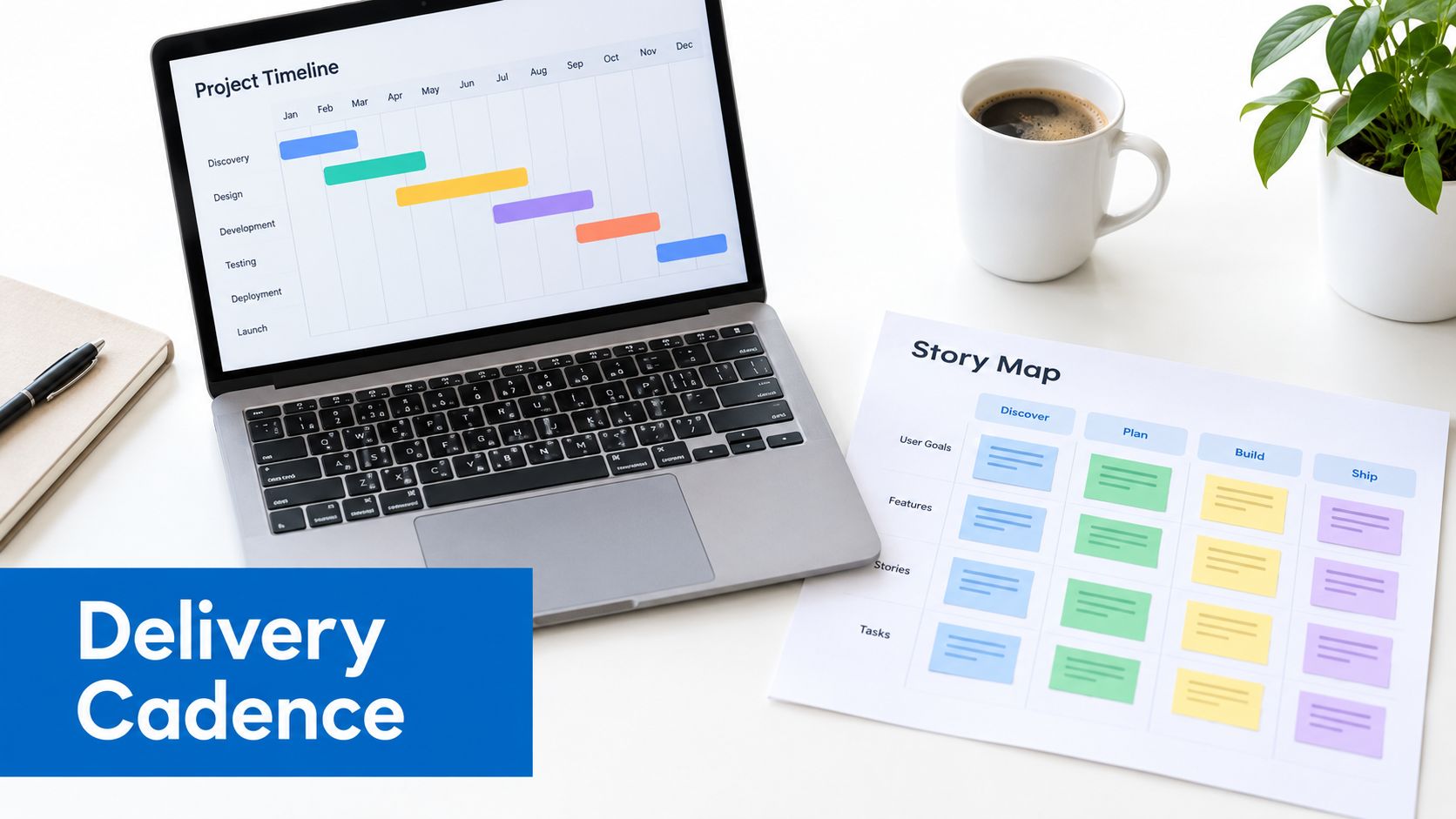
Planning works when it produces artifacts the team can build against. That means outcome-based epics, thin vertical slices, and a Definition of Done that includes tests, observability, and security gates. Anything less is just a wish list with dates on it.
Estimate with honesty, not optimism
T-shirt sizing helps with very early filtering. Planning poker is useful when the team already understands the work and needs a shared view. Reference-class forecasting is the better choice for programs that run longer than a few months, because it anchors estimates in historical slippage instead of self-confidence.
That matters in software because overrun patterns are rarely symmetric. The PMI-linked risk analysis notes that schedule and effort overruns tend to follow a power-law distribution, which means a small share of projects create a disproportionate amount of delay (PMI risk-based scheduling analysis). In practice, that's why single-point estimates age badly.
Treat the toolchain as a pipeline
The toolchain should behave like one system, not a pile of preferences. A practical flow looks like this, issue tracker, branching strategy, trunk-based development, pull request checks, CI on every merge, artifact promotion across dev, staging, and production, feature flags for safer release, and infrastructure as code for reproducible environments.
Each tool has to justify the artifact it produces. If the board doesn't drive the standup, the standup turns into status theatre. If the weekly review doesn't tie back to outcome metrics, it becomes a recitation. If monthly forecasting doesn't use burndown and dependency maps, the forecast is just polite fiction.
A good planning ritual doesn't create certainty. It makes uncertainty visible early enough to change the plan without breaking trust.
That's also where AI fits in now. Teams can use it to speed estimation support, backlog grooming, and documentation, but the output still needs human review and a release system that can absorb change without drama.
Data, AI, and Quality as One Operating System
A release can pass code review and still fail in production because its data contract changed, its model behaved differently, or its observability stopped at deployment. Manage data pipelines, AI-assisted coding, and QA as one operating system. Otherwise, speed in one area creates hidden rework elsewhere.
Where AI helps and where it breaks things
AI can generate tests, sort code-review findings, draft documentation, and group related defects. It also produces plausible but incorrect APIs, misses edge cases, and drifts from approved data contracts. Each use needs a defined review point and an owner who can reject the output.
Engineering teams widely use AI coding tools, while fewer measure their effect with engineering metrics. That gap can create false productivity gains and verification fatigue, according to GetDX on software project management and AI. More generated code is not the same as more delivered value. Track whether AI reduces cycle time, escaped defects, or review effort without weakening reliability.
Snowflake and data contracts need upfront governance
In Snowflake-centered programs, delivery depends on agreeing data contracts, lineage, ownership, and access patterns before engineers connect pipelines. Delayed decisions force rework across permissions, naming, transformations, and downstream expectations. A short design review can prevent weeks of repair.
Slow down deliberately for technical debt, model governance, and security review. Skipping those checks often surfaces later as integration failures, unreliable analytics, or audit friction. In data-heavy systems, technical debt becomes a charge on every subsequent release.
QA should be risk-shaped
Use shift-left unit and contract tests to catch interface drift before integration. Use shift-right observability to confirm that releases behave correctly in production. Size the test pyramid around failure impact and change risk, not coverage percentages that look impressive but miss the important paths.
Data-contract tests should verify schema, ownership, compatibility, and representative failure cases. Model checks should cover input quality, output constraints, and material behavior changes. If a release crosses a security boundary or changes model behavior, slow the rollout, verify the assumptions, and then ship through the lower-risk work.
Metrics That Prove Delivery and ROI
Sponsors need metrics that say something real about schedule, quality, and business return. That means separating flow, stability, value, and engineering health from vanity indicators that only look good in slides.
Use metrics that predict, not decorate
Flow metrics show how work moves. Stability metrics show how often releases break. Value metrics show whether users adopted what was shipped. Engineering health metrics show whether the team can keep going without burning itself out.
The practical software-project metric set includes sprint burndown, velocity, cycle time, cumulative flow, bug escape rate, schedule variance, and team satisfaction (ONES metrics guide). Those are useful because each one measures a mechanic, not a slogan.
Metric layerPredictive metricsVanity metrics to retireFlowLead time, cycle time, WIP, deployment frequencyStory count without contextStabilityChange failure rate, MTTR, escaped defects“Green” status slides with no release evidenceValueActivation, adoption, revenue or cost-out tied to releasesOutput shipped, regardless of useEngineering healthOn-call load, toil share, unplanned work, review turnaroundRaw commit counts
Show the business a small set of outcome KPIs
DORA-style indicators belong on the dashboard, but they shouldn't stand alone. A sponsor also needs one or two outcome KPIs tied to the business case, such as adoption, cost-out, or task completion in the target workflow. Without that link, teams can get faster without getting more valuable.
Avoid three common traps. Don't confuse output with outcome. Don't let velocity become a performance contest. Don't use code coverage as a proxy for product quality.
A one-page reporting cadence works best, delivery dashboard weekly, business review quarterly. That keeps the audience short on excuses and long on clarity.
Risk, Change, and Stakeholder Governance
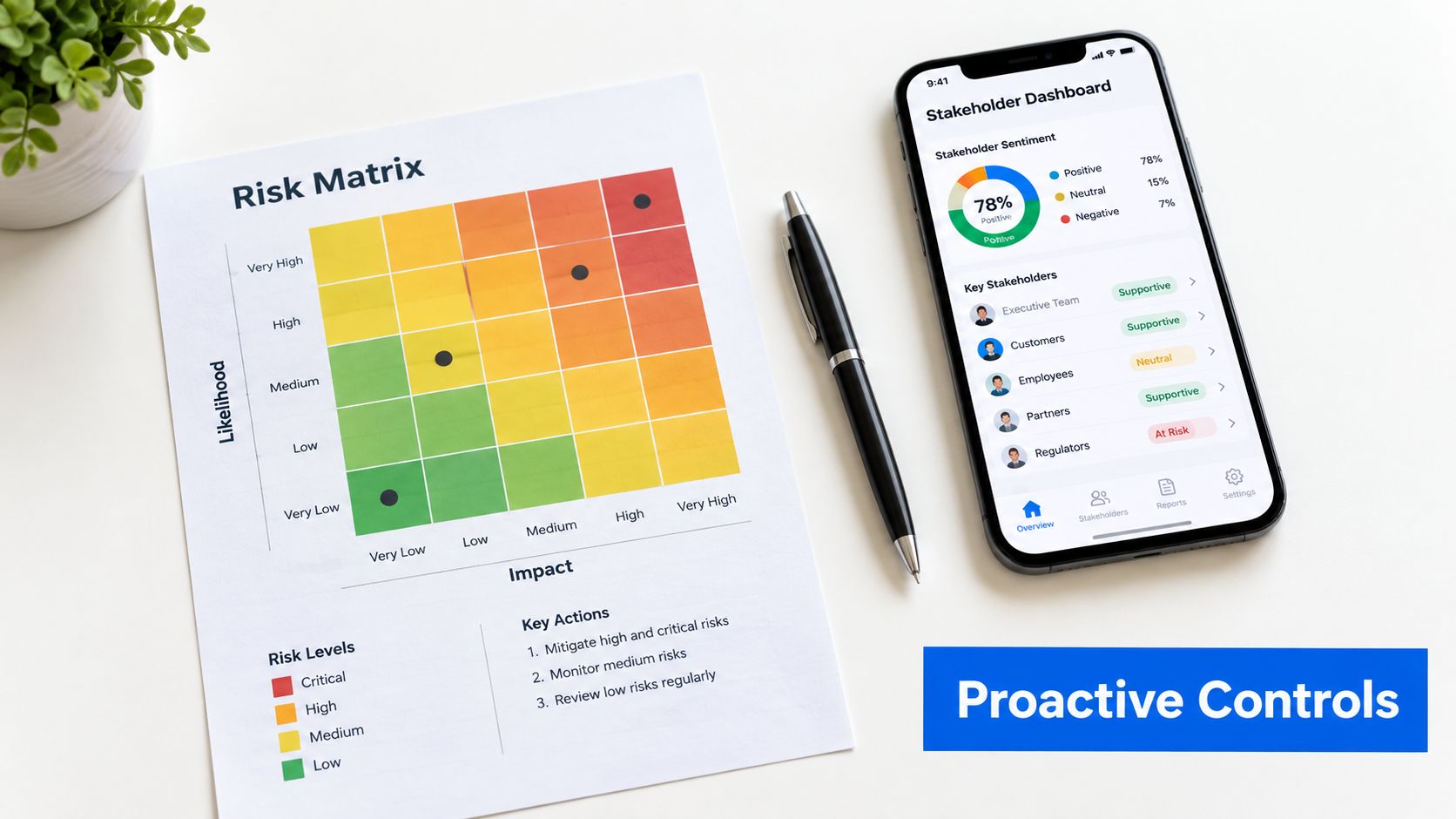
A release can be technically ready and still fail in production because a dependency changed, compliance arrived late, or a sponsor approved new scope without funding it. Treat risk and change decisions as portfolio controls, with named owners and visible trade-offs. In an AI-augmented delivery environment, triage matters: slow down where architecture, security, or irreversible cost is at stake, and ship through low-risk work with clear rollback options.
Watch the failure modes that repeat
Enterprise programs tend to fail in familiar ways. Scope expands without a funding owner. Shared platforms change underneath the team. Compliance work appears near launch. Stakeholders reprioritize without recording what the change displaces. A single architect becomes the only person who can resolve a design decision.
Keep a live risk register with likelihood, impact, owner, trigger, and response. Review it in delivery meetings, then turn material risks into explicit bets. Define the evidence required to continue, pause, or stop each bet. That gives the team permission to slow down on high-consequence uncertainty instead of treating every issue as an emergency.
Late architecture discoveries often force expensive rework, while early review protects the quality attributes the business depends on. Surface dependency drift, security boundaries, and technical debt before they become release blockers. The technical debt risk-control note provides a practical way to frame debt as a managed delivery choice, with an owner and an accepted consequence.
Make change control specific
Scope, schedule, priority, and funding changes need different approval paths. Name the approver, decision deadline, expected impact, and displaced work. A clarification may need a product decision, while a launch delay requires sponsor action and a revised forecast.
Set governance at useful intervals: a weekly delivery review, a monthly steering committee, and a quarterly portfolio review. Each forum needs defined decision rights and an escalation route. Conflicts left in email usually return as rework, missed commitments, or unplanned spend.
If no one owns the trade-off, the loudest stakeholder becomes the project manager by default.
Use AI to accelerate analysis and option generation, not to hide accountability. Every material decision should record the assumption, owner, risk response, and evidence that will trigger a change.
A Manager's Outcome Checklist Before You Call It Shipped
Before you call the project shipped, you should be able to defend the handoff without a war room. That means the scope delta versus baseline is written down, the delivery cadence still matches the chosen methodology, and the CI/CD maturity is good enough that support or another squad can operate it.
You also need an AI usage policy with a review trail, a list of open defects by severity, observability coverage for the critical paths, and a change request log with costed impact. The original business case should still be visible in the reporting, with the relevant ROI line items tied back to what the sponsor approved.
The final test is simple. If the team can hand the system to support, another squad, or operations without hidden dependencies, and the post-launch metrics are already wired to the sponsor's dashboard, it's shipped. If not, it's still in play.
If you're managing a software development project right now, use this checklist in your next steering meeting. Ask for the baseline scope delta, the active risk register, the current forecast, the release evidence, and the business KPI view in one room. That's the fastest way to find out whether the project is under control, and if you want a delivery partner to help you put that operating rhythm in place, start a conversation with Faberwork LLC and bring your current plan, risk list, and release dashboard with you.


