Machine learning in manufacturing isn't a future concept—it's about applying smart algorithms to your existing factory data to drive better, faster outcomes. It shifts your operations from reactive firefighting to a proactive, data-driven model. This translates directly into measurable gains in efficiency, quality, and your bottom line.
How Machine Learning Is Remaking the Factory Floor
Forget the buzzwords; let's talk about tangible results. Smart factories are already using ML to solve costly problems, drastically cutting unplanned downtime, achieving near-perfect quality, and building resilient supply chains. The focus is on outcomes that boost productivity and strengthen profitability.
Driving Operational Excellence with Data
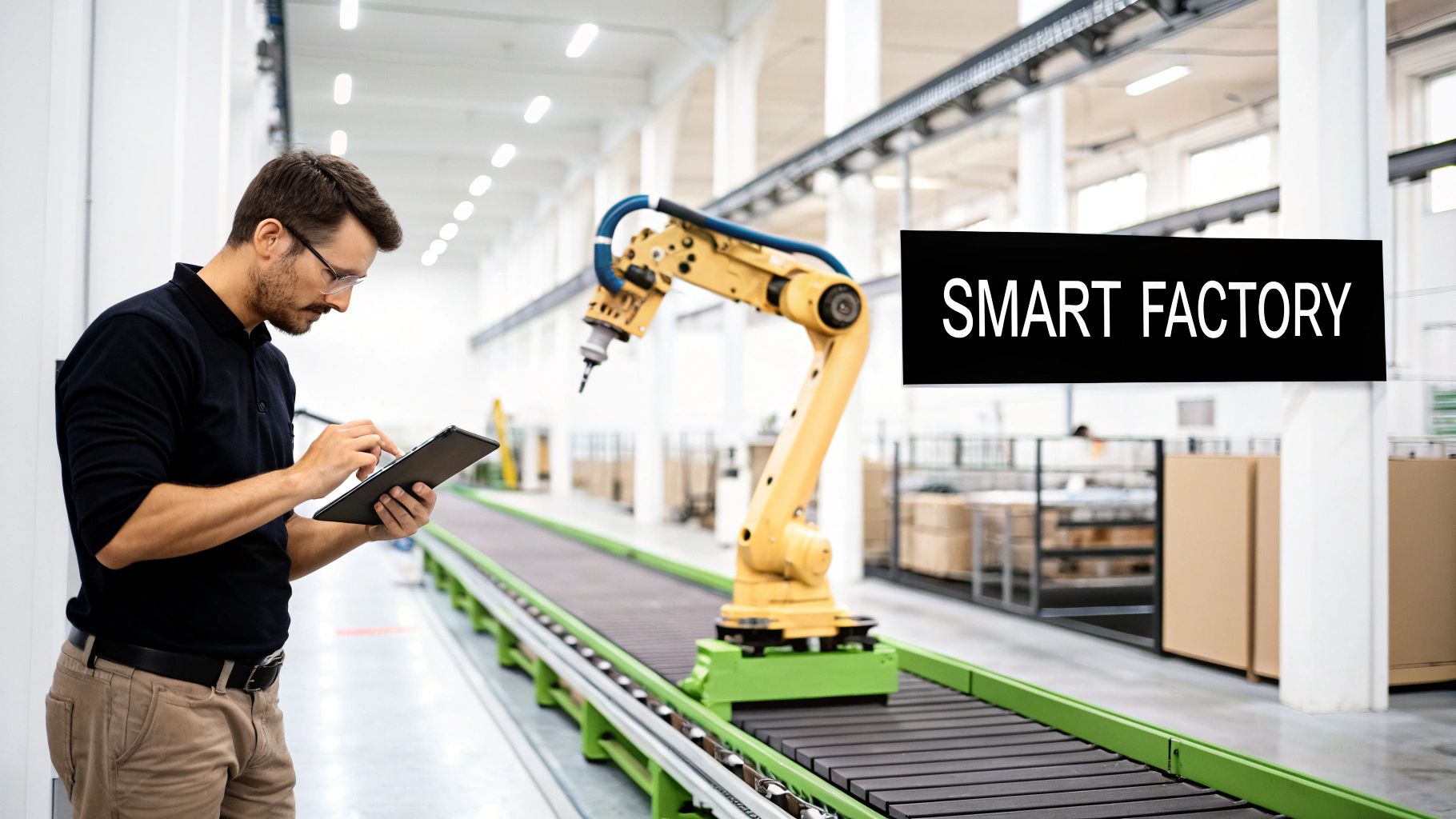
The core value of machine learning in manufacturing is its ability to spot patterns invisible to the human eye. By analyzing data from IoT sensors, production systems, and quality logs, ML models detect faint signals that predict major issues. This is a game-changer for operational efficiency.
For example, an ML model can detect imperceptible vibrations or a minor temperature increase in a CNC machine days before a failure. It triggers a maintenance alert, turning a potential line-stopping disaster into a scheduled repair. This moves maintenance teams from constant firefighting to strategic asset management, directly boosting uptime.
Key Use Cases and Their Business Impact
The practical applications of machine learning deliver value across the entire production lifecycle. Here are the most impactful use cases delivering results today.
- Predictive Maintenance: By analyzing real-time equipment data, ML models predict machine failures before they happen. Outcome: Eliminates costly unplanned downtime and allows you to schedule repairs on your terms.
- Quality Control and Defect Detection: Using computer vision, ML models inspect products on the assembly line with superhuman speed and precision. They spot microscopic cracks or flaws a human eye would miss. Outcome: Slashes scrap rates, reduces warranty claims, and ensures consistent product quality.
- Supply Chain and Inventory Optimization: ML algorithms analyze historical sales, market trends, and external factors to forecast demand with incredible accuracy. Outcome: Optimizes inventory, cuts holding costs, and prevents costly stockouts.
- Process Optimization: ML models analyze production parameters like temperature, pressure, and speed to find the optimal settings for maximum output. Outcome: Increases yield, reduces energy consumption, and ensures consistent product quality.
The momentum is real. As of 2024, 35% of manufacturing firms have adopted AI, focusing on predictive maintenance and quality control. The results are clear: predictive maintenance can cut maintenance costs by up to 25% and slash unexpected downtime by 30%. You can explore these AI manufacturing statistics to see the trends.
Each use case directly targets a major business challenge, turning operational data into a competitive advantage.
Building a Data Strategy That Actually Works
Successful machine learning outcomes are built on a solid data foundation. Your strategy is the blueprint for turning raw factory data—from sensor readings to production logs—into a powerful asset for driving operational improvements.

Modern data platforms like Snowflake break down the data silos that have plagued manufacturing for years. This unification is what enables sophisticated ML models to analyze complete, meaningful datasets.
Bridging the OT and IT Divide
A primary hurdle is the gap between Operational Technology (OT) on the factory floor (SCADA, PLCs) and Information Technology (IT) in the back office. For ML to work, these two worlds must communicate seamlessly.
The goal is a unified data pipeline. For example, sensor data from a conveyor belt (OT) must be instantly correlated with its maintenance history from your asset management system (IT). Fusing this data allows an ML model to accurately predict a future breakdown. Success requires clear governance from the start, defining data ownership, access, and security.
From Raw Data to Actionable Datasets
Simply collecting data is not enough; it must be clean, structured, and relevant. An effective data strategy involves key stages:
- Data Capture: Use Industrial Internet of Things (IIoT) sensors to gather high-frequency data like temperature and vibration. Ensure sensors are properly calibrated to avoid the "garbage in, garbage out" problem.
- Data Aggregation: Centralize data from ERP, MES, and quality control databases into a single data warehouse or data lakehouse.
- Data Preparation: This crucial stage often consumes 80% of project time. It involves cleaning missing values, normalizing formats, and labeling data for supervised learning (e.g., tagging sensor readings as "normal" or "failure event").
This foundational work is why industry leaders are investing heavily in data analytics (40%), cloud computing (29%), and IIoT (27%). These are the essential building blocks for effective machine learning, as detailed in Deloitte's 2025 Smart Manufacturing Survey.
Deciding Between Edge and Cloud Processing
The question of where to process data depends on how quickly you need an answer. The best strategy often uses both.
Edge Computing This involves processing data directly on or near the machine. It is ideal for tasks requiring an instantaneous response.
- Use Case: A computer vision system on an assembly line detects a defect. A model running on an edge device instantly triggers an actuator to remove the faulty product.
- Outcome: Achieves near-zero latency, reduces data transmission costs, and ensures continuous operation even if the internet connection fails.
Cloud Computing Here, data is sent to a centralized cloud platform for heavy-duty storage and processing. This is built for complex tasks that are not time-sensitive.
- Use Case: Aggregating years of historical sensor data from hundreds of machines to train a complex predictive maintenance model.
- Outcome: Provides virtually unlimited scalability for storage and computation, enabling the training of powerful, large-scale models. We explored this in our case study on handling large-scale time-series data with Snowflake.
Key Takeaway: A hybrid approach wins. Use the edge for real-time action on the factory floor and the cloud for heavy-duty model training and large-scale analytics. This delivers both speed and power.
Choosing Machine Learning Models for Your Use Case
Selecting the right machine learning model means matching the tool to the job. Instead of getting lost in algorithms, focus on mapping specific manufacturing problems to the models best suited to solve them, driving real-world outcomes.

The goal isn't to build a perfect model, but one that is good enough to solve a real problem and deliver business value. A simple, reliable model that prevents a single line stoppage is infinitely more valuable than a complex one that's impossible to maintain.
Matching Models to Common Manufacturing Problems
Different challenges require different analytical tools. Predicting when a machine will fail is a regression problem, while identifying a product as "good" or "defective" is a classification problem.
Here are some of the most effective model-problem pairings:
- Predicting Equipment Failure: To predict the remaining useful life (RUL) of a machine, Random Forest or Gradient Boosting models are excellent. They effectively analyze complex sensor data to spot patterns that precede a failure.
- Automating Visual Quality Control: For spotting microscopic defects on a production line, Convolutional Neural Networks (CNNs) are the gold standard. Trained on thousands of images, a CNN can identify flaws with superhuman speed and accuracy.
- Optimizing Production Parameters: To find the perfect combination of temperature, pressure, and speed for maximum yield, Reinforcement Learning is a powerful tool. It allows an "agent" to learn the optimal settings through trial and error in a simulated environment, reducing waste and improving consistency.
The right model delivers an immediate, measurable impact. Industry 4.0 leaders using AI for demand forecasting and equipment routing report two to three times improvements in productivity and a 30% reduction in energy consumption. This highlights the tangible benefits of AI adoption when smart choices are made.
A Quick-Reference Guide: Models for Manufacturing
This table maps common manufacturing use cases to the right model type and the key metric for measuring success.
Manufacturing Use CaseRecommended ML Model TypeKey Performance MetricPredictive MaintenanceRegression (e.g., Random Forest, Gradient Boosting)Remaining Useful Life (RUL) Accuracy, Mean Absolute ErrorVisual Quality InspectionClassification (e.g., Convolutional Neural Networks)Precision, Recall, F1-ScoreDemand ForecastingTime-Series Forecasting (e.g., ARIMA, LSTM)Mean Absolute Percentage Error (MAPE)Production Yield OptimizationReinforcement Learning, RegressionYield Percentage, Overall Equipment Effectiveness (OEE)Supply Chain OptimizationOptimization Algorithms (e.g., Linear Programming)On-Time Delivery Rate, Inventory Turnover
Use this as a starting point for discussions with your data science team.
The Build vs. Buy Dilemma
You will face a strategic choice: build a custom model or buy an off-the-shelf solution. The right answer depends on your needs, team skills, and the uniqueness of your problem.
When to Buy (Off-the-Shelf Tools) For common, well-defined problems, pre-built solutions are the fastest path to value.
- Use Case: A predictive maintenance solution for standard industrial pumps.
- Outcome: Rapid implementation with pre-trained models and data pipelines, reducing the need for a large in-house data science team.
When to Build (Custom Development) If your process is unique or a source of competitive advantage, a custom model is a better long-term investment.
- Use Case: A proprietary quality inspection system for a new composite material with unique defect types.
- Outcome: A tailored solution that addresses your specific operational needs, creating a competitive edge that cannot be bought.
Many companies start by buying a solution to score an early win, then use that success to justify building a more strategic, custom model later.
From Pilot to Production with MLOps
A great machine learning model is useless until it's deployed on the factory floor, preventing downtime or cutting defect rates. MLOps (Machine Learning Operations) is the discipline that bridges the gap between a promising pilot and a production-grade asset. It provides a framework to make your ML workflows repeatable, manageable, and reliable in a dynamic factory environment.
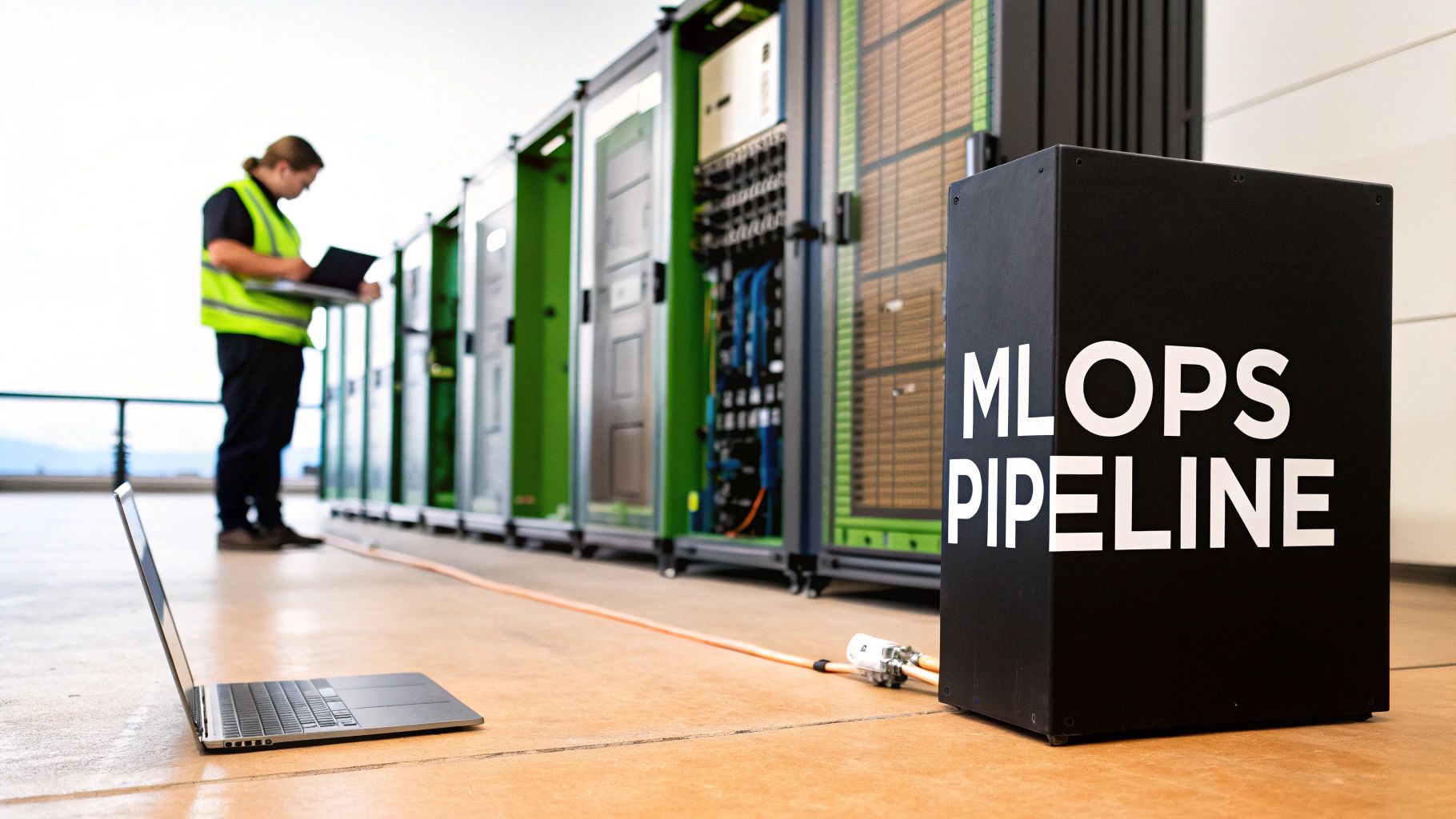
This diagram from ML-Ops.org shows that deployment is not the end goal. It's the beginning of a continuous loop of monitoring, retraining, and redeploying to keep the model performing optimally.
Deployment Strategies for the Factory Floor
How you deploy a model depends on how fast you need an answer.
- Edge Deployment for Instant Decisions: For tasks like real-time defect detection on a high-speed conveyor, models must run on edge devices (e.g., a camera or local server). This bypasses network latency, enabling immediate action.
- Cloud Deployment for Scalable Services: For less time-sensitive tasks like updating a plant-wide demand forecast, models are often deployed as scalable services in the cloud. This approach is ideal for computationally intensive jobs that require massive processing power.
Building an Automated Process
The core of MLOps is automation. A robust MLOps pipeline automates key steps to ensure every deployment is consistent and reliable. It must handle:
- Automated Retraining: Automatically trigger retraining when new data is available or when model performance dips below a set threshold.
- Version Control: Track versions of your data, models, and experiments to ensure reproducibility and allow for instant rollbacks if a new model underperforms.
- CI/CD for ML: Use a Continuous Integration/Continuous Deployment (CI/CD) pipeline to automate testing and deployment, dramatically reducing the time from development to impact.
Detecting and Correcting Model Drift
In a factory, you must manage model drift—the natural decay of a model's performance as real-world conditions change. A new raw material supplier or a recalibrated machine can make a once-accurate model obsolete.
Key Takeaway: An unmonitored model is a ticking time bomb. Without a system to detect drift, your ML application could start making bad predictions, silently costing you a fortune.
Your MLOps strategy must monitor for two types of drift:
- Concept Drift: The relationship between inputs and outcomes changes (e.g., a new machine failure mode appears that wasn't in the training data).
- Data Drift: The statistical properties of your input data change (e.g., a sensor starts degrading and sending different readings).
By constantly monitoring performance metrics and input data, your MLOps system can automatically flag drift and trigger an alert or an automated retraining pipeline. This proactive cycle ensures your machine learning in manufacturing systems remain trustworthy and continue to deliver ROI.
Proving the Business Value of Your ML Project
To get any machine learning in manufacturing initiative funded, you must focus on business outcomes. Technical specs don't persuade executives; a clear business case with measurable financial gains does.
Instead of saying "we can predict failures," say "we will cut unplanned downtime by 20%, saving $1.2 million a year." This is the language of business value. Connect your ML project directly to core goals like operational efficiency and profitability.
Calculating the Return on Investment
A compelling ROI is anchored in your factory's actual data. Pinpoint the key performance indicators (KPIs) your ML model will impact and use simple formulas to quantify that impact.
- Predictive Maintenance ROI: Calculate your current cost of unplanned downtime: (Avg. Downtime Hours) x (Lost Production Value/Hour) + (Avg. Emergency Repair Cost). Your projected savings are this total cost multiplied by the expected percentage of downtime eliminated.
- Quality Control ROI: Calculate your current scrap cost: (Annual Production Volume) x (Scrap Rate %) x (Cost per Unit). Your model's value is the reduction in this cost, plus savings from fewer warranty claims.
- Supply Chain ROI: The ROI comes from slashing inventory holding costs and capturing sales previously lost due to stockouts.
These tangible calculations transform your proposal from a tech expense into a strategic investment. Businesses adopting smart manufacturing are already reporting 10% to 20% improvements in production output, according to recent smart manufacturing survey findings.
Aligning ML with Strategic Company Goals
An ML project that drives a top-level business objective is unstoppable. If the company goal is to boost gross margin by 3%, show exactly how your yield optimization model contributes by reducing raw material waste.
When you frame your ML initiative this way, it is no longer just a data science project. It becomes a core part of the CFO's plan to improve financial performance or the COO's strategy to boost operational excellence.
This alignment secures budget and gains powerful allies. When senior leaders see how your work helps them achieve their goals, you gain champions who can clear roadblocks. To learn more about how tech investments drive factory performance, see our guide on using smart controllers to boost profitability.
Let’s Clear the Air: Your Toughest ML in Manufacturing Questions Answered
When I talk with manufacturing leaders, the same practical questions always come up. Forget the hype—let's get straight to the real answers you need to move your machine learning in manufacturing initiatives from the whiteboard to the factory floor.
How Much Data Do We Really Need to Get Started?
There’s no magic number. Focus on quality and relevance, not just volume.
For a predictive maintenance model, a good starting point is several months of continuous sensor data (e.g., vibration, temperature) correlated with maintenance logs. For a visual inspection system, you'll want at least a few thousand high-resolution images showing both good parts and a wide variety of defects.
The best first step is to pick one high-value problem and analyze the data you already have. A quick exploratory analysis will tell you if you have a solid foundation for a pilot and will immediately highlight any critical data gaps.
What Are the Biggest Hurdles in a Factory Setting?
The technology is rarely the hardest part. The real challenges are operational and cultural.
The most common roadblock is data readiness—bridging the gap between legacy OT systems (SCADA, PLCs) and modern IT infrastructure. This integration is non-negotiable and requires upfront effort to break down data silos.
Next is the skills gap. Finding people who understand both manufacturing processes and data science is challenging.
Finally, change management is crucial. You need buy-in from operators and engineers on the floor. If they don't trust the model's recommendations or see it as a tool to help them, the project will fail.
Don't underestimate the human element. A model with 99% accuracy is worthless if the team ignores its insights. Success depends on how well the technology is integrated into their daily workflow.
Can We Do This Without a Team of PhDs?
Absolutely. The barrier to entry has dropped significantly, allowing companies to start without a large team of data scientists.
While specialists are needed for highly complex or proprietary models, many valuable manufacturing problems can be solved with AutoML (Automated Machine Learning) platforms.
- Cloud-Based AutoML: Tools from AWS, Google Cloud, and Azure empower existing engineers to build and deploy solid models with focused training.
- Low-Code/No-Code Platforms: A growing ecosystem of platforms is built for domain experts, not data scientists, offering intuitive interfaces for common use cases like predictive maintenance.
Start here. Use these accessible tools to score a quick win and demonstrate tangible value. That success will build a compelling business case for expanding your data science team as your ML program matures.


