
Machine learning development services build a strategic partnership to transform your company's data into a tangible, competitive edge. These services focus on creating, deploying, and maintaining custom AI solutions that solve specific business challenges. The goal isn't just technology; it's about turning raw information into predictable, actionable outcomes that deliver measurable business results.
From Data Puzzles to Business Performance

Many businesses sit on a goldmine of data but struggle to unlock its value. Machine learning development services bridge that gap, connecting untapped potential to real-world performance. Instead of a generic product, these services deliver an end-to-end solution tailored to your operational needs.
Your data—from customer behavior to operational logs—is like a complex puzzle. An ML partner assembles those pieces to reveal hidden patterns and predict future trends. This process transforms your data from a static asset into a dynamic engine for growth and efficiency.
The Core Outcome: Actionable Insights
The objective is to move beyond historical reports ("what happened") to predictive and prescriptive analytics ("what will happen, and what should we do?"). This is achieved by building systems that learn from your data to automate decisions, forecast trends, and pinpoint opportunities humans might miss.
Use Case: An e-commerce company implements a custom recommendation engine.
- Outcome: A 15% increase in average order value by personalizing the customer journey in real-time.
A successful machine learning initiative is defined by its business impact. The focus is on delivering tangible outcomes, such as reducing operational costs by 20%, improving forecast accuracy by 30%, or creating new revenue streams.
The Journey from Concept to Continuous Value
Engaging with machine learning development services is a lifecycle, not a one-off project. It starts by identifying a high-impact business problem and moves through key stages to deliver compounding value.
This journey ensures a reliable business tool that delivers sustained results through four key steps:
- Strategic Data Preparation: Cleaning and organizing data for high-quality modeling.
- Custom Model Building: Developing algorithms fine-tuned to your specific challenge.
- Reliable System Deployment: Integrating the model into existing workflows for autonomous operation.
- Ongoing Performance Monitoring: Continuously tracking model accuracy and retraining with new data.
The Four Pillars of an ML Project Lifecycle
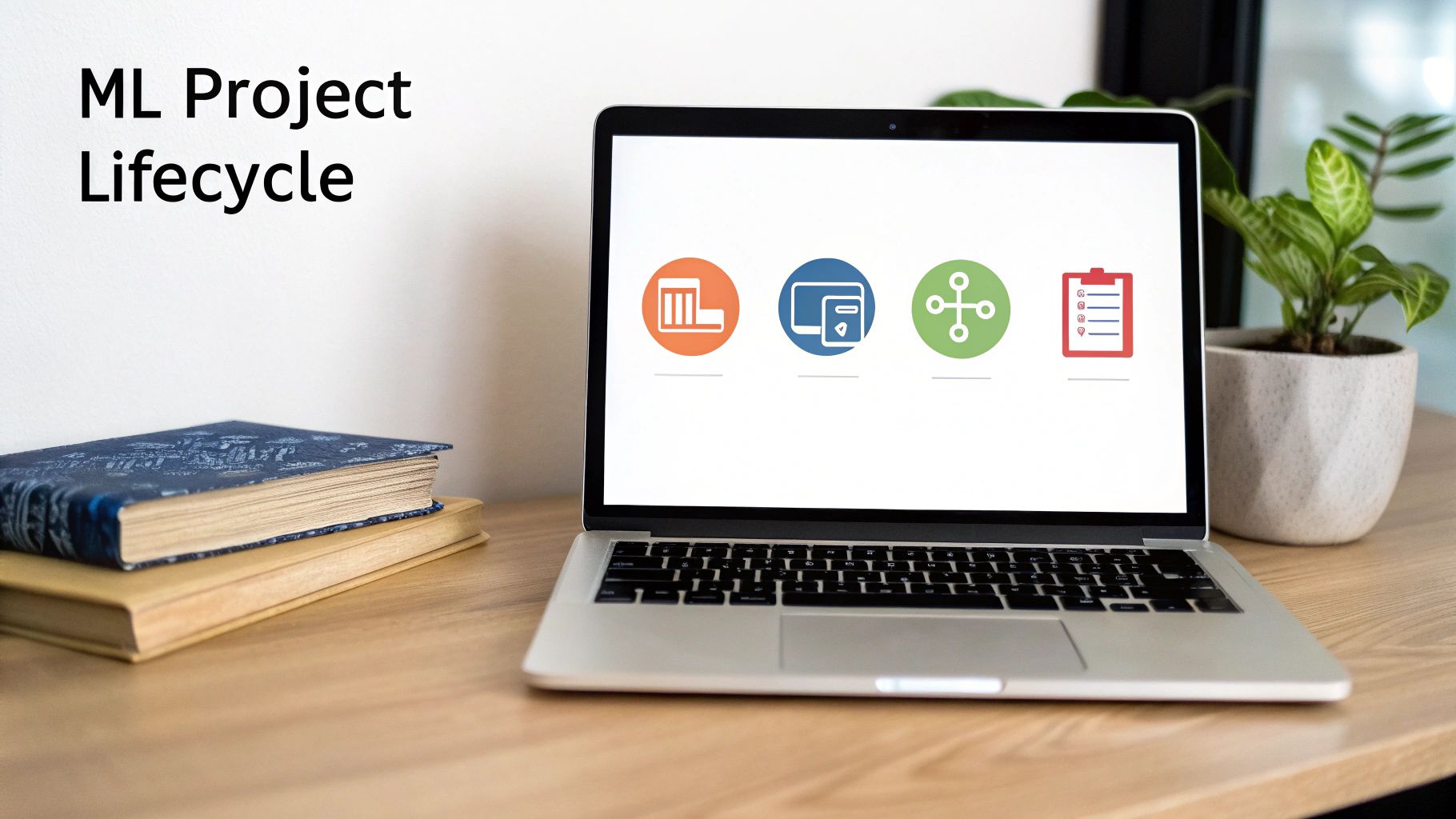
Delivering a machine learning solution that generates real value is a structured journey. Every impactful ML project is built on four distinct pillars, ensuring a concept evolves into a reliable business tool that grows with your organization. This framework manages risk, guarantees quality, and maximizes the return on your data investment.
The Four Pillars of Machine Learning Development
Project PhasePrimary ObjectiveKey Business OutcomeData EngineeringCollect, clean, and structure raw data.A reliable, high-quality dataset ready for model training.Model DevelopmentBuild a model that solves the business problem.A validated model proven to perform on your data.MLOps & DeploymentIntegrate the model into business systems.A live solution generating real-time business value.Monitoring & SupportEnsure the model remains accurate and effective.Sustained ROI and long-term reliability.
Pillar 1: Data Engineering
Before an algorithm can learn, the data must be right. Data engineering is the foundation where raw, chaotic information is gathered, cleaned, and structured into a high-quality asset. This phase involves sourcing data from diverse systems (CRMs, IoT sensors), correcting inconsistencies, and identifying the most important data points (features) for accurate predictions. The result is a clean, dependable dataset that powers the entire project.
Pillar 2: Model Development
With quality data in hand, model development begins. Data scientists test various algorithms to find the optimal match for your business problem. The process involves training and validating multiple models to achieve the highest possible accuracy.
Use Case: A retail company wants to reduce customer churn.
- Process: Test a dozen algorithms to find the one that best predicts which customers are likely to leave.
- Outcome: A validated model that provides an actionable list of at-risk customers for proactive engagement.
A model is only as good as the business question it answers. This phase translates a real-world need—like "How do we reduce equipment failures?"—into a mathematical solution that delivers a clear, actionable answer.
Pillar 3: MLOps and Deployment
A predictive model is useless on a developer's laptop. MLOps and Deployment integrates the model into your real-world business processes. This pillar builds the automated pipelines needed to plug the model into your existing software, where it can start generating value.
Use Case: A bank needs to stop fraudulent transactions.
- Action: An anomaly detection model is integrated into the live payment processing system.
- Outcome: Fraudulent transactions are flagged and blocked in milliseconds, saving money and protecting customers.
Pillar 4: Monitoring and Support
A model's accuracy can degrade over time as data patterns shift—a problem known as model drift. Monitoring and support ensures the model remains effective long after launch. This involves continuously tracking performance, setting up alerts for accuracy degradation, and retraining the model with fresh data. This ongoing governance is a non-negotiable part of professional machine learning development services and protects your investment.
This end-to-end management is why the global machine learning market is projected to hit $192 billion in 2025. You can discover more about these industry trends in this comprehensive market overview.
Machine Learning Use Cases That Drive Business Growth

The power of machine learning development services is most evident when applied to tangible business problems. It's about delivering measurable outcomes that impact revenue, efficiency, and customer satisfaction. Across industries, companies are using predictive models to anticipate future events and automate complex decisions.
Finance: Real-Time Fraud Detection
Traditional rule-based systems are no longer sufficient to combat sophisticated financial fraud. Machine learning provides a dynamic, intelligent defense.
- Problem: A credit card processor was losing millions to fraudulent charges and frustrating customers with a high rate of false positives.
- Solution: An ML development partner built a real-time anomaly detection model trained on millions of historical transactions. The model learned the subtle patterns of both normal and fraudulent behavior.
- Outcome: Fraudulent losses were cut by 40%, and false positives dropped by 60%, saving money and dramatically improving the customer experience.
Healthcare: Predictive Analytics for Better Outcomes
In healthcare, identifying high-risk patients early can transform outcomes. Predictive analytics enables a proactive approach to patient care.
- Problem: A hospital network struggled with high readmission rates for patients with chronic conditions like heart failure.
- Solution: A predictive model was developed to analyze electronic health records (EHR), generating a risk score for each patient upon admission.
- Outcome: The system identified high-risk patients with 85% accuracy, allowing care teams to implement personalized discharge plans. This led to a 25% reduction in 30-day readmissions.
By shifting from a reactive to a predictive model of care, healthcare providers can allocate resources more effectively, prevent adverse events, and ultimately save lives.
Retail: Hyper-Personalization to Drive Sales
In the competitive retail landscape, personalization is key. Recommendation engines powered by machine learning create tailored shopping experiences that boost sales.
- Problem: An e-commerce brand had high traffic but low conversion rates due to generic product recommendations.
- Solution: A smart recommendation engine was built to analyze browsing history, past purchases, and user behavior to generate personalized product suggestions.
- Outcome: The new system drove a 15% increase in conversion rates and a 20% lift in average order value, building customer loyalty.
From optimizing energy use in smart buildings, as detailed in our case study on how AI transforms smart buildings, to stopping fraud, these examples show that machine learning delivers clear business value.
Choosing the Right ML Development Partner
Selecting a partner for your machine learning development services is a strategic decision. The right team becomes invested in your business success, while the wrong one can lead to stalled projects and wasted budgets. A top-tier firm is obsessed with delivering business results, not just building algorithms.
Look Beyond the Algorithm
A true strategic partner translates your business challenges into a production-ready solution with a clear, measurable ROI.
To find the right partner, evaluate them on three critical points:
- Proven Industry Experience: Do they understand the specific data challenges, nuances, and regulatory hurdles of your sector?
- Modern Data Platform Expertise: Can they build scalable solutions on modern platforms like Snowflake to handle massive datasets?
- A Robust MLOps Culture: Do they have a strong practice for automating deployment, monitoring performance, and ensuring models adapt to new data?
A Practical Checklist for Vetting Potential Partners
Ask targeted questions to get past the sales pitch and understand a vendor's true capabilities.
Essential Questions for Your Shortlist
- Industry & Domain Knowledge:
- Walk me through a case study in our industry. What was the business problem and the measurable outcome?
- How do you handle data privacy and regulatory compliance specific to our sector (e.g., GDPR, HIPAA)?
- Technical & Platform Expertise:
- Describe your experience building ML solutions on a modern data platform like Snowflake.
- What is your standard process for MLOps, including model deployment, monitoring, and retraining?
- Process & Engagement Model:
- What engagement models do you offer, and which would you recommend for our project?
- How do you measure project success beyond model accuracy? What business KPIs do you track?
- What does your post-launch support and maintenance include?
The goal is to find a partner who thinks like a business owner. They should be as focused on your key performance indicators—like reducing costs or increasing customer lifetime value—as they are on technical metrics.
A strong partner delivers a sustainable, high-impact business asset. Explore the range of Faberwork's end-to-end technology services to see what a comprehensive partnership looks like.
Understanding Project Costs and Timelines
Securing stakeholder buy-in for a machine learning project requires demystifying the investment. When you engage machine learning development services, you are funding a strategic business outcome. Understanding the breakdown of costs and timelines is crucial for setting clear expectations.
Common Pricing Models Explained
The right pricing structure defines how you collaborate and manage scope.
- Time & Materials (T&M): Flexible model where you pay for actual time and resources spent. Ideal for exploratory projects with evolving requirements.
- Fixed Price: A set price agreed upon upfront for projects with a clearly defined scope. Offers budget predictability.
- Dedicated Team: An entire ML team acts as an extension of your own. Best for complex, long-term projects requiring deep integration.
The right model depends on your project's maturity. T&M is great for an initial proof-of-concept, while a dedicated team is better for scaling a proven solution across the enterprise.
Mapping a Realistic Project Timeline
A typical engagement follows a predictable path from idea to a production system.
- Discovery & Strategy (2–4 weeks): A deep dive into the business problem, data sources, and project goals to define a clear and feasible roadmap.
- MVP Development (3–6 months): Core development focuses on building a minimum viable product (MVP) to solve the primary business challenge and demonstrate value quickly.
- Production Scaling & Integration (Ongoing): After the MVP proves its worth, the focus shifts to refining the model, building robust MLOps pipelines, and integrating the solution into existing workflows for long-term performance.
This phased approach ensures you see a return on investment sooner. The complexity of these stages is driving the growth of tools to accelerate development. The automated machine learning (AutoML) market, valued at $4.65 billion in 2025, is expected to hit $61.23 billion by 2033. You can read more about automated machine learning's rapid expansion on Grand View Research.
Navigating Security and Compliance in Your ML Projects

In a data-driven world, security and compliance are the foundation of any trustworthy machine learning project. Proper governance protects your customers, your reputation, and your bottom line. This requires a proactive strategy to address risks unique to ML, from protecting sensitive training data to securing live models from manipulation.
Safeguarding Data from Day One
Data privacy must be a core requirement from the start, especially with regulations like GDPR and CCPA. A professional development partner will build privacy-preserving techniques directly into the data engineering workflow.
Key practices include:
- Data Anonymization: Stripping personally identifiable information (PII) from datasets to protect individual privacy while still allowing the model to learn from behavior.
- Access Control: Implementing strict, role-based access to ensure only authorized personnel can handle sensitive data.
- Regulatory Alignment: Ensuring the entire project is compliant by design with industry- and region-specific rules.
A "privacy-first" mindset isn't just about avoiding fines; it's about earning customer trust. When people are confident their data is handled responsibly, they are more likely to engage with your services.
Protecting Models from Modern Threats
Once a model is deployed, it can become a target for attacks designed to fool it or steal its logic. Model security focuses on defending against these sophisticated manipulations. A common threat is the adversarial attack, where small, often invisible changes to input data cause the model to make an incorrect prediction. A skilled partner builds defenses against these attacks to ensure your model's decisions remain reliable and secure.
Common Questions About ML Development Services
Business leaders considering a machine learning project often have practical questions about resources, returns, and timelines. Here are direct answers to the most common inquiries.
How Much Data Do I Need to Start a Project?
It depends on the problem you're trying to solve. You don't always need a massive "big data" operation. A simple forecasting model might only require a few thousand data points, such as a few years of daily sales figures. In contrast, a computer vision model for manufacturing defect detection could require tens of thousands of labeled images. A good partner will determine the minimum viable dataset needed to build a working proof-of-concept. The focus is on data quality and relevance, not just volume.
What Is a Realistic ROI for a Machine Learning Initiative?
The return on an ML project is tied directly to the business problem it solves. Measure ROI against the KPIs you already track.
Consider these concrete outcomes:
- Cost Reduction: A predictive maintenance model reduces equipment downtime by 20%.
- Revenue Growth: A recommendation engine increases average order value by 15%.
- Efficiency Gains: Automating a data entry task frees up hundreds of employee hours monthly.
A realistic ROI is one that appears on your existing business dashboard.
Successful ML projects have a clear line to a core business metric. The goal isn't just 99% model accuracy; it's to build a system that moves a number your C-suite cares about.
Do I Need to Hire My Own Data Scientists?
Not necessarily, especially when starting out. Partnering with a specialized machine learning development services firm provides immediate access to an expert team, bypassing the high costs and lengthy process of hiring in-house. A development partner offers a complete team with skills in data engineering, MLOps, and project management, ensuring your model becomes a robust, well-maintained system that delivers long-term value.
How Quickly Can We Expect to See Results?
You can see tangible results faster than you might think. A phased approach allows for the development of a Minimum Viable Product (MVP) within three to six months. The purpose of an MVP is to solve the core business problem quickly and prove the value of the solution. From there, the model can be refined and scaled, compounding the returns over time. The key is to deliver value in incremental steps rather than waiting for a "perfect" solution that may never arrive.


