A dispatcher starts the morning with a full queue, a phone that won't stop ringing, and a transport management system that's already behind reality. A driver has crossed a customer geofence, but the arrival event hasn't reached the dock schedule. A trailer waits at a cross-dock, the warehouse team updates a spreadsheet, and a buyer asks for a revised delivery time before anyone has a reliable answer.
That pattern is often blamed on insufficient automation. In practice, the deeper problem is usually disconnected automation. A fleet may have telematics, a warehouse may have robotics, and the planning team may have a capable TMS, yet each system can still operate as an island. Logistics automation creates value when those systems share usable data and act on the same operational state.
The market's scale reflects that broader reality. One forecast values logistics automation at USD 88.09 billion in 2025, with a projected USD 260.75 billion by 2034 and a 12.80% CAGR, while another estimate places it at USD 90.72 billion in 2026 and USD 132.74 billion by 2031. The estimates differ, but both describe a major enterprise technology category rather than a narrow warehouse robotics niche. (Fortune Business Insights' logistics automation market forecast)
When Manual Coordination Stops Scaling
A fleet can survive manual coordination for a while. Dispatchers know which drivers need a call, planners recognize recurring delays, and warehouse supervisors compensate for incomplete system data through experience. The operating model becomes fragile when volume, locations, carriers, and customer commitments grow faster than people can relay information.
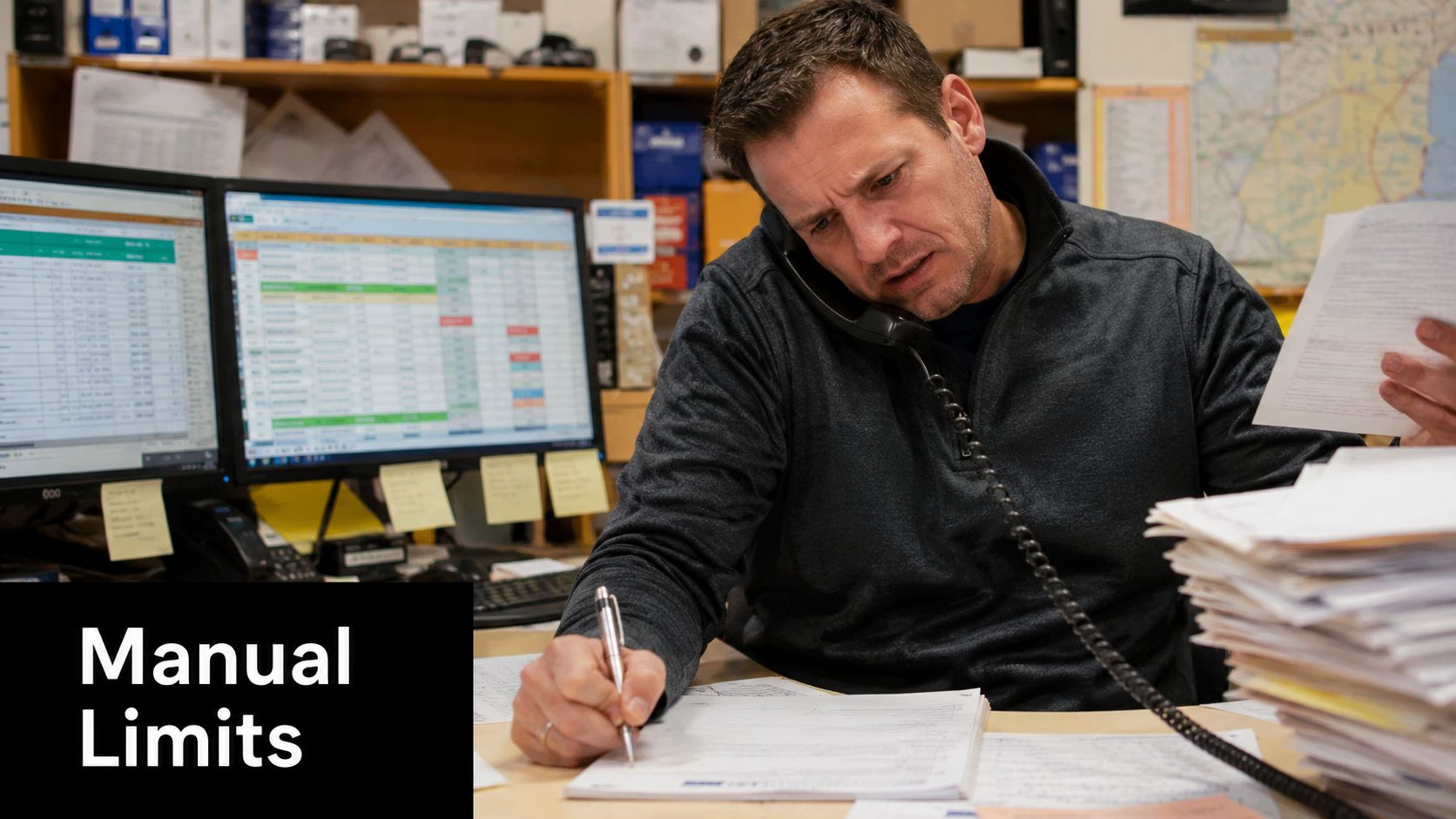
A typical Tuesday exposes the weakness. A truck reaches a site, but a missed geofence entry leaves the TMS showing the vehicle as en route. The cross-dock doesn't assign the right door, the trailer sits idle, and an employee manually reconciles an EDI message with a spreadsheet. By the time the retail buyer receives a rescheduling update, several people have touched the same exception without creating a dependable record.
The symptoms leaders see first
Operational leaders usually notice the consequences before they identify the architecture problem:
- Exception rates rise: More shipments require human investigation, calls, or manual status correction.
- TMS snapshots go stale: Planners make decisions using yesterday's location, appointment, or inventory state.
- Telematics islands multiply: Vehicle data remains trapped in a vendor portal instead of reaching dispatch, customer service, or analytics.
- Ownership becomes unclear: Operations, IT, carriers, and warehouse partners each hold part of the truth.
These symptoms create a costly relay race. One employee reads a sensor event, another interprets it, a third changes a schedule, and a fourth communicates the outcome. Every handoff adds delay and creates an opportunity for inconsistent identifiers, duplicate updates, or an exception that disappears between systems.
Practical rule: Automate the decision path, not just the individual task.
Logistics automation should move the operation from reactive coordination to continuous orchestration. A vehicle event should update the shipment state, trigger a planning rule, notify the warehouse, and expose the result to customer-facing teams without requiring a dispatcher to translate the same fact repeatedly.
That doesn't eliminate human judgment. It reserves human attention for exceptions that require negotiation, safety decisions, or commercial discretion. The control layer, including event models, integration contracts, workflow rules, and exception ownership, determines whether the robots and AI can contribute at scale.
What Logistics Automation Actually Means
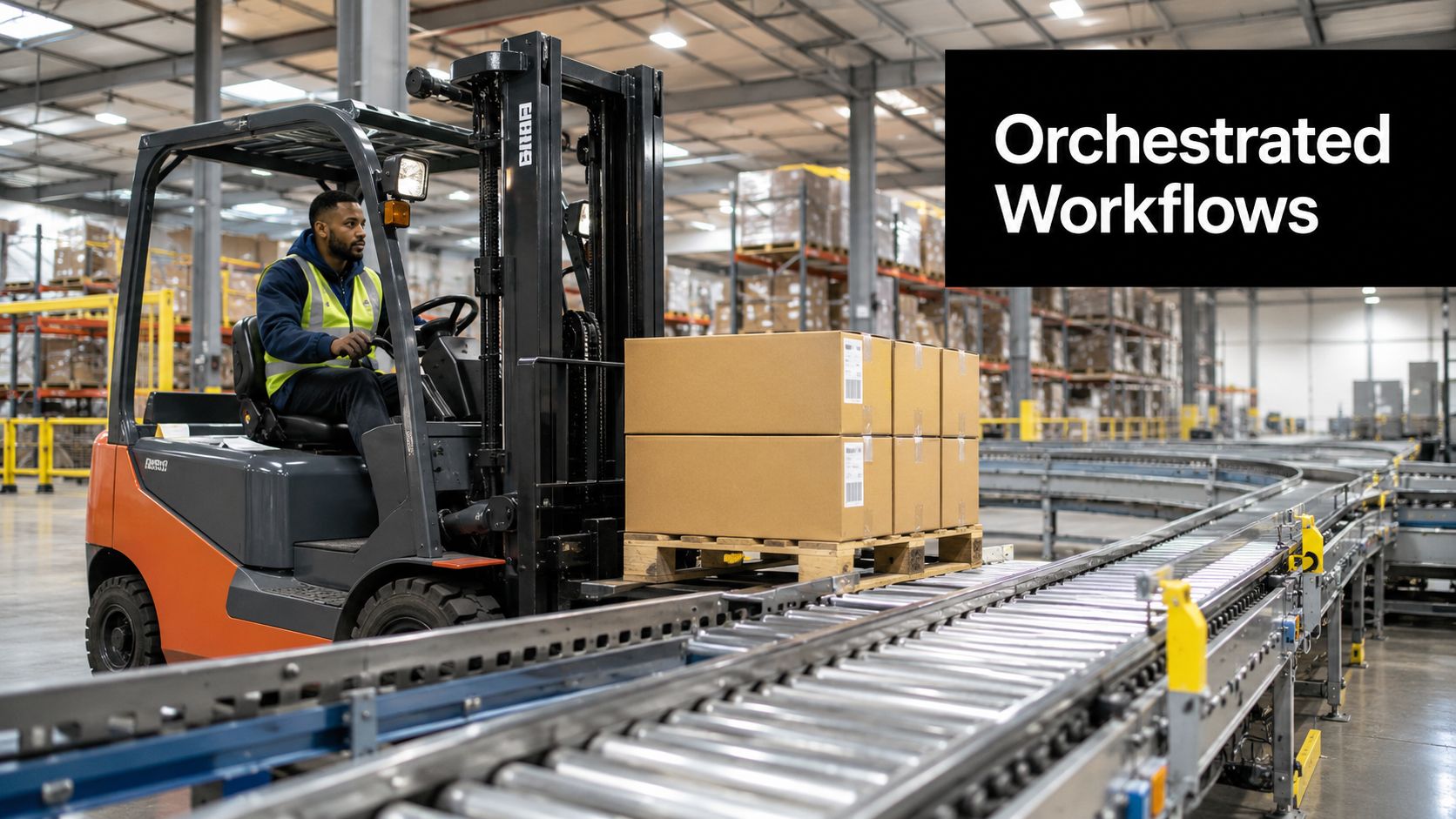
The phrase often brings robots to mind, but mechanized movement is only the starting point. Conveyors, pallet systems, automated storage and retrieval systems, forklifts, and guided vehicles move physical goods. Software automation captures what happened, determines what should happen next, and sends instructions to the people or machines responsible for execution.
The history of the field shows that progression clearly. A warehouse automation history traces the conveyor belt milestone to 1795, pallet standards to the late 1930s, AGVs to 1953, a semi-automated high-density storage and retrieval system to 1962, and an early warehouse management system concept to 1967. Those milestones represent transport, standardization, autonomous movement, and information control developing in stages. (Warehouse automation history and market background)
Follow one refrigerated shipment
Take a refrigerated shipment from order capture to proof of delivery. Four layers participate:
- Physical assets: A trailer, refrigeration unit, loading equipment, dock, and delivery vehicle perform the work.
- Telemetry and sensors: GPS, temperature sensors, door sensors, and geofences produce events about location and cargo conditions.
- Orchestration software: The TMS, WMS, workflow rules, RPA bots, and potentially Agentic AI decide how to route, stage, prioritize, or escalate the shipment.
- Analytics: A data platform combines shipment, vehicle, warehouse, carrier, and customer records so teams can measure performance and train models.
The important distinction is between data capture and operational actuation. A sensor that reports a temperature deviation is useful only when a workflow classifies the event, checks the shipment rules, alerts the right owner, and records the resolution. Likewise, an AI recommendation is not automation until a system can safely apply it or route it to an accountable operator.
Agentic AI belongs inside the orchestration layer. It can help triage exceptions, summarize context, recommend actions, or initiate approved workflows. It isn't a substitute for clean identifiers, reliable APIs, clear permissions, or an auditable event history.
For a practical overview of how software connects shipping tasks across planning and execution, the Routelink blog on shipping automation provides useful context. The working definition used here is straightforward: logistics automation is the continuous capture, integration, and software-driven actuation of decisions across transport, warehousing, and fulfilment operations.
The Technology Stack Behind Modern Automation
Modern logistics automation works as a layered system. Each tier has a distinct job, and failures occur when teams expect one product to perform the work of the others.
The vehicle and yard edge
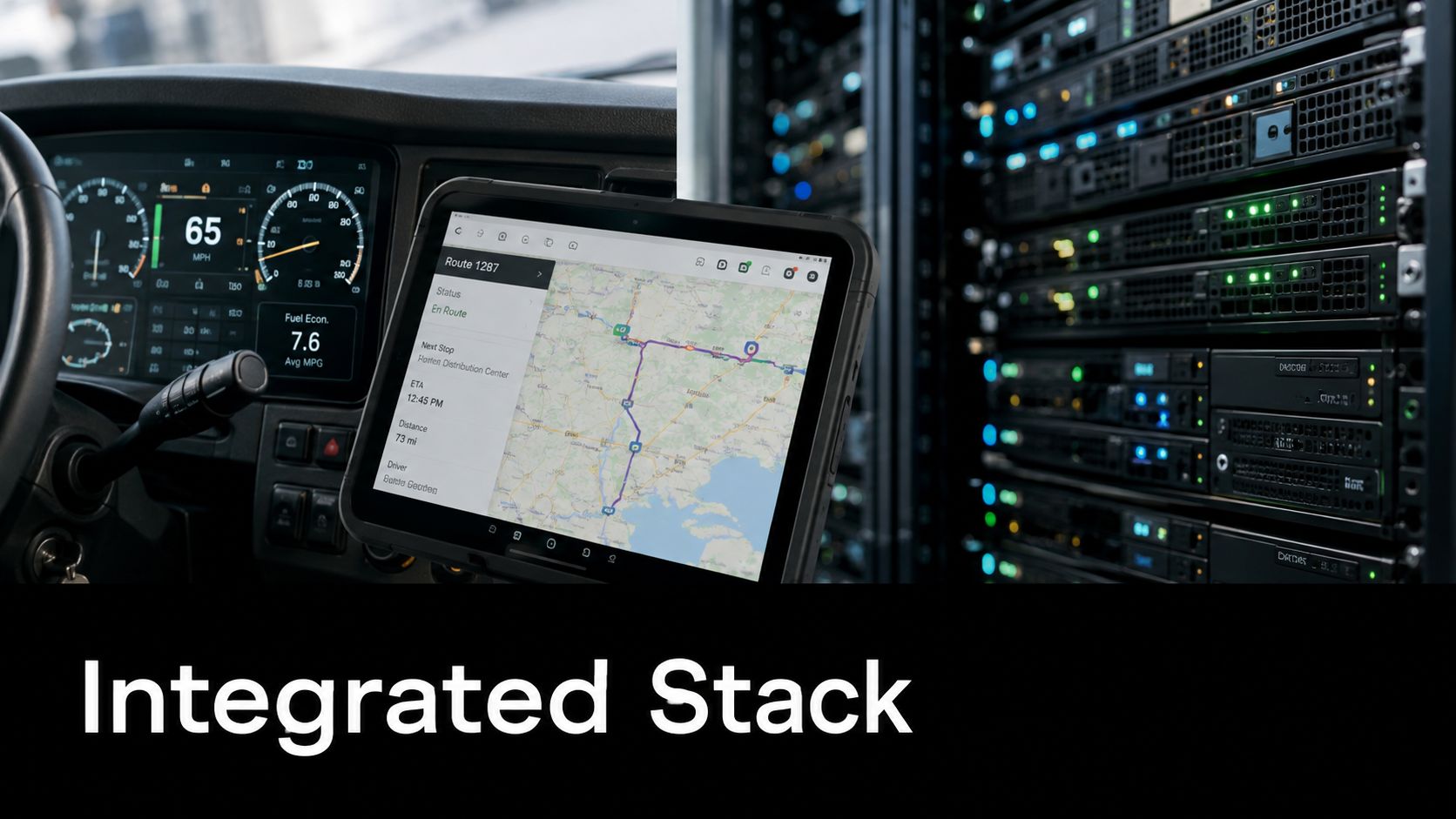
At the edge, telematics devices, GPS, IoT sensors, barcode scanners, cameras, and yard equipment generate operational events. A geofence can detect a vehicle entering a facility. A temperature sensor can report a cold-chain condition. A trailer sensor can indicate whether a door is open.
The edge doesn't decide the entire response. It supplies timely, trustworthy signals with enough context for downstream systems to use them. Poor device configuration, inconsistent timestamps, or weak connectivity can make a complex workflow unreliable.
A fleet geofence illustrates the handoff. The vehicle enters the site, the telematics platform emits an event, and the integration tier converts that event into a canonical arrival message. The TMS can then check appointment status, the WMS can prepare receiving activity, and the yard system can assign a staging location.
The integration tier
APIs, EDI, message brokers, and RPA bots move information between systems. APIs are the preferred route when a platform exposes stable, supported interfaces. EDI remains important where trading partners exchange structured documents. Message brokers help manage event delivery, retries, and asynchronous processing.
RPA has a different role. It can interact with an application that lacks a usable API, but it depends on screen layouts, credentials, and predictable workflows. Treating RPA as a universal integration strategy creates maintenance debt. A bot may bridge a gap quickly, yet a durable program should still document the data contract and pursue a more reliable interface where practical.
For compliance workflows that depend on timely vehicle data, a remote tachograph download guide offers useful operational context. The same principle applies elsewhere: automation is only dependable when the source data arrives consistently and the receiving system knows how to interpret it.
The orchestration tier
The TMS, WMS, WES, route optimization engine, and workflow services turn events into decisions. Agentic AI can support exception triage, but the surrounding rules must define what it may read, recommend, change, and escalate.
Consider an arrival event with no matching appointment. A safe workflow can verify the shipment identifier, check the planned route, query dock availability, and create a task for a planner. It shouldn't reassign a delivery or alter a customer commitment without the required approvals.
The following video offers a visual reference for how connected systems can support fleet and operational workflows.
The analytics tier
Snowflake or an equivalent cloud data platform belongs above the transactional systems. It shouldn't replace the TMS or WMS. Its role is to bring telematics, TMS, ERP, warehouse, and carrier data into a governed analytical environment for KPI reporting, time-series analysis, and model training.
The integration tier is typically the bottleneck during enterprise scaling. Robots can execute a defined task, but scale introduces more identifiers, sites, vendors, event types, exception paths, and ownership questions. The winning architecture makes those relationships explicit before expanding the hardware footprint.
Business Outcomes and KPIs That Matter
Automation earns its place through operating results, not a convincing demonstration. A faster robot has little value if appointment adherence declines, inventory records stay inaccurate, or planners spend their shifts repairing failed integrations. The control layer must connect each event to a measurable business response.
Four KPI groups give executives a balanced view.
Cost efficiency covers cost per mile, cost per shipment, fuel consumption, and empty-mile ratio. Telematics and route optimization expose route drift and unused capacity. A Snowflake-backed analytical layer then compares cost-per-mile movement across lanes, customers, equipment, and carriers.
Service quality includes on-time delivery, order accuracy, dock-to-stock time, and proof-of-delivery completion. WMS workflows and automated shipment lifecycle management can connect booking confirmations, documentation, customs clearance, tracking, and delivery updates in one flow. (Shipment lifecycle automation examples)
Fleet utilization depends on asset utilization, route adherence, geofence compliance, and trailer dwell time. Telematics supplies the event signal. The TMS or yard workflow must convert that signal into an action, such as a reassignment, alert, or investigation.
Resilience is measured through exception-handling time, manual-intervention rate, and predictive-maintenance adoption. RPA and Agentic AI can reduce repetitive investigation when the workflow records the action taken, the supporting event, and the point at which a person assumed control.
KPIOperational LayerDriver TechnologyTypical RangeCost per shipmentCost efficiencyTMS, route optimization, analyticsEstablish a baseline before automationOn-time deliveryService qualityTMS, telematics, event orchestrationTrack by lane and customerOrder accuracyService qualityWMS, vision, robotic pickingIntegrated automation has reported 0.5% error rates in one study (IJRTI research on integrated warehouse automation)Exception-handling timeResilienceRPA, workflow rules, Agentic AICompare automated and manual queuesAsset utilizationFleet utilizationTelematics, geofencing, Snowflake analyticsSegment by vehicle and operating regionLabor productivityCost efficiencyWMS and process redesignOne study of three distribution warehouses reported a 40% productivity increase, with gains taking at least six months to emerge (WMS implementation study)
Reported outcomes are pressure tests, not guaranteed targets. Warehouse automation coverage cites fulfillment accuracy of 99.98%, labor-cost reductions of up to 70%, and throughput increases of 30% to 50% or more. (Warehouse automation workforce and throughput outcomes) An integrated AS/RS, robotic picking, and conveyor setup reported throughput rising from 150 to 220 tasks per hour, with cycle time falling to roughly 84 seconds. These figures show what coordinated system design can produce, rather than what hardware delivers by itself.
For compliance and operational governance, an OperatorCompliance fleet software guide can help teams define the records and controls that belong beside productivity measures. Each KPI needs an owner, a data definition, and a response threshold. Without all three, a dashboard only makes ambiguity more visible.
An Implementation Roadmap from Data to Scale
A credible roadmap starts with the control layer, not a robot purchase. Each phase should end with a decision gate that answers whether the foundation is strong enough for the next investment.
Phase one establishes the data architecture
Unify telematics, TMS, WMS, and ERP events in Snowflake or an equivalent cloud warehouse. Define canonical models for shipments, orders, assets, locations, appointments, and exceptions.
The gate questions are practical:
- Identity: Can every system refer to the same shipment, asset, stop, and order?
- History: Can the team reconstruct what happened, including corrections and late-arriving events?
- Ownership: Who approves definitions for arrival, delay, cancellation, and completion?
- Access: Can operational users, analysts, and models access the data they need without bypassing governance?
A data steward should own the definitions rather than leaving them to whichever vendor configured the first dashboard.
Phase two makes systems interoperable
Connect event streams and APIs through an integration platform, message broker, or carefully governed middleware. Use RPA for genuine interface gaps, but don't hide unstable processes behind bots indefinitely.
Most timelines slip here because teams discover inconsistent identifiers, undocumented EDI variations, missing status codes, and unclear retry behavior. A successful integration design includes schemas, validation rules, dead-letter handling, monitoring, and an escalation path for failed messages.
Experienced programs often plan their investment around 50% integration, 30% data, and 20% application work. That split is a planning heuristic, not a universal budget rule, but it reflects where complexity usually accumulates. The application may be visible to executives, while the integration and data work determine whether it performs.
Phase three tests a constrained workflow
Choose a lane pair, distribution node, or shipment class with enough volume to expose real exceptions but limited enough to control. Establish the baseline KPIs before changing the process, then run an 8 to 12 week controlled experiment. The duration is specified in the implementation plan, not presented as a verified industry benchmark.
The pilot should test more than the happy path:
- What happens when a vehicle misses a geofence?
- What happens when an API times out?
- Who handles an unrecognized shipment identifier?
- Can an operator override the recommendation?
- Does the audit trail explain every automated action?
Teams evaluating the analytics foundation can also review Faberwork's logistics data analytics perspective for a practical view of data processing and operational insight.
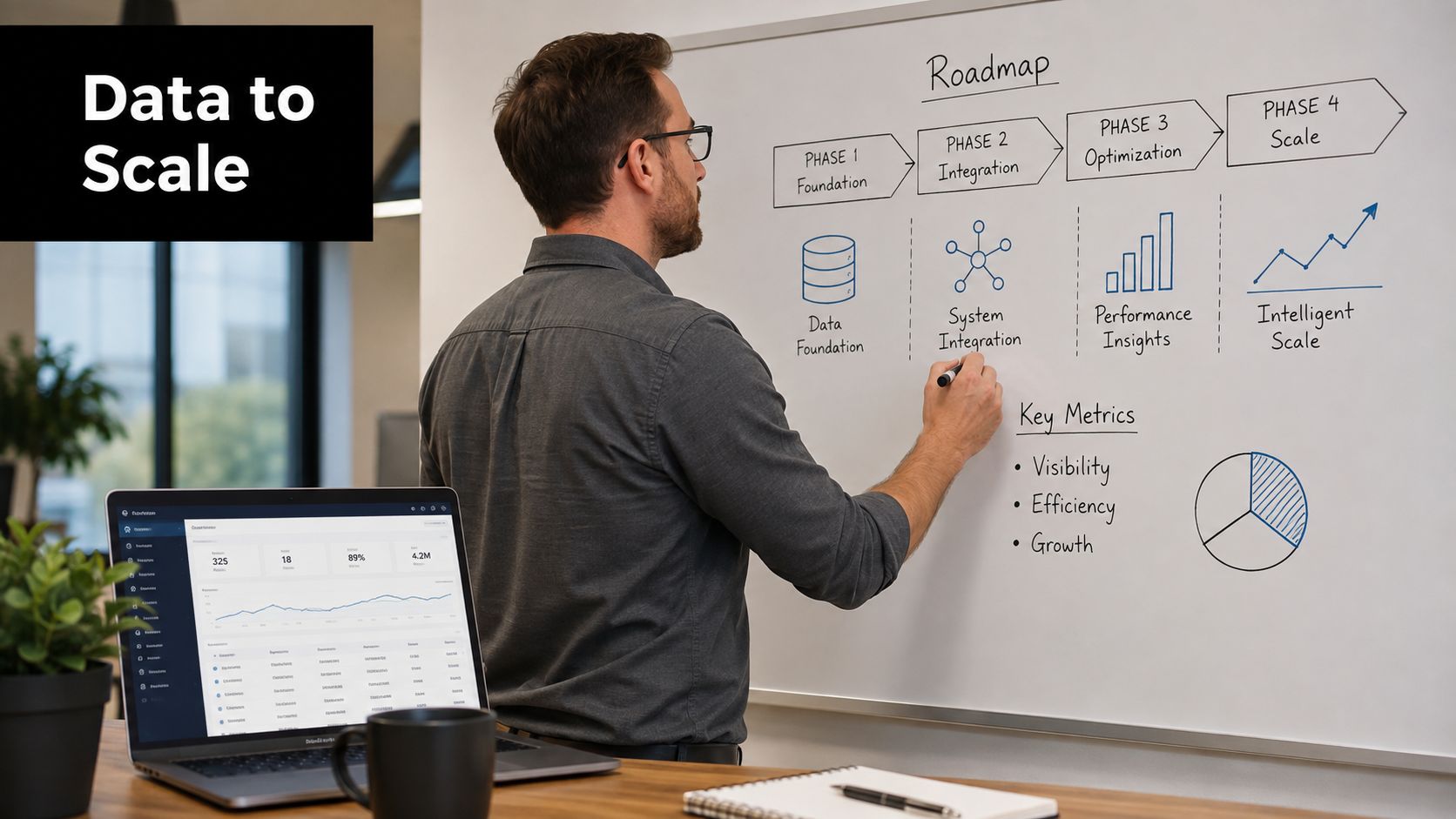
Phase four scales a proven pattern
Scale only when the pilot clears a documented ROI gate. Promote the integration pattern, event model, controls, training materials, and support model together. Copying software without copying operating ownership reproduces the original weakness in more locations.
Change management belongs in every phase. Dispatchers and planners need a clear explanation of which decisions automation handles, which decisions remain theirs, and how they can intervene. Training should use real exceptions rather than idealized demonstrations, because confidence comes from seeing the system behave safely when the normal process breaks.
Why So Many Programs Stall at the Pilot Stage
A pilot can work perfectly and still fail as a program. The demonstration proves that a technology can perform a task under controlled conditions. Enterprise deployment requires shared identifiers, reliable connectivity, operational ownership, and support for every exception that the demonstration avoided.
Recent logistics coverage identifies poor interoperability across WMS, WES, and WCS layers as a central lesson, with inconsistent APIs, weak exception handling, and inadequate robot work-unit data structures among the recurring failure points. (Warehouse automation integration lessons)
Four failure modes
Feature-first procurement creates hidden integration debt. Vendors are selected for robot speed or AI capability, then the enterprise discovers that identifiers, event formats, and permissions don't align.
The ownership gap leaves no one accountable for the canonical shipment state. Operations owns telematics, sales owns order information, and a logistics partner owns warehouse records. Each group can defend its data while the business still lacks one dependable view.
The pilot trap rewards demo metrics instead of business outcomes. A team measures whether a bot completed a task, but not whether dwell time, cost per shipment, service quality, or manual intervention improved.
Workforce resistance appears when dispatchers and planners believe automation is taking away judgment without clarifying their future role. RPA and Agentic AI should remove repetitive relay work, not make people responsible for systems they can't inspect or override.
The scaling gap is visible in adoption data. One logistics AI report says 54% of organizations remain in use-case discovery, 46% remain in evaluation, and 83% cite poor data quality as their biggest barrier. The same source reports that 39% of storage functions remain fully or primarily manual, while only 28% of talent report access to training and upskilling and 60% of logistics roles are expected to change through AI and automation. (State of AI in logistics 2025)
The lesson is architectural and organizational at once. If the roadmap omits ownership, data quality, network reliability, and workforce readiness, the pilot has already been designed to stall.
Two Enterprise Stories and What They Teach Us
Consider a mid-sized distributor that treated fleet geofencing as a data product rather than a dashboard feature. The team created shared ownership across fleet operations and IT, landed vehicle events in a Snowflake data layer, and mapped geofence events to shipment and asset identifiers before building alerts. The resulting workflow connected route deviation detection with dispatch review and customer communication. The distributor reduced unauthorized route deviation by 38% within nine months, according to the supplied case narrative.
The important decision wasn't the geofence itself. The team defined what counted as unauthorized deviation, identified who reviewed each event, and designed the data model before expanding the workflow. A related fleet geofencing success story illustrates how geofence events can support a broader management and automation layer.
A 3PL took the opposite route. It launched an RPA pilot to move warehouse updates between its TMS and WMS, and the demonstration worked for a narrow set of transactions. When the team attempted to expand the workflow, the platforms used incompatible data formats and inconsistent status definitions. The pilot collapsed into a six-month rebuild, because the initial scope had concealed the integration work.
These stories produce a simple decision checklist:
- Shared data ownership: Someone must govern canonical identifiers and event definitions.
- Integration governance: APIs, EDI, middleware, retries, and exception paths must be designed before expanding automation scope.
- Business metrics: The pilot must measure outcomes such as service quality, utilization, cost, and intervention, not only task completion.
- Scale pattern: The team should know how a successful workflow will be templated across sites before the first pilot begins.
- Human control: Operators need visibility, override rights, training, and clear accountability.
The control layer determines whether logistics automation compounds or stalls. Hardware and AI can accelerate a sound operating model, but they can't repair missing ownership or contradictory data.
AI optimization has also been associated with 12.7% lower logistics costs and 20.3% lower inventory levels in companies using AI in supply chains, while industry projections cited in the same coverage estimate potential reductions of 15% in logistics costs and 35% in inventory levels, alongside a 65% improvement in service levels. These figures are context for business-case testing, not promises for every rollout. (AI automation ROI discussion in logistics)
If your fleet, warehouse, and customer operations still depend on manual status relay, start with an integration and KPI assessment. Map your shipment and asset identifiers, select one constrained workflow, and define the ROI gate before buying additional automation. That preparation will show whether your next investment belongs in hardware, orchestration, data engineering, or the people who keep the system dependable.


