The value of IoT is never in the sensors. It's in the decisions they enable. That distinction matters at enormous scale: an OECD review reported that IoT connections surpassed non-IoT connections in 2020, with approximately 11.7 billion connected things compared with about 10 billion smartphone, laptop, and computer connections.
Connecting equipment is no longer the interesting part. Getting a maintenance planner to intervene before a pump fails, or a warehouse operator to rescue a warming shipment, is where operational value starts.
The strongest IoT use cases connect a physical event to an accountable action. A sensor detects a change, software interprets it, and a person or control system responds while there's still time to improve the outcome.
Start with the decision: If nobody can explain what they'll do differently when a reading changes, don't buy more sensors.
The examples below prioritize avoided downtime, lower energy consumption, reduced spoilage, and faster intervention. Each includes the operational trade-off and a tactic you can replicate. Where published results exist, they're evidence of what a particular deployment achieved, not a promise that another organization will get the same return.
1. Predictive Maintenance for Industrial Equipment
Avoided production loss is the outcome to measure, not the number of anomalies detected. Sensors on motors, pumps, and conveyors capture vibration, temperature, and pressure so maintenance teams can investigate deterioration before equipment stops.
A review of IoT-enabled predictive-maintenance implementations reports downtime reductions of up to 50% and maintenance-cost reductions of approximately 25%. Those results depend on technicians receiving actionable warnings and having the parts, access, and authority to intervene.
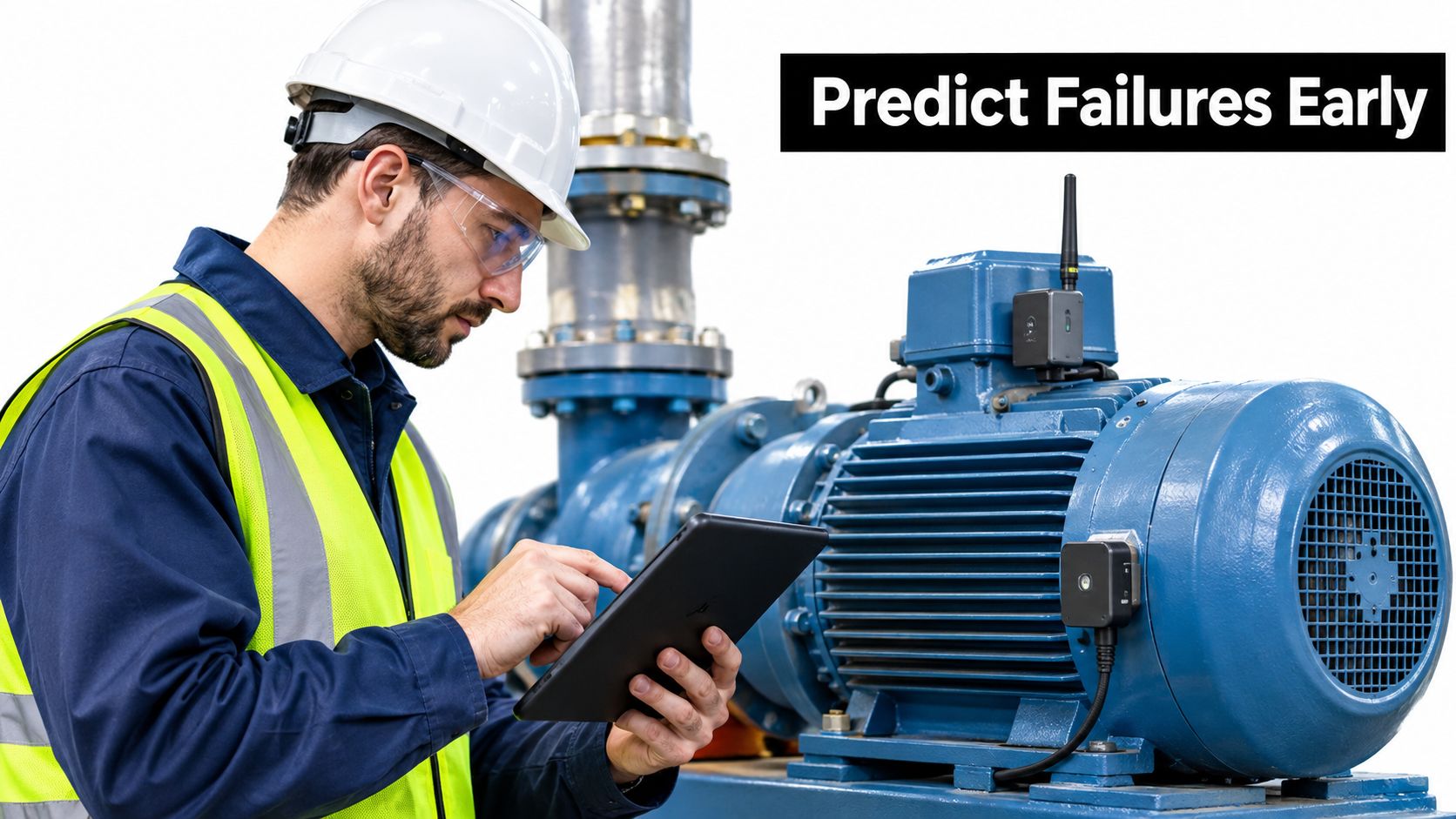
Turn a warning into a work order
Say a pump's vibration rises under comparable operating loads. Attach the trend, operating context, and inspection recommendation to a maintenance work order rather than sending an isolated email.
- Baseline the loss: Record downtime, repair labor, and lost output before installation.
- Add maintenance history: Join sensor readings to bearing replacements and inspection findings.
- Verify the intervention: Have technicians label confirmed faults and false alarms.
The cost isn't just instrumentation. Sensor mounting, historical-data cleanup, and maintenance-system integration all require effort. Start with a failure-prone asset class whose downtime has a clear financial impact.
The same operating pattern applies to smaller distributed assets, including proactive upkeep for smart vending machines: prioritize service from equipment condition rather than an undifferentiated visit schedule.
2. AI-Driven Smart Building Energy Optimization
A building that uses less electricity but generates constant comfort complaints hasn't been optimized. Energy savings must stay inside comfort, ventilation, and equipment-safety constraints.
Combine HVAC telemetry, occupancy, weather, and meter readings to adjust schedules and setpoints. TensorFlow-based models are an option when there's enough reliable history, but correcting schedules and faulty sensors should come before training a model.
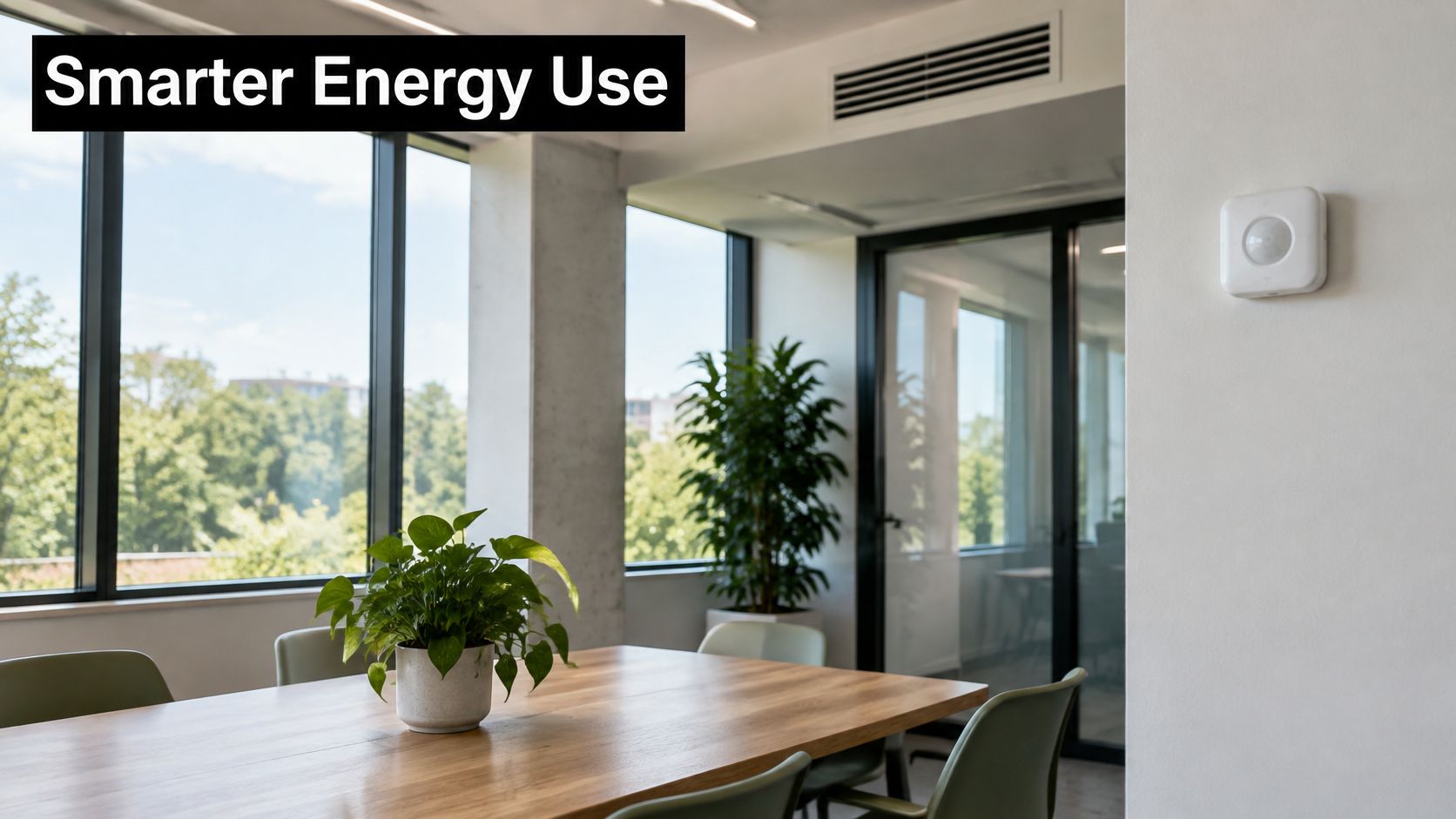
Prove the control strategy in a zone
Consider an office wing that receives full cooling before anyone arrives. Use occupancy forecasts to delay startup, then compare weather-adjusted consumption and comfort complaints against its previous operation.
The engineering burden sits in BMS integration, inconsistent point names, sensor calibration, and permission to write control commands. BACnet connectivity alone doesn't establish whether a temperature point represents supply air, return air, or room conditions.
Keep the existing controller's safety limits authoritative. An optimization model should never bypass equipment protections.
A practical pilot begins in recommendation mode, with a facilities operator approving adjustments. Move to bounded automation only after testing overrides and rollback behavior.
For an implementation example, examine the control-and-analytics approach in AI-powered smart building optimization. Measure consumption alongside occupant experience, not in isolation.
3. Fleet Telematics and Geofencing
A dispatcher needs to know whether a truck arrived, not whether its GPS position briefly crossed a circle. Reliable arrival events can replace check-in calls, improve customer notifications, and expose excessive depot waiting.
Fleet platforms such as Samsara and Geotab combine location and vehicle telemetry. For custom applications, the important work is translating those readings into operational states that dispatchers and drivers recognize.
Commercial interest is strong: the IoT M2M Council's summary of Eseye's adoption report says 80% of supply-chain and logistics respondents in 2024 identified competitive advantage as IoT's leading benefit. That's an adoption signal, not proof of a particular fleet's savings.
Make arrival events trustworthy
Say a delivery vehicle passes a customer's property on a nearby road. A simple radius can incorrectly announce arrival; a site-shaped boundary combined with dwell time and job assignment provides better context.
- Match the site: Draw boundaries around entrances, yards, and loading areas.
- Handle uncertainty: Suppress duplicate events and flag stale GPS positions.
- Connect the workflow: Send verified arrival and departure events to dispatch and mobile applications.
Costs include device installation, cellular service, mapping maintenance, and driver-policy communication. Explain who can access location history and how it will be used before rollout.
The practical integration issues are illustrated by enhanced geofencing for fleet management. Track missed arrivals, false arrivals, and dispatcher corrections before expanding coverage.
4. Cold Chain Monitoring for Perishable Goods
A temperature record doesn't rescue a shipment. A timely intervention can. Cold chain monitoring becomes valuable when an excursion reaches someone who can inspect refrigeration, relocate stock, or quarantine affected goods.
Temperature, humidity, and shock sensors can accompany food and pharmaceutical shipments. Say chilled produce warms during a loading delay: the useful output is an alert identifying the shipment, its location, the excursion duration, and the person responsible for responding.
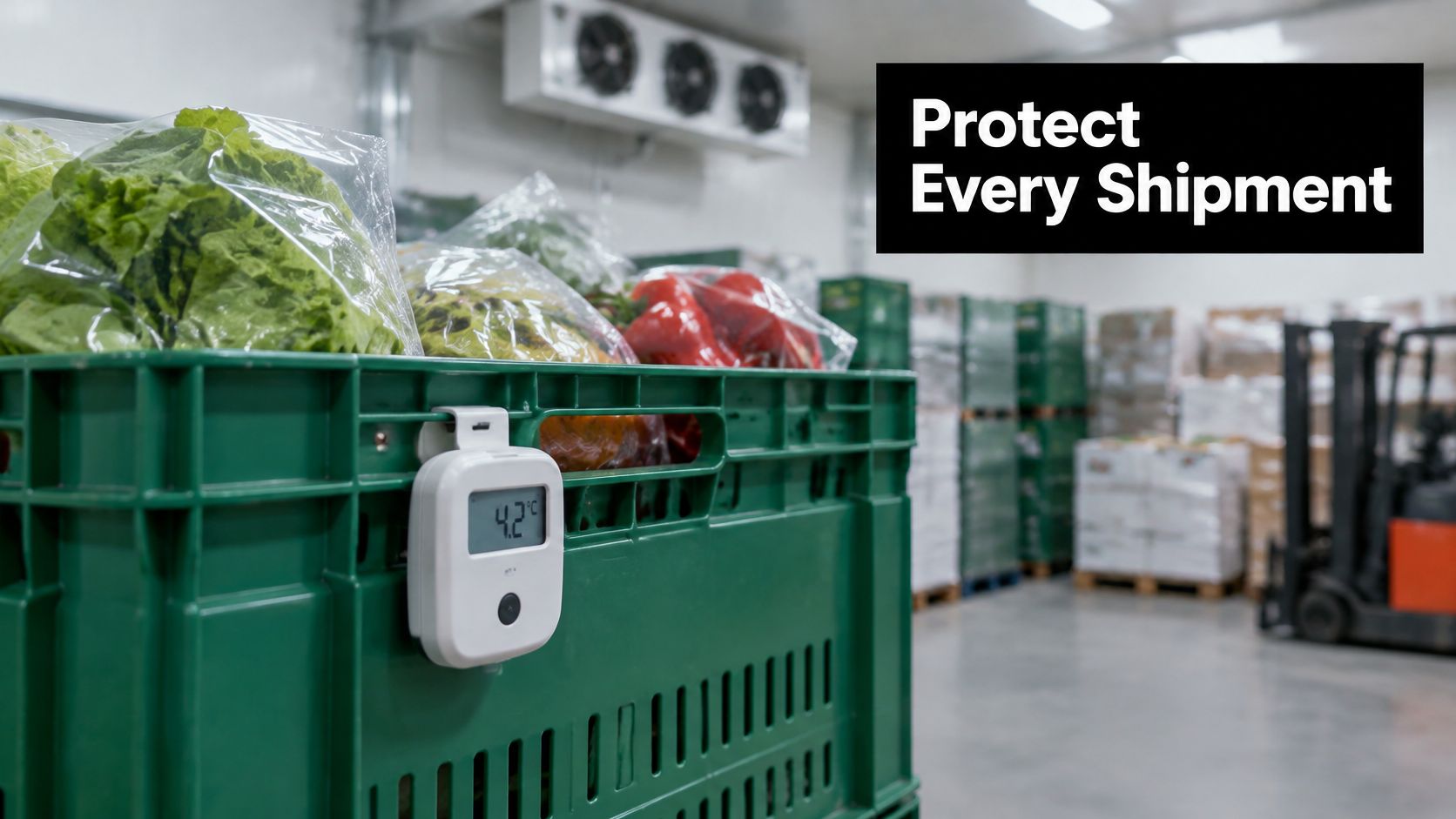
Design for gaps in connectivity
A logger can preserve an accurate history without being able to transmit an immediate warning. Distinguish continuous recording from continuous connectivity when evaluating the system.
- Use product-specific limits: Set thresholds from approved handling requirements.
- Buffer locally: Preserve timestamps and readings when backhaul disappears.
- Route exceptions: Send excursion records to quality teams with acknowledgement and escalation.
Budget for calibrated probes, battery replacement, retrieval logistics, and connectivity along the actual route. Satellite backhaul may suit some remote journeys, but it changes hardware, power, and service costs.
Measure rejected shipments, excursion response time, and avoidable product loss. Don't treat an air-temperature spike near an open door as automatic proof that the product itself is unsafe. Quality teams need placement details and exposure context to make disposition decisions.
5. Smart Grid and Advanced Metering Infrastructure
For a utility, faster outage confirmation and more dependable consumption records can matter as much as automated meter reading. Smart meters supply interval data that supports billing, load forecasting, and demand-response operations.
Consider a neighborhood outage. Correlating meter communication events with the network topology can help operators identify the affected area, but a silent meter might also indicate a communications failure rather than lost power.
That distinction prevents unnecessary dispatches. A meter-data platform must preserve event context instead of treating every missing reading as an electrical fault.
Separate metering from control
Build billing-quality ingestion and validation separately from time-sensitive operational decisions. Keep protection and safety functions in appropriately engineered local systems rather than depending on a cloud analytics round trip.
- Validate readings: Identify duplicates, gaps, clock drift, and implausible consumption.
- Secure devices: Establish device identity, credential rotation, and firmware ownership.
- Test dispatch logic: Compare inferred outages with confirmed field findings.
The main costs include field installation, communications infrastructure, device certification, and integration with customer and outage-management systems. Long-lived meters also create an ongoing obligation to maintain secure software.
A replicable starting point is outage analytics in a defined service area. Measure time to confirmation, unnecessary crew visits, and restoration verification before adding automated customer messaging or demand-response control.
6. Precision Agriculture with Soil and Crop Sensors
Apply water where the root zone needs it, rather than running every irrigation zone on the same calendar. Soil-moisture probes, weather stations, and connected controllers let growers adjust irrigation to field conditions.
Say a field contains sandy and heavier soil. A probe near the farmhouse won't represent both; place sensors in representative management zones and compare readings with field inspections before automating valves.
Placement matters more than dashboard polish
The cost includes rugged installation, power, seasonal maintenance, and checking whether sensors still represent conditions around active roots. Poor placement can produce precise readings of the wrong thing.
Computer-vision systems such as John Deere See & Spray illustrate a related approach: target an intervention where a detected condition warrants it, rather than treating an entire field uniformly. Irrigation pilots should follow the same selective logic.
- Start with representative zones: Include different soil types and irrigation conditions.
- Keep local control: Buffer readings and maintain safe schedules during network outages.
- Validate agronomically: Compare water use, crop stress, and harvest quality.
The field-sensing approach is illustrated in this video.
Don't credit the system for lower water use if crop performance deteriorates. The useful outcome is resource efficiency with acceptable crop results, assessed across comparable conditions.
7. Remote Patient Monitoring
A connected blood-pressure cuff is useful only if the care team can distinguish a meaningful change from a bad measurement. Clinical response capacity, not device count, determines whether remote monitoring is operationally workable.
Wearable and home devices can transmit blood pressure, glucose, oxygen saturation, weight, and heart-rate readings. Systems such as Medtronic CareLink illustrate device-to-clinician monitoring, but each clinical program still needs its own escalation rules and responsibilities.

Staff the response before enrolling patients
Consider a patient whose weight readings trend upward. The workflow should check measurement quality, apply clinician-approved criteria, and route the event to the assigned care team rather than generate an unexplained alarm.
Clinical boundary: Monitoring software should support clinical judgement, not imply that every abnormal reading is a diagnosis.
Costs include patient onboarding, device support, clinical review time, EHR integration, and privacy controls. Confirm HIPAA or applicable local requirements with the organization's compliance team before launch.
Measure review delays, actionable-alert rates, missing readings, and escalation completion. Publish monitoring hours and emergency instructions so patients don't mistake a connected device for continuous emergency supervision.
Patient education also matters. Resources about using watch data to discuss autonomic symptoms can support a clinical conversation without substituting wearable readings for professional assessment.
8. Smart Retail Inventory with RFID and Shelf Sensors
Stock visibility should trigger replenishment, not merely produce a more colorful inventory screen. RFID readers, shelf-weight sensors, and cameras can identify movement between receiving, storage, sales floors, and checkout.
Say a store's system lists an item as available, but every unit is in the stockroom. Shelf detection can create a replenishment task before another shopper leaves empty-handed.
Test the merchandise, not just the reader
RFID performance depends on tag placement, product materials, and reader geometry. Liquids, metal packaging, and closely packed goods deserve physical testing before a purchasing commitment.
- Choose a valuable category: Start where missed sales or manual counting create a clear cost.
- Reconcile events: Distinguish shelf movement from a completed sale or return.
- Close the task: Require associates to confirm replenishment or flag a discrepancy.
Budget for tags, readers, installation, item-master cleanup, and changes to store routines. Cameras introduce additional privacy and deployment considerations; weight sensors require calibration and accurate product-weight mappings.
RFID-led stock visibility, associated with retailers such as Zara, is a useful model, but the replicable tactic is narrower: connect an observed inventory discrepancy to a named store task.
Measure stock accuracy, shelf availability, counting labor, and task completion. Don't call a system successful because it reads tags reliably while associates still receive unusable replenishment instructions.
9. Water Leak Detection and Smart Water Metering
A persistent flow signal overnight can justify an inspection before anyone sees water damage. Earlier investigation of hidden losses is the practical outcome for utilities and facility managers.
Smart meters identify unusual consumption patterns, while acoustic sensors help crews investigate suspected pipe leaks. Platforms such as Xylem's Sensus smart water network belong to this category, but deployment design should follow the pipe network and operating conditions.
Corroborate before excavating
Consider a municipal main with a recurring acoustic anomaly. Compare neighboring sensors, pressure changes, and field checks before dispatching an excavation crew.
A building needs different logic. Continuous flow might indicate a failed valve, but it could also reflect scheduled cleaning or overnight production.
- Prioritize exposure: Instrument aging mains, high-pressure segments, and damage-sensitive facilities.
- Separate loss types: Distinguish physical leakage from metering and billing discrepancies.
- Route customer alerts: Explain the suspected pattern and the next inspection step.
Installation access, battery servicing, communications coverage, and accurate network maps drive cost. Automatic shutoff adds actuator maintenance and operational risk, especially where water supports essential processes.
Track non-revenue water for utility programs, alongside confirmed leak volume and repair time. In buildings, track time from abnormal flow to investigation and verified repair.
A dependable inspection workflow beats an aggressive alarm threshold that repeatedly sends crews to normal water use.
10. Smart Parking and Urban Traffic Management
Less searching and smoother traffic flow are related outcomes, but they require different controls. Parking sensors detect occupied spaces; traffic sensors inform signal timing and corridor management.
A published review's Barcelona traffic-management example reports a 30% reduction in congestion and a 20% reduction in vehicle emissions. Those are reported traffic-system outcomes, not evidence that a parking-availability app alone produces comparable results.
Start with a corridor that operators can manage
Say a busy district has curb sensors and connected signals. Publish current parking availability with freshness indicators, then assess queue length and intersection delay before changing traffic-control settings.
San Francisco's SFpark is a recognizable example of sensor-informed, demand-based parking management. The transferable lesson is to connect availability information and operating policy, rather than assuming sensors will change driver behavior by themselves.
- Communicate clearly: Explain prices, restrictions, and how availability is estimated.
- Design for stale readings: Mark uncertain spaces instead of presenting false certainty.
- Measure displacement: Check whether changes move queues into neighboring streets.
Costs include roadworks, sensor maintenance, communications, payment integration, and public consultation. Camera-based detection avoids some in-ground installation work but introduces occlusion and privacy concerns.
Keep safety constraints and operator override in signal-control systems. For a pilot, compare travel time, parking-search behavior, and traffic conditions across matched periods, not a quiet day against a congested holiday.
10 IoT Use Cases Compared
Use CaseIndustryPrimary OutcomeMain ChallengeMaturityPredictive Maintenance for Industrial EquipmentManufacturing and industrial operationsReduce unplanned downtime and repair costsRetrofitting legacy equipment and obtaining quality failure dataWidely adoptedAI-Driven Smart Building Energy OptimizationCommercial real estate and facilitiesReduce energy use while maintaining occupant comfortUpfront integration costs and ongoing model tuningEstablishedFleet Telematics and GeofencingLogistics and transportationImprove routing, safety, and fleet visibilityDriver privacy and hardware and subscription costsWidely adoptedCold Chain Monitoring for Perishable GoodsFood, pharmaceuticals, and logisticsPrevent spoilage and strengthen complianceMaintaining connectivity and coordinating data across carriersEstablishedSmart Grid and Advanced Metering InfrastructureEnergy and utilitiesImprove billing, outage response, and demand managementHigh deployment costs and endpoint security and privacy risksWidely deployedPrecision Agriculture with Soil and Crop SensorsAgricultureReduce input use and improve crop yieldsRural connectivity and equipment costsGrowing adoptionRemote Patient MonitoringHealthcareEnable earlier intervention and reduce avoidable hospital visitsRegulatory compliance and managing device use and alert workloadsGrowing adoptionSmart Retail Inventory with RFID and Shelf SensorsRetailImprove stock accuracy and reduce stockoutsTag costs and integration with retail systemsEstablishedWater Leak Detection and Smart Water MeteringWater utilities and facilitiesReduce water losses and detect leaks soonerInstrumenting underground networks and managing sensor maintenanceGrowing adoptionSmart Parking and Urban Traffic ManagementLocal government and transportationReduce parking search time, congestion, and emissionsStreet installation and public acceptance of dynamic pricingPilot-to-established
Choosing the Use Case Worth Building First
Choose the operational problem with the clearest baseline, not the most impressive demonstration. A failing compressor with documented production losses is often a stronger starting point than an organization-wide initiative to connect everything.
Published returns can help frame expectations, but they aren't a business case. An industry study of validated IoT deployments reported a median payback period of 12 months across 36 deployments; use that as directional context, not a commitment for your asset mix.
Integration deserves its own budget. In Verizon's 2025 IoT market insights survey, 37% of organizations identified integration with business processes or operational technology as a hurdle, while 34% cited legacy IT and network integration.
Design the action path before the dashboard
Write down the chain from device event to verified outcome. Specify who owns the asset identifier, where timestamps are normalized, how late readings are handled, and which enterprise application receives the resulting task.
For a Snowflake-centered architecture, preserve raw telemetry separately from validated operational records. Join readings to asset, location, maintenance, or shipment context so analysts and applications work from consistent definitions.
- Pilot narrowly: Select a bounded asset group, route, zone, or workflow.
- Count the full cost: Include installation, integration, connectivity, calibration, and response labor.
- Prove closure: Confirm that alerts lead to completed actions and measurable operational change.
Agentic workflows can assemble context, recommend next steps, and draft work orders. Keep approval gates around consequential actions such as changing equipment controls, releasing quarantined goods, or making clinical decisions.
Validate demand inside the organization as carefully as a startup validates a market. Find Startup Idea's demand validation guide offers a useful framing: test whether the intended users have a problem worth changing their behavior to solve.
Bring a specific operational bottleneck, its baseline cost, and the system that must receive the resulting action to Faberwork LLC. We bring direct experience with TensorFlow-based smart building optimization, enhanced fleet geofencing, and AI-driven anomaly detection and predictive insights on the GridPoint IoT sensor data platform. Start by defining a bounded pilot with a measurable outcome, an integration plan, and an accountable operating owner.


