
60% of IoT initiatives stalled at proof of concept, and only 26% were considered complete successes in Cisco's survey of 1,845 IT and business decision-makers. The reported challenges included completion time, limited expertise, data quality, cross-team integration, and budget overruns. Getting a sensor online wasn't enough.
Effective IoT solution development starts with evidence that an operational workflow will improve, then preserves that evidence through deployment. Design for the second site and the fifth year, not just the demonstration. That means measurable exit gates, replaceable devices, recoverable data pipelines, and someone accountable when an alert doesn't reach an operator.
Map the Build Stages and Exit Gates First
Treat the proof of concept as a decision gate, not permission to deploy. A working dashboard proves that data traveled somewhere. It doesn't prove that a maintenance team prevented a failure, that the network survives production conditions, or that another site can repeat the result.
Use the following map as a project-control document. Each artifact should have an owner, and each exit gate should identify the evidence an approver must inspect.
IoT build stages and their exit gates
StageWhat You BuildExit GateOutcome baselineKPI baseline such as unplanned downtime hours per monthBusiness owner signs the baseline and targetRequirementsDevice, connectivity, latency, data-quality and security specificationsEvery requirement has a test that can failEnd-to-end sliceOne device type from sensor to dashboard and alertAlert fires within target latency in a lab runField pilotOne representative site under real network conditionsKPI moves against the pre-IoT baselineProduction hardeningDevice management, key rotation and monitoringPasses network-loss and failover testsMulti-site rolloutStandard templates for each new siteSecond site repeats the KPI result without custom code
Make the baseline harder than the demo
For predictive maintenance, have the plant record unplanned downtime hours per month before installing sensors. Agree on which assets count, how planned maintenance is excluded, and where downtime records come from. Otherwise, teams can change the measurement after seeing the result.
The business owner must approve both the baseline and the target. This is often the hardest gate because it requires an operational commitment rather than a technical demonstration.
Bring engineering and operations together while those decisions are still changeable.

Translate requirements into tests with explicit failure conditions. A latency requirement needs a defined start event, end event, and timing method. A data-quality requirement needs rules for missing readings, invalid units, and unacceptable sensor drift.
Practical rule: No stage starts until the previous exit gate is written down and its evidence has been accepted.
Paste the table into the project plan. Before buying hardware, write the baseline gate and name the person authorized to approve it.
Choose Devices by the Data They Must Produce
A threshold sensor, a vibration analyzer, and a protocol gateway need different hardware even when their dashboards look identical. Compare device classes before committing to a development board, and weight the comparison toward what the fleet still has to do in year five rather than what impresses during the pilot.
Device classes and where each fits
Device ClassCompute and MemoryBest FitMain RiskLow-power microcontroller (Cortex-M0 or M0+)Tens of KB RAM, very low sleep currentThreshold sensing and multi-year battery nodesLittle room for edge analyticsWi-Fi and BLE system-on-chip (ESP32 class)Integrated radios with constrained embedded memoryPrototypes and indoor sensingRadio draw shortens battery lifeCortex-M4 or M7 with DSP and FPUHundreds of KB RAM, hardware floating pointVibration analysis and FFT at the edgeHigher board cost and firmware effortLinux gateway (Raspberry Pi class or industrial)Application-class processor with larger memory and persistent storageProtocol translation, buffering and local inferenceOS patching and enclosure power
A low-power microcontroller is a sensible starting point when the only decision is whether temperature crossed a threshold. A Linux gateway earns its place when the application must translate industrial protocols, manage local storage, and run substantial application code. Skip the operating system unless those capabilities justify years of patching across every deployed unit.
Capture the signal before optimizing the model
The predictive-maintenance opportunity gets cited constantly, usually at secondhand. A vendor's predictive-maintenance summary page cites McKinsey's analysis of more than 150 IoT use cases, reporting estimated maintenance-cost reductions of up to 40% and unplanned-downtime reductions of around half. Those figures arrive through a summary rather than the primary report, so treat them as potential for the category and let your own baseline gate set expectations.
For motor vibration, record the signature of healthy equipment across relevant operating conditions before committing to a sensor. As a minimum sampling rule, sample at least twice the highest frequency you need to detect, then add practical margin and appropriate anti-alias filtering. A high sample rate cannot rescue poor sensor placement or an unsuitable measurement range.
Check the complete board rather than the processor datasheet alone:
- Sleep current: Measure the assembled device against its battery-life target, including regulators and peripherals.
- Environmental suitability: Verify operating temperature, enclosure protection, and the required IP rating.
- Sample rate: Confirm sustained acquisition while communications and storage are active.
- Memory headroom: Reserve space for buffering, diagnostics, and future edge code.
- Supply continuity: Obtain a supplier commitment covering the planned product life and an acceptable replacement path.
Choose the lowest-cost device class that meets acquisition and supply requirements across the full product life, then confirm the same firmware image flashes onto spares at the second site without rework. A cheap board that forces a redesign halfway through deployment ends up costing more than the one you priced at the start.
Pick Connectivity You Can Still Run in Year Five
Which network can you still operate in year five? Answer that before comparing modem prices. Range and throughput matter, but so does who controls coverage, credentials, contracts, and infrastructure changes.
Connectivity options compared
OptionTypical RangeThroughputBest FitTrade-offBLE 5Short-range links near a gatewayUp to about 2 MbpsAsset tags and wearables near a gatewayNeeds a nearby gatewayWi-FiBuilding-scale coverage around access pointsTens to hundreds of MbpsBuildings with existing Wi-Fi and higher-rate sensorsPower draw and reliance on the site networkLoRaWANSeveral km in open areasLow-rate, small-payload telemetrySparse telemetry across campuses and farmlandDuty-cycle and payload limits; you run or rent the networkNB-IoTCarrier cellular coverageLow-rate telemetryFixed meters and sensors with small payloadsCarrier coverage and plan renewalsLTE-MCarrier cellular coverageUp to about 1 MbpsMobile assets such as trailers and fleet trackersHigher modem cost than NB-IoT and carrier dependenceEthernetCable-limited links within site infrastructureHigh-throughput wired networkingFixed industrial controllersCabling cost and site work
Treat these as selection categories, not guaranteed application performance. Building materials, antenna placement, interference, protocol configuration, and operator support can change what a device delivers in practice.
Select for the deployment location
BLE and Wi-Fi fit deployments where a gateway or managed building network is nearby. LoRaWAN suits small messages spread across campuses or farmland, provided someone owns gateway coverage and capacity planning. Ethernet deserves consideration for fixed industrial controllers when predictable connectivity matters more than installation convenience.
Consider a trailer tracker sending a GPS fix every few minutes. Its connectivity decision depends on every region the trailer visits, not the coverage available outside the engineering office. Review coverage maps, roaming terms, and field-test results before committing to a carrier.
For long-lived cellular hardware, favor a modem supporting the bands required across deployment regions. Keep the carrier agreement separable from device ownership where possible, and confirm that the vendor supports remote firmware updates. Remote updates help maintain supported software, but they can't add unsupported radio hardware capabilities.
A network choice is also a decision about who can change the system later.
Before approving a site, answer:
- Gateway distance: How far is the nearest usable gateway, and what blocks the signal?
- Traffic profile: How many bytes does each message contain, and how often will it be sent?
- Outage behavior: What does the device do if connectivity disappears for a day?
Reject a connectivity design that answers only the first question.
How to Build the Edge Layer and Ingest Device Data
Build an end-to-end path that preserves meaning through disconnections, retries, and software changes. The edge layer should reduce traffic without hiding the evidence needed to diagnose a bad measurement.
Installation conditions belong in that design, including where technicians can reach gateways and replace sensors.

Build the path in dependency order
- Define and version the message contract. Include device ID, UTC event timestamp, sensor type, value, unit, quality flag, and firmware version. Version the schema from the beginning so a firmware upgrade doesn't silently change downstream interpretation.
- Implement store-and-forward buffering. Size durable storage for the longest credible outage, for example, a day of minute-level aggregates. Define overflow behavior explicitly, because overwriting unsent readings without notice makes later completeness checks misleading.
- Filter and aggregate locally. Send minute-level summaries and anomaly events rather than every raw reading when the use case allows it. Retain a short local raw-data window for diagnosis, and preserve enough context to explain why an anomaly triggered.
- Publish securely over MQTT. Use QoS 1, persistent sessions where supported, TLS, and a unique certificate for each device. Expect duplicate deliveries and validate broker session limits, because delivery assurance doesn't make application processing exactly-once.
- Route into a device-keyed ingestion path. Partition by device ID where the ingestion technology supports ordered partitions. Preserve sequence information and handle replay explicitly, because partitioning alone doesn't correct events arriving late or out of sequence.
- Keep event time and receive time. Stamp readings with both the device's timestamp and the ingestion timestamp. Their difference helps distinguish delayed transmission from clock problems rather than treating every late event as current activity.
Test scale without confusing it with market forecasts
A NIST presentation reported approximately 15.4 billion connected IoT devices in 2015 and projected 20.4 billion by 2020. Those historical estimates establish context, not a capacity target for your broker.
For a hypothetical expansion from 200 devices to 200,000, test connection churn, certificate operations, backlog recovery, and downstream write capacity. Steady-state message throughput alone won't show whether the system survives a fleet reconnecting after an outage.
The exit gate should include a replay test that preserves readings and produces the intended operational alert. Keep the message structure readable enough that a technician can compare a device log with the landed record.
An illustrative message, with example values rather than measured results:
{"deviceId": "mtr-0412", "utcTs": "2026-03-14T09:30:00Z", "receivedTs": "2026-03-14T09:30:04Z", "sensor": "vibration_rms", "value": 4.82, "unit": "mm/s", "quality": "ok", "fwVersion": "2.3.1", "schemaVersion": 1}
Design the Snowflake Pipeline in Three Layers
Separate ingestion evidence from operational interpretation. The raw record should remain available when a parser changes, a device sends delayed telemetry, or someone challenges a dashboard total.
Snowflake pipeline responsibilities
LayerTable DesignResponsibilityRaw landingVARIANT payload with device ID, receive time, and ingestion metadataPreserve what arrived and support replayCleansedTyped event columns, quality status, and stable event identityValidate, normalize, deduplicate, and quarantineCuratedAsset- and site-level aggregates with reporting statusServe dashboards and operational analysis
Match ingestion to the arrival pattern
Use Snowpipe Streaming when low-latency row ingestion matches the application. Consider the Kafka connector if Kafka already provides durable transport and operational ownership. Use file-based Snowpipe when gateways naturally upload batches, such as hourly files.
Don't introduce Kafka merely because the workload involves sensors. It adds another platform to operate. Conversely, don't force a continuously arriving stream into tiny files without considering file handling, latency, and cost.
For a concrete architectural reference, review time-series data with Snowflake. Evaluate any implementation against its ingestion pattern and reporting requirements rather than copying its topology wholesale.
Build correctness before aggregates
Create the raw table with a VARIANT payload, extracted device ID, received timestamp, and source metadata. Keep ingestion append-oriented so rejected transformations don't erase the original evidence.
Next, use a stream and task, or a dynamic table where its supported transformations and refresh behavior fit, to parse typed columns. Normalize units and distinguish malformed records from valid readings marked as poor quality. Send rejected records to an inspectable quarantine path rather than dropping them.
Deduplicate using device ID, event time, and sequence number when the device supplies a reliable sequence. Include a boot or session identifier if counters reset after restart. If sequence numbers aren't available, define another stable event identity before treating retries as harmless.
Build hourly and daily aggregates only after those rules are testable. Keep the asset-to-site mapping governed so a moved device doesn't accidentally rewrite historical site ownership.
Preserve arrival evidence separately from the interpretation used in a signed report.
Handle late data and operating cost explicitly
Suppose a device reconnects after three days. Land its readings in raw storage, identify the affected event-time windows, and run controlled reprocessing. For signed-off reporting periods, publish an approved correction or version rather than replacing previously accepted totals without notice.
Consider clustering by device ID and event time only when large-table query patterns and pruning measurements justify it. Clustering maintenance consumes compute, and the right column order depends on actual filters. Benchmark before enabling it broadly.
Apply row access policies so site managers see authorized assets, and mask precise location fields for contractors. Test policies through representative user roles rather than only an administrator account.
Finally, reconcile readings per device per hour across raw and cleansed data. Explain every difference through duplicates, quarantined records, or documented exclusions. An unexplained gap is a failed pipeline gate.
Test Failure Modes and Monitor the Fleet
Before approving the field pilot, run failures that a clean laboratory demonstration won't expose:
- Network interruption: Disconnect for a proposed test window of 30 to 60 minutes, then verify buffered replay and reconstructed event order.
- Interrupted firmware update: Cut power during installation and confirm recovery to a known-good image.
- Clock drift: Move the device clock by several minutes and check event-time validation.
- Broker overload: Test at twice the expected peak, including reconnects and backlog traffic.
- Credential rotation: Rotate credentials on a device sample without disrupting the remaining fleet.
- Malformed telemetry: Send invalid payloads from a rogue device and verify isolation without blocking legitimate traffic.
Make hardware troubleshooting part of acceptance, not an activity deferred until rollout.
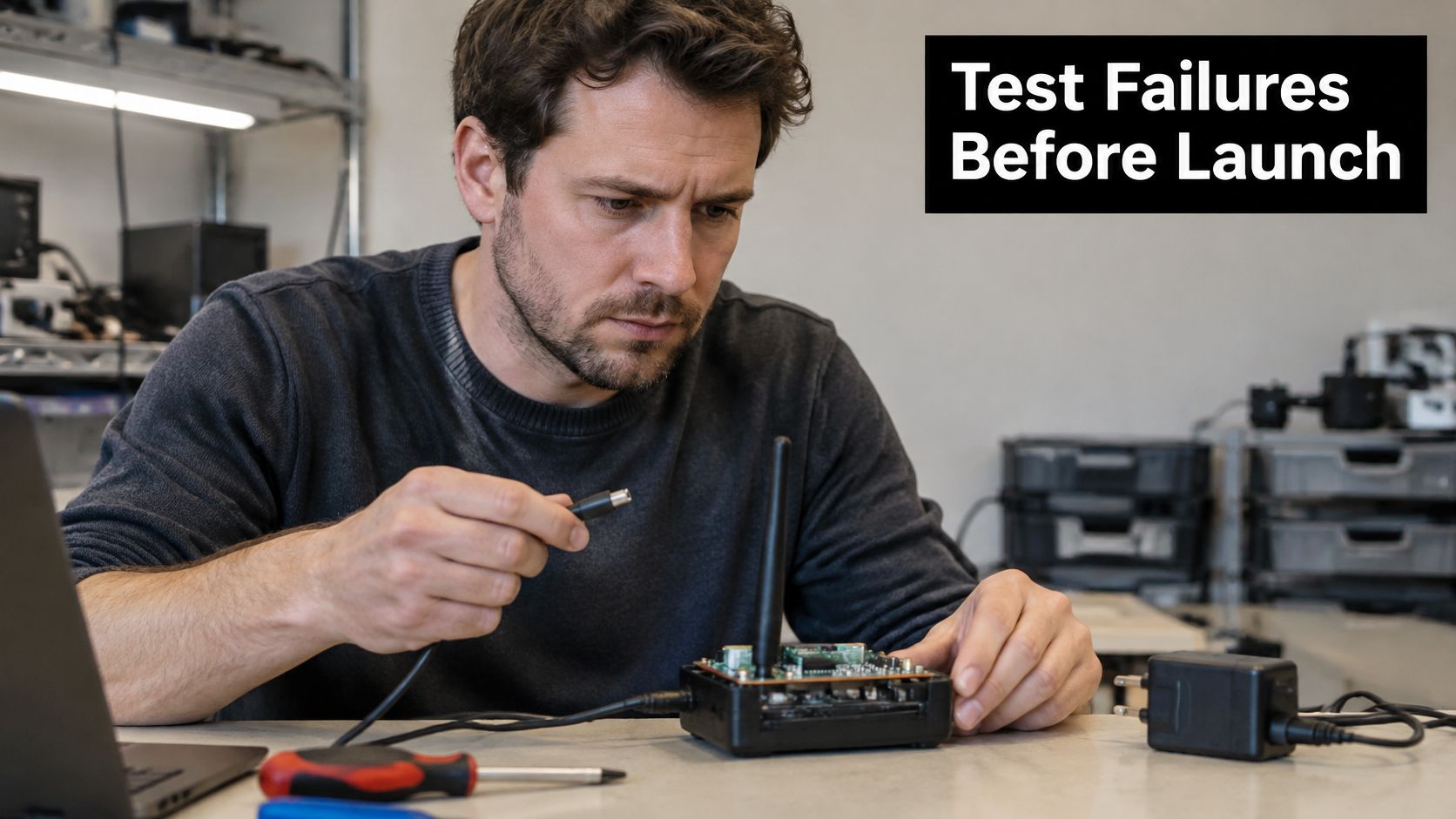
Secure deployment isn't lifecycle ownership
Verizon's 2025 IoT Market Insights report identified cybersecurity as the biggest implementation challenge for 43% of respondents, alongside legacy integration at 34%, data privacy or governance at 32%, and reliability or network coverage at 31%. The same report emphasizes ongoing updates, security support, technology migration, and total cost of ownership.
Translate those concerns into named responsibilities. Maintain an inventory connecting each device to its asset, location, firmware version, credential identity, support status, and operational owner. Define a service-level objective for each device class rather than applying the same availability expectation to a battery tag and a critical gateway.
Write down how unsupported firmware is isolated and who approves exceptions. Specify how credentials rotate without physical access, including recovery when a device misses the rotation window. Assign responsibility for cellular and gateway migrations before vendor support ends.
Use simulation and IoT risk mitigation as systems grow as a reference when planning repeatable failure scenarios. The acceptance artifact should contain observed results and recovery evidence, not merely a list of tests someone intended to run.
Use the accompanying video as a discussion prompt, then validate behavior on the deployed hardware and network.
Monitor the chain from device to operator
Track heartbeat and last-seen time, battery trend, data completeness per device per hour, broker-to-curated-table lag, and alert false-positive rate. Keep device health separate from ingestion health. A connected gateway can still be forwarding stale sensor readings.
Use this initial alert rule: flag any device silent for twice its normal reporting interval. Adapt it for scheduled sleep and maintenance windows so operators don't learn to ignore expected silence.
Test the full response path. A missed heartbeat should page a named person within the target response time, with the device identity, last valid reading, and recovery instructions attached.
Confirm the Pilot Before You Scale
In EY's 2025 Reimagining Industry Futures study, 68% of organizations found moving from trials to pervasive deployment challenging, up from 63% previously. Integration with existing systems was the leading barrier at 48%. A successful trial doesn't remove the work of making deployment repeatable.
Return expectations are rarely patient either. Sponsors fund pilots on a short payback clock, so a pilot that shows no measurable progress inside its first budget cycle is a warning sign, whatever the original business case promised.
Use operational results as the acceptance bar
A grocery retailer's smart-shelf pilot shows what a clean acceptance bar looks like: connected shelving surfaced out-of-stock items faster and measurably shortened replenishment time, a deployment profiled in McKinsey's IoT value analysis. The lesson worth copying is the discipline of measuring one operational outcome, not the retailer's specific results.
Approve expansion only when the evidence answers this checklist:
- KPI movement: The agreed operational metric improved against the signed baseline.
- Alarm quality: False alarms remain within the accepted tolerance.
- Business accountability: A named owner signs for savings or revenue.
- Reusable integration: Interfaces follow documented patterns rather than site-specific code.
- Operational readiness: Runbooks cover replacement, credential rotation, and rollback.
- Complete economics: Costs include support, connectivity renewals, and retirement.
If the KPI or ownership check fails, extend the pilot and fix the gap. If every item passes, deploy the same templates to a second site and confirm the outcome repeats without custom code. That second-site pass is the gate that matters: templates that repeat cleanly will still serve you in year five, when the original hardware starts retiring and the integration code has long outlived the engineers who wrote it.
Choose one measurable workflow this quarter, write its exit gates, and complete the baseline stage this week. If you need external implementation support, Faberwork LLC is one option for building the Snowflake pipeline and test harness. Keep operational ownership inside your business, regardless of who builds the software.


