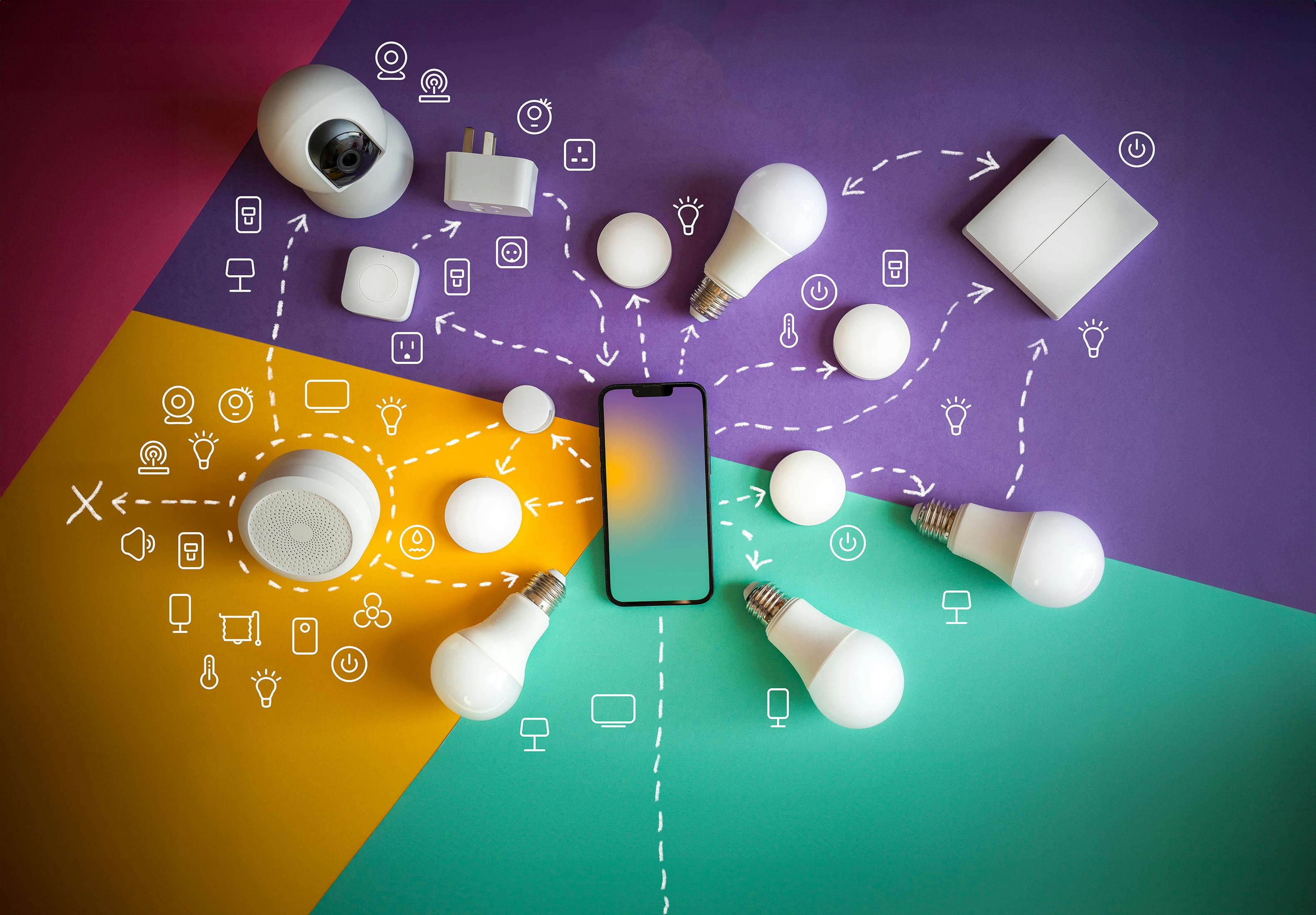
When you think of architecture, you likely picture static structures of concrete, steel, and glass. But what if buildings were living, intelligent ecosystems? That's the core outcome of IoT in architecture: embedding a network of sensors and devices that collect data, communicate, and automate a building’s functions to deliver greater efficiency and a better occupant experience.
How IoT in Architecture Is Redefining Buildings

A traditional building is a fixed design for a specific purpose. An IoT-enabled building is a dynamic environment. It has a central nervous system of connected devices, allowing it to sense, analyze, and react in real time. This transforms an architect's role from designing passive spaces to creating adaptive environments that serve people and their surroundings.
The concept is straightforward: buildings generate a constant stream of operational data. Analyzing that data unlocks powerful insights and business outcomes that were previously out of reach.
From Static Structures to Intelligent Ecosystems
IoT in architecture connects previously separate systems like HVAC, lighting, and security. Instead of operating in silos, they collaborate to achieve specific goals. For instance, occupancy sensors detect an empty meeting room, automatically dimming the lights and lowering the thermostat. The outcome is a direct reduction in energy consumption with zero manual effort.
This connectivity creates a building that responds intelligently, becoming an active partner in its own management. To understand how the built environment is changing, it helps to explore the wider world of smart buildings and the internet of things in buildings.
An IoT-enabled building is not just "smarter"; it's a strategic asset that actively drives business outcomes like cost reduction, sustainability, and improved productivity.
This table highlights the difference in outcomes.
Traditional vs. IoT-Enabled Architecture at a Glance
AttributeTraditional BuildingIoT-Enabled Smart BuildingOperationsManual controls, scheduled maintenanceAutomated, predictive, and condition-basedDataMinimal to none; analog systemsContinuous stream of real-time dataEnergy UseInefficient, based on fixed schedulesOptimized based on real-time occupancyOccupant ExperienceStandardized, one-size-fits-allPersonalized and adaptive (light, temp)MaintenanceReactive (fix when broken)Proactive (predicts failures)Decision-MakingBased on historical data and intuitionData-driven, real-time insights
This shift from a reactive to a proactive model is where IoT in architecture delivers its greatest value.
Focusing on Tangible Business Outcomes
The true value of IoT in architecture comes from its ability to deliver measurable results. This isn't about adding gadgets; it’s about making buildings more efficient, sustainable, and responsive to deliver clear business advantages.
The business case is solid, with projections showing a jump to 21.9 billion IoT connections by 2026, a trend fueled by clear ROI. In commercial real estate, developers use IoT to slash energy consumption by up to 30%—a massive saving at scale. You can explore other IoT trends and their impact by learning more about the latest projections.
Key outcomes of this approach include:
- Operational Efficiency: Automating maintenance and energy management reduces manual work and lowers utility costs.
- Enhanced Occupant Experience: Adaptive buildings that adjust lighting, temperature, and air quality create healthier, more productive spaces.
- Improved Sustainability: Intelligent resource use dramatically lowers a building's carbon footprint.
- New Revenue Streams: Building owners can offer premium, data-driven services like personalized space usage or advanced security.
Understanding the Four Layers of IoT Architecture

An IoT in architecture system acts as a building’s central nervous system. It's not a single technology but a stack of four distinct layers, each performing a specific job. Together, they create a seamless path from raw data to a smart, actionable decision.
The process is logical: data is collected, transmitted, processed for meaning, and finally presented in a useful format. This breakdown shows how a simple temperature reading can ultimately lead to a major business insight.
Layer 1: The Perception Layer
This layer is the building’s “senses”—a network of sensors and actuators that gathers raw data from the physical environment. They constantly measure changes in temperature, light, motion, and air quality.
This layer's use cases deliver tangible information:
- Occupancy sensors determine if a conference room is in use, enabling automated energy savings.
- Temperature sensors monitor the climate in different zones, providing data for HVAC optimization.
- Smart locks and cameras act as the building's digital eyes and ears, enhancing security.
Each device generates a small piece of data. By itself, a single point is not very useful. The value emerges when this data is passed to the next layer.
Layer 2: The Network Layer
If sensors are the senses, the Network Layer is the web of nerves that carries the signals. Its sole purpose is to reliably transmit data from the Perception Layer to the processing stage. This layer is all about connectivity.
A variety of technologies are used, chosen based on the building’s need for range, data speed, and power consumption:
- Wi-Fi for high-bandwidth data over short distances.
- 5G/Cellular for connecting devices across a large campus.
- LoRaWAN for low-power, long-range communication, ideal for simple sensors sending small data packets.
This layer is the data highway, ensuring the constant flow of information from thousands of devices moves without bottlenecks.
The goal of the Network Layer is seamless and secure data transport. It's the invisible yet essential infrastructure that enables a smart building's real-time responsiveness.
Layer 3: The Processing Layer
Here, raw, messy data becomes clean, valuable information. The Processing Layer is the "brain" of the operation. It takes the massive volumes of data from the Network Layer and makes sense of it. This processing happens in two main places: at the edge or in the cloud.
Edge computing processes data locally for instant responses, like a security camera detecting an intruder. Cloud computing is built for heavy-duty analysis, such as identifying long-term trends or running predictive models. For large-scale IoT projects, a data fabric architecture often unifies these different data streams.
Layer 4: The Application Layer
Finally, the Application Layer is the part humans interact with. It’s where processed data is presented so building managers, occupants, or executives can use it. This layer is the "face" of the entire IoT system.
This is where the final value is delivered through tools like:
- Dashboards showing real-time energy consumption and operational health.
- Mobile apps letting employees book a hot desk or adjust their workstation's lighting.
- Alert systems that automatically notify maintenance crews about a potential equipment failure.
This layer completes the circuit, turning complex data into simple, actionable tools that make buildings more efficient, less costly, and better for people.
Why Edge Computing Is Essential for Smart Buildings

In a smart building, some decisions can't wait for a round trip to the cloud. While cloud platforms are great for heavy analysis, the delay—or latency—is a deal-breaker when milliseconds count. This is why edge computing is a non-negotiable part of modern IoT in architecture.
Edge computing processes data locally, at the source. This change delivers three massive benefits: real-time responses, reduced data bottlenecks, and the ability to operate even if the internet goes down.
Delivering Real-Time Responses for Safety and Efficiency
The biggest advantage of edge computing is its ability to act instantly. For critical building systems, latency is a serious liability. Placing processing power where the action is enables responses in a fraction of a second.
Consider these practical outcomes:
- Instant Fire Alarm Triggers: An edge-powered smoke detector analyzes data on-site, instantly sounding alarms, activating sprinklers, and notifying emergency services without cloud dependency. Those seconds saved are critical.
- Adaptive Lighting Control: Occupancy sensors paired with an edge processor adjust lighting the moment someone enters a room, creating a seamless experience and eliminating wasted energy.
- Access Control: A facial recognition camera processes biometric data on the device itself. This provides immediate entry verification, eliminating lag and keeping traffic moving securely.
Reducing Data Bottlenecks and Lowering Costs
A large smart building can generate terabytes of data daily. Pushing all of that raw data to the cloud is slow and expensive, consuming bandwidth and racking up data transit fees.
Edge computing acts as a smart filter. It analyzes data streams locally, sending only relevant summaries or critical alerts to the cloud for long-term storage and trend analysis.
This approach drastically cuts network traffic. Instead of streaming video 24/7, an edge device might only send a 10-second clip when it detects unusual activity. This decentralized model is the new industry standard. Trends show that by 2026, this multi-level processing will deliver bandwidth savings of up to 70% in architectural projects, while also keeping systems online during outages. You can dig deeper into these developments by checking out the latest IoT trends.
Building Resilience Against Connectivity Failures
What happens to a "smart" building when the internet fails? If its intelligence is entirely in the cloud, it becomes a very dumb building. Automations stop and systems freeze.
Edge computing provides essential resilience. Because decision-making logic runs locally, core functions continue working regardless of external connectivity. The HVAC system keeps regulating temperature, security stays vigilant, and access controls function normally. This autonomy ensures the building remains safe and efficient even when offline, making edge a fundamental piece of any mission-critical IoT architecture.
Turning Raw IoT Data Into Business Intelligence
Collecting mountains of data is a start, but the real payoff comes from turning that raw information into clear, actionable business intelligence. A modern cloud data platform like Snowflake is a core piece of any serious IoT in architecture strategy. It acts as a central hub to ingest and unify diverse data streams—from temperature readings to foot traffic counts—for holistic analysis.
Let's walk through a real-world use case to see how data travels from sensor to strategy.
A Retail Chain's Journey to Data-Driven Savings
Imagine a national retail chain with hundreds of stores, each equipped with IoT sensors tracking occupancy, light levels, HVAC performance, and appliance energy draw. This creates a constant, overwhelming flood of raw data. Knowing the temperature is 72.4 degrees at one store is noise; the value comes from connecting it to a business outcome.
The first step is to stream all this data into a scalable cloud data platform.
The core challenge is not just collecting data, but connecting it. By combining IoT sensor data with other business metrics—like sales figures, staffing schedules, and local weather forecasts—organizations can uncover deep correlations that drive powerful business outcomes.
Once centralized, data engineers and analysts can clean, organize, and query this information to answer critical business questions that were previously impossible to tackle.
From Sensor Pings to Strategic Decisions
With all data in one place, the retail chain can generate real intelligence. Analysts query the combined datasets to find patterns across the entire store portfolio.
This quickly leads to several high-impact results:
- Pinpointing Energy Waste: By comparing energy usage against foot traffic and store hours, the company identifies dozens of stores where HVAC runs at full power overnight. This insight alone flags an opportunity for millions in annual savings.
- Automating HVAC Adjustments: This analysis is used to build an automated system. Now, if sensors detect an empty store for over 30 minutes, the HVAC automatically shifts to an energy-saving mode. The system even uses local weather data to pre-cool or pre-heat stores efficiently before opening.
- Optimizing Store Layouts: The team correlates foot traffic data with sales data. This reveals which product displays get the most dwell time, enabling data-driven redesigns of store layouts to improve customer flow and boost sales.
- Predictive Maintenance Alerts: The system analyzes performance data from freezers and HVAC units to predict failures. It spots subtle changes in energy draw or temperature stability and automatically creates a maintenance ticket before a critical asset fails, preventing business disruption.
This process, from a sensor ping to a multi-million dollar operational fix, shows the power of a well-executed data strategy. When you treat IoT data as a strategic asset, you can find measurable growth and build truly intelligent environments.
Real-World Examples of IoT in Architecture

The theory behind IoT in architecture comes alive when you see how it solves actual problems. These real-world applications deliver tangible results in efficiency, cost savings, and human experience. Each use case follows a simple path: a clear problem, a focused IoT solution, and a measurable business outcome.
Smart Hospitals Improving Patient Care
In a busy hospital, a major drain on staff time is the hunt for mobile medical equipment like infusion pumps and wheelchairs. This hunt creates care delays and operational bottlenecks.
A smart hospital solves this with an IoT asset tracking system. Low-power tags are attached to critical equipment, broadcasting their location. A network of receivers pinpoints each item, displaying its real-time position on a digital map accessible via tablet.
The result is immediate. Staff find the nearest available infusion pump in seconds, cutting equipment search time by an estimated 40%. This boosts nurse productivity and directly improves patient safety by ensuring critical gear is always available when needed.
This simple architectural shift transforms the hospital into a coordinated environment where vital resources are managed with precision.
Automated Warehouses Driving Operational Savings
Warehouse logistics is a battle against inefficiency. Manual inventory counts are slow and inaccurate, while forklift routes are often based on guesswork, wasting fuel and labor.
An IoT architecture solves this by integrating geofencing with automated inventory management. Forklifts fitted with IoT sensors follow optimized routes generated by an algorithm that accounts for inventory location and pickup schedules. Geofencing creates virtual perimeters that send alerts if a forklift enters an unsafe or unauthorized area.
The impact is a 22% reduction in operational costs, driven by higher inventory accuracy, lower fuel use, and smarter labor allocation.
Corporate Offices Optimizing Space and Energy
Modern offices must manage a flexible workforce using hot-desking while controlling massive energy bills. It's difficult to know which desks are free, which areas need cleaning, and when an entire floor is empty and can be powered down.
An IoT solution using a dense network of occupancy sensors solves this. The sensors detect presence at desks, in meeting rooms, and across floors, feeding data into a central building management system.
This single deployment provides a trifecta of benefits:
- Efficient Hot-Desking: Employees use an app to see a real-time map of open desks, eliminating the frustrating search for a workspace.
- Targeted Cleaning: Janitorial staff are sent only to used desks and rooms, optimizing schedules and reducing labor costs.
- Energy Conservation: The system automatically powers down lights and HVAC on empty floors, delivering significant energy savings.
These use cases show that a thoughtfully designed IoT architecture delivers a powerful return. For a deeper dive into implementation, you can explore success stories detailing how AI transforms smart buildings.
Your Roadmap to a Successful IoT Implementation
Rolling out an IoT in architecture project can seem massive, but breaking it down into clear, manageable steps makes it achievable. This is a practical guide for delivering reliable results and showing a clear return on investment. The key is to start with business goals and prove value at every stage before scaling.
Stage 1: Define Clear Business Outcomes
Before connecting a single sensor, ask: "What business problem are we solving?" A successful IoT project is never about the technology itself. It’s about achieving a specific goal. Are you trying to slash energy costs, better manage physical assets, or create a healthier workspace?
You must define measurable Key Performance Indicators (KPIs) from the start. A vague goal like "save energy" is not enough. A specific target like "reduce HVAC energy costs by 15% in the next 12 months" is actionable.
Stage 2: Launch a Pilot Project
Don't try to make your entire portfolio smart overnight. A focused pilot project lets you test your technology, validate assumptions, and demonstrate ROI with minimal risk. Pick one high-impact use case, like monitoring energy on one floor or tracking equipment in one department. A small-scale win makes it far easier to get buy-in for a larger deployment.
Stage 3: Design a Scalable Architecture
Your long-term plan must be built for growth. A scalable architecture can handle more devices, more data, and new use cases without a complete overhaul. At this stage, you will make critical decisions about connectivity (Wi-Fi, LoRaWAN, 5G), data processing (edge vs. cloud), and a central data platform. Planning for scale early saves major rework later. You can learn more about how to mitigate risk as IoT systems grow in our related article.
Stage 4: Prioritize End-to-End Security
Adding thousands of connected devices to your network makes security a top priority. Every sensor is a potential entry point for a threat, making a multi-layered security strategy non-negotiable. Adopt a zero-trust security model from day one, where no device is trusted by default. This involves network segmentation to isolate IoT devices, end-to-end data encryption, and continuous monitoring to spot anomalies.
Stage 5: Foster a Data-Driven Culture
The goal of IoT is to provide teams with actionable insights. The most advanced system is useless if no one uses the data it produces. Invest in training and provide intuitive dashboards and tools. When building managers, maintenance crews, and business leaders can easily access and understand the data, they can make smarter, faster decisions that directly impact the bottom line.
Frequently Asked Questions About IoT in Architecture
When digging into IoT in architecture, a few key questions about cost, security, and integration always come up. Here are straight answers to help you understand the practical side of building a smart building strategy.
What Is the Typical ROI on an IoT Project?
The return on an IoT project in a commercial building is a mix of benefits. The most immediate payback almost always comes from energy savings. We've seen buildings cut HVAC and lighting costs by up to 30% by using real-time data to optimize energy use.
Next is predictive maintenance. By spotting trouble early, IoT sensors can lower overall repair bills by 15-20%. The best way to calculate your specific ROI is to start with a focused pilot project to measure real results against your current baseline before committing to a full-scale rollout.
ROI isn't just about cost savings. Enhanced occupant experiences, improved productivity, and higher building valuations are also critical returns that a well-designed IoT system delivers.
How Do You Secure Thousands of Connected Devices?
Securing thousands of IoT devices comes down to a clear, disciplined strategy centered on a zero-trust security model. This means you never automatically trust any device on your network. It’s not a single product, but a combination of security practices.
A solid zero-trust approach must include:
- Network Segmentation: Isolate all IoT devices on their own separate network. This contains any potential breach and prevents it from spreading to core business systems.
- End-to-End Data Encryption: All data must be encrypted, both in transit and at rest, making it unreadable to unauthorized parties.
- Regular Security Audits: Continuous monitoring and planned audits are vital for finding and fixing vulnerabilities before they become a problem.
Can We Integrate New IoT Data with Existing Systems?
Absolutely. In fact, if you don't integrate new IoT data with your existing business systems, you are leaving most of the value on the table. Modern cloud data platforms are built to connect disparate systems, which is where the real magic happens.
For example, you could connect real-time occupancy data with your company's CRM to see how your sales team's use of physical space correlates with performance. Or, you could feed IoT data into your ERP system for a live, unified view of asset health and energy spend. The goal is to create a single source of truth, enabling smarter, data-backed decisions across the entire organization.


