An IoT healthcare solution is a network of connected medical devices, sensors, and software that collect, share, and analyze patient data in real time. This technology moves healthcare beyond hospital walls, enabling proactive patient monitoring, smarter clinical workflows, and data-driven decisions that improve outcomes and reduce operational costs.
The Real Impact of an IoT Healthcare Solution
An IoT healthcare solution is more than a collection of gadgets; it's a strategic asset that transforms patient care and strengthens your bottom line. It turns disconnected data streams into an interconnected highway, flowing information smoothly from patient sensors to clinical teams.
From Reactive to Proactive Care
Traditionally, healthcare responds to problems after they occur. An IoT solution flips this model by providing a continuous stream of physiological data. Instead of relying on scheduled check-ins, clinicians can monitor vitals, glucose levels, or medication adherence from anywhere, at any time. This visibility enables early intervention before a small issue becomes a critical emergency.
A modern, integrated IoT system—from wearable sensors to AI-powered analytics—establishes the foundation for predictive health, where data is used not just to treat illness but to prevent it.
This shift is why the market is exploding. The IoT in healthcare space is projected to swell from $113.75 billion in 2019 to an estimated $332.67 billion by 2027. A key driver is the need to better manage chronic diseases affecting over 1.7 billion people globally. The results are clear: adoption of wearables for real-time data collection has cut hospital readmissions by up to 30% in certain programs. You can discover more insights about this market growth on alliedmarketresearch.com.
Key Outcomes for Technical Leaders
The table below shows how an integrated IoT solution delivers tangible results across different healthcare domains.
Key Outcomes of an Integrated IoT Healthcare Solution
DomainChallenge Without IoTOutcome With IoT SolutionKey Metric ImprovedPatient MonitoringEpisodic data from in-person visits; delayed response to patient deterioration.Continuous, real-time monitoring of vitals and biometrics, enabling early intervention.Hospital Readmission RatesClinical OperationsManual data entry, staff overburdened with routine tasks, delayed alerts.Automated data collection, streamlined workflows, and instant critical alerts.Staff-to-Patient RatioAsset ManagementLost or underutilized medical equipment, high replacement costs, manual inventory checks.Real-time tracking of medical devices and supplies, optimizing utilization and availability.Equipment Utilization RateData AnalyticsSiloed data, inability to perform population health analysis, reactive decision-making.Unified data platform enabling predictive analytics, AI-driven insights, and proactive care.Patient Outcome Scores
For CTOs and technical leaders, implementing an IoT healthcare solution means building a unified data ecosystem that empowers clinicians and streamlines operations. It transforms scattered data points into a powerful strategic asset, enabling a more efficient, effective, and forward-looking model of healthcare.
Designing Your Solution From Sensor to Secure Cloud
Building an IoT healthcare solution is like designing a nervous system for your patient care operation. It starts with sensors—the nerve endings—and flows to a centralized brain in the cloud where data is processed and understood. This blueprint ensures data moves securely and efficiently from the patient's bedside to your core analytics platform.
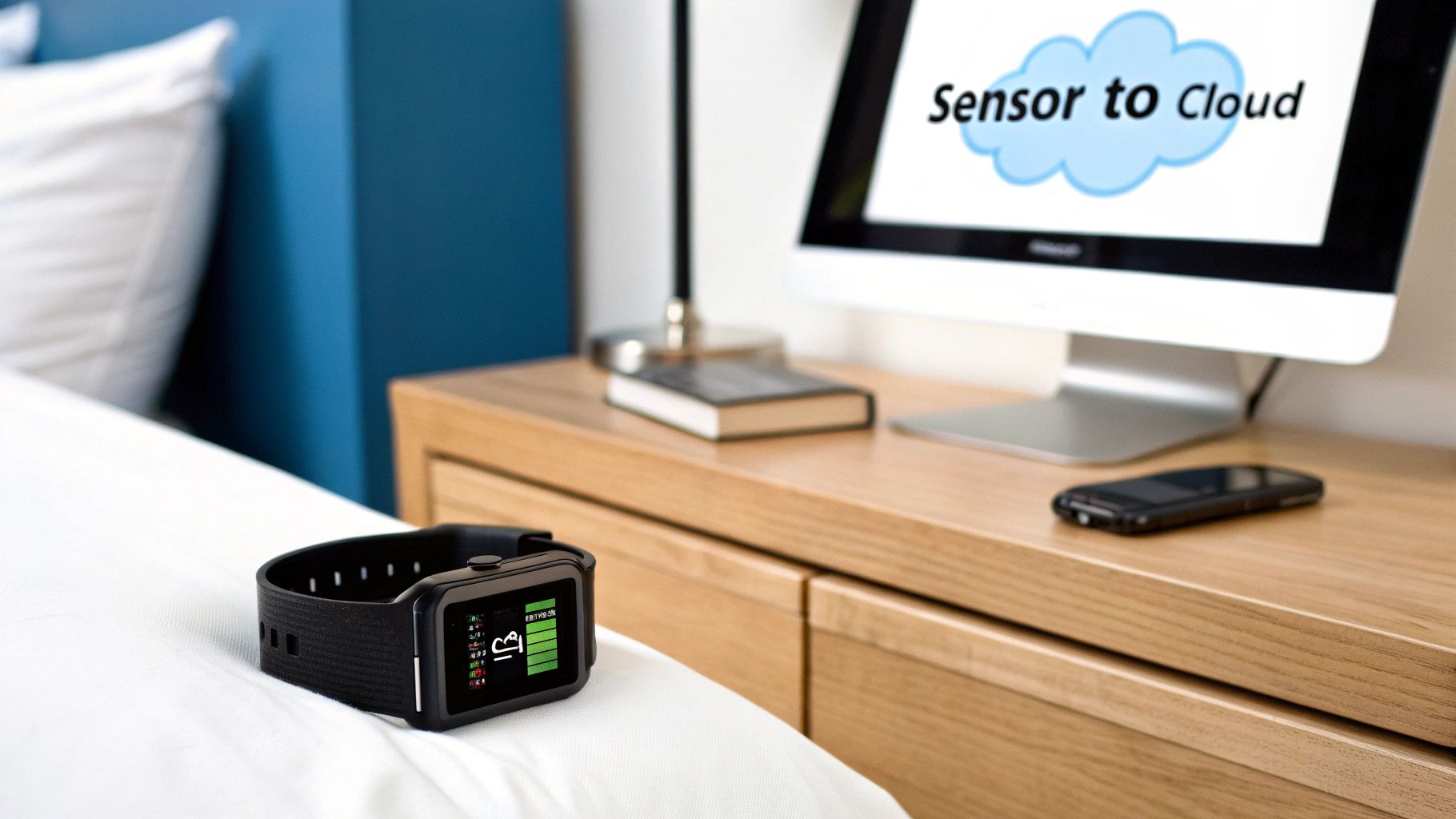
The foundation of any IoT healthcare solution is its edge devices: physical sensors and connected medical gear that collect raw patient data. Examples include continuous glucose monitors, smart inhalers, or wearable ECG patches. Each device is a critical source of real-time information, capturing data previously only available during clinic visits.
However, sending all this raw data to the cloud is inefficient and expensive. This is where edge computing comes in.
The Critical Role of Edge Computing
Edge computing processes data on or near the device itself. Instead of flooding your network, the edge device analyzes data locally to filter information, spot anomalies, and trigger immediate alerts. For example, a wearable fall detection sensor for an elderly patient processes accelerometer data onboard and only sends an alert when a fall is detected. This slashes latency, delivering a potentially life-saving notification in milliseconds.
By pre-processing data at the edge, you conserve bandwidth, reduce cloud costs, and enable faster responses that directly impact patient outcomes.
This local processing creates a scalable and responsive architecture. Once data is flagged as important, it's sent securely to the central data platform.
Secure Data Ingestion and Transport
The journey from edge to cloud is a critical vulnerability point. To protect sensitive health information, the system must use secure, lightweight communication protocols like MQTT (Message Queuing Telemetry Transport). MQTT is built for low-bandwidth environments and uses a publish/subscribe model to efficiently send small data packets. The process is wrapped in security layers like Transport Layer Security (TLS) encryption to ensure data remains confidential and tamper-proof in transit.
This secure pipeline guarantees data integrity every step of the way.
Building a Single Source of Truth in the Cloud
The final destination for all this data is a scalable cloud data platform, which becomes the single source of truth for patient information. For handling massive volumes of time-series data from IoT devices, a platform like Snowflake is ideal. Its architecture ingests and stores huge amounts of data without performance bottlenecks. Here, raw telemetry is combined with other information, like Electronic Health Records (EHR), to create a 360-degree patient view.
Centralizing data this way creates a powerful engine for high-performance analytics. It allows clinicians to query years of patient data in seconds, identify population health trends, and build the predictive models that drive proactive care.
Securing Patient Data Across Your IoT Network
For any IoT healthcare solution, trust is non-negotiable. When sensitive data travels from a patient's home to a cloud server, every point in that journey must be secure. This isn't just about compliance; it's the foundation of patient adoption and clinical confidence.
Security must be woven into your architecture from the start. The explosion of connected devices has made healthcare a prime target, with cybersecurity threats against healthcare IoT increasing by 300% in 2024. This risk runs parallel to massive growth, as the remote patient monitoring market is set to grow from $78.84 billion in 2026 to over $368 billion by 2034, fueled by devices already cutting hospital visits by 38%.
Core Pillars of IoT Data Protection
Protecting patient data demands a multi-layered strategy that breaks down into three core pillars:
- Robust Device Authentication: Each device connecting to your network must be authenticated using unique digital certificates to prevent rogue devices from injecting malicious data.
- End-to-End Encryption: Data must be encrypted from the moment it leaves the sensor until it is stored in the cloud, making it unreadable to unauthorized parties.
- Secure Network Gateways: These gateways act as security checkpoints, inspecting traffic, enforcing policies, and containing potential threats.
Navigating HIPAA and GDPR Compliance
Compliance with regulations like HIPAA in the U.S. and GDPR in Europe is mandatory. Your IoT architecture must be designed to meet their strict requirements from day one. Understanding these frameworks, like GDPR Compliance in IoT, is essential for building a secure network.
Building security and compliance into your solution from the start is a competitive advantage. It builds lasting trust with patients and providers, which is essential for long-term success.
To remain compliant, implement key strategies directly within your data platform.
Actionable Strategies for Your Data Platform
Inside your central data environment, enforce security with granular controls to ensure data integrity and confidentiality are never compromised.
- Data Anonymization and De-identification: Before data is used for large-scale analytics, all personally identifiable information (PII) must be stripped or masked. This allows data scientists to uncover insights without exposing patient identities.
- Role-Based Access Control (RBAC): RBAC ensures users only access data they are authorized to see. A clinician might see a full patient record, while a billing administrator only accesses financial details.
- Comprehensive Audit Trails: Your platform must log every action taken on the data—who accessed it, what they did, and when. These logs are indispensable for security audits and proving compliance.
By embedding these measures into your IoT healthcare solution, you create a system that is not only powerful but also trustworthy.
Proven Use Cases That Deliver Real ROI
An IoT architecture's true value is demonstrated through applications that solve tangible problems. An IoT healthcare solution creates measurable value by using connected devices to drive specific, positive outcomes, including better patient health, smoother hospital workflows, and significant cost savings.
The COVID-19 pandemic accelerated IoT adoption, triggering a 400% jump in telehealth visits between 2020 and 2022. These systems matured, with devices like smart glucose monitors feeding data to cloud platforms, leading to improved outcomes for 70% of patients with chronic conditions. In the US, AI-powered Remote Patient Monitoring (RPM) is already slashing healthcare costs by up to 25% by running predictive analytics on this device data.
Remote Patient Monitoring for Chronic Conditions
Managing chronic diseases like heart failure or diabetes with occasional clinic visits leaves large gaps where a patient’s health can deteriorate unnoticed. Remote Patient Monitoring (RPM) fills these gaps. Patients use connected devices like blood pressure cuffs or smart scales that automatically send daily readings to their care team.
- The Outcome: This continuous data flow allows clinicians to spot warning signs, like a sudden weight gain in a heart failure patient, and intervene early. This leads directly to reduced hospital readmissions, more engaged patients, and more efficient use of clinical staff time.
Smart Hospital Operations and Asset Tracking
Hospitals are complex environments where finding critical equipment like infusion pumps or portable ECG machines can waste valuable nursing time and delay patient care. Real-time location systems (RTLS) use IoT tags to create a live map of every critical asset.
By automating inventory and environmental checks, IoT solutions free up highly skilled clinical staff from logistical tasks, allowing them to focus entirely on patient care.
IoT sensors can also automate environmental monitoring, ensuring that pharmacy refrigerators stay within required temperature ranges. This automates compliance logging and prevents the costly spoilage of sensitive medications.
IoT Healthcare Use Case ROI Comparison
Use CasePrimary Business DriverCore TechnologiesEstimated ROI / OutcomeRemote Patient MonitoringReduced readmissions, improved chronic disease managementWearables, biometric sensors, cloud data platform, telehealth15-25% reduction in hospital readmission costs within 18 monthsSmart Hospital Asset TrackingImproved staff efficiency, reduced equipment lossRTLS (BLE, RFID), indoor location gateways, asset management software20-30% reduction in time spent searching for equipment; 10% reduction in asset shrinkageProactive Senior CareAging in place, faster emergency response, reduced caregiver burdenAmbient sensors, fall detection, smart home devices, alert systemsDelays entry into residential care by an average of 1-2 years, reducing long-term care costsAutomated Environmental MonitoringRegulatory compliance (e.g., Joint Commission), prevention of spoilageTemperature/humidity sensors, automated logging, cloud dashboardPrevents 95% of spoilage incidents for temperature-sensitive medications and supplies
As the table shows, each application targets a specific, high-cost problem and delivers a clear, measurable benefit.
Proactive Senior and At-Home Care
For aging populations, maintaining independence safely is a key goal. IoT provides a discreet safety net. Privacy-respecting ambient sensors (motion, pressure, contact) can be placed in a living space to learn a baseline of normal activity. Consumer devices like the Apple Watch already offer health benefits like fall detection, as detailed in this comprehensive guide to Apple Watch health features.
- The Outcome: The system learns daily routines and sends an alert to a caregiver if it detects an anomaly, such as a long period of inactivity that could signal a fall. This technology enables faster emergency response times, supports aging in place, and can delay the need for more expensive residential care.
Turning IoT Data Into Proactive Care With AI
Collecting patient data is just the beginning. The real breakthrough happens when an IoT healthcare solution uses that data to predict and prevent crises. This is where Artificial Intelligence (AI) transforms your solution from a passive data collector into an intelligent, proactive care system. AI acts as the brain that analyzes the flood of sensory data, spotting patterns a human would miss and triggering intelligent action.
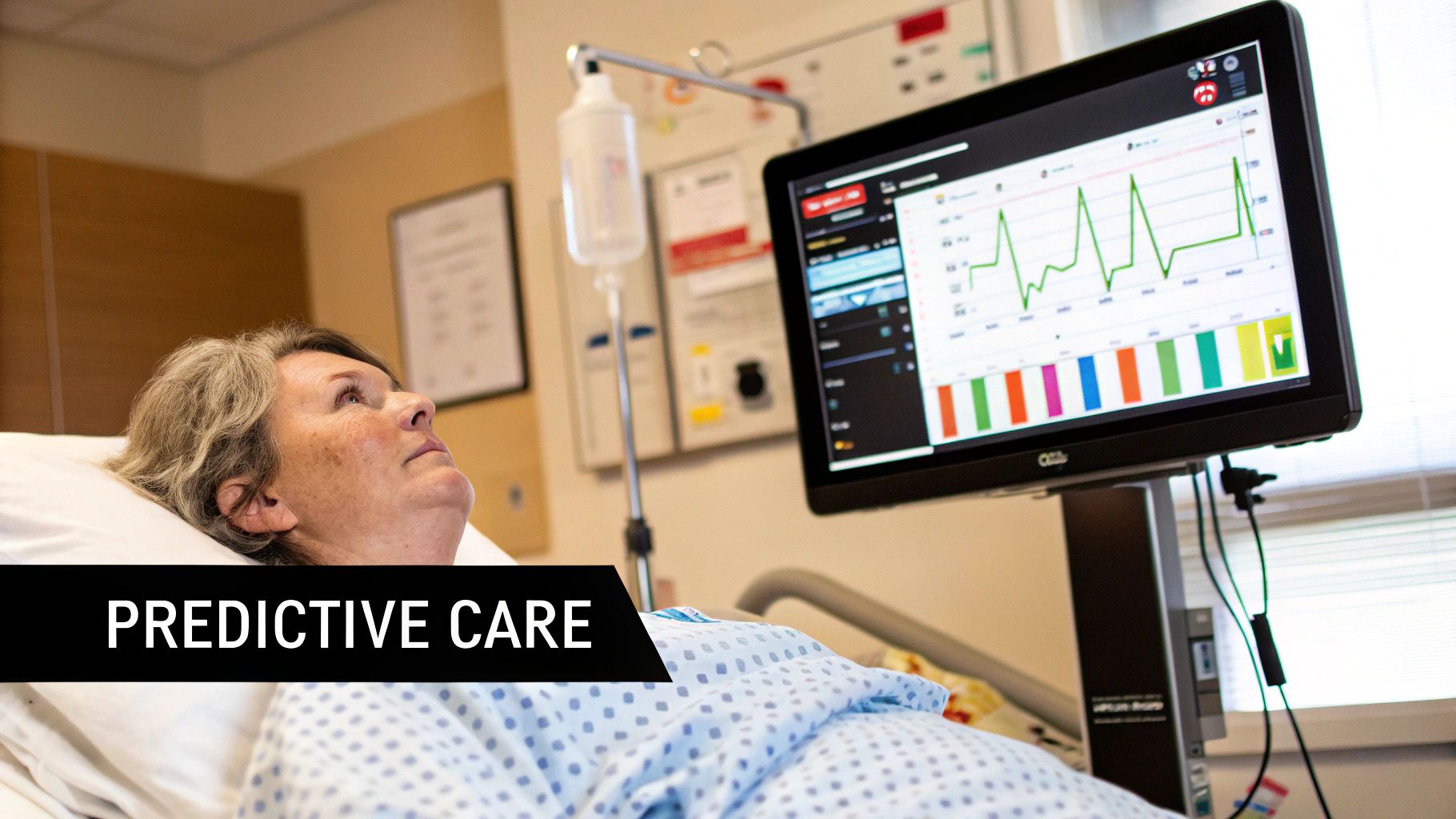
This intelligent layer transforms raw data into an engine for preventive care and operational efficiency. It’s the difference between seeing a patient’s heart rate and understanding that a subtle shift in its variability over 72 hours predicts an imminent cardiac event.
From Data Streams to Predictive Insights
AI workflows, particularly machine learning (ML) models, analyze vast volumes of real-time sensor data. Trained on historical datasets, these models detect faint signals that precede a serious health decline. For instance, an ML model can monitor multiple data streams from a post-op patient at home—heart rate, oxygen saturation, activity levels—and predict the probability of sepsis hours or even days before physical symptoms appear. For a technical deep dive, explore how to manage massive time-series data with Snowflake, the foundation for such analysis.
By turning raw telemetry into actionable predictions, AI gives clinical teams a crucial head start, allowing them to shift from reactive firefighting to a proactive model of care that prevents emergencies.
This capability changes clinical workflows. Instead of sifting through charts, clinicians receive prioritized alerts for high-risk patients, allowing them to intervene with precision.
Automating Alerts With Critical Context
A simple alert like "Patient A's heart rate is high" is not very helpful and adds to alarm fatigue. An AI-driven system delivers intelligent, context-rich alerts. When an AI model flags a patient at risk, it bundles the alert with crucial supporting information:
- Relevant Data Trends: The alert might show a steady decline in heart rate variability over the past 48 hours.
- Contributing Factors: It could highlight a 50% drop in medication adherence, tracked by a smart pill bottle.
- Risk Score: The system can assign a calculated risk score, helping clinicians quickly triage urgent cases.
This approach turns disruptive noise into valuable, decision-support signals.
Optimizing Hospital Resources Intelligently
AI's impact extends to a hospital's operational core. By analyzing real-time data from across the facility, AI can optimize resource allocation. For example, AI models can analyze data from bedside monitors to forecast which patients are likely to need a higher level of care, allowing administrators to manage bed capacity proactively. AI can also analyze asset tracking data to predict demand for equipment like ventilators, ensuring they are always where they are needed most, reducing care delays and rental costs.
Your Roadmap to a Successful IoT Launch
Deploying a powerful IoT healthcare solution requires a practical, step-by-step approach. The most effective way to manage risk and prove value is to start with a focused pilot project that targets a single, high-impact problem, like reducing readmissions for a specific patient group or tracking a critical type of medical equipment. The goal is to generate clear, measurable results that build a strong business case for a broader rollout.
Assembling Your Team and Defining Success
Success depends on a partnership between technical experts and clinical staff. Your implementation partner must have a proven track record in building scalable data platforms and a deep understanding of the healthcare domain.
Define your Key Performance Indicators (KPIs) from day one:
- Clinical KPIs: A 15% reduction in 30-day readmissions or faster nurse response times.
- Operational KPIs: A 20% decrease in time staff spend searching for equipment or automating compliance logs.
- Financial KPIs: A clear return on investment from reducing operational waste or preventing costly emergencies.
A successful IoT launch is a change management initiative. Clinician buy-in, intuitive tools, and solid training are as important as the backend architecture.
Planning for Scale and Mitigating Risk
Once your pilot proves its value, plan to scale the solution across the organization. This requires a robust architecture that can handle growth in data volume and device management without performance issues. Use simulation to model how the system will behave under a heavier load to identify potential bottlenecks early. For more on this strategy, see our insights on simulation and IoT for mitigating risk as systems grow.
Finally, build a framework for continuous improvement. The data from your IoT solution is a goldmine for refining clinical workflows, improving care protocols, and uncovering new opportunities for innovation. By starting small, proving value, and planning for scale, you can successfully launch an IoT healthcare solution and secure the support needed to drive real change.
Frequently Asked Questions
Here are concise answers to common questions about implementing an IoT healthcare solution.
What Is the Biggest Implementation Challenge?
The biggest challenge is typically data integration and interoperability. Healthcare organizations often use a mix of legacy systems, EHRs, and new IoT devices that don't communicate well. A successful IoT initiative requires a central platform that can ingest, standardize, and connect these disparate data streams into a single source of truth. Without this, you create more data silos, making advanced analytics and AI impossible.
The goal is to build a single source of truth. Overcoming data fragmentation is the most critical step in transforming collected data into actionable clinical insights that improve patient outcomes.
How Do You Ensure Data Reliability From Wearables?
Consumer-grade wearables are less precise than clinical-grade devices. A well-designed IoT solution accounts for this with data validation and cleansing pipelines that:
- Set Thresholds: Automatically flag readings outside of normal ranges.
- Detect Anomalies: Use algorithms to identify patterns that might indicate a faulty sensor.
- Correlate Data: Cross-reference data from multiple sources, prioritizing information from certified medical devices.
Critical applications must rely on data from clinically validated devices. Data from consumer wearables can be used for secondary trend analysis, with each data point tagged by its source and a reliability score.
How Can We Calculate ROI Before a Full Deployment?
Calculate a reliable ROI by launching a focused pilot program targeting a single, high-impact use case, such as reducing hospital readmissions for a specific patient group.
Before starting, define clear success metrics, like a 15% reduction in 30-day readmissions. Track all costs, including devices, platform fees, and staff time. Once the pilot is running, measure these costs against the savings generated, such as fewer readmissions or shorter hospital stays. This provides a concrete, data-backed ROI model to justify a larger, enterprise-wide implementation.


