IoT for retail connects physical store elements—shelves, cameras, and product tags—to the internet, creating a network of real-time communication. This transforms a passive space into an intelligent environment that automates inventory, personalizes customer experiences, and prevents operational issues before they start. The core outcome is a store that uses data to drive efficiency and sales.
How IoT Is Redefining the Retail Landscape

Imagine a store that maintains perfect inventory without manual counts. This is the central promise of IoT in retail. It’s not about adding gadgets; it’s about building a store that anticipates customer needs and resolves operational problems before they impact the business. By collecting vast amounts of data directly from the shop floor, IoT gives managers a live, unfiltered view of their operations.
To tackle persistent issues like stockouts and impersonal service, IoT offers concrete, data-driven solutions. Here’s a look at how this technology maps directly to common retail challenges and delivers measurable outcomes.
Key Retail Challenges and Their IoT Solutions
Retail ChallengeIoT Solution ExampleBusiness OutcomeInaccurate Inventory & StockoutsRFID tags on products continuously update stock levelsReduced lost sales, improved inventory accuracy to 99%+Inefficient Store LayoutVideo analytics and heat maps track customer foot trafficOptimized product placement, increased dwell time in key areasImpersonal Customer ExperienceBeacons send targeted offers to shoppers' phones in specific aislesHigher conversion rates, increased basket size, improved loyaltyHigh Operational CostsSmart HVAC and lighting adjust based on store occupancyLower energy consumption, reduced utility billsProduct Spoilage (Grocery)Temperature sensors in refrigeration units send real-time alertsReduced waste, ensured food safety and complianceTheft and ShrinkageSmart tags and video analytics identify suspicious behaviorDecreased loss, improved asset protection
These examples show a clear pattern: IoT is a practical toolkit for turning store data into smarter decisions and a healthier bottom line.
Connecting the Physical to the Digital
IoT closes the gap between the physical store and digital analytics. Each sensor acts as a tireless digital employee, constantly reporting on its specific task:
- RFID tags on apparel: Broadcast their location, providing a perfect inventory count automatically.
- Weight sensors on shelves: Send an immediate alert when a popular item is running low.
- Smart cameras with people-counting: Analyze foot traffic to identify which displays attract attention and which are ignored.
This constant data stream creates a "digital twin" of your store. Instead of relying on weekly reports, managers can see what’s happening in real-time. This immediacy enables faster, more accurate decisions that directly impact revenue.
By making previously "dumb" assets intelligent, retailers build an ecosystem that is always learning and adapting. This is the real game-changer—moving from reactive problem-solving to proactive optimization.
Driving Tangible Business Outcomes
Adopting IoT for retail is a strategic move with a clear ROI. The market is exploding because the results are compelling.
The global retail IoT market was valued at around $14.5 billion in 2022 and is on track to more than double to $35.5 billion by 2025, fueled by an annual growth rate of nearly 20%. This growth is driven by retailers seeing concrete benefits like higher sales, less waste, and increased customer loyalty. You can find out more about the growth of IoT in the retail industry. By turning raw data into meaningful action, IoT builds a more efficient, profitable, and customer-focused shopping experience.
Practical IoT Use Cases That Drive Real Results
The real value of IoT for retail lies in solving specific business challenges. Effective applications deliver measurable returns by shifting operations from reactive to proactive, turning a store into a dynamic space that responds instantly to inventory and customer behavior. Let's explore three high-impact use cases that deliver clear business outcomes.
Use Case 1: Automate Inventory with Smart Shelves
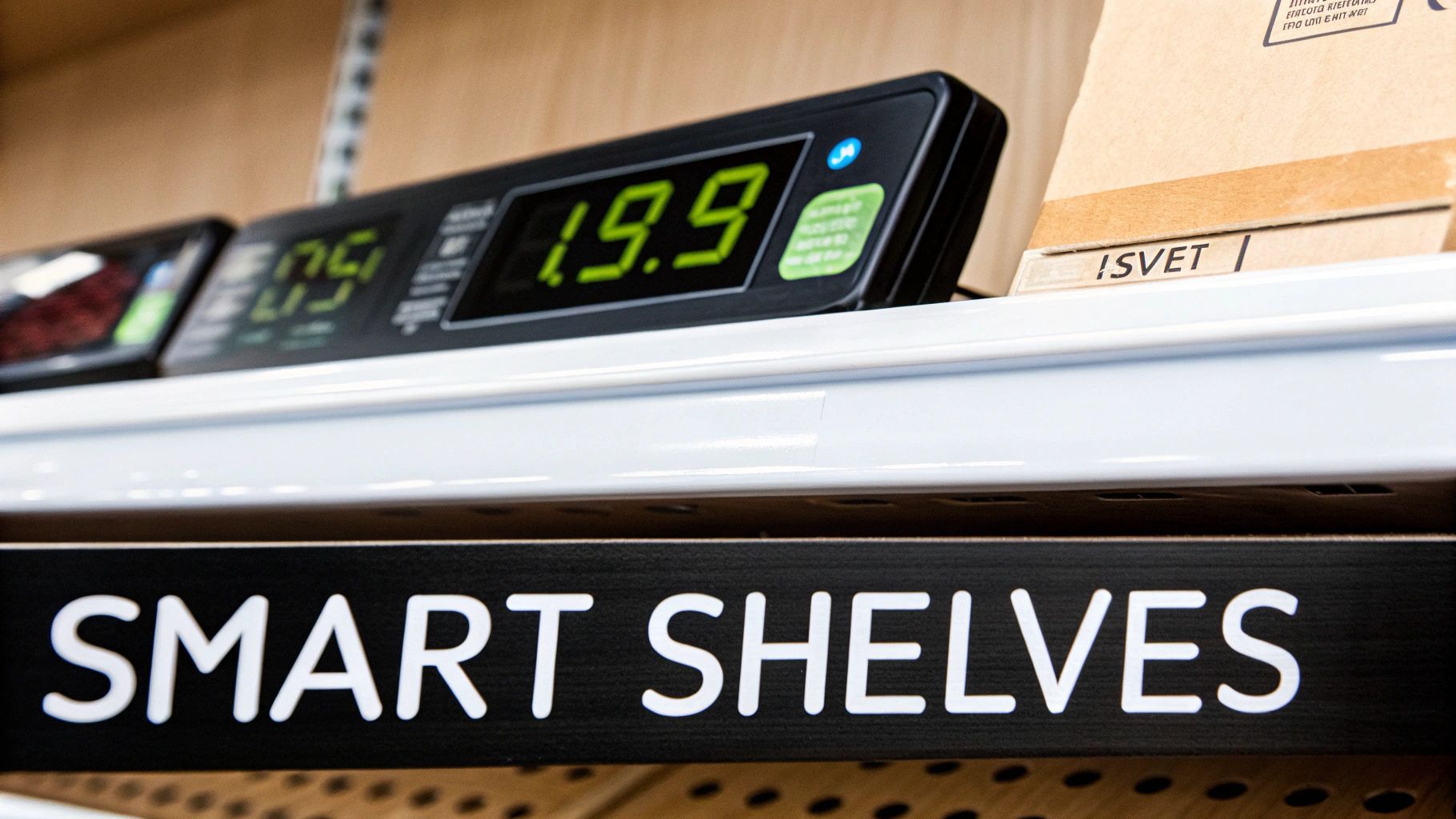
Manual inventory counts are slow, expensive, and inaccurate, directly causing stockouts that cost retailers an estimated $1 trillion globally each year. Smart shelves solve this by using Radio-Frequency Identification (RFID) tags on products and readers built into the shelving, creating a 24/7 automated stock-take.
- How it Works: When an item is picked up, the RFID reader detects its absence and instantly updates the inventory system. If stock drops below a set level, an alert is automatically sent to a store associate's device to restock.
- The Outcome: Retailers achieve over 99% inventory accuracy, nearly eliminating out-of-stocks. This improves the customer experience and frees up staff from tedious counting to focus on helping shoppers.
Use Case 2: Drive Conversions with In-Store Beacons
Personalizing the in-store experience is key to building loyalty, but it's difficult to know what a customer wants in the moment. Beacons—small, low-energy Bluetooth devices placed around the store—solve this by triggering actions on a shopper's phone when they get close.
This technology bridges the digital and physical worlds, allowing retailers to deliver the kind of personalized, context-aware offers that online shoppers have come to expect, but right at the point of decision in the aisle.
- How it Works: Imagine a customer pausing by the headphones display. A beacon can send a notification to their phone offering 15% off that model or showing a special bundle, turning consideration into a sale.
- The Outcome: This targeted approach can boost in-store offer redemption by as much as 25% and significantly lift conversion rates for promoted items.
Use Case 3: Reduce Shrinkage with Intelligent Loss Prevention
Retail shrinkage, primarily theft, is a multi-billion dollar problem. Traditional security is reactive, helping investigate theft after it occurs. An intelligent loss prevention system uses a network of IoT devices—smart cameras, RFID tags, and entry sensors—to spot and stop theft in real time.
- How it Works: The system can flag an alert if multiple high-value items are grabbed at once or if a tagged product passes an exit without being paid for. This sends an immediate alert to security, allowing for intervention before the merchandise leaves the store.
- The Outcome: Shifting from after-the-fact analysis to real-time response leads to a direct, measurable reduction in losses and improved asset protection.
Designing Your Retail IoT Architecture
To build a powerful IoT for retail system, you need a solid technical blueprint that maps how data gets from your store floor to your analytics platform. Without a good plan, you’ll end up with an unreliable system that's impossible to scale. Think of your IoT system as having four distinct layers, each with a critical job.
The Four Layers of Retail IoT Architecture
A well-designed architecture ensures that data from thousands of devices is captured reliably and processed efficiently. This foundation is key to building a system that can grow with your business.
- Edge Devices (The Collectors): These are the sensors, cameras, RFID readers, and beacons in your stores. They capture specific pieces of information—a product's location, a shelf's weight, or a customer's path.
- Gateways (The Aggregators): A single store may have thousands of devices. Gateways act like local hubs, collecting data from nearby sensors, doing initial filtering, and bundling it for efficient transfer.
- Messaging and Streaming (The Transport): Once data is bundled, it needs a secure way to travel to the cloud. Messaging and streaming protocols are the digital highways that ensure data packets arrive intact and in order.
- Cloud Platform (The Brain): All data arrives at its destination—your cloud platform (like Snowflake). This is where everything is processed, analyzed, and stored, turning raw data into actionable insights like inventory alerts or traffic heatmaps.
Think of this layered approach as a system of checks and balances. Each layer has a specific function, from collection to transport to analysis. This ensures the entire process is efficient, scalable, and secure from end to end.
Building for Scale and Reliability
This layered structure is a practical model for handling growth. The number of IoT devices is expected to hit 30 billion by 2030, fueling massive sensor deployment in retail. A solid architecture ensures your system can handle this data explosion. For deeper insights, explore information on IoT implementation in retail.
Start with a pilot project, but design the architecture with the end goal in mind. This modular approach allows you to upgrade or expand one layer without rebuilding the entire system, creating an adaptable foundation for your retail IoT initiatives.
Turning IoT Data into Automated Actions with AI
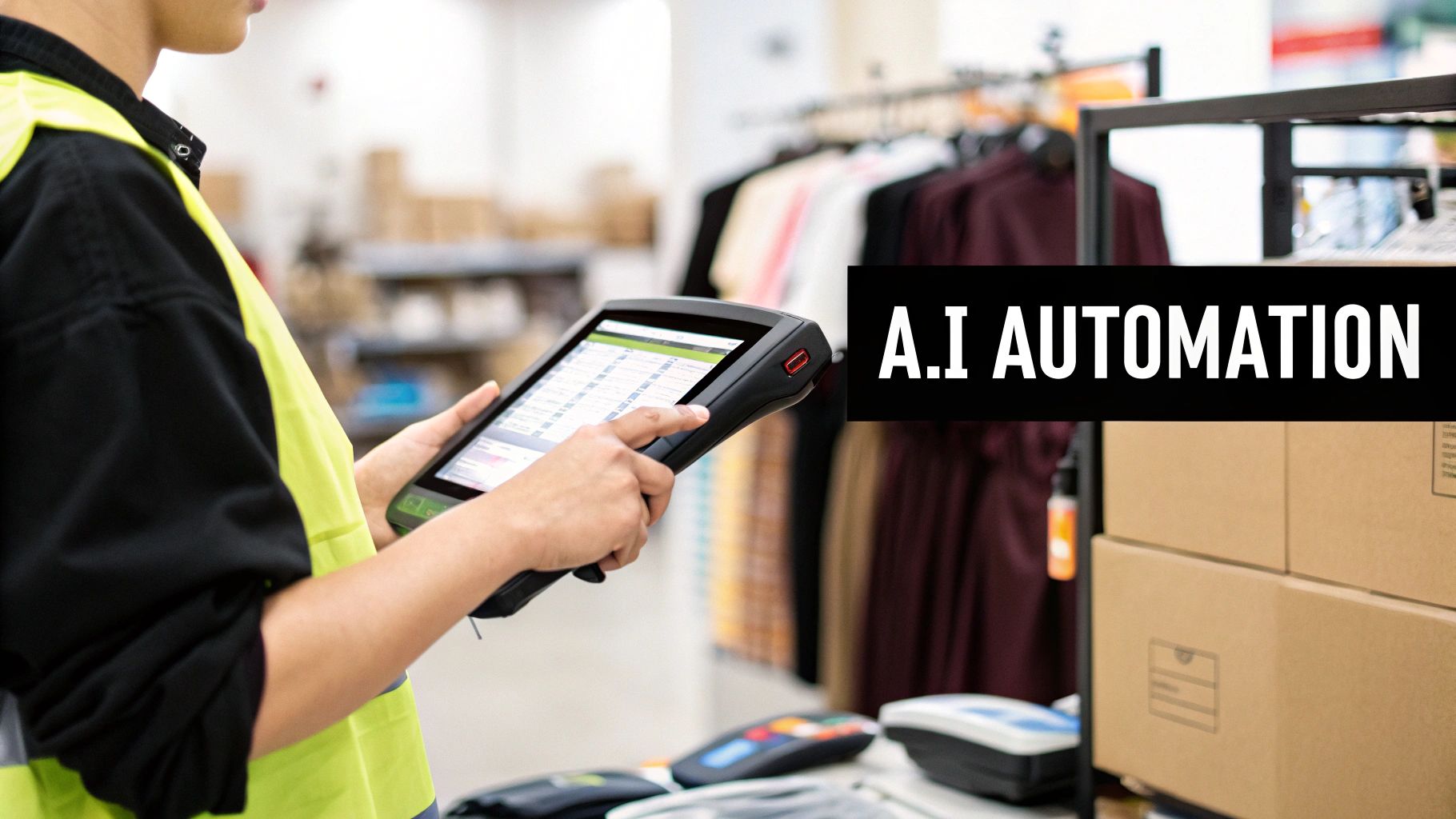
Collecting data is just the first step. The real value of IoT for retail is realized when that data triggers intelligent, immediate action. This is where a modern data platform and artificial intelligence work together to create a truly automated store.
The speed and volume of IoT data can overwhelm traditional databases. Modern platforms like Snowflake are built to handle massive, non-stop data streams, acting as the central nervous system for your operations. Our team has shared insights on managing time series data with Snowflake, which is exactly what IoT devices produce.
From Raw Data to Proactive Solutions
Once data is flowing into a capable platform, Agentic AI can make it actionable. Instead of just generating reports, Agentic AI deploys autonomous "agents"—specialized AI programs—to monitor data streams and take action independently. Think of an AI agent as the ultimate store assistant that watches everything at once and initiates entire workflows.
This is the leap from passive data collection to active, hands-off operational automation. The system no longer just tells you there's a problem; it starts solving it for you, often before a human even knows what's going on.
An Agentic AI Workflow in Action
Here’s how this automated process solves a common problem: the empty shelf.
- Monitor: An AI agent sees real-time data from a smart shelf showing only three units of a popular soda are left, below the reorder threshold.
- Trigger: Without human input, the agent connects to your ERP system and automatically places a purchase order with the supplier.
- Alert: Simultaneously, the agent sends a specific notification to a store associate's device: "Restock Aisle 4, Shelf 2 with product XYZ from the back room."
- Confirm: Once the associate restocks, the RFID readers register the new inventory. The AI agent sees the update and marks the task as complete.
This entire sequence can happen in minutes, getting the product back on the shelf before a single customer is disappointed.
The Business Outcome of Automation
This shift from manual checks to AI-driven action creates a powerful engine for efficiency. It directly tackles major retail pain points by building a self-correcting system.
- Reduced Lost Sales: Shelves are restocked proactively, slashing the risk of out-of-stocks.
- Optimized Labor: Associates are freed from tedious tasks like manual counts and can focus on helping customers.
- Improved Supply Chain: Automated reordering based on real-time demand makes your supply chain more responsive.
By connecting a robust data platform with Agentic AI, retailers can close the loop, turning store data into a dynamic system that drives sales, boosts efficiency, and creates a better customer experience.
Securing Your System and Measuring Your ROI
Rolling out a network of connected devices introduces two critical questions: is our data secure, and how do we prove this investment is paying off? Security and Return on Investment (ROI) must be core components of your strategy from day one. Without a solid security plan, you risk sensitive data and customer trust. And without clear success metrics, your IoT project will seem like a cost, not a value driver.
Fortifying Your IoT Ecosystem
Every sensor and gateway is a potential security threat. A single weak link could expose customer information or halt operations. Building a secure system requires a multi-layered approach to keep data safe at every point.
- End-to-End Encryption: Data must be encrypted both in transit (from sensor to cloud) and at rest (in your database).
- Secure Device Onboarding: A strict authentication process is needed for any new device joining your network to prevent unauthorized access.
- Privacy Compliance: Adherence to regulations like GDPR and CCPA is non-negotiable, ensuring customer data is handled transparently and with consent.
As IoT adoption grows, so do security concerns. Over 78% of industrial deployments now use tailored encryption and cybersecurity measures, a best practice retail enterprises are adopting. You can learn more about the business impact of IoT trends.
Proving the Value of Your Investment
To get stakeholder buy-in, you must demonstrate financial value with hard numbers. This means establishing a baseline before implementation and tracking Key Performance Indicators (KPIs) afterward.
A strong business case is built on clear, quantifiable metrics. By tracking the right KPIs, you can confidently calculate your ROI and showcase the direct financial benefits of your IoT for retail project to leadership.
KPIs for Measuring Retail IoT Success
Here are key metrics to track to prove the value of your IoT implementation.
Business AreaKey Performance Indicator (KPI)How IoT Improves ItInventory ManagementInventory Accuracy RateSmart shelves and RFID provide real-time stock counts, boosting accuracy from ~65% to 99%.Sales & RevenueStockout RateProactive alerts from smart shelves enable timely restocking, reducing empty shelves and lost sales.Operational EfficiencyLabor Hours on Manual CountsAutomating inventory checks frees up employee hours that can be reallocated to customer service.Loss PreventionShrinkage RateIntelligent video and smart tags deter theft in real time, directly reducing inventory loss.
Tracking these KPIs builds a powerful, data-backed narrative, changing the conversation from "We think this is working" to "We boosted inventory accuracy by 30% and cut stockouts by 45%, leading to a measurable revenue lift." This is the proof needed to justify your investment.
Your Roadmap to a Successful IoT Implementation
Implementing an IoT for retail project can feel overwhelming, but a successful rollout doesn’t require a complete overhaul on day one. A phased approach that builds momentum, proves value, and mitigates risk is the smartest path forward. Start small to win big.
Phase 1: Start with a Targeted Pilot Project
Instead of connecting everything at once, pick one high-impact problem to solve. For example, equip a single, high-value department like electronics with smart shelves to tackle chronic stockouts. This small, contained experiment lets you test the technology and iron out issues in a low-stakes environment.
Phase 2: Measure Impact and Validate the Business Case
Once the pilot is running, measure its impact against your initial KPIs. Did inventory accuracy improve? Did the stockout rate drop? Did sales for that department increase?
This is your proof point. The data you collect here is essential for building a rock-solid business case to present to stakeholders, transforming a theoretical benefit into a tangible, data-backed success story.
This validation stage provides the hard numbers needed to justify expanding the project.
Phase 3: Design and Scale the Architecture
With a successful pilot, you can now design an architecture that scales. Your learnings will inform decisions about gateways, cloud platforms, and security protocols for a multi-store rollout. This is a good time to explore how simulation and IoT can mitigate risk as systems grow. Plan how IoT data will integrate with core systems like your ERP and CRM.
Phase 4: Scale and Integrate Across the Enterprise
Now you are ready to roll out your proven solution across more stores and departments, integrating it tightly with existing enterprise systems. Your IoT initiative transitions from a special project to a core part of your business operations. Choosing the right technology partner is critical for this phase.
Key Questions to Ask Potential IoT Vendors:
- Scalability: How does your platform handle data from thousands of stores?
- Integration: Can you show case studies of successful integrations with systems like ours?
- Security: What are your end-to-end encryption and device authentication standards?
- Support: What does your support model look like during and after implementation?
Common Questions We Hear About Retail IoT
When discussing IoT for retail, practical concerns about cost, integration, and team skills quickly emerge. Let's address these common questions from enterprise buyers.
What’s a Realistic Budget for an IoT Pilot?
The cost depends entirely on the project's scope. A simple beacon pilot for proximity marketing might cost only a few thousand dollars. A full smart shelf system with RFID in a single store could exceed $100,000. Key cost drivers include hardware, platform subscription fees, and integration services.
To manage costs, start with a small, focused pilot. Choose a specific business problem, like stockouts of a best-selling product line, and build the pilot around solving it. This ties your initial investment to a clear, measurable financial outcome.
How Hard Is It to Connect IoT with Our Existing Systems?
Integration difficulty depends on your current systems (ERP, CRM) and your IoT vendor's platform. Modern IoT platforms are built for connectivity and often offer pre-built connectors or robust APIs to simplify data exchange.
When vetting vendors, don't just ask if they can integrate. Ask for specific case studies where they've connected to systems just like yours. This provides a realistic sense of the effort involved.
A phased approach is best. For example, start by integrating smart shelf data with your ERP. Once that is stable, move on to connecting foot traffic data to your CRM. Breaking the project into smaller wins makes it more manageable.
What Kind of Skills Do We Need on Our Team?
A successful IoT implementation requires a mix of technical and operational skills. On the tech side, you need people who understand IT networking and data management, especially with platforms like Snowflake. A data scientist is valuable if you plan to build custom AI models.
Operationally, you must train store managers and supply chain teams to use the new dashboards and real-time alerts to make smarter decisions. For many retailers, a partnership model is effective: lean on your IoT vendor for technical heavy lifting while your internal teams focus on using the insights to drive business value.


