
Your IoT pilot has a working dashboard, connected equipment and an enthusiastic sponsor. But expanding it means answering questions the pilot avoided: who replaces failed gateways, who approves firmware updates, and whether a missing reading means a stopped machine or a broken connection.
That's where IoT for enterprises becomes an operating problem. The useful question isn't how many sensors you can connect. It's whether the right person can trust the data enough to make a decision, and whether someone owns the system when it stops working.
What Enterprise IoT Means and How It Differs From Smart Devices
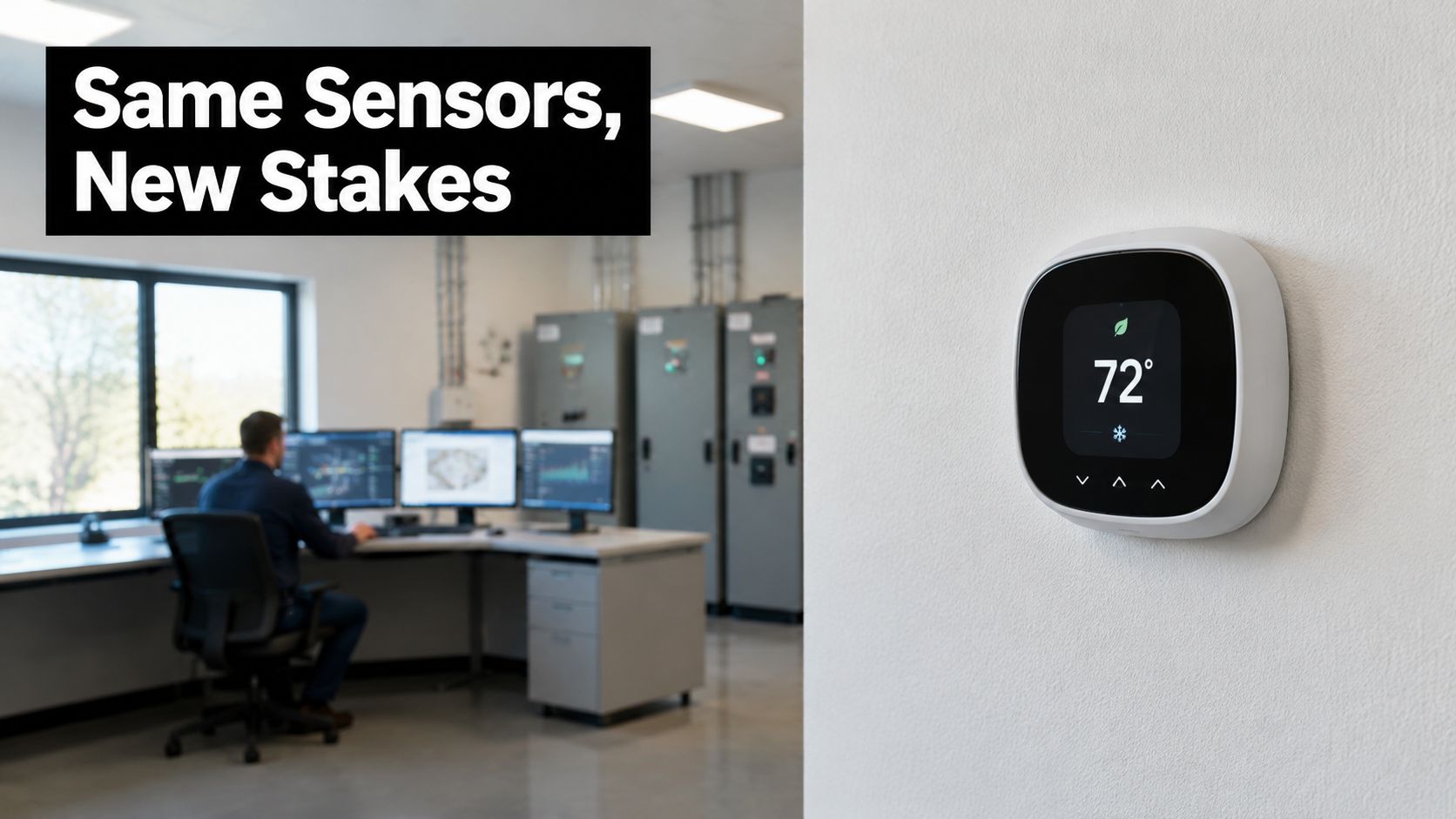
A thermostat in one home measures temperature and adjusts heating. Across thousands of substations, a grid operator uses similar sensing to monitor equipment, but must also determine whether a reading signals a fault, a network outage or an unsafe condition. The difference is the work required to trust and act on the data.
Enterprise IoT connects sensors, controllers, gateways and platforms to machines, vehicles, buildings and meters. Its data has value when it changes a business process, such as scheduling maintenance, investigating energy use or flagging a shipment at risk. A familiar device is only the visible starting point.
The technology is older than the label
The World Economic Forum's history of IoT traces the industrial foundations through programmable logic controllers in 1968, distributed control systems in 1975, Ethernet standardization in 1983, Kevin Ashton's introduction of the term at MIT's Auto-ID Center in 1999, and cloud momentum following Amazon Web Services' launch in 2002.
In recent years, the emphasis has shifted from connecting equipment to integrating its data into workflows and analytics. Knowing a machine's temperature is only the first step. A useful system also gets an approved maintenance action into the software technicians use every day.
At enterprise scale, several operating conditions change:
- Device population: Thousands of assets may span multiple sites, rather than a dozen household devices.
- Ownership: IT manages networks and applications, while operational technology, or OT, teams manage equipment that interacts with physical processes.
- Failure consequences: Incorrect data can halt production, put a cold-chain shipment at risk or misstate an energy bill.
An enterprise IoT system needs physical assets, reliable networks, a data platform and business applications to work together. The sensor provides a measurement; the operating process determines whether that measurement can be trusted and acted on. Without clear ownership of those steps, adding connected devices creates more readings, not necessarily better decisions.
Use Cases That Return Measurable Value
Use caseSectorWhat the data doesReported outcomeReal-time anomaly detection and automated root-cause analysisSemiconductor manufacturingMachine telemetry flags anomalies and diagnoses causesAt Micron, unplanned downtime fell 30%, new-product ramp-up accelerated 20%, and labor productivity improved 20%, according to the OECD case study.Energy dashboard for plant consumptionSemiconductor manufacturingContinuous readings expose consumption patternsThe same Micron case reported 15% lower energy consumption.Continuous energy monitoring with heatmapsCable manufacturingConnected meters replace manual readings and reveal abnormal loadsA published cable-manufacturing case study reported net profit beginning in month 21, with ROI initially 2% and reaching a cumulative 73% by month 36.Geofencing and fleet trackingLogistics and fleet managementGPS positions are checked against site and route boundariesEstablish an empty-mile and route-exception baseline before deployment.Smart building optimizationReal estate and facilitiesEnergy and occupancy readings feed optimization modelsMeasure energy per occupied area alongside comfort exceptions.Network and grid performance monitoringTelecom and energyEquipment metrics feed operational dashboardsMeasure outage duration and time to identify faults.Patient and asset monitoringHealthcareTags track equipment location and conditionMeasure equipment-search time and asset availability.
What changed on the factory floor
Micron's example wasn't merely a sensor installation. Its facility combined machine telemetry, real-time anomaly detection and automated root-cause analysis. Operators could move from noticing a deviation to investigating its cause while the information was still useful.
That distinction matters. A dashboard that shows a vibration spike still leaves someone to interpret it, find the relevant machine history and decide what happens next. Connecting those steps to a maintenance or production workflow is what makes operational improvement plausible.
The cable-manufacturing case addressed a less glamorous problem: manual energy readings. Connected meters and heatmaps made abnormal loads easier to identify and reduced reliance on handwritten records.
Its payback timeline is also instructive. Installation, integration and corrective work happen before the full financial benefit arrives. Don't evaluate a sustained operating-cost program as though it were a quick software subscription saving.
Selection rule: Choose a use case whose success metric already appears in an operations or finance report.
Useful scenarios without invented returns
For fleet management, a geofence is a virtual boundary around a site or route. Crossing the wrong boundary can trigger an exception for a dispatcher to investigate, but a boundary alert alone doesn't prove lower transport costs.
A building team can combine occupancy and energy readings to recommend heating or cooling changes. It should check comfort complaints alongside consumption, otherwise an apparent saving may merely reflect an uncomfortable building.
Telecom teams use operations support systems, or OSS, to monitor network elements. Energy teams use energy management systems, or EMS, to track equipment performance and electrical conditions. Their dashboards should help operators locate faults, not just display more measurements.
For healthcare asset tracking, start with a practical question: can staff find available equipment faster? For every scenario without a published outcome, establish the baseline before installing devices, then measure whether the operating team actually changes its work.
Reference Architecture From Sensor to Decision
LayerJobTypical componentsFailure to design forDevice and sensorMeasure and act on the physical assetSensors, PLCs, meters, actuatorsDrift, unpatched firmware, unauthorized configurationEdge gateway and connectivityBuffer data, translate protocols, carry it outIndustrial gateways, cellular or LoRaWAN links, MQTT clientsLost links, buffer overflow, stale timestampsIngestion and normalizationAuthenticate devices, standardize formats, attach metadataMessage broker, IoT hub, schema registryDuplicates, out-of-order records, unknown devicesStorage and analyticsKeep time-series history and model itTime-series store, Snowflake tables, feature pipelinesSilent gaps interpreted as normal operationApplication and controlTurn insight into approved actionWork-order systems, dashboards, guarded AI agentsAutomated action on untrusted data
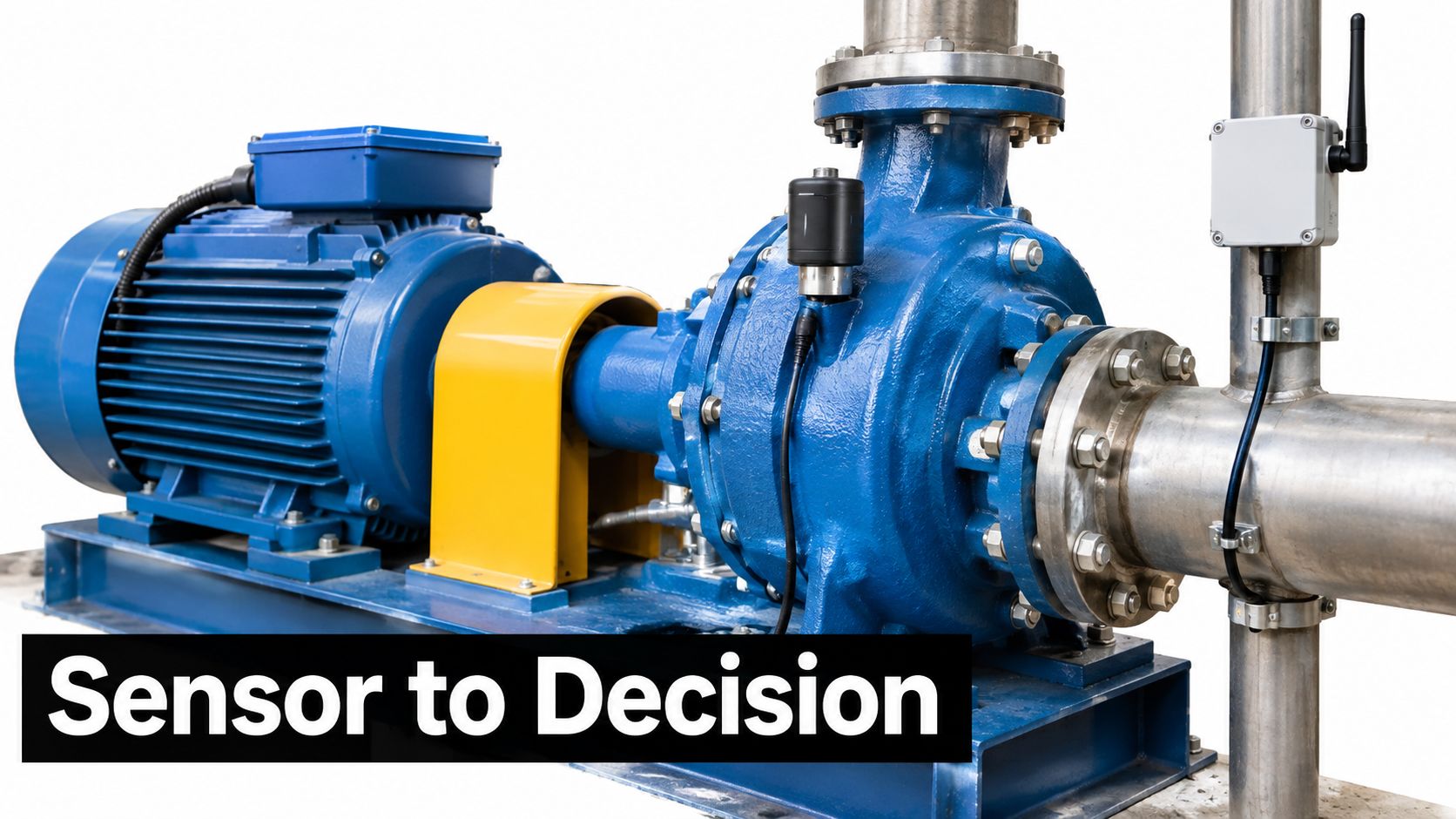
A pump makes these layers easier to understand.
Follow a reading through the system
Suppose a pump's vibration sensor samples every second. A nearby edge gateway, a computer between field equipment and central systems, buffers readings during an outage rather than immediately discarding them.
When connectivity returns, the ingestion service authenticates the device, standardizes the message and flags the interrupted delivery. The analytics platform stores the history; the application raises a work order only when an approved rule passes.
For teams deciding what to measure on rotating equipment, Forge Reliability's condition monitoring guide provides useful context for connecting equipment condition to maintenance decisions.
Keep observation separate from command
Telemetry is the measurement path. The control path carries instructions back to equipment. A dashboard or model that can read pump data shouldn't automatically have permission to stop the pump.
NIST's IoT cybersecurity capability guidance considers devices, data, systems and the broader ecosystem, with capabilities mapped to controls including NIST SP 800-53. Translate that system-level approach into explicit architecture rules:
- Restrict paths: Allow only defined network destinations and APIs.
- Authenticate both ends: Devices and services should verify each other.
- Encrypt information: Protect data in transit and at rest.
- Authorize access: Check permissions before operational or analytical workloads receive data.
These boundaries limit the blast radius, the extent of damage from a compromise. A low-cost sensor shouldn't become a route into unrelated production systems.
Use the accompanying video as additional architecture context.
Retain each measurement's timestamp, device identifier, firmware and configuration metadata, and quality flags. Those fields let analysts distinguish genuine process changes from sensor drift or deployment changes.
For every layer, ask: what happens when this part fails, and who finds out?
Security and Compliance Terms to Write Into Contracts
In a Ponemon Institute survey of enterprise IoT and OT cybersecurity, 88% of respondents said their enterprise IoT devices were internet-connected, only 29% reported a complete IoT and OT inventory, and 44% had experienced an incident involving such a device during the preceding two years.
That's a procurement and management gap, not just a firewall problem. Security teams can't reliably protect assets whose identity, support status and responsibilities remain unknown.
Make security an acceptance condition
NIST SP 800-213 recommends evaluating a device as a system element. Derive requirements from its role, data flows, interfaces, update model and dependencies rather than applying an identical checklist to every product.
Write testable purchase specifications:
- Unique identification: Each device must have a distinguishable identity.
- Secure configuration: Commissioning must remove insecure defaults and restrict configuration changes.
- Data protection: The device must protect stored and transmitted information.
- Interface access control: Every management and data interface needs appropriate logical access restrictions.
- Authenticated updates: The device must verify software updates before accepting them.
- Cybersecurity-state visibility: Operators need a way to detect and report relevant security conditions.
- Device security functions: Required protective capabilities must remain available throughout supported operation.
A vendor's promise isn't acceptance evidence. Request a demonstration of identity provisioning, update verification and unauthorized-access rejection before approving deployment.
Separate device capabilities from vendor support. Documentation, security information, update support and customer education need named deliverables and contractual responsibilities.
Keep an inventory that supports decisions
Maintain these fields for every asset:
- Identity and firmware version: Match the physical unit to its software state.
- Owner and location: Name the responsible team and where the unit operates.
- Data classification: Record the sensitivity of information it handles.
- Connectivity path: Identify the gateway, network and services it uses.
- End-of-support date: Make replacement planning possible before support expires.
Map controls to the framework your organization or regulator requires, such as NIST SP 800-53 where applicable. Keep dated test results, configuration evidence and exception approvals. Following guidance isn't automatically proof of regulatory compliance.
A device that can't meet its security requirements needs a replacement decision, not an indefinitely open exception.
Suppose a valve controller accepts unsigned updates and loses vendor support next year. Treat it as a replacement item, with interim containment agreed by OT and security, rather than assuming a patch project can resolve its design limitations.
Who Owns the Connected Estate After the Pilot
The sensors can work while the handoffs fail. A platform purchase won't resolve disagreement about who handles a silent device or pays for an obsolete gateway.
Only 26% of surveyed organizations found scaling IoT easier than expected, while 48% credited strong IT/OT collaboration as the leading success factor, according to 451 Research's Digital Industries Insider.
The reliability challenge is concrete: a 2024 survey of 1,200 senior IoT decision-makers and implementers found 80% planned to expand their estates within 18 months, yet fewer than 0.4% achieved connectivity above 98%, down from 1.49% in 2023.
Assign operating responsibilities before expansion
The following is a proposed operating cadence, not an industry benchmark.
Estate elementOwnerReview cadenceHealth measureDevice identity and inventoryOT engineering with IT asset managementMonthly reconciliationShare of devices present in inventoryFirmware and patch statusOT engineering with securityPer vendor advisory and quarterlyShare on supported firmwareConnectivity and uptimeNetwork operationsDaily dashboard reviewShare reporting within the service-level objectiveData quality and lineageData platform teamEvery pipeline runMissing, delayed and duplicated record ratesIncident responseSecurity operationsPer event, with twice-yearly drillsMean time to isolate a compromised deviceLifecycle cost and replacementFinance with plant or facilitiesAnnual budget cycleShare past end-of-support
A service-level objective defines an operating target, such as how long a device may remain silent before escalation. When that limit is exceeded, network operations checks the link, OT checks the equipment, and security determines whether isolation is necessary.
The data owner also marks affected records. Otherwise, a report may interpret silence as zero consumption or zero activity, creating a business error from an infrastructure failure.
Finance belongs in this process because replacement and support decisions require money. Without a funded renewal plan, teams may keep unsupported equipment operating because nobody owns its replacement budget.
For cross-border connected-product programs, legal responsibilities need an owner too. DilicheckRep Data Act representation services offer a resource for discussing representation needs with the legal team, without treating a service engagement as a substitute for a compliance assessment.
The scaling test is straightforward: if a critical element has no named owner, don't expand it yet.
Making IoT Data Trustworthy for Snowflake and Agentic AI
No AI agent should act on telemetry it can't date, trace or score. An agent is software that can choose and execute actions toward a goal; giving it operational permissions makes unreliable inputs more consequential.
In a 2025 survey of 1,200 UK and US enterprise IoT decision-makers, 29.3% identified unreliable IoT data as a risk to AI operationalization, 25.4% associated device downtime with untimely or inaccurate data and poor decisions, and 73.3% reported an IoT security breach during the prior year.
Operators need visible evidence that an input is suitable for the proposed action.

Apply automation readiness gates
The process owner sets the actual thresholds. For example, line-control freshness might be measured in seconds, while a fleet-position view might tolerate minutes; these are design examples, not universal safety limits.
GateWhat to measureExample pass conditionIf it failsFreshnessLatest reading's age per assetWithin the process-approved thresholdHold automation; show last-known value with its ageCompletenessMissing and duplicate record ratesBelow the agreed limit, hypothetically under 1% missingQuarantine the group; alert the data ownerLineageDevice-to-table path and version tagsFields traceable to source and versionExclude the feed from training and agent actionsConfidence scoreRule or model confidence per decisionAbove the process owner's thresholdRequest human reviewDevice healthSecurity state and firmware trustNo open high-severity alerts on the assetIsolate safely and freeze outputsAction permissionAllowed scope of agent actionsRead-only until approved; consequential actions require sign-offReturn recommendations only
Define the feed before granting permissions
Publish a data contract for each Snowflake feed. This is an agreement covering schema, units, freshness, completeness, ownership and failure behavior, built on the measurement metadata retained during ingestion.
Keep raw and curated records distinguishable. A corrected reading should retain its relationship to the original rather than silently overwriting the evidence. The time-series data with Snowflake case study offers implementation context for teams planning that data path.
Kagool's framework for enterprise AI governance is a useful companion when defining accountability and oversight around models and agents. Translate governance into enforceable permissions, not just policy documents.
Expand authority deliberately:
- Begin with read-only recommendations. Compare proposed actions with operator decisions.
- Permit low-impact automatic steps only after measuring errors against a process-approved tolerance.
- Require human approval for actions that stop a machine, reroute a fleet or change patient-facing settings.
Safe degradation: When the feed becomes unreliable, show last-known values with their age. Don't replace missing measurements with silent zeros.
Confirm One Use Case and Its Data Path Before You Scale
A scale decision should come from evidence about one operating process, not enthusiasm about a platform demonstration. Use a bounded evaluation with explicit exit criteria.
- Choose an existing money metric. Pick unplanned downtime, energy per unit or fuel per route, then agree how finance will translate the operational change into value. Avoid a pilot whose only success measure is the number of connected devices.
- Map the complete delivery path. Match devices to inventory records and architecture layers, naming the accountable person at every handoff. Include the application where someone receives and acts on the result.
- Test before enabling automation. For a proposed pilot, run the readiness gates against 30 days of telemetry before connecting a model or agent. Include outages, maintenance periods and deployment changes rather than selecting only clean operating days.
Make the decision explicit
Budget for a sustained improvement program, not an assumed quarterly return. A proposed two-to-three-year planning horizon can make room for commissioning, corrective work and adoption, but finance should approve it against the actual business case.
Use these proposed decision criteria:
- Go: Freshness and completeness meet the data contract for four consecutive weeks, with exceptions explained.
- Fix: The failure is isolated to a repairable layer and the remedy fits the pilot budget.
- Stop: No accountable owner can be named for a critical element, or the proposed action can't be made safe.
Before expanding the deployment, consider simulation and IoT risk mitigation as systems grow to examine failure conditions that routine operation may not expose.
Alongside an internal engineering team or another integration partner, Faberwork LLC builds time-series and IoT data platforms, has delivered smart-building optimization with TensorFlow, large-scale EMS on Snowflake and fleet geofencing, and fits logistics, telecom and energy teams needing a reliable telemetry path before agentic AI.
Schedule a working session with operations, OT, network, security, data and finance. Bring the chosen use case, its named owner, the readiness-gate results and a proposed go, fix or stop decision. Leave with an accountable action and an agreed acceptance test, not another dashboard demonstration.


