Imagine a store that knows what's on every shelf, anticipates customer needs, and operates with near-perfect efficiency. This isn't science fiction; it's the reality being built today by the Internet of Things (IoT) in the retail industry. IoT acts as a digital nervous system for physical stores, connecting everyday objects to the internet to gather and share real-time data for tangible business outcomes.
How IoT Overhauls Retail Operations

For decades, retailers have fought the same battles: inaccurate inventory, frustrating stockouts, and a disconnect between physical and digital stores. Manual tasks, from cycle counts to checking refrigerators, are slow and prone to errors that lead to financial loss and unhappy customers.
The Internet of Things addresses these problems by embedding intelligence directly into the store environment. By connecting devices like shelves, cameras, and temperature sensors, retailers gain a crystal-clear view of their operations, enabling them to shift from reactive problem-solving to proactive management.
Shifting From Reactive to Proactive Management
Traditionally, retail has been a game of reaction. A manager finds out a shelf is empty when a customer complains or a sale is lost. IoT flips this script. Instead of waiting for problems, retailers can anticipate and prevent them using a constant stream of data from connected devices.
This data-first approach delivers clear outcomes:
- Prevent Product Loss: Smart sensors monitor freezer temperatures 24/7, sending an alert before a failure leads to thousands in spoiled goods.
- Eliminate Stockouts: RFID tags provide a precise, up-to-the-second count of what's in stock, automating replenishment and preventing lost sales.
- Optimize Labor: Foot traffic sensors show managers when the store is busiest, allowing them to align staffing with actual customer demand for better service and lower costs.
The real power of IoT in retail is turning raw data into actionable insights. This intelligence drives smarter, faster decisions that improve both profitability and the customer journey.
The table below illustrates how IoT solutions solve persistent retail problems to deliver specific business results.
Common Retail Problems and Practical IoT Solutions
Retail ChallengeIoT SolutionKey Business OutcomeInaccurate Inventory CountsRFID Tags & Smart Shelves99%+ inventory accuracy, reduced manual labor, and elimination of stockouts.Supply Chain DelaysGPS & Environmental SensorsReal-time shipment tracking, temperature control for perishables, and proactive disruption alerts.High Energy CostsSmart Thermostats & LightingAutomated energy management based on store hours and foot traffic, leading to significant cost savings.Poor Customer ExperienceBeacons & In-Store AnalyticsPersonalized offers sent to shoppers' phones, optimized store layouts, and reduced checkout wait times.Equipment FailuresPredictive Maintenance SensorsAlerts on refrigeration or HVAC units before they break down, preventing product loss and costly emergency repairs.
The economic impact is significant. The latest IoT in the retail market analysis shows substantial growth, driven by fixing age-old problems in inventory, operations, and customer experience. IoT removes guesswork, providing the data to build a smart, efficient, and customer-focused retail ecosystem.
High-Impact IoT Use Cases for Retailers
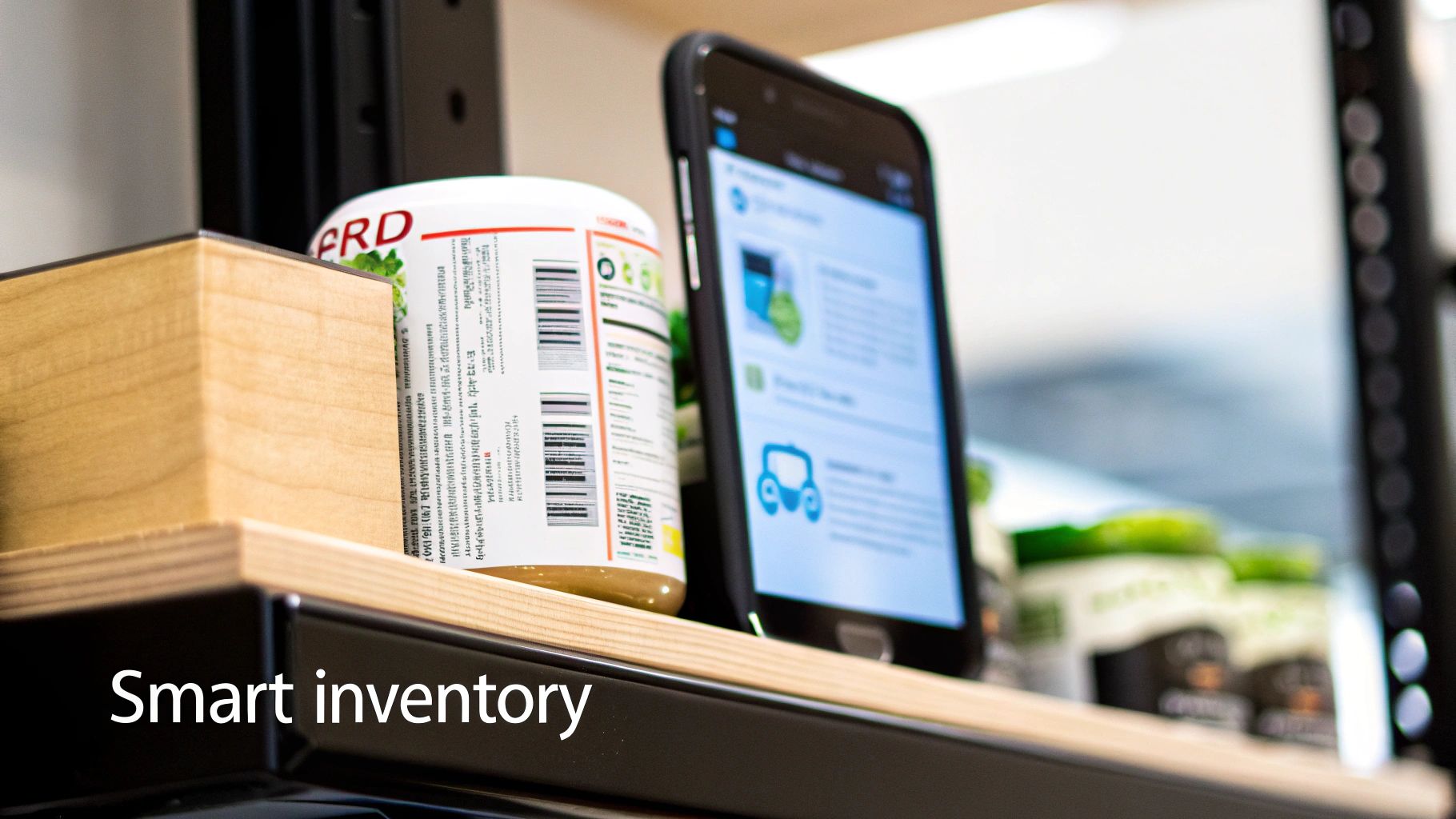
The power of the internet of things in the retail industry becomes clear when examining its practical applications. These use cases directly solve persistent operational headaches, turning abstract technology into tangible business results like improved accuracy, efficiency, and customer satisfaction.
Automated Inventory for Near-Perfect Accuracy
Manual inventory counts are slow, error-prone, and lead to lost sales from stockouts or tied-up capital in overstocked items. Automated systems, often powered by Radio-Frequency Identification (RFID), change this entirely. Tiny RFID tags attached to products allow for a full, store-wide inventory count in minutes.
The outcomes are dramatic:
- Achieve 99%+ Inventory Accuracy: Gain a precise, real-time view of stock on the floor and in the backroom.
- Drastically Reduce Stockouts: Proactively replenish popular items to ensure they are always available for customers.
- Reallocate Labor: Free up employees from counting boxes so they can focus on assisting shoppers.
By providing a continuous, accurate feed of inventory data, IoT removes one of the biggest blind spots in retail, enabling precise forecasting and optimized stock levels.
End-to-End Supply Chain Visibility
The supply chain is often a black box, where delays or damage can cause significant financial loss. IoT sensors provide the visibility needed to manage it effectively. GPS trackers and environmental sensors on pallets offer a live feed of location, temperature, and humidity. If a refrigerated truck's temperature rises, an alert is sent immediately, allowing for a fix before an entire shipment is lost.
Smart Shelves and Real-Time Stock Monitoring
Smart shelves use weight sensors or RFID readers to monitor on-shelf availability in real-time. They know instantly when an item is low, misplaced, or potentially stolen.
This delivers immediate operational wins:
- Instant Restock Alerts: Staff receive automated notifications to replenish shelves, especially during peak hours.
- Misplaced Item Detection: The system flags items on the wrong shelf, maintaining planogram integrity.
- Theft Prevention: A sudden removal of high-value items can trigger a security alert, reducing shrinkage. Getting this right requires choosing the right smart controllers for profitability.
Personalized In-Store Marketing
IoT beacons bridge the gap between digital and physical shopping. These small Bluetooth devices communicate with a shopper's smartphone via the store app. When a customer enters a specific department, a beacon can trigger a personalized notification, such as a special offer on a product they viewed online. This transforms a generic visit into a tailored experience, boosting engagement and sales.
Breaking Down the Modern Retail IoT Architecture
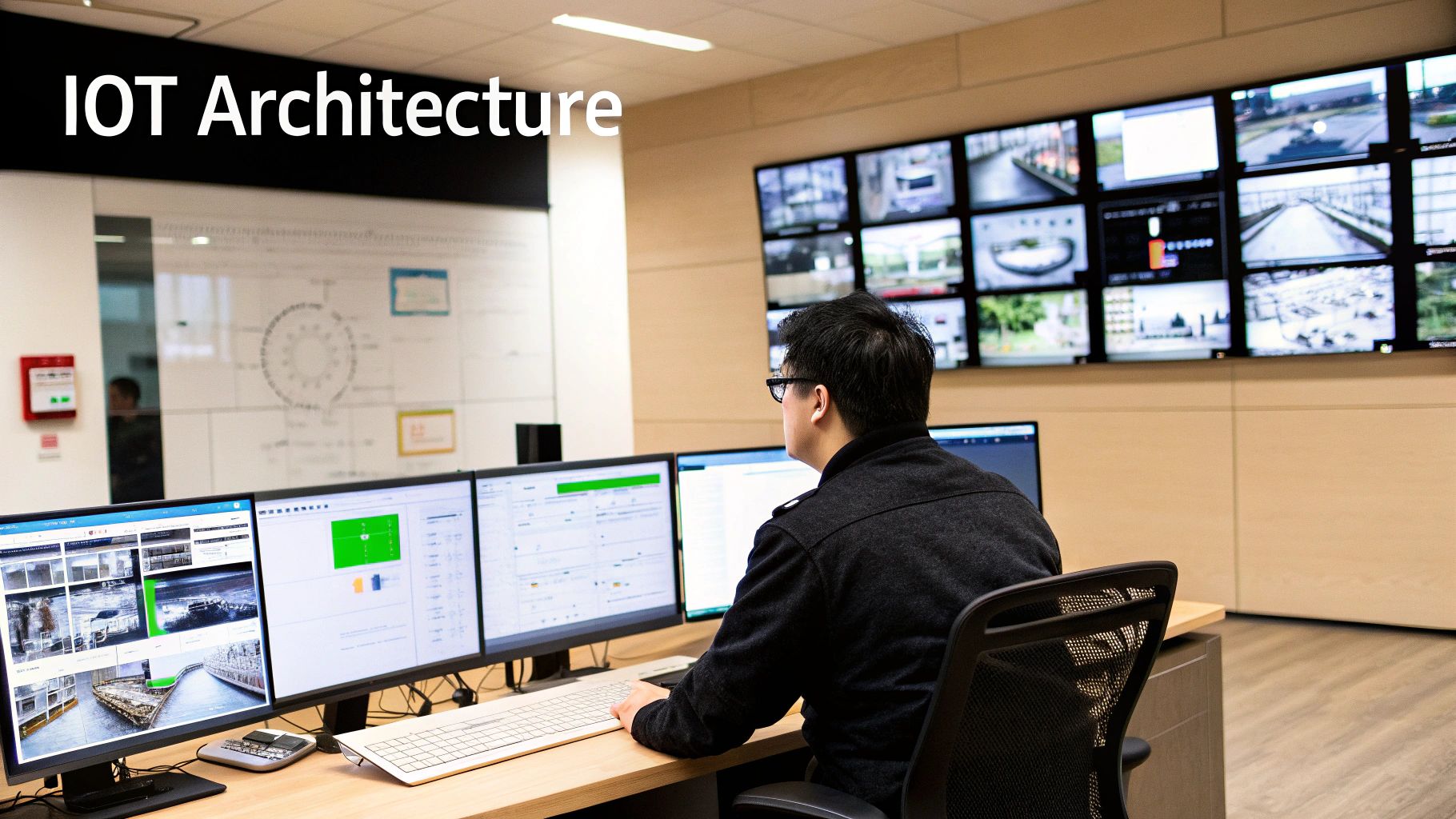
A well-designed IoT architecture is the central nervous system for your retail operation. It gathers, transmits, and processes data to trigger intelligent actions. This system is a stack of four distinct layers, each performing a specific job to deliver business results.
The Sensor Layer: Nerve Endings of the Store
This layer is where the digital world meets the physical one. It consists of devices that collect raw data from your store, inventory, and equipment.
Common retail sensors include:
- RFID Tags and Readers: The workhorses of modern inventory, providing real-time data on product location.
- Beacons: Small Bluetooth devices that enable personalized in-store offers by sensing a shopper's smartphone.
- Video Cameras: AI-powered cameras analyze shopper behavior, monitor shelf stock, and measure queue lengths.
- Environmental Sensors: Devices that monitor conditions like temperature and humidity to prevent spoilage.
The Connectivity Layer: Transmitting Vital Signals
This layer provides a reliable path for sensor data to reach a central hub. The choice of technology depends on range, bandwidth, and cost requirements.
Key connectivity options are:
- Wi-Fi: Ideal for high-bandwidth needs like video streams within a store.
- Bluetooth Low Energy (BLE): Perfect for short-range communication, such as between beacons and smartphones.
- Cellular (4G/5G): Provides reliable coverage for assets on the move, like delivery trucks.
- LoRaWAN: A long-range, low-power protocol for connecting thousands of simple sensors across a large area.
A modern retail IoT architecture integrates multiple technologies, each selected to solve a specific business problem, from tracking an item to analyzing store-wide customer flow.
The Data Platform Layer: The Central Brain
This is the "brain" where massive volumes of data are ingested, stored, and processed. It’s a powerful engine that transforms raw sensor readings into valuable business intelligence. Here, data is cleaned, aggregated, and enriched with other information, like POS sales figures. Modern cloud platforms like Snowflake are built for these workloads, allowing retailers to query real-time and historical data to uncover deep insights and patterns.
The Application Layer: Turning Insight Into Action
The application layer is where processed data becomes useful. This user-facing part of the architecture delivers insights to your team and triggers automated actions.
Examples include:
- Staff Dashboards: Visualizing real-time inventory levels and alerting an employee to restock a shelf.
- Predictive Maintenance Alerts: Notifying a manager that a freezer unit shows signs of failure.
- Automated Workflows: Triggering a replenishment order automatically when a smart shelf detects low stock.
- Customer-Facing Apps: Sending a personalized coupon to a shopper’s phone in a specific aisle.
This layer closes the loop, transforming a simple sensor reading into a measurable business outcome, whether it’s less waste, higher sales, or a more efficient operation.
Your Roadmap to a Successful IoT Implementation
Bringing the internet of things in the retail industry from concept to reality requires a clear, outcome-focused plan. A strategic roadmap turns a complex technical project into manageable, value-driven steps. The key is to think big but start small, proving the technology's worth with a single project to build momentum.
Start with a High-Impact Pilot Project
Instead of a store-wide overhaul, solve a single, high-pain problem first. A focused pilot project demonstrates tangible ROI and allows your team to learn in a controlled environment.
Good candidates for a pilot have clear, measurable outcomes:
- Automated Temperature Monitoring: Use sensors in refrigerated units to prevent spoilage and calculate a fast financial return.
- High-Value Asset Tracking: Apply RFID tags to an expensive merchandise category to reduce theft.
- Checkout Area Optimization: Implement queue-monitoring cameras to better align staffing with customer flow.
A quick win provides a powerful internal case study to justify further investment.
Design a Scalable Architecture from Day One
Your pilot may be small, but the underlying architecture must be built for growth. Choose a flexible data platform and connectivity protocols that won’t become bottlenecks later. The number of connected devices is exploding, expected to hit 21.1 billion by 2025, as noted in the latest IoT device market analysis. Planning for this data volume upfront ensures your system remains effective as you scale.
Integrate and Secure Your Ecosystem
Your IoT solution cannot operate in a silo. Plan for integration with core business systems like your ERP and CRM. This integration turns raw data into actionable intelligence, such as feeding real-time stock levels into your inventory management software.
Security is not an afterthought; it must be a foundational element. Every connected device is a potential network entry point, making a security-by-design approach non-negotiable.
This means implementing end-to-end encryption, securing device access, and establishing clear data governance policies from the start. As systems grow, you can use advanced methods like simulation and IoT to mitigate risks. Building in security protects your data, customers, and brand.
A structured roadmap keeps your project on track. The table below breaks down the key phases.
IoT Implementation Phases and Key Considerations
- Implementation PhaseKey ObjectiveCritical Action Items1. Discovery & StrategyDefine business goals and identify a high-impact use case.Align with stakeholders on a specific problem to solve.
- Calculate potential ROI for the pilot project.
- Define clear, measurable success metrics (KPIs).
- 2. Pilot ProjectProve the concept and demonstrate value in a controlled setting.Select a single, focused use case (e.g., freezer monitoring).
- Deploy a small number of devices.
- Collect and analyze initial data to validate the solution.
- 3. Architecture DesignBuild a foundational platform that can support future growth.Choose a scalable data platform (like Snowflake).
- Select appropriate connectivity protocols (e.g., LoRaWAN, 5G).
- Plan for data integration with existing systems (ERP, CRM).
- 4. Phased RolloutExpand the solution incrementally across locations or use cases.Use learnings from the pilot to refine the deployment process.
- Expand to more stores, a larger product category, or a new use case.
- Monitor system performance and business impact at each stage.
- 5. Scale & OptimizeAchieve full-scale deployment and continuously improve.Complete the enterprise-wide rollout.
- Implement advanced analytics and AI/ML models.
- Establish a governance model for ongoing management and security.
Following these phases de-risks the project and ensures technology investments are tied to tangible business outcomes.
Real-World Examples of IoT Transforming Retail

The true story of the internet of things in the retail industry is told through real-world results. Major brands are deploying IoT solutions at scale to solve stubborn operational problems and achieve impressive, measurable returns. These examples show how connected devices fix specific business challenges and build more efficient, profitable operations.
A Global Supermarket Chain Tackles Food Spoilage
For one global supermarket chain, preventing food spoilage across thousands of refrigerators was a massive operational challenge reliant on inefficient manual checks. They deployed wireless temperature and humidity sensors in every unit, feeding a continuous stream of data to a central system.
The results were immediate and powerful:
- A 30% reduction in food spoilage by catching temperature swings in real time.
- Automated compliance reporting, saving thousands of staff hours.
- Predictive maintenance alerts that flagged potential equipment failures before they happened.
A Fashion Retailer Achieves Near-Perfect Inventory Accuracy
A top fashion retailer struggled with inventory inaccuracy, leading to lost sales from out-of-stocks and deep markdowns on overstocked items. They implemented an RFID-based inventory management system, attaching a small tag to every garment. This allowed them to conduct a full stock count in minutes with near-perfect precision.
This shift from manual spot-checks to continuous, automated visibility gave the retailer a single, trustworthy source of truth for its entire inventory.
This clarity enabled a stronger omnichannel strategy, allowing customers to confidently check online for in-store availability. The retailer also saw a sharp drop in theft and administrative errors, boosting their bottom line. Success stories like this are fueling market growth, with the latest retail IoT market report projecting the market to reach USD 78.95 billion by 2025.
Measuring Success and Shaping the Future of Retail
How do you know an IoT investment is working? Measuring the success of your internet of things in retail industry project means tracking Key Performance Indicators (KPIs) that reflect operational and financial health. This validates the initial spend and builds a solid business case for future investment by drawing a straight line from sensor data to bottom-line results.
Essential KPIs to Track Your IoT Investment
A mix of operational and financial metrics provides a complete picture of performance.
Operational KPIs to watch:
- Inventory Turnover Rate: A rising rate indicates sharper demand forecasting and less cash tied up in slow-moving stock.
- Out-of-Stock Percentage: A plummeting number is a clear win for any automated inventory system.
- Labor Efficiency: Measure the time reallocated from manual tasks to high-impact customer service activities.
Financial KPIs should be just as clear:
- Reduction in Spoilage and Shrinkage: Tally the direct cost savings from preventing product loss due to equipment failure or theft.
- Sales Lift: Connect increased sales directly to better on-shelf availability or personalized marketing.
- Lowered Energy Costs: Track utility bill savings from smart lighting and HVAC systems.
The Next Frontier: IoT and AI Convergence
The vast data from IoT devices becomes even more powerful when fed into an Artificial Intelligence (AI) model. This is the next logical step for building an intelligent retail operation.
IoT tells you what’s happening now. AI uses that data to predict what will happen next and automates the smartest response. It’s the difference between being reactive and becoming truly predictive.
This synergy unlocks game-changing possibilities:
- Predictive Inventory Ordering: AI algorithms can analyze sales trends, foot traffic, and even weather forecasts to automate stock orders.
- Dynamic Pricing: In-store sensors can track shopper density, allowing systems to automatically adjust promotions to drive sales.
- Hyper-Personalized Journeys: Combining a customer's online wish list with their real-time path through the store enables truly one-to-one offers.
Ultimately, IoT is a foundational technology for building a retail business that is smarter, faster, and more profitable. Retailers who embrace this data-driven future will create streamlined operations and customer experiences that build loyalty for years to come.
Common Questions About Retail IoT
When exploring the internet of things in the retail industry, technology leaders often ask about cost, complexity, and security. Here are clear, practical answers to these common questions.
What Is a Realistic ROI Timeframe for a Retail IoT Project?
A tangible return on investment can often be achieved within 6 to 18 months, depending on the project's scope. The key is to start with a high-impact pilot that solves a specific, costly problem. For example, automated temperature monitoring can deliver a clear ROI in months by preventing a single major spoilage event. Similarly, using RFID to reduce theft of high-value items can pay for itself quickly. Starting small proves value fast and builds momentum for larger rollouts.
How Do We Manage Massive IoT Data Volumes?
The modern approach is to use a scalable cloud data platform built to ingest and process enormous streams of information in real time. Platforms like Snowflake separate data storage from computing power, allowing you to affordably store petabytes of sensor data and pay for processing only when you need it. This elastic model makes managing IoT data cost-effective and prevents performance issues as your device network grows.
The goal isn't just to collect data; it's to make it accessible and actionable. A scalable cloud platform turns a potential data flood into a manageable river of business intelligence.
What Are the Biggest Security Risks and How Can We Mitigate Them?
The primary security risks in retail IoT are unsecured devices, data interception, and privacy breaches. Every connected sensor is a potential entry point to your network, making a proactive, security-by-design approach essential.
- Device Security: Ensure every device has a unique identity and can receive remote firmware updates to patch vulnerabilities.
- Data Encryption: Encrypt all data, both in transit (from sensor to cloud) and at rest (in your data platform).
- Network Segmentation: Isolate IoT devices on a separate network from critical corporate systems, like POS terminals or financial records.
Building these security practices in from the beginning creates a resilient foundation that protects your business and your customers.


