At its heart, Internet of things data analytics is about turning the constant flood of data from connected devices into clear, actionable business outcomes. Think of your IoT devices as a vast nervous system, constantly sensing what's happening. The analytics is the brain that makes sense of all those signals, allowing you to drive measurable improvements.
From Sensor Signals to Business Strategy
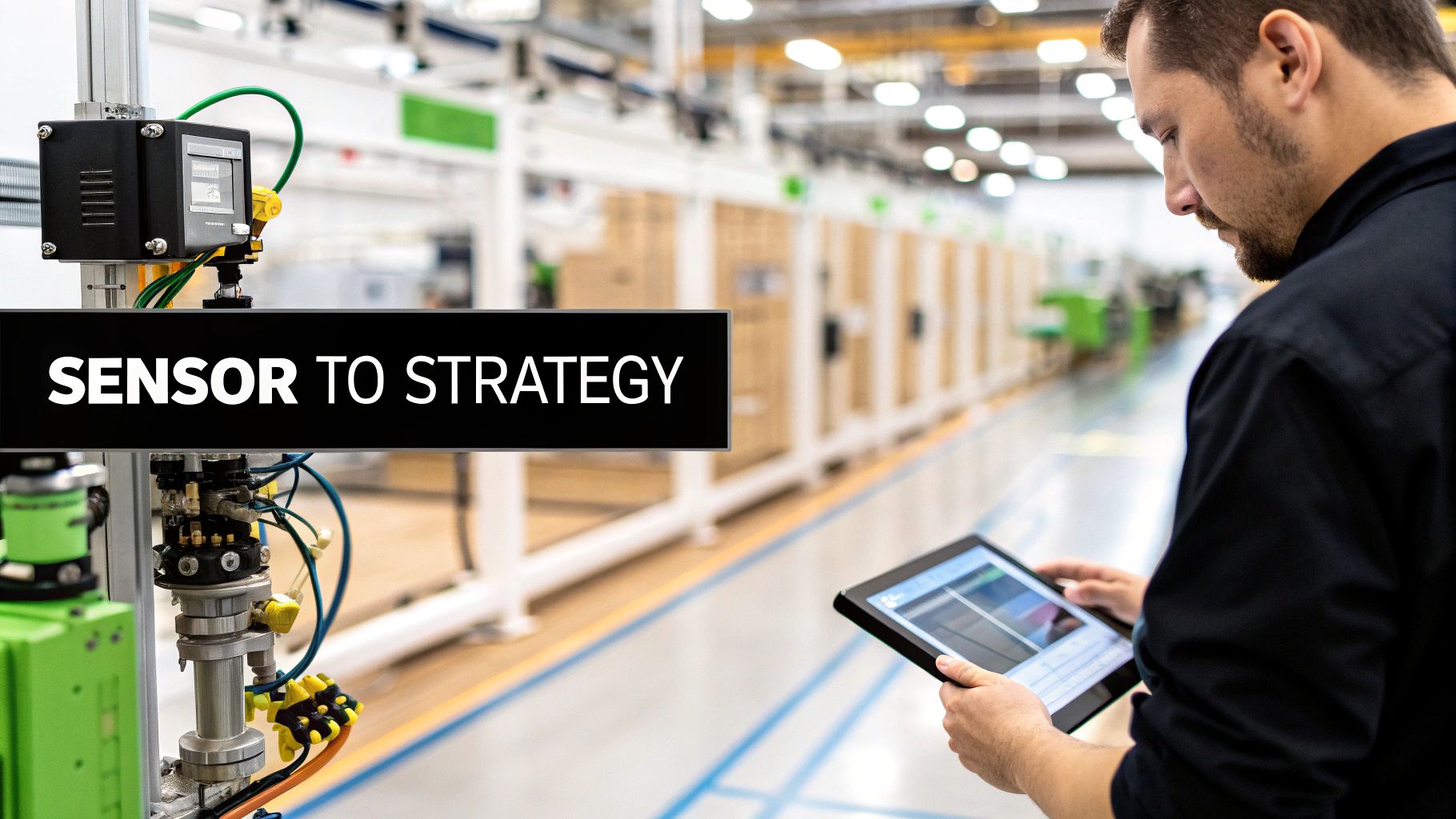
What if every piece of equipment in your operation could tell you exactly how to improve your bottom line? A generator could signal it’s overheating, helping you prevent a costly failure. A delivery truck could report precise location and fuel data, revealing opportunities to cut expenses. A smart thermostat could reveal occupancy patterns, pointing the way to significant energy savings.
This is the promise of the Internet of Things (IoT). But the raw data itself—billions of signals and status updates—is just noise without interpretation.
IoT data analytics translates that chaotic noise into real business intelligence. It’s not about staring at dashboards; it’s about finding the hidden patterns that predict what comes next and even automating the response to drive efficiency and reduce costs.
The Shift From Data Collection to Decision Making
Not long ago, operational data was used for post-mortem analysis. When a machine broke down, a technician would dig through log files to find the cause. IoT analytics flips this model, making operations proactive and predictive to prevent problems before they happen.
This shift is powered by key outcomes:
- Real-Time Visibility: See the health and performance of every asset, right now, no matter where it is, enabling immediate intervention.
- Predictive Insights: Analyze historical data to forecast future events, like when a part will need replacing, preventing unplanned downtime.
- Process Automation: Set up rules that automatically trigger actions based on sensor data—like adjusting climate controls to reduce energy spend or rerouting a vehicle to save fuel.
Moving from a reactive to a proactive stance is a game-changer, which is why the global IoT analytics market is exploding. Valued at USD 27.41 billion in 2023, it's projected to hit USD 136.14 billion by 2030—a compound annual growth rate of 24.8%. Businesses are investing heavily because turning device data into a competitive edge is no longer optional.
Turning Operational Data into Strategic Assets
Ultimately, the goal of IoT data analytics is to drive measurable business outcomes. Understanding the signals your devices send unlocks new efficiencies, smarter products, and better services.
At its core, IoT analytics is the bridge between operational technology (the physical world of sensors and machines) and information technology (the digital world of data and strategy). It translates physical events into business language.
For example, a logistics company uses GPS and vehicle telematics to fine-tune delivery routes, cutting fuel costs by 15-20%. A manufacturing plant uses vibration sensors to predict motor failure, avoiding unplanned downtime that costs thousands per hour.
These aren't futuristic ideas; they're practical applications delivering real returns today. For organizations looking to manage risk as their systems expand, understanding how simulation and IoT work together is a crucial next step.
Before diving into the architecture, it's helpful to understand the key pillars that hold up any successful IoT analytics strategy. The table below breaks down the essential components.
Core Components of an IoT Analytics Strategy
ComponentFunctionBusiness OutcomeData Ingestion & ProcessingCollect, clean, and structure high-volume data streams from diverse IoT devices.Ensures data is reliable and ready for analysis, preventing a "garbage in, garbage out" scenario.Data Storage & ManagementStore massive datasets efficiently, often using time-series databases or data lakes.Provides a scalable and cost-effective foundation for historical analysis and model training.Analytics & Machine LearningApply statistical models, ML algorithms, and AI to uncover patterns and make predictions.Turns raw data into actionable insights like predictive maintenance alerts or demand forecasts.Data Visualization & ActionPresent insights through dashboards, alerts, and reports; trigger automated actions.Empowers users to make informed decisions and enables systems to respond automatically to events.
With these core functions in mind, we can start to see how a collection of individual technologies comes together to create tangible business value from the ground up.
Designing a High-Performance IoT Data Pipeline
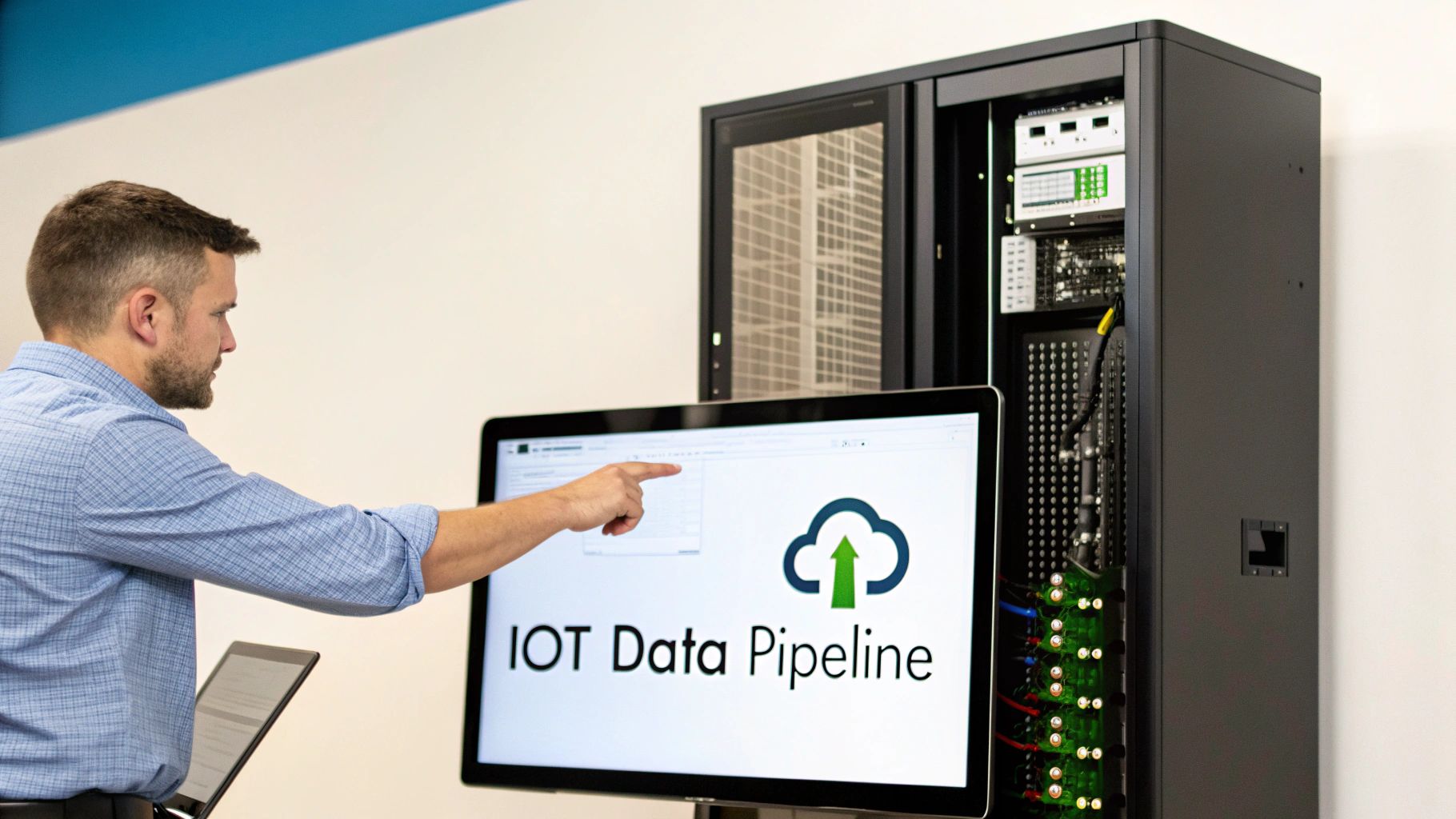
A powerful analytics strategy depends on a robust data architecture. Without a reliable way to get information from sensors to analysts, even the most advanced AI models are useless. The IoT data pipeline is the digital circulatory system moving information from collection to action.
Think of it as an assembly line: raw sensor data enters at one end, moves through processing stations, and emerges as an actionable insight. Each stage must be efficient, scalable, and resilient enough to handle a massive, constant flow of information. The goal is to get the right data into the right format at the right time. For a deeper technical dive, this guide on how to build a data pipeline offers invaluable insights.
The Four Core Stages of an IoT Pipeline
A well-designed pipeline has four key stages that transform raw signals into strategic intelligence.
- Ingestion: This is where all device data enters the system. The main challenge is handling the immense volume and velocity of data streaming from thousands of sensors simultaneously.
- Processing: Raw data is almost always messy. This stage cleans, filters, normalizes, and enriches data to prepare it for analysis.
- Storage: Processed data needs a home. This involves choosing the right solution, like a data lake for raw information or a structured data warehouse for analysis-ready data.
- Analysis and Visualization: This is where value is extracted. Prepared data is queried, fed into machine learning models, and displayed on dashboards to uncover patterns and drive decisions.
These stages work in concert. A bottleneck in one area can disrupt the entire system, highlighting the need for a thoughtful, end-to-end architecture from the start.
Architectural Patterns: Edge and Stream Processing
Not all IoT data requires the same path. Modern internet of things data analytics pipelines use different patterns based on the required speed of response. Two of the most important are edge computing and stream processing.
Edge Computing places processing power near the sensors. Instead of sending every data point to a central cloud, some analysis happens directly on or near the device.
This approach is critical for use cases requiring a near-instant response. A self-driving car can't wait for a signal to bounce to the cloud and back to decide whether to hit the brakes. Edge computing makes those sub-second decisions possible.
Stream Processing analyzes data while it's in motion, rather than waiting for it to be stored. This is ideal for real-time monitoring and alerts. For example, a factory manager can receive an immediate notification if a machine’s temperature spikes, enabling quick intervention to prevent damage.
The Central Role of a Modern Data Platform
As data flows from the edge or through streams, it needs a central destination built for IoT's unique demands. A cloud data platform like Snowflake is a game-changer here. Traditional databases weren't designed for the volume and speed of sensor data and often fail under pressure.
Snowflake’s architecture separates storage from compute, allowing it to ingest massive data streams without slowing down analytical queries. This elasticity is crucial for IoT, where data loads are often unpredictable.
It also excels at handling time-series data—the sequential measurements that form the bulk of IoT information. As companies scale from thousands to millions of devices, having a data foundation that can grow without performance degradation is essential. To see this in action, explore detailed examples of managing time-series data with Snowflake. A robust platform ensures your analytics can keep pace with operational growth.
Real-World Use Cases Driving Measurable Outcomes
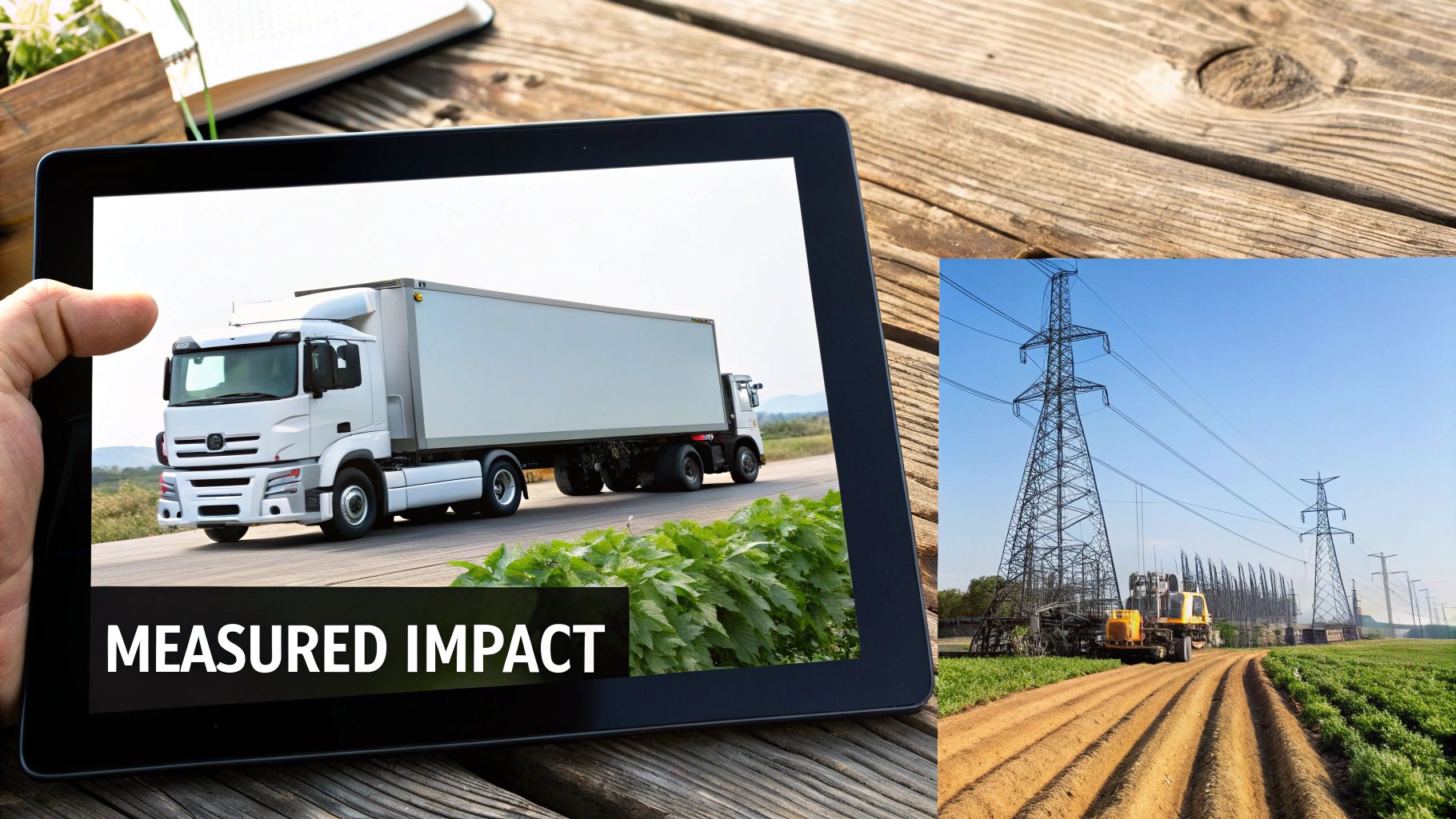
The real test for internet of things data analytics is its impact on the bottom line. Does it cut costs, improve efficiency, or enhance safety? Let's examine how industries are turning raw sensor data into a measurable return on investment.
Use Case: Predictive Maintenance in Manufacturing
In any factory, unplanned downtime is a primary enemy, costing thousands of dollars per minute in lost output and emergency repairs. Predictive maintenance solves this problem by using sensor data to anticipate equipment failures.
Manufacturers embed sensors on critical machinery to monitor subtle changes in vibration, temperature, and power consumption. This data flows into an analytics system that uses machine learning to identify patterns signaling an impending failure.
- Business Problem: Unexpected equipment breakdowns causing expensive production shutdowns.
- IoT Solution: Vibration and thermal sensors feed live data to an analytics platform that predicts component failure.
- Measurable Outcome: Maintenance is scheduled proactively, slashing equipment failures by 30-50% and cutting overall maintenance costs by up to 40%.
By shifting from a reactive "fix it when it breaks" model to a predictive "fix it before it breaks" strategy, companies transform maintenance from a cost center into a competitive advantage that boosts uptime and reliability.
This powerful shift fuels the growth of the Industrial Internet of Things (IIoT). The IIoT market is projected to grow from USD 202.97 billion in 2025 to USD 491.37 billion by 2035, driven by investments in analytics that turn device data into operational gold. You can dive deeper into the data on the IIoT market's projected growth.
Use Case: Smart Logistics and Optimized Fleet Management
For fleet managers, the biggest operational drains are fuel and time. Inefficient routes and idling engines silently erode profits. Smart logistics uses data to inject precision into every mile traveled.
GPS trackers and onboard telematics sensors provide a constant stream of data on vehicle location, speed, fuel consumption, and engine health. This information is fed into a central analytics platform, giving managers a real-time view of the entire fleet.
- Business Problem: High fuel costs, inefficient delivery routes, and no real-time fleet visibility.
- IoT Solution: Geofencing, real-time GPS tracking, and telematics data are analyzed to optimize routes and monitor driver behavior.
- Measurable Outcome: Route optimization alone can cut fuel consumption by 15-20%, while real-time monitoring improves delivery accuracy and asset utilization.
One powerful tool is geofencing, which creates virtual perimeters around locations like warehouses. When a truck enters or leaves a zone, an alert is automatically triggered, automating logs, improving security, and providing customers with accurate ETAs.
Use Case: Intelligent Energy Grid Management
Power grids are incredibly complex, and a single failure can cause a widespread outage. Traditionally, utility companies were reactive, scrambling to fix faults after they occurred.
Intelligent grid management changes the game. IoT sensors on transformers, power lines, and substations constantly monitor the flow of electricity, tracking voltage, temperature, and other vital signs. By analyzing this data in real time, operators can spot trouble before it escalates. For example, an overheating transformer triggers an alert for a maintenance crew, preventing a catastrophic failure. This not only boosts reliability but also optimizes energy distribution, ensuring power gets where it's needed most efficiently.
IoT Analytics Impact Across Industries
The use cases vary by sector, but the results are consistently measurable improvements.
IndustryUse CaseKey Performance Indicator (KPI) ImprovedLogisticsReal-time fleet tracking and route optimizationFuel consumption, On-time delivery rateManufacturingPredictive maintenance for factory machineryMachine uptime, Maintenance costsEnergySmart grid monitoring for fault detectionGrid reliability (SAIDI/SAIFI), Outage durationTelecomNetwork performance monitoring and optimizationNetwork latency, Call drop rateSmart BuildingsHVAC and lighting automation based on occupancyEnergy consumption (kWh), Operational costs
These examples show that IoT analytics isn't just about collecting data; it's about connecting that data to clear business outcomes you can actually measure.
Turning IoT Analytics into Automated Action with AI
Knowing what happened is useful. Predicting what will happen—and acting on it automatically—is transformative. This is where internet of things data analytics evolves beyond simple reports. By pairing IoT data with advanced Machine Learning (ML) and Agentic AI, businesses can build systems that optimize themselves.
The goal is to close the loop between insight and action. Imagine a system that doesn't just alert a human to a problem but instead makes the optimal decision and executes the response in milliseconds. This creates operations that are more resilient, responsive, and intelligent. The shift from analysis to autonomous action is what creates a true competitive advantage, moving a business from passively monitoring its environment to actively shaping it.
From Prediction to Proactive Intervention
The first step beyond basic analytics is prediction. Machine learning models trained on historical IoT data can forecast future events with remarkable accuracy, enabling a shift from reactive fixes to proactive strategies.
Key outcomes include:
- Equipment Failure Forecasting: An ML model analyzes sensor data to predict that a specific motor will fail within the next 72 hours, allowing maintenance to be scheduled during off-peak hours to avoid costly downtime.
- Real-Time Anomaly Detection: AI learns the normal "heartbeat" of a complex system and can flag subtle deviations that are early indicators of a major problem, often invisible to human operators.
- Demand Forecasting: Retailers combine data from smart shelves and foot traffic counters with external factors like weather to predict product demand with far greater precision, optimizing inventory.
These predictive insights are powerful, but the next evolution empowers AI to take the final step.
Agentic AI: The Autonomous Decision-Maker
While machine learning excels at prediction, Agentic AI is designed for action. An AI agent is like a digital employee with a specific goal and the authority to execute tasks to achieve it. It doesn't just present options; it makes and carries out decisions.
Agentic AI shifts the paradigm from decision support to automated execution. It gives systems the ability to not only see the future but also to act on that foresight to achieve a better outcome, often without human intervention.
This is where the true power of automated internet of things data analytics comes to life. Companies like SYRATE are already demonstrating what's possible, using artificial intelligence to optimize complex industrial and electrical networks, as seen in their presentations to SYRATE's AI solutions for energy specialists.
Practical examples of this shift include:
- Smart Building Automation: An AI agent's goal is to slash energy costs while maintaining comfort. It analyzes data from occupancy sensors, thermostats, and weather forecasts to autonomously adjust the building's HVAC and lighting in real-time, outperforming any static schedule.
- Autonomous Logistics Rerouting: A delivery truck's AI agent has one mission: on-time delivery. It monitors GPS, traffic, and weather data. If it detects a major accident ahead, it automatically recalculates the optimal route and updates the vehicle's navigation without driver intervention.
- Self-Optimizing Energy Grids: An agent managing a power grid can predict a demand surge during a heatwave and autonomously reroute power from an area with lower demand or tap into battery storage to prevent a brownout, all before human operators are aware of a potential issue.
In each scenario, the AI makes and executes operational decisions to achieve a defined business goal. This is the ultimate aim of a mature IoT strategy: creating intelligent, self-healing, and self-optimizing systems that drive efficiency at scale.
Your IoT Analytics Implementation Roadmap
A brilliant idea for using internet of things data analytics is worthless without a clear execution plan. A strategic roadmap turns ambition into a tangible project, reducing risk and accelerating time to value. This step-by-step guide should always start with the business problem, not the technology.
This structured approach helps you avoid common pitfalls, like trying to solve too many problems at once or building a system disconnected from core business goals. A successful rollout is a journey of well-defined stages, not a single, risky leap.
Stage 1: Start with the Business Outcome
Before you buy a single sensor, define what success looks like in plain business terms. What specific problem are you trying to solve? Vague goals like "improving efficiency" are not enough.
Focus on a clear, measurable objective. For instance:
- Reduce unplanned downtime on our most critical production line by 20% within six months.
- Decrease fuel consumption across our long-haul fleet by 10% by optimizing routes in real-time.
- Cut energy costs in our main office building by 15% through automated HVAC adjustments.
Starting with a specific, quantifiable goal forces clarity, secures stakeholder buy-in, and provides a clear benchmark to measure your return on investment.
Stage 2: Secure Everything from Edge to Cloud
Security cannot be an afterthought; it must be integrated into your IoT architecture from day one. Every connected device is a potential attack vector, and the data it sends is a valuable asset that requires robust protection.
The scale of this challenge is massive. By the end of 2024, the world is set to have 18.8 billion connected IoT devices. This explosion of endpoints creates a minefield of new vulnerabilities. IoT cyberattacks spiked to 112 million incidents in 2022—an 87% jump from the previous year. You can dig deeper into the numbers in this IoT device market report.
A real security strategy has to cover the entire data journey: securing the physical device itself, encrypting data as it travels over the network, and protecting it while it's stored in the cloud. If you neglect any one of these layers, the entire system is exposed.
Stage 3: Design for Scale and Establish Governance
Many IoT projects fail because their initial architecture cannot handle the eventual scale. A proof-of-concept that works for 100 devices will likely crumble under the load of 100,000. It is critical to choose a data platform built for the immense volume and velocity of IoT data.
A modern cloud data platform like Snowflake excels here. Its architecture separates storage from compute, meaning it can ingest massive, continuous streams of sensor data without slowing down analytical queries. This choice ensures your system remains fast and responsive as your device fleet grows.
At the same time, you must establish strong data governance. This involves creating clear rules and processes for:
- Data Quality: Ensuring sensor data is accurate, consistent, and trustworthy.
- Data Access: Defining who can access which datasets and for what purpose.
- Data Lineage: Maintaining a clear record of data origins and transformations.
Without good governance, you end up with a data swamp—a messy repository of untrustworthy information that undermines confidence in your analytical insights. A well-governed, scalable foundation is key to building a reliable and future-proof internet of things data analytics program that delivers consistent value.
Common Questions About IoT Analytics
Diving into internet of things data analytics often raises many questions. Here are answers to some of the most common ones to provide clarity and help you move forward with confidence.
What Is the Best Way to Start an IoT Data Analytics Project?
The most successful projects start by focusing on a specific business problem, not the technology. Instead of a vague goal like "let's collect all our sensor data," zero in on a tangible pain point.
For example, identify the single piece of equipment whose failure causes the most downtime and cost. Then, set a clear goal: "reduce this machine’s unexpected failures by 25%."
This approach delivers:
- A clear target: Everyone, from engineers to executives, understands the mission.
- A tight scope: You know exactly which data you need, avoiding the trap of trying to do too much at once.
- Real momentum: A quick, tangible win makes it easier to secure buy-in and funding for larger initiatives.
The secret is to start small, prove the value with a clear business outcome, and then expand. It’s the fastest way to de-risk the investment and demonstrate a real ROI.
How Does Snowflake Specifically Help with IoT Data Analytics?
Snowflake’s cloud platform is uniquely suited for the challenges of IoT data. It is engineered to handle the volume, speed, and variety of sensor data in a way that traditional databases cannot.
Its key feature is the separation of storage and compute. This architecture allows you to ingest a relentless, high-speed flood of data from millions of devices without slowing down complex analytical queries. For IoT, where the data firehose never turns off, this design is critical.
Snowflake also handles semi-structured data formats like JSON natively. Since most IoT devices output JSON, this eliminates complex data engineering work, allowing you to get raw sensor data into the system and ready for analysis much faster. This results in a scalable, cost-effective foundation that won't buckle under pressure.
What Are the Biggest Challenges in an IoT Analytics Implementation?
While the potential payoff is huge, IoT analytics projects have common pitfalls. Addressing them early is key to success.
The three main hurdles are security, scalability, and data quality.
- Data Security: Every sensor is a potential entry point into your network. A rock-solid security plan must cover everything—the physical device, data in transit, and data at rest. It's not an afterthought; it's job one.
- Scalability: An architecture that works for 100 devices in a pilot can fail completely at 100,000. You must design for massive scale from day one, choosing technologies that can handle exponential growth.
- Data Quality: Poor data quality is the silent killer of analytics projects. If your sensor data is inaccurate or inconsistent, your insights will be worthless. Strong data governance, cleansing pipelines, and continuous monitoring are essential to ensure you can trust the analysis.
How Is Agentic AI Different from Traditional Machine Learning for IoT?
This distinction highlights the future of the industry. In IoT, traditional machine learning is about prediction. It excels at answering questions like, "When is this motor likely to fail?" or "What will our building's energy consumption be tomorrow?" It provides a human with a powerful insight, who then decides on the action.
Agentic AI takes the next step, moving from prediction to autonomous action. An agent doesn't just surface an insight; it has a goal and is empowered to act on that insight to achieve it. It closes the loop between analysis and execution, often without human intervention.
For example, in a smart building, a traditional ML model might predict a room will be empty and alert the facilities manager. The manager must then decide to adjust the A/C. An AI agent, however, receives the same prediction, knows its goal is to minimize energy use, and autonomously adjusts the HVAC system itself. This leap from decision support to automated decision-making unlocks truly self-optimizing systems.


