
An internet of things architecture is the blueprint for turning raw data from a sensor into a valuable business outcome. It’s the structured system that ensures information flows smoothly from a device in the field to a data center for processing and back again, enabling automated actions and intelligent decisions.
What Is Internet of things Architecture
Think of an internet of things architecture as a strategic plan for how your business will sense, understand, and act on real-world events. Its goal is to build a seamless bridge between physical assets and digital intelligence, defining how devices communicate, where data is processed, and how insights are delivered to applications and people. Without a solid architecture, an IoT project is just a collection of gadgets, not a cohesive system that generates measurable value.
How IoT Architecture Drives Outcomes
A helpful analogy is the human central nervous system, where different parts work in concert to produce an intelligent response.
- Sensors and Devices (Nerve Endings): Just as nerve endings sense heat, sensors on a factory motor detect vibrations. This is the first step: capturing a critical piece of data directly from the physical world.
- Gateways (Spinal Cord): Gateways act like the spinal cord, processing critical data locally for quick, reflexive actions. For instance, a gateway can trigger an immediate shutdown of an overheating machine without waiting for cloud commands—just like your hand pulls back from a hot stove automatically. This delivers the outcome of immediate safety and asset protection.
- Cloud (The Brain): The cloud is the command center for complex analysis and long-term learning. It aggregates data from thousands of sensors to spot patterns and make strategic decisions. This is where a factory manager's dashboard lights up with a predictive maintenance alert, preventing costly downtime by analyzing subtle vibration changes over weeks.
This integrated system transforms isolated data points into smart, automated actions. The real value isn't just in connecting devices; it's in creating a feedback loop where digital insights drive physical outcomes. This capability is fueling massive growth, with the global IoT market size expected to surpass USD 1 trillion by 2025. You can explore these trends with IoT market growth insights from MarketsandMarkets.
The Four Core Layers of IoT Architecture
To build a robust system, the architecture is broken into four distinct layers. Each one handles a specific part of the journey from raw data to actionable insight.
LayerPrimary FunctionKey Components1. Sensing LayerGathers raw data from the physical environment.Sensors (temperature, motion, GPS), actuators, cameras, microcontrollers.2. Network LayerTransmits data from the physical world to the processing systems.IoT gateways, cellular (4G/5G), Wi-Fi, LoRaWAN, Bluetooth, MQTT, CoAP.3. Data Processing LayerCleans, normalizes, and analyzes data for insights.Cloud platforms (AWS, Azure, GCP), edge computing nodes, data lakes, databases.4. Application LayerPresents data and enables user interaction.Dashboards, mobile apps, business intelligence tools, alert systems, APIs.
This layered approach provides a clear framework for building a scalable IoT system where every component has a specific purpose.
Deconstructing the Four Foundational Layers
An effective internet of things architecture is a stack of four distinct layers, like an assembly line for data. Each station performs a unique task, and the entire process works only if the handoff between them is flawless, transforming a physical event into a valuable business insight.
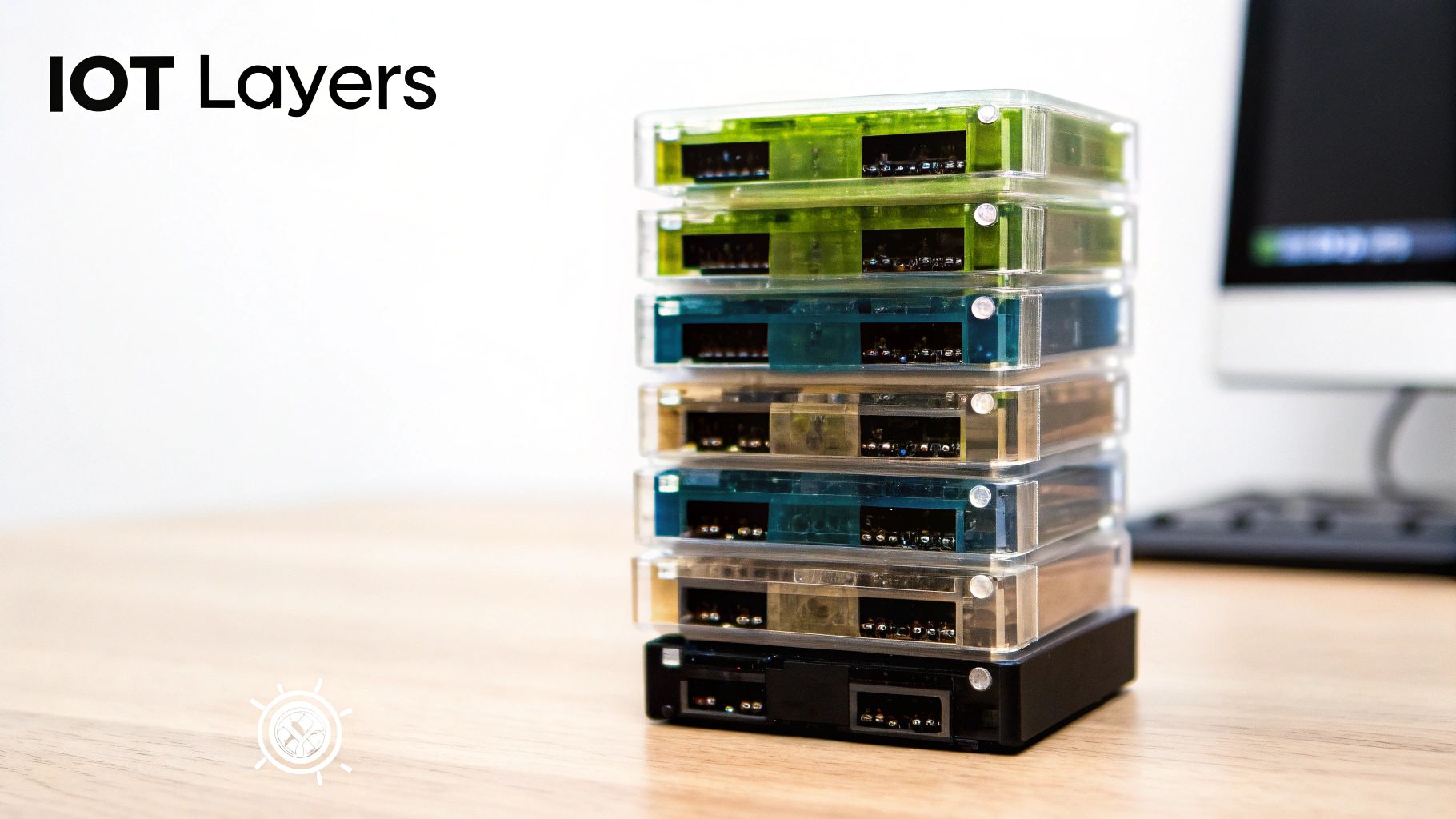
This model brings order to IoT complexity, allowing engineers to focus on one piece of the puzzle at a time—from device hardware to cloud analytics—without losing sight of the overall goal.
Layer 1: The Perception Layer
This is where the digital world meets the physical one. The Perception Layer is filled with sensors and actuators that "perceive" and interact with the real world, acting as the sensory system for your entire architecture.
Sensors collect data by measuring properties like temperature, motion, or location. Actuators take action by responding to digital commands to perform a physical task, like turning a valve or flipping a switch.
Outcome Focus: The goal is to capture the right data to answer a critical business question, like "Is this refrigerated container holding at the correct temperature to prevent spoilage?" or "Is this machine about to fail?"
Use Case: In a smart logistics operation, GPS sensors pinging a truck's location are part of this layer. This data directly enables real-time tracking, route optimization, and accurate delivery estimates.
Layer 2: The Network Layer
Once data is collected, the Network Layer reliably moves it from devices to processing systems. This layer is the communications backbone, focused entirely on connectivity.
Key components include IoT gateways, which act as local hubs to aggregate data from many sensors, and the communication technologies themselves.
Connectivity options are chosen based on the specific need:
- Short-Range Wireless: Bluetooth and Zigbee are ideal for connecting devices in a limited area like a smart office.
- Wide-Area Networks: Cellular (4G/5G) and Low-Power Wide-Area Networks (LPWANs) like LoRaWAN are used for assets scattered over large areas, like a city-wide network of smart meters.
The U.S. Internet of Things market, valued at USD 413.22 billion in 2024, is built on the availability of these diverse and cost-effective connectivity options. Learn more from this detailed industry analysis from Grand View Research.
Layer 3: The Processing Layer
Raw data is rarely useful. The Processing Layer is where it gets cleaned, structured, and analyzed to extract meaningful insights. This is the brain of the operation.
Processing happens in two key locations:
- Edge Computing: For time-sensitive actions where latency is critical, analysis happens locally on a gateway or edge device. An example is triggering an emergency stop on a factory floor to prevent an accident.
- Cloud Computing: The majority of data is sent to powerful cloud platforms like AWS IoT or Azure IoT Hub for large-scale storage, aggregation, and advanced analytics, like running machine learning models to predict future trends.
Layer 4: The Application Layer
The Application Layer is where processed data is presented to users or integrated into other business systems. This is the user-facing part of the architecture that turns abstract data into tangible value.
This layer includes dashboards for visualizing key metrics, mobile apps for controlling devices, and alert systems that notify users of critical events. It also provides APIs to connect IoT data with other business software, like ERP or CRM systems.
Outcome Focus: This is the layer that delivers the final business outcome, closing the loop from a physical event to a digital insight that drives action.
Securing Your Ecosystem from Device to Cloud

In an internet of things architecture, security cannot be an afterthought. With millions of potential entry points, a weak security posture is a massive liability. A single compromised sensor could expose your entire corporate network. The only effective approach is a defense-in-depth strategy, wrapping robust security controls around every layer of the architecture.
Fortifying the Device Layer
Security starts with the devices themselves. As they are often physically exposed and have limited resources, they are prime targets for attackers.
A secure boot process is the first line of defense, cryptographically verifying that a device's firmware is authentic and untampered with. Each device also needs a unique identity, often managed by a Trusted Platform Module (TPM). A TPM is a hardware chip that securely stores cryptographic keys, making them nearly impossible for software attacks to compromise.
Protecting Data in Transit
Data moving across a network is vulnerable to interception. That’s why all communication must be encrypted from end to end.
Protocols like Transport Layer Security (TLS) create a secure, encrypted tunnel between a device and its destination (like a gateway or the cloud), rendering the data unreadable to eavesdroppers.
Outcome Focus: The goal is to design a network that assumes a breach will eventually occur. Network segmentation is a key tactic, isolating groups of devices to contain potential damage and prevent a single compromised device from affecting the entire system.
Securing the Cloud and Application Layers
In the cloud, security shifts to controlling access and detecting threats. A robust Identity and Access Management (IAM) framework is essential to ensure only authorized users and services can access specific data or perform actions. This is governed by the principle of least privilege: a user or service should only have the bare-minimum permissions required to do its job.
Continuous threat detection using machine learning helps establish a baseline of normal device behavior. This allows the system to spot anomalies—like a sensor suddenly communicating with an unknown server—and trigger an immediate security alert.
Use Case: Securing Connected Medical Devices
Consider a fleet of internet-connected infusion pumps in a hospital, where a breach could have life-or-death consequences.
- Device Layer: Each pump uses secure boot to validate its software and a hardware TPM to store its unique digital certificate, proving its identity to the hospital network.
- Network Layer: All data transmission is encrypted with TLS, and the pumps operate on a segmented network, isolated from the public guest Wi-Fi to prevent unauthorized access.
- Cloud & Application Layer: Clinicians access pump data through a secure portal with two-factor authentication. An AI-powered monitoring system watches for unusual activity, instantly flagging potential threats for the IT security team.
This layered security approach creates a resilient and trustworthy internet of things architecture capable of handling even the most critical applications.
Building an Architecture That Can Scale
An architecture designed for ten sensors will fail spectacularly with ten thousand. Scalability must be a core design principle from day one to avoid the common pitfall where promising IoT pilots collapse when moving to full-scale production. The goal is to build a system that can handle massive growth in data volume and device connections without downtime or data loss.
Handling Massive Data Ingestion
Large IoT systems generate a constant, high-velocity flood of data. This is where message brokers like Apache Kafka or cloud services like AWS Kinesis become essential.
Instead of sending data directly to an application, devices publish messages to the broker. The broker holds these messages in a queue, allowing downstream applications to process the data at their own pace.
Outcome Focus: This decoupling ensures resilience. If a processing application goes down, the message broker holds the incoming data until it's back online, guaranteeing zero data loss and maintaining system integrity.
Designing for Unpredictable Loads
Device traffic can be unpredictable, with thousands of devices coming online simultaneously. Your architecture must absorb these bursts without failing.
Load balancing distributes incoming requests evenly across a pool of servers. Combined with the auto-scaling capabilities of modern cloud platforms, this creates a truly elastic system.
- Scale Out: When traffic spikes, the system automatically adds more processing instances.
- Scale In: When traffic subsides, it removes those instances to reduce costs.
This dynamic approach ensures you have the exact resources needed at any given moment, optimizing both performance and cost.
Optimizing Time-Series Data Pipelines
Nearly all IoT data is time-series data—a measurement with a timestamp. Optimizing your data pipelines for this format is critical for performance. The global IoT market's rapid growth, with connected devices projected to surge from 19.8 billion in 2025 to over 40 billion by 2030, is driven by architectures that can efficiently process real-time data. You can explore these projections in research from Precedence Research on the global IoT market.
This means using specialized time-series databases like InfluxDB or Amazon Timestream. These are engineered to store and query time-series data far more efficiently than standard relational databases, making it faster to analyze trends and detect anomalies. We cover practical approaches in our guide on simulation and IoT for mitigating risk as systems grow.
By combining scalable ingestion, elastic processing, and optimized data pipelines, you can build an architecture ready for enterprise-level growth.
Real-World IoT Architecture Blueprints
The true test of an internet of things architecture is how it performs in the real world to solve tangible business problems. Examining blueprints from different industries reveals how components are assembled to achieve specific, mission-critical goals. Each design choice is made with a clear business outcome in mind.
Smart Logistics: Fleet and Cargo Monitoring
For logistics companies, real-time visibility into vehicle location and cargo condition is key to efficiency and customer satisfaction.
- Architecture: GPS trackers and environmental sensors in trucks transmit data via a 5G/LTE cellular network using the lightweight MQTT protocol. The data flows into a cloud platform for analysis and is presented on a web dashboard for dispatchers.
- Outcome: This delivers operational intelligence. The company can prevent spoilage of perishable goods by monitoring temperature, optimize routes to avoid traffic, and provide customers with precise ETAs, significantly improving service quality and reducing operational costs.
Telecom: Predictive Maintenance for Cell Towers
For telecom providers, network uptime is paramount. Predictive maintenance helps identify and fix equipment issues before they cause service outages.
- Architecture: Sensors on tower equipment monitor power consumption and temperature. Data is transmitted via cellular or LoRaWAN to an edge gateway for initial filtering, then sent to the cloud where machine learning models analyze performance trends.
- Outcome: The result is a shift from reactive repairs to proactive maintenance. This system can slash costly downtime by up to 70%, reduce maintenance costs, and extend the lifespan of critical infrastructure, ensuring reliable network service for customers.
Energy: Smart Grid Management
Grid operators must balance power supply and demand in real-time. A smart grid architecture provides the visibility and control needed to maintain stability and efficiency.
- Architecture: Smart meters and grid sensors report real-time energy consumption and load data over a mix of cellular and fiber optic networks. Edge computing nodes perform real-time analysis to reroute power during an outage, while the cloud handles large-scale demand forecasting.
- Outcome: The architecture delivers grid resilience and efficiency. It helps minimize outages, seamlessly integrates renewable energy sources, and can defer the need for expensive infrastructure upgrades, leading to a more stable and cost-effective power grid.
IoT Architecture Patterns by Industry
As these examples show, the architecture is always designed to serve a specific business need.
IndustryPrimary Use CaseKey Protocols/TechnologiesCore Business OutcomeLogisticsReal-time asset tracking & condition monitoringGPS, Cellular (5G/LTE), MQTTOperational Intelligence & EfficiencyTelecomPredictive maintenance for remote infrastructureLoRaWAN, Cellular, Edge Gateways, AI/MLProactive Maintenance & UptimeSmart BuildingsHVAC optimization & space utilizationBACnet, Zigbee, Wi-Fi, Cloud AnalyticsEnergy Savings & Occupant ExperienceEnergySmart grid stability & demand responseCellular, Fiber Optics, Edge Computing, SCADAGrid Resilience & Efficiency
The technology stack is always selected to directly support the primary objective, whether that's saving fuel, preventing outages, or balancing a power grid.
The real power of an internet of things architecture is realized when its data drives intelligent automation. This is where AI and modern data platforms transform an IoT network from a simple monitoring tool into the sensory nervous system for an autonomous operation.
https://www.youtube.com/embed/40NoBOu_sjg
Connecting your IoT system to AI creates a direct pipeline from a physical event to an intelligent response, enabling proactive solutions that can anticipate problems before they happen.
Building the AI Data Pipeline
First, you need a robust pipeline to stream device data into a cloud platform designed for analytics, such as Snowflake. There, the data is cleaned, structured, and enriched with other business data (like maintenance histories) to provide the full context needed for accurate AI models.
Outcome Focus: The goal is to transform historical IoT data into fuel for predicting what will happen. A reliable data pipeline ensures this fuel is clean and flows uninterrupted to your analytics engine.
Use Case: Agentic AI for Predictive Maintenance
In a smart factory, thousands of sensors monitor the vibration and temperature of critical machinery.
- Real-Time Data Streaming: Sensor data flows continuously into a cloud data platform.
- AI Model Analysis: A trained AI model analyzes these data streams in real time, identifying subtle anomalies that signal an impending mechanical failure.
- Autonomous Action by AI Agents: When the model flags a potential failure, it triggers an AI agent. Instead of just sending an alert, this autonomous agent takes action:
- It checks the production schedule to find the least disruptive time for maintenance.
- It verifies that the necessary spare parts are in stock.
- It automatically generates a work order and assigns it to an available technician.
This entire sequence happens automatically. A potential catastrophic failure becomes a routine, scheduled repair with zero unplanned downtime. We see similar principles driving huge efficiencies in other sectors, as shown in this example of how AI transforms smart buildings to optimize energy use. By integrating AI, the system doesn't just report problems—it solves them.
Common Questions Answered
When designing an internet of things architecture, getting clear answers to key questions early on can prevent costly mistakes and ensure the system delivers on its promises.
What’s the Most Important Layer in an IoT Architecture?
While all layers are codependent, the Processing Layer is often where the most direct business value is created. This is where raw sensor data is transformed into actionable insights that can drive automation and inform strategic decisions. However, the security of every single layer is equally critical. A vulnerability anywhere in the system can compromise the entire architecture.
How Do You Choose Between Edge and Cloud Computing?
The choice depends on your specific needs for speed, bandwidth, and connectivity.
- Choose Edge computing for time-critical decisions where latency is unacceptable, such as triggering an emergency stop on a factory floor. Edge is also ideal for reducing data transmission costs or in locations with unreliable internet connectivity.
- Rely on the Cloud for heavy-duty tasks like storing massive historical datasets, running complex analytics, and managing your entire device fleet from a central location.
What Is the Biggest Challenge in IoT Architecture Design?
The biggest challenge is planning for security and scalability from day one. Many IoT projects fail because the initial design cannot handle the data volume from thousands of devices or because a major security flaw is discovered too late.
You must plan for robust device identity, end-to-end data encryption, and a resilient data pipeline from the start. Getting this right avoids painful and expensive redesigns when you scale from a small pilot to a full enterprise deployment.


