Improving operational efficiency requires moving beyond surface-level tweaks. It's about a structured, data-driven redesign of your core processes, leveraging Agentic AI to find and fix the true bottlenecks. This guide provides a clear framework to build scalable solutions that deliver measurable outcomes.
Your Blueprint for Operational Transformation

This playbook is for leaders ready to drive fundamental change. We'll skip generic advice and focus on a practical framework for a complete operational overhaul, grounded in data and technology. The numbers confirm this approach works: global technology consulting spending is set to exceed US$421 billion in 2025, driven by the 79% of technology buyers investing to make operations more efficient.
The outcome is clear: companies engaging specialized firms report significant success, with 84% confirming their businesses now run more smoothly.
The Modern Approach to Efficiency
Old-school, incremental adjustments are no longer sufficient. Today's most effective strategies combine deep process analysis with modern automation and analytics. This guide outlines a proven methodology that connects every phase of the improvement cycle.
At the core is AI automation, a critical driver for resolving complex process issues and boosting company-wide efficiency.
Here's a look at our outcome-focused framework:
- Data-Driven Diagnosis: Start by creating a precise, data-backed snapshot of your current operations. Using techniques like process mining, you'll pinpoint the exact sources of waste and delay, moving beyond guesswork.
- Intelligent Redesign: With problems identified, redesign workflows using Agentic AI. This goes beyond simple automation to handle dynamic processes requiring complex decision-making, directly improving process resilience and speed.
- Scalable Data Platforms: Lasting efficiency requires a solid data foundation. Platforms like Snowflake create a single source of truth, enabling real-time analytics and supporting your most critical automated systems.
- Strategic Rollout: Learn how to move from a controlled pilot to a full-scale enterprise deployment, ensuring user adoption and proving ROI early to build momentum for broader transformation.
The objective isn't just speed. It's building a more resilient, accurate, and intelligent operation that empowers your team to focus on high-value, strategic work.
To illustrate these concepts, we'll draw from real-world use cases in logistics, finance, and manufacturing, showing how these strategies solve specific, everyday challenges.
The Four Pillars of Modern Efficiency Improvement
This table summarizes the guide's core concepts, outlining the what, why, and expected outcome for each phase of your efficiency journey.
PillarCore ObjectiveKey TechnologiesExpected Business OutcomeData-Driven DiagnosisEstablish an accurate baseline of current performance and identify root causes of inefficiency.Process Mining, Observability Platforms, Business Intelligence (BI) ToolsReduced operational waste, clear targets for improvement, and a data-backed business case.Intelligent RedesignRe-engineer workflows to eliminate bottlenecks and automate complex, decision-based tasks.Agentic AI, Robotic Process Automation (RPA), Low-Code/No-Code Platforms30-50% reduction in manual effort, faster cycle times, and improved process accuracy.Scalable Data PlatformsBuild a single source of truth to enable real-time analytics and support automated systems.Snowflake Data Cloud, ETL/ELT Tools, Data Warehousing SolutionsEnhanced decision-making, improved data governance, and a foundation for scalable AI.Strategic Rollout & GovernanceMove from a successful pilot to an enterprise-wide deployment while ensuring continuous improvement.A/B Testing Frameworks, KPI Dashboards, Change Management MethodologiesMeasurable ROI, high user adoption rates, and a culture of continuous operational excellence.
With these pillars as our guide, let's dive into the practical steps for achieving sustainable operational excellence.
Diagnosing Inefficiencies with Data-Driven Baselines

You can't fix what you can't measure. Before improving operational efficiency, you need a crystal-clear, data-driven snapshot of your current performance. This isn't about guesswork; it's about establishing a precise baseline to measure progress and quantify the real-world impact of friction, waste, and delay.
Moving Beyond Surface Metrics
High-level numbers like overall cost or production volume often hide the root causes of inefficiency. To get a complete picture, you must analyze the granular data from daily activities, including event logs, timestamps, and transaction data from all relevant systems.
Use Case: Logistics Delivery Times
- The Problem: A logistics company's dashboard showed an acceptable average delivery time of 48 hours.
- The Insight: A deep dive into the data revealed that 70% of all delays occurred during last-mile dispatch, specifically between 2 PM and 4 PM daily.
- The Outcome: This actionable insight allowed the company to focus resources on the true bottleneck, rather than making broad, ineffective changes.
Platforms like Snowflake are built to unify massive volumes of data from different sources. By creating a single source of truth, you can connect your CRM, ERP, and IoT sensor data to build a comprehensive operational view. For a practical example, see our guide on enhancing logistics with Python data analytics.
Practical Techniques for Root-Cause Analysis
Once data is centralized, you can apply specific techniques to visualize workflows and make bottlenecks impossible to ignore.
- Process Mining: This technique automatically creates a visual map of how your business processes actually run by analyzing event logs. Instead of a theoretical flowchart, it reveals every deviation and delay. For example, it can uncover that a three-step invoice approval process frequently involves seven steps due to manual escalations, quantifying the hidden inefficiency.
- Value Stream Mapping (VSM): This hands-on approach diagrams every step in a process to identify which steps add value and which create waste (e.g., waiting, rework). A manufacturing team might use VSM to discover that a component spends 85% of its time waiting for the next machine, highlighting a clear capacity issue that can be targeted for improvement.
The objective is to gather hard evidence. By quantifying a bottleneck's impact—in lost revenue, wasted hours, or customer dissatisfaction—you build an undeniable business case for change and know exactly where to focus redesign efforts.
From Diagnosis to Prioritization
The final step is to turn your findings into a prioritized action plan. Not all inefficiencies are equal. A data-driven baseline makes it obvious where to focus first for the greatest impact.
For instance, a financial services firm might uncover two issues: a 10-minute delay in daily report generation and a two-day delay in new client onboarding. While the first is an internal frustration, the second directly impacts revenue and customer satisfaction. The data makes the choice clear.
This diagnostic work lays the essential groundwork for any successful efficiency initiative, ensuring your efforts are aimed at areas that will deliver the most significant return.
Redesigning Workflows with Agentic AI
Once you’ve pinpointed operational weak spots, it’s time to architect the solution. Agentic AI offers a new way to rebuild inefficient processes from the ground up. We're moving beyond basic automation to create systems that can perceive, reason, and act within a dynamic business environment.
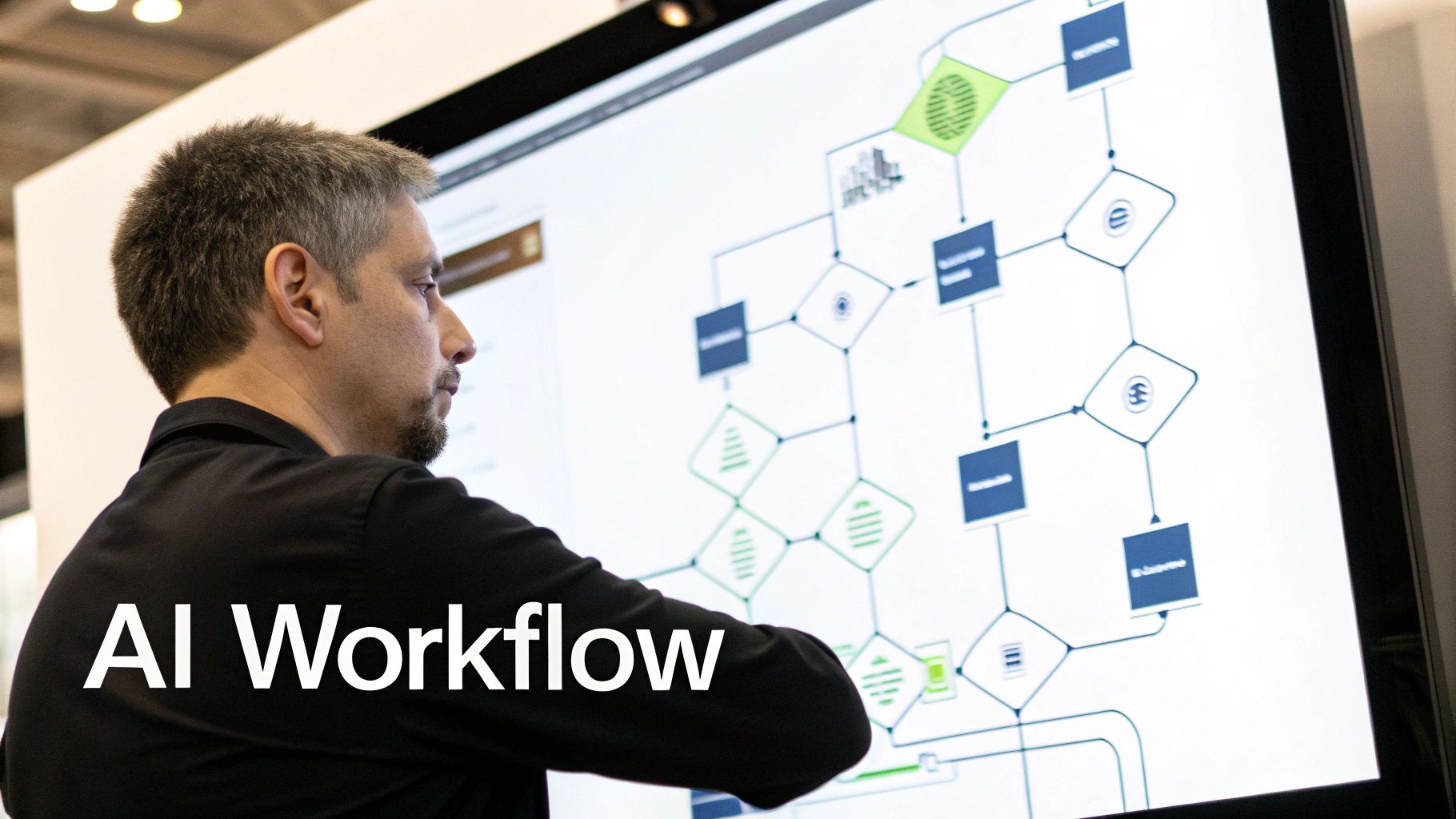
Instead of just following pre-programmed rules, an agentic system understands a business goal and builds its own plan to achieve it. It monitors live data, determines next steps, and suggests actions—all while keeping a human expert in the loop. This approach is essential for tackling the complex, multi-step workflows that cause the biggest bottlenecks.
The business world is taking notice. PwC's 2025 operations survey shows that 59% of tech leaders see AI as a primary tool for boosting efficiency. More importantly, 98% of adopters confirm it works, effectively driving revenue and productivity. You can explore the findings in the full PwC operations survey.
Identifying Prime Candidates for AI-Driven Redesign
Start with processes that are repetitive but still require human judgment—workflows where basic automation fails but Agentic AI excels.
Look for these characteristics:
- High Volume and Frequency: Tasks performed hundreds or thousands of times daily, like invoice processing or customer support ticket routing.
- Multiple Data Sources: Workflows requiring staff to switch between systems (ERP, CRM, spreadsheets) to make a single decision.
- Complex Approval Chains: Processes that stall in approval queues, where delays are common.
- Real-Time Monitoring Needs: Operations that depend on constant monitoring of data streams, like network health or fleet tracking.
Agentic AI delivers not just speed but resilience. When an AI agent encounters unexpected data, it adjusts its plan on the fly, unlike a traditional script that would break. This makes your new workflow far more robust.
From Manual Drudgery to Intelligent Automation
These real-world use cases illustrate the leap from manual work to an intelligent, automated workflow.
Use Case 1: Manufacturing Predictive Maintenance
- Before: Maintenance was either reactive (fixing broken machines) or based on a rigid schedule, both leading to costly downtime.
- The Outcome: An AI agent now monitors machine sensor data 24/7, detecting patterns that signal potential failure. It automatically creates a maintenance ticket, orders parts, and schedules a technician before the machine goes down, eliminating unplanned downtime.
Use Case 2: Financial Services Approval Chains
- Before: A loan application involved manual data entry and a long, slow approval chain, with requests sitting in queues for days.
- The Outcome: An agent now processes the application, instantly validating data against multiple sources. It flags anomalies for human review and routes the application to the right approver with a summary and recommendation. The entire cycle is reduced from days to hours.
The goal is to create a smarter way of working that eliminates wait times, slashes errors, and frees your team for high-value tasks.
Manual vs AI-Driven Process Comparison
The difference becomes clear when comparing old and new processes side-by-side. Let’s examine invoice processing, a classic source of operational friction.
Process StepManual Workflow (Before)AI-Driven Workflow (After)Efficiency GainData EntryAn employee manually keys in invoice data from a PDF or email into the accounting system.The AI agent automatically extracts and validates data from any invoice format, flagging exceptions.90% reduction in manual data entry time and errors.ValidationA manager cross-references the invoice against purchase orders and delivery receipts.The agent performs a three-way match against system records in seconds, confirming accuracy.Validation time reduced from minutes to seconds.Approval RoutingThe invoice is emailed to the appropriate department head, often getting lost in inboxes.The agent instantly routes the validated invoice to the correct approver's dashboard with a one-click option.75% faster approval cycles; no lost invoices.PaymentAfter approval, an accounts payable clerk manually schedules the payment in the banking portal.Once approved, the agent automatically schedules the payment according to vendor terms and logs it.Complete automation of the final step.
By re-engineering these workflows with Agentic AI, you build an operation that is fundamentally more accurate, scalable, and cost-effective.
Powering Decisions with the Snowflake Data Cloud
Any serious effort to improve operations runs on fast, clean, and accessible data. The most advanced AI and redesigned workflows will fail if they are fed slow, siloed, or unreliable information. Your data platform is the engine for the entire transformation.
Legacy data warehouses cannot handle the demands of real-time analytics or the massive data volumes of modern operations. They create bottlenecks and make achieving a "single source of truth" a painful engineering nightmare. A modern data cloud like Snowflake eliminates these friction points, acting as a central hub where all business data can be put to work instantly.
Building the Foundation for Real-Time Insights
The biggest challenge for most CIOs is unifying disparate data streams from transactional systems, IoT devices, and logistics platforms. This fragmentation makes a complete, real-time business view nearly impossible.
A Snowflake-centered architecture solves this by ingesting and processing all data types—structured, semi-structured, and unstructured—in a single environment. This creates the elusive single source of truth that powers everything from executive dashboards to Agentic AI models.
This is a strategic shift. Unified, instantly accessible data allows you to move from reacting to problems to proactively optimizing the business. You can spot issues before they impact customers and uncover hidden opportunities.
This move to centralized, cloud-native data management is a major business trend. With the world projected to generate 175 zettabytes of data by 2025, cloud-first strategies are essential. This is a key driver behind the US IT consulting industry's expected growth to $759.6 billion in revenue, as detailed in IBISWorld's report on IT consulting in the United States.
Practical Use Cases Driving Business Outcomes
The value of a modern data platform lies in the specific, high-impact business outcomes it enables. Clean, real-time data unlocks new operational capabilities and smarter decision-making.
Use Case 1: Logistics Route Optimization
- The Problem: A national logistics company struggled with inefficient fleet routing.
- The Outcome: By streaming real-time GPS, traffic, and delivery data into Snowflake, they built a dynamic routing engine. An AI agent now adjusts routes in real-time to avoid congestion and optimize fuel consumption. The result was a 15% reduction in fuel costs and a significant increase in on-time delivery rates.
Use Case 2: Telecom Network Health Monitoring
- The Problem: A major telecom firm wanted to predict network issues instead of reacting to failures.
- The Outcome: By processing billions of network data points in Snowflake, they built predictive models that identify subtle performance degradation. This system flags equipment for maintenance before it fails, preventing countless costly outages and improving customer experience. Read about similar work in our story on managing time-series data with Snowflake.
Investing in a modern data cloud like Snowflake delivers tangible returns. It drastically reduces data engineering time, freeing your team to create value from the data. The result is faster, more accurate insights that drive measurable improvements across the business.
Moving from a Successful Pilot to Enterprise Scale
A brilliant strategy is worthless without flawless execution. The transition from a controlled pilot to a full enterprise rollout is a make-or-break moment for any efficiency initiative. This phase requires a structured approach to de-risk the process, build momentum, and ensure new processes are adopted.
A successful pilot project serves as your proof point—the tangible evidence needed to secure buy-in for a wider deployment.
Selecting the Right Pilot Project
Your first pilot should not be your most complex problem. Aim for a project that offers both high impact and a manageable scope. The goal is a quick, decisive win that demonstrates undeniable value and builds organizational confidence.
Choose a process with these characteristics:
- Clearly Defined Scope: A distinct beginning and end, making it easy to measure improvement.
- Visible Bottlenecks: The pain points are well-known, so the "before and after" difference will be obvious.
- Engaged Stakeholders: The team involved is open to change and willing to collaborate.
- Measurable Outcomes: Success can be backed by hard data (e.g., reduced cycle time, lower error rates).
Automating accounts payable is a great example. It's a universal function with easily measured inefficiencies. A successful pilot delivers immediate ROI, creating a repeatable framework for more complex financial processes.
Defining Success and Iterating Quickly
Before launching, define what a "win" looks like with concrete, measurable success metrics tied to your operational baseline.
For a customer support ticketing pilot, key metrics might be:
- Reduce average ticket resolution time by 40%.
- Decrease ticket escalation rate by 60%.
- Improve the team’s CSAT (Customer Satisfaction) score by 15 points.
Once live, gather feedback in a continuous loop through regular check-ins with users. This qualitative feedback on usability is just as valuable as quantitative KPIs.
The most successful rollouts are iterative. Use pilot feedback to make rapid adjustments before expanding. This cycle of deploying, gathering feedback, and refining is crucial for building a solution that people will actually use and advocate for.
Mastering Change Management for Enterprise Adoption
The biggest barrier to scaling improvements is almost always human resistance to change. A solid change management strategy is non-negotiable.
Effective change management includes:
- Clear Communication: Explain what is changing, why it's changing, and how it benefits each employee. Frame it as reducing tedious work to free them for more valuable tasks.
- Comprehensive Training: Provide hands-on training, easy-to-access documentation, and designate "champions" within each team to offer peer support.
- Phased Rollout: Don't flip the switch for the entire enterprise at once. Roll out new processes department by department or region by region. This controlled deployment allows you to address issues on a smaller scale and use each group’s success to build excitement for the next.
By treating the rollout as a strategic initiative focused on people and process, you create a repeatable model for sustained operational excellence.
Measuring Success and Driving Continuous Improvement
Launching a more efficient workflow is a milestone, not the finish line. Operational efficiency is a daily discipline, and long-term gains come from embedding a cycle of continuous improvement into your company culture.
This final step is about closing the loop by setting up the right Key Performance Indicators (KPIs) and making that data visible to everyone involved. This creates a feedback system that fuels ongoing improvement.
Selecting KPIs That Truly Matter
You must measure what matters. Your KPIs should be directly linked to the pain points you set out to solve. Generic metrics are useless; you need specific indicators that tell a clear story about process performance.
Effective KPIs typically fall into one of these categories:
- Time-Based Metrics: Track speed. Examples include cycle time (total process duration) or lead time (from customer request to delivery).
- Quality Metrics: Measure accuracy. Track error rates or rework percentages. A bank could monitor the percentage of loan applications requiring manual correction.
- Cost Metrics: Show financial impact. Metrics like cost per transaction or cost per unit quantify the dollar value of your efficiency gains.
- Utilization Metrics: Measure resource effectiveness. Resource utilization helps you spot bottlenecks or costly idle time.
From Data to Decisions with Real-Time Dashboards
Once your KPIs are defined, make them visible. Use your data platform, like Snowflake, to build dynamic, real-time dashboards that give every stakeholder an at-a-glance view of performance.
These dashboards are decision-making tools, not just static reports. They put actionable data into the hands of the people who can use it.
When a team can see the direct impact of their work on key metrics, it creates a powerful sense of ownership. A logistics team can watch how a new routing algorithm affects on-time delivery percentages as it happens, enabling them to make smart, immediate adjustments.
The ultimate goal is a culture where data-backed insights are part of the daily conversation. When teams use dashboards to spot trends and propose their own optimizations, you have moved from a top-down project to a self-sustaining cycle of improvement.
Your Top Questions, Answered
When leaders explore untangling operational knots with AI and smarter data platforms, a few key questions always arise. Here are straight-talk answers to the most common ones.
How Long Until We See a Return on This Investment?
It depends on where you start. By selecting the right pilot project—one with high friction and high volume—you can see a tangible ROI in as little as three to six months. Automating invoice processing is a prime example. We've seen teams slash manual effort by 70-90%, delivering immediate savings in labor costs and faster payment cycles.
A full enterprise overhaul takes longer, but a smart rollout strategy allows early wins from pilots to help fund the larger, more ambitious phases of the project.
What's the Biggest Mistake Companies Make?
The single biggest mistake is focusing on the technology while forgetting the people who must use it. Many initiatives fail not because of flawed AI models or data platforms, but because of a complete lack of a change management strategy.
Without early buy-in and proper training and support, teams will inevitably revert to old habits. Technology is an enabler, not a magic wand. You are not just deploying software; you are building a new, better way of working that your teams must want to adopt.
Remember that you are building a fundamentally new—and better—way of working that your teams have to actually want to adopt. The human element is as critical as the technical architecture.
Can We Just Use Our Existing Data Infrastructure?
While you might be able to use current systems for initial analysis, most legacy data warehouses and on-premise databases hit a wall when you try to scale. They cannot handle the real-time data ingestion and heavy query loads required to power modern AI agents or live operational dashboards.
This is why migrating to a cloud-native platform like Snowflake is often a foundational step. It eliminates performance bottlenecks and provides the scalable, unified source of truth needed for reliable analytics and automation across the business.
Trying to build a modern efficiency engine on outdated infrastructure is like strapping a jet engine to a horse-drawn carriage—it simply won't fly.


