Improving data quality requires a unified framework of governance, automated validation, continuous monitoring, and structured remediation. This isn't about reactive data cleaning; it's about embedding quality into your business processes so data is reliable from creation to consumption. This approach prevents errors, accelerates decision-making, and drives tangible business growth.
Why Data Quality Is a C-Suite Conversation
Poor data quality is a multi-million dollar business problem that torpedoes revenue, guts operational efficiency, and stalls strategic growth. When data is flawed, marketing campaigns miss their targets, financial forecasts are built on quicksand, and supply chain decisions lead to painful stockouts or costly overages.
The financial stakes are staggering. A 2023 Forrester survey found poor data quality costs organizations over $5 million annually on average, with some hemorrhaging $25 million or more. Another estimate pegs the cost at $12.9 million per year per organization. The incentive to get this right is immense. You can dig into more research on the business obstacles caused by poor data governance if you want to see the full financial impact.

This reality shifts the conversation from an IT budget line item to a strategic imperative that belongs in the boardroom.
The Real Business Cost of Flawed Data
The most dangerous outcome of bad data is the erosion of trust. When leaders can't rely on the numbers, decision-making grinds to a halt as teams debate data validity instead of acting on insights. This organizational drag kills opportunities.
Consider these common business impacts:
- Failed AI Initiatives: Junk data trains flawed AI models, producing disastrous product recommendations or faulty demand forecasts.
- Operational Inefficiency: A logistics company running on incorrect address data burns money through higher fuel costs, delayed deliveries, and frustrated customers.
- Compliance Risk: In regulated industries like finance and healthcare, data errors trigger severe penalties, legal battles, and long-term reputational damage.
Low-quality data creates a hidden "tax" on every business process it touches. It forces teams to spend more time validating and correcting information than using it to create value.
A Framework for Enterprise-Grade Data Quality
To break the cycle of constant firefighting, you need a structured, proactive approach built on four interconnected pillars. This framework connects technical functions to the tangible business outcomes the C-suite cares about, making it easier to justify investment and secure company-wide buy-in.
The table below breaks down these essential components and the outcomes they deliver.
The Four Pillars of an Enterprise Data Quality Framework
Here’s a snapshot of the core components that make up an effective data quality strategy and the business outcomes they drive.
PillarCore ActivitiesPrimary Business OutcomeGovernanceDefine data ownership, establish data contracts, create a data catalog, and manage access controls.Accountability and Trust. Ensures everyone knows who is responsible for data, leading to higher confidence and consistency.ValidationImplement automated checks for schema, format, and business rules directly within data pipelines.Prevention of Errors. Stops bad data at the source, reducing the cost and effort of downstream cleanup.MonitoringTrack data freshness, volume, and distribution in real-time; set up automated anomaly detection and alerting.Proactive Issue Detection. Catches data drift and pipeline failures before they impact business operations or dashboards.RemediationEstablish clear workflows for fixing data errors, including root cause analysis and SLAs for resolution.Efficient Resolution. Creates a repeatable process for fixing issues quickly and preventing them from recurring.
Implementing these four pillars moves you from a reactive stance to a proactive one, where data quality becomes a managed, measurable, and reliable part of your operations.
Building a Governance Model That Actually Works
Modern data governance isn’t about restriction; it’s about acceleration. It’s the framework that builds trust and clarity, enabling teams to move faster and make smarter decisions. Without it, you’re just managing organized chaos.
The goal is to answer a simple question for every critical dataset: Who owns it? The most practical way to establish this is by defining clear data owners and data stewards within your business domains. This ensures the people who best understand the data's business context are empowered to maintain its quality.

Use Case: Driving Outcomes with Clear Ownership
A logistics company struggled with costly routing errors due to inconsistent fleet telemetry data. No one was accountable for its quality.
The breakthrough came when they assigned ownership of the dataset to the Head of Fleet Operations. The business leader responsible for fuel efficiency was now also responsible for the data measuring it. This shift incentivized the operations team to work with engineers to fix sensor calibration issues at the source.
The outcome: a 15% reduction in routing errors within one quarter, demonstrating the power of clear ownership.
Using Data Contracts to Create Accountability
Once ownership is clear, data contracts establish expectations between teams. A data contract is a formal, code-based agreement between a data producer and a data consumer that spells out the schema, semantics, and quality guarantees for a dataset.
These enforceable agreements prevent "silent failures" that corrupt downstream analytics. For instance, a data contract for customer transaction data might mandate:
- Schema Enforcement: The
transaction_amountfield must be a positive decimal. - Freshness Guarantee: Data must be available within one hour of the transaction.
- Completeness Check: The
customer_idfield cannot be null.
If a producer pushes data that violates the contract, the pipeline automatically rejects it and sends an alert. This stops bad data before it pollutes financial reports or ML models. It’s a way of proactively managing data-centric technical debt, a concept explored in our article on managing technical debt in risk control.
A data contract transforms data quality from a hopeful expectation into a testable, automated, and binding commitment between teams.
Activating Governance with a Practical Data Catalog
A governance model is only effective if people use it. This requires a practical data catalog—a centralized, searchable inventory of your data assets. A good catalog provides the context that helps users discover, understand, and trust the data.
Inside a platform like Snowflake, you can build a powerful catalog using native features like object tagging to label data with its owner and domain. The real value comes from integrating data lineage, which visually maps data flow from source to destination. When an analyst sees an unexpected number in a sales report, they can use lineage to instantly trace it back to the source table and transformation logic. This transparency dramatically cuts down diagnostic time and builds organization-wide confidence in your analytics.
Engineering Quality Into Your Data Pipelines
With governance in place, the work shifts to your data pipelines. This is where you move from reactive cleanup to proactive prevention by embedding automated quality checks directly into your data flows. The goal is simple: stop bad data at the door.
By engineering for quality by design, you build a system that automatically enforces your rules. This ensures only clean, compliant, and trustworthy data reaches your analytics platforms.

Use Case: Automated Validation in Manufacturing
A manufacturing client was buried in unreliable IoT sensor data, causing their predictive maintenance models to fail. Their data teams spent over 60% of their time cleaning and backfilling data instead of building models.
The solution was an automated defense system. By implementing schema validation and null checks directly within their Snowflake ingestion process, they immediately began rejecting malformed sensor data at the source.
The outcome was a dramatic productivity increase for the data science team and a 25% improvement in predictive maintenance model accuracy, leading to a measurable drop in unplanned equipment downtime.
Implementing Automated Validation Checks
Automated validation is your first line of defense. These programmatic rules ensure data passes quality gates before moving to the next stage. Start with foundational checks and layer on more specific business logic.
Essential checks for every pipeline include:
- Schema Validation: Ensures incoming data matches the expected structure, columns, and data types.
- Null and Uniqueness Checks: Verifies critical fields like primary keys are never empty and have no duplicates.
- Range and Value Checks: Confirms data falls within acceptable business limits (e.g., order quantity is not negative).
- Referential Integrity: Checks that foreign keys in one table correctly point to a primary key in another.
Modern solutions like intelligent document processing (IDP) can further improve accuracy by reducing manual errors at the source.
Building quality into your pipelines means treating data like code. It must pass automated tests before it's "merged" into your production environment. This is the essence of DataOps.
Building Resilient Pipelines in Snowflake
In Snowflake, you can use Streams and Tasks to orchestrate a powerful, self-correcting workflow that enforces quality by design.
Here’s how it works:
- Capture Changes with Streams: A Snowflake Stream acts like a change log on your raw ingestion table, capturing every new record.
- Validate with Tasks: A scheduled Snowflake Task reads new records from the stream and applies your validation logic.
- Route Data Accordingly: The task routes the data based on the results. Valid records are inserted into a clean production table, while invalid records are moved to a "quarantine" table with error logs for review.
This closed-loop system automatically separates good data from bad, keeping your main analytics tables pristine. This pattern is incredibly powerful for high-volume data, a common challenge we cover in our success story on managing time-series data with Snowflake.
Shifting to Proactive Data Monitoring
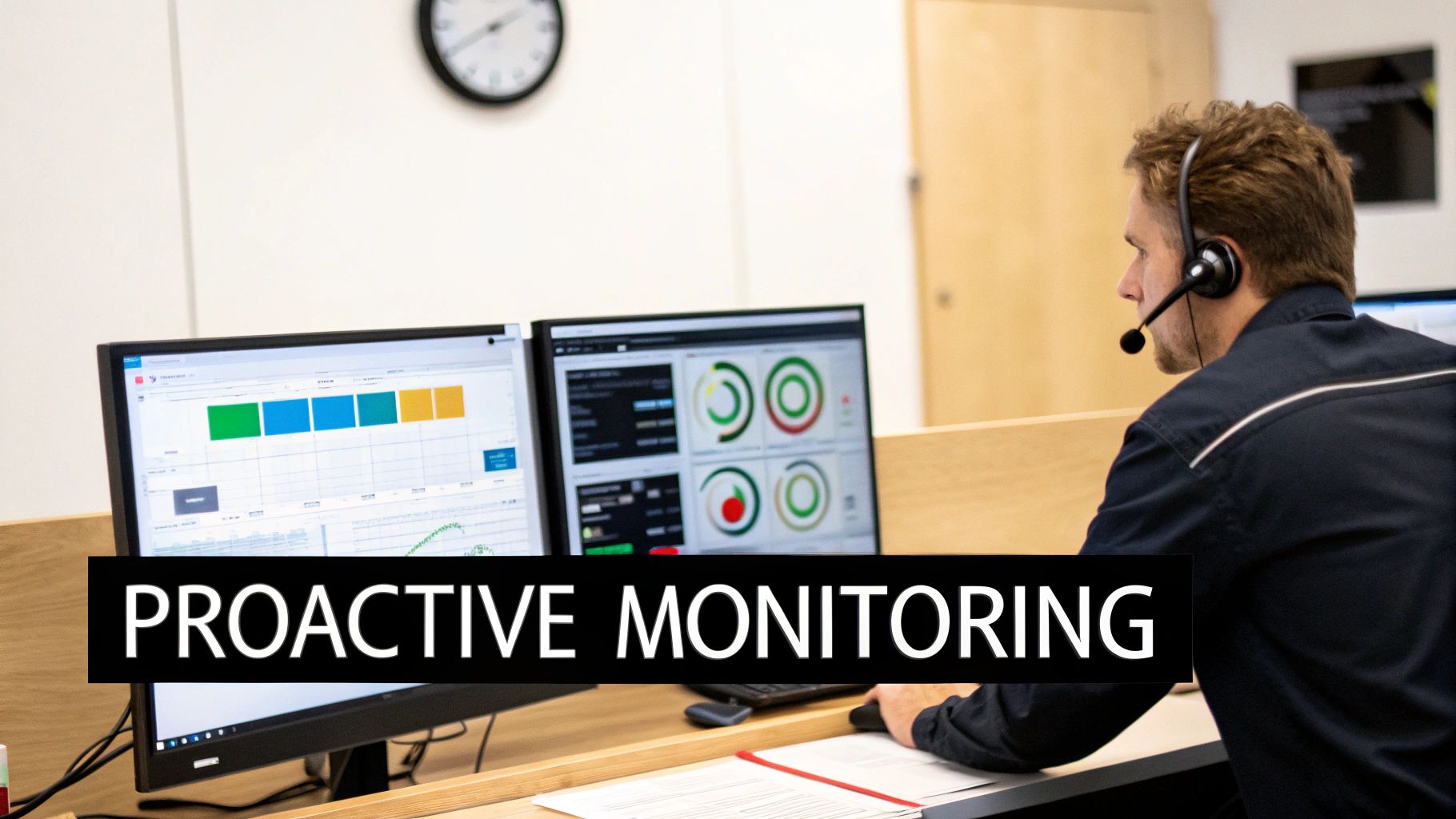
If your data team feels like a fire department, it's time to shift from a reactive to a proactive stance. Continuous monitoring creates an intelligent nervous system for your data—one that detects issues long before they cascade downstream and corrupt business decisions.
By constantly tracking vital signs like completeness, timeliness, and accuracy, you can catch subtle data drift and pipeline hiccups before they impact a critical report or machine learning model. This gives your team real-time visibility into the health of your data, empowering them to resolve anomalies the moment they appear.
Use Case: Real-Time Monitoring in Telecom
A telecom client’s business relied on processing millions of Call Data Records (CDRs) hourly to feed their billing systems. Minor errors created a tidal wave of incorrect invoices and customer complaints.
We implemented real-time monitoring dashboards that triggered alerts on statistical anomalies, not just pipeline failures. Key alerts included:
- Volume Anomaly: Alerted if record volume dropped by over 20% in a 15-minute window, often indicating a network issue.
- Format Drift: Triggered on any sudden spike in records with null values in critical fields.
- Timeliness Lag: Fired if the latency between a call ending and its CDR arriving exceeded 5 minutes.
The outcome: The operations team could pinpoint and fix transmission errors before they ever impacted a customer's bill. This shift dramatically reduced billing disputes and improved customer trust.
Proactive monitoring transforms data quality from a historical analysis of what went wrong into a real-time capability to ensure things go right.
Using AI for Smarter Anomaly Detection
Traditional monitoring often leads to alert fatigue from static, rule-based thresholds. As data complexity grows, manual rule maintenance becomes impossible. This is where AI and machine learning are game-changers.
AI-powered anomaly detection learns the natural rhythm of your data—its seasonality, trends, and normal distributions. It builds a dynamic baseline of what "good" data looks like and flags only statistically significant deviations. The global market for data quality management services is expected to hit $5.9 billion by 2032, driven largely by this need for smarter tools, especially since some studies show 47% of new data has critical errors. You can explore more on the rise of AI in data quality management.
This approach catches subtle issues that simple rules miss, like a slight drop in average transaction value signaling a payment gateway problem. By surfacing only critical alerts, AI frees your team to solve real problems instead of chasing false positives.
Creating a Clear Path to Data Remediation
Spotting a data quality issue is the easy half. The real work is fixing it efficiently and ensuring the problem doesn't happen again. Without a structured remediation process, data errors fester, draining your team's energy and eroding business-wide trust in the data.
A clear remediation path transforms this chaos into a controlled, repeatable system for maintaining data integrity.
Who Owns the Fix?
The first step is assigning clear responsibility. When an error is flagged, who is responsible for the fix? Designate specific data stewards who are empowered to investigate and correct issues within their domain. This eliminates finger-pointing and ensures problems are handled by those with the most business context.
Set the Clock with Service Level Agreements
Not all data errors are created equal. A typo in a contact field isn't as critical as an incorrect transaction amount in a financial report. This is where Service Level Agreements (SLAs) are essential.
By categorizing issues by severity, you set clear expectations for resolution time:
- Critical (P1): Issues impacting financial reporting or major business operations. SLA: Resolution within 4 hours.
- High (P2): Errors affecting key analytics dashboards or internal workflows. SLA: Resolution within 24 hours.
- Medium (P3): Minor inaccuracies with limited business impact. SLA: Resolution within 3-5 business days.
SLAs create accountability and provide a transparent framework for prioritizing work, ensuring the most dangerous fires are put out first.
Remediation isn't just about fixing the bad data point; it's about fixing the broken process that created it. Without root cause analysis, you're just playing whack-a-mole.
Use Case: Structured Remediation in Financial Services
Imagine a financial services firm flags mismatched trade settlement data during a nightly reconciliation—a direct financial and compliance risk.
Their automated remediation workflow kicks in:
- A P1 alert is routed to the designated data steward with a 4-hour SLA.
- The steward uses data lineage tools to trace the error to a third-party API change that caused a formatting error.
- Immediate Fix: The steward manually corrects the affected records to ensure the daily reconciliation report is accurate, preventing immediate financial exposure.
- Long-Term Fix: The steward logs a ticket for root cause analysis. The engineering team updates the ingestion pipeline to handle the new API format, preventing the error from recurring.
This process meets regulatory requirements, minimizes financial risk, and improves the underlying data pipeline. It provides both a short-term fix and long-term stability—a repeatable blueprint for how to improve data quality.
Measuring the ROI of Your Data Quality Program
A successful data quality program is not a cost center; it's a strategic investment that pays dividends. To prove its worth, you must move past technical metrics and connect your work to the numbers that matter to the C-suite.
The key is to translate data improvements into measurable business outcomes. This is the language that secures buy-in and demonstrates ongoing value.
Framing the Business Value
Focus on tracking metrics across four key business pillars directly impacted by better data. Showing the "before and after" in these areas builds a powerful case that resonates with leadership.
Here are the core areas to measure:
- Reduced Operational Costs: Calculate the hours teams previously spent on manual data cleaning and firefighting. A retail client saved their data team 20 hours per week by automating quality checks, time they reinvested in high-value analytics projects.
- Lower Compliance Risk: Quantify the potential cost of fines or penalties you are now avoiding. A financial services firm can measure the reduction in trade reconciliation errors, drawing a straight line from improved data to a lower risk of costly regulatory sanctions.
- Improved Decision-Making Speed: Track how long it takes for teams to trust and act on data. A marketing team launched new campaigns 30% faster because they no longer wasted days manually verifying customer segmentation data.
- Increased Revenue and Opportunity: High-quality data fuels growth. A CPG company with accurate sales data improved its demand forecasting, leading to a 15% reduction in stockouts and a direct, measurable lift in sales. That's an ROI everyone understands.
By presenting the ROI in these terms, you shift the conversation from a technical discussion about data purity to a strategic one about business performance.
Data Quality Improvement FAQ
Here are answers to the most common questions from data leaders starting a data quality program.
Where Should I Start Improving Data Quality?
Don't try to fix everything at once. Start by picking a single, high-impact business problem where bad data is causing visible pain, such as customer billing errors or inaccurate supply chain forecasts.
Run a focused data quality assessment only on the datasets feeding that specific process. This narrow scope lets you demonstrate tangible ROI quickly. A successful pilot project builds momentum and provides the political capital needed for a broader, enterprise-wide program.
What Are the Most Important Metrics to Track?
Focus on metrics that connect directly to business outcomes. Frame the six core dimensions of data quality with business-specific KPIs.
Here's how that looks in practice:
- Completeness: Are we missing values?
- KPI Example: Percentage of customer records with a complete and validated shipping address.
- Uniqueness: Do we have duplicate records?
- KPI Example: Number of duplicate customer accounts merged per week.
- Timeliness: Is data available when we need it?
- KPI Example: Average lag time between a sales transaction and its availability in our analytics database.
- Validity: Does the data follow our required format?
- KPI Example: Percentage of product SKUs that match the established format.
- Accuracy: Does our data reflect the real world?
- KPI Example: Mismatch rate between our inventory data and physical stock.
- Consistency: Is our data the same across different systems?
- KPI Example: Percentage of customers whose status differs between our CRM and our billing system.
When you track these, you’re translating abstract data quality concepts into measurable business performance.
Your goal isn't just to report on data purity; it's to show how that purity drives better business results. Connect every metric back to an operational efficiency, cost saving, or revenue opportunity.
How Can We Implement Governance Without Slowing Teams Down?
Modern data governance should be an accelerator, not a roadblock. Ditch the idea of a centralized, bureaucratic committee. Instead, adopt a federated governance model that distributes data ownership to the business domains that know the data best.
Empower these "data stewards" with automated tools for data cataloging, lineage tracking, and quality monitoring. Use Data Contracts defined as code to set clear, automated expectations between data producers and consumers, enforcing quality rules directly within your pipelines.
This approach weaves governance directly into existing workflows, making quality a shared responsibility. It builds trust and actually speeds up access to reliable data instead of creating a bottleneck.


