
Your leadership team has approved an AI initiative, but nobody can answer a basic question: which systems, data, permissions, and people must change before it can operate safely? Meanwhile, integration work consumes delivery capacity, legacy applications remain expensive to maintain, and technology investment reviews still rely on disconnected project proposals.
That is the practical context for enterprise architecture consulting in 2026. The useful work isn't producing another attractive diagram. It is creating an operating model that connects business capabilities, data, applications, platforms, governance, and measurable outcomes, including the controls required when software agents start making decisions.
What Enterprise Architecture Consulting Solves
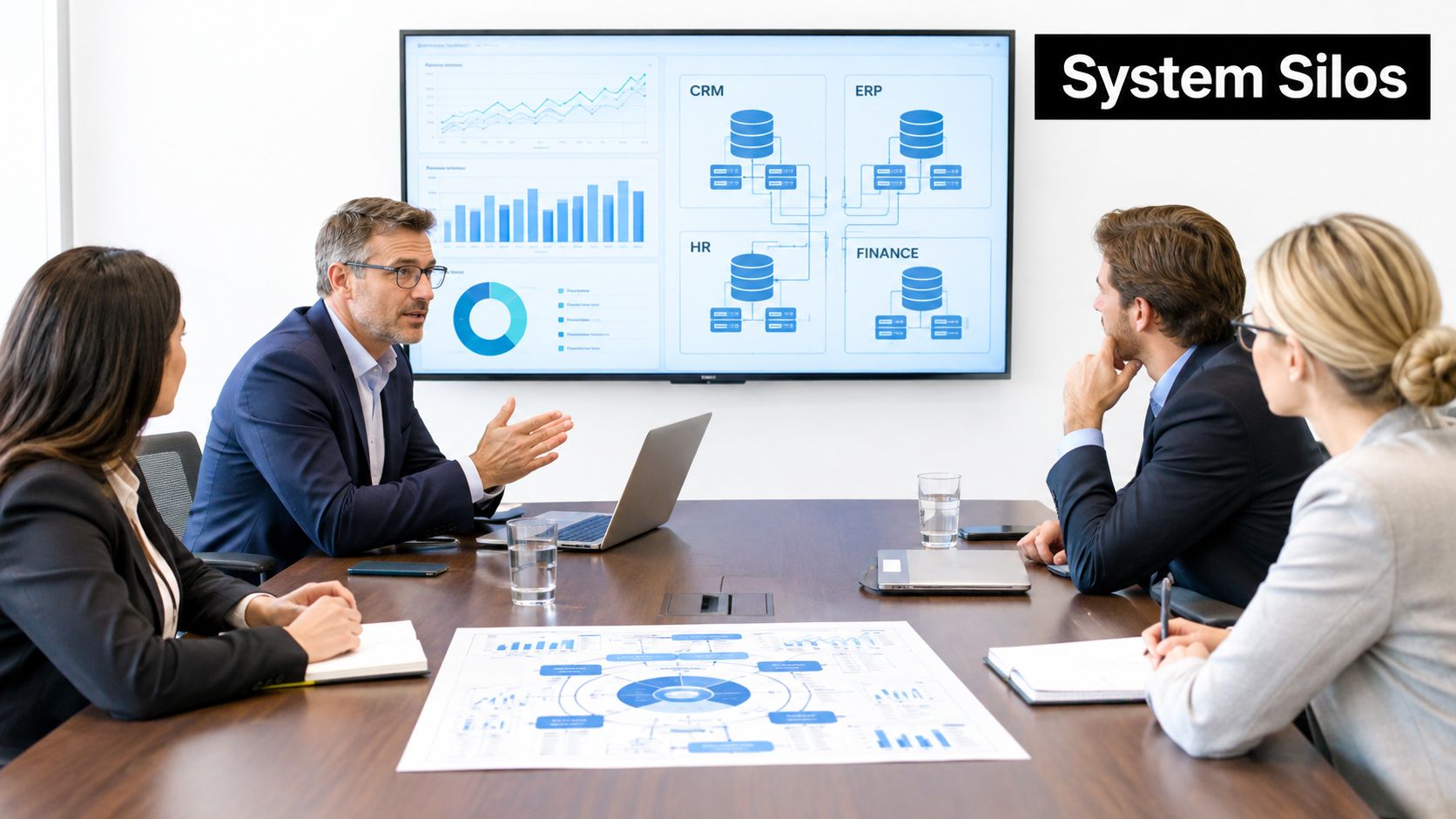
A manufacturer can run a solid ERP, a modern customer platform, a data warehouse, and a stack of operational apps, yet still fail on basic questions: which system owns the customer record, why reporting conflicts across teams, and why a digital program keeps slipping. Business leaders get inconsistent answers. Architects see duplicate integrations and unclear ownership. Delivery teams lose time reconciling definitions instead of shipping changes.
Enterprise architecture consulting solves that problem by creating a shared, structured representation of how the organization works. Done well, it links strategy to business capabilities, operating model choices, information, applications, platforms, and decision rights. That matters even more when AI agents enter the picture, because agent behavior depends on clean data boundaries, clear permissions, and explicit accountability. In practice, the work is less about drawing boxes and more about deciding how the business should run.
The discipline predates cloud platforms and modern data stacks. It grew out of IBM's Business Systems Planning methodology in the 1960s, which established top-down planning, formal architectural analysis, and structured views of business and information systems that still shape EA practice (historical overview of enterprise architecture frameworks).
From diagrams to decisions
A useful engagement might uncover several business units running separate customer-notification services, each with different consent rules and different integration patterns. The right answer is not always consolidation. Sometimes one shared service reduces cost and risk. Sometimes standardized interfaces are enough. Sometimes local variation is justified because the transition cost is too high or the business model is genuinely different. Good architecture consulting makes that trade-off explicit and ties it to business outcomes, not framework purity.
That is the line between documentation and consulting. A model matters only if it changes a real decision:
- Which capabilities need differentiation: Invest where the organization competes, where AI can improve throughput, or where risk is material.
- Which systems create drag: Track application, data, integration, infrastructure, security, and architecture debt with named owners and realistic remediation options.
- Which decisions need governance: Define who approves exceptions, who owns a data domain, and who can grant an automated workflow or agent additional access.
For leaders and transformation teams, the most valuable architecture artifacts are usually capability maps, operating-model assessments, application portfolios, data-domain maps, transition architectures, and decision registers. These are the tools that connect enterprise theory to execution on platforms such as Snowflake and to the controls required for agentic AI.
Practical rule: If an architecture deliverable does not change funding, sequencing, ownership, or delivery behavior, it is documentation, not consulting.
The Evolution and Core Principles of Enterprise Architecture
Enterprise architecture became more explicit as organizations needed a way to describe increasingly complex relationships among business operations and information systems. The progression matters because it explains why credible EA work spans several layers instead of treating software as the enterprise itself.
John Zachman's 1987 publication in the IBM Systems Journal described an organizing schema built around six interrogatives, what, how, where, who, when, and why. These correspond broadly to data, function, network or location, people and roles, time, and motivation, while different stakeholder perspectives move from high-level scope toward detailed design and implementation (Zachman Framework background).
The framework was a classification structure, not a prescriptive delivery method. That is an important distinction. It helped organizations compare current-state and target-state architectures across multiple viewpoints without pretending that a single application diagram could explain the enterprise.
The architecture layers that survive framework changes
The field developed through milestones including the PRISM framework in 1986, Zachman's work in 1987, and the NIST Enterprise Architecture Model in 1989. Later terminology shifted from information-systems architecture toward enterprise architecture, reflecting a wider ambition: describe and align the organization, not just design individual systems.
In practice, the principles translate into a set of connected views:
ViewConsulting questionTypical outputBusinessWhat outcomes and capabilities matter?Capability map and operating-model assessmentInformationWhich domains exist, and who owns them?Data-domain map, lineage, and ownership modelApplicationWhich systems support each capability?Portfolio rationalization and integration mapTechnologyWhich platforms provide the required qualities?Standards, reference patterns, and roadmapGovernanceWho decides, approves, and handles exceptions?Decision rights and architecture review process
A strong consultant doesn't force every organization into identical terminology. The underlying discipline is more durable than any one framework or tool. Leaders need a traceable link from organizational objectives to processes, information, systems, and infrastructure, with enough detail to sequence investment.
That also changes how teams approach modernization. Starting with a preferred cloud, ERP, microservices pattern, or AI platform can create expensive confirmation bias. Starting with capabilities and outcomes makes the technology choice answer a business requirement instead of becoming the requirement.
Comparing Major Enterprise Architecture Frameworks
Framework selection should follow the problem, not fashion. TOGAF, Zachman, SABSA, and ArchiMate are often discussed together, but they perform different jobs.
Framework or notationPrimary strengthAppropriate useMain limitationTOGAFProcess and lifecycle guidanceLarge transformation programs needing structured governance across business, data, application, and technology domainsCan become bureaucratic when teams apply every artifact regardless of decision valueZachmanClassification and architectural completenessOrganizations that need a disciplined way to organize viewpoints and identify gapsDoesn't prescribe implementation steps or a delivery methodSABSASecurity and risk architectureRegulated or risk-centric environments where business requirements must drive security controlsNarrower focus than a full enterprise transformation methodArchiMateVisual communicationTeams that need a common notation to connect business, application, and technology viewsA notation alone doesn't create governance, ownership, or execution
TOGAF is useful when a complex portfolio needs a repeatable method for moving from vision to transition architectures and governance. It becomes counterproductive when consultants treat the framework as a documentation quota. A transformation team rarely needs every possible artifact. It needs the artifacts that resolve its highest-risk decisions.
Zachman is valuable when the organization has inconsistent descriptions of the same enterprise. It can expose missing perspectives, such as an application inventory with no clear business ownership or a data model that says nothing about motivation and timing. It won't tell a team how to implement a target state.
SABSA fits environments where security architecture must begin with business risk and trace through services and controls. A bank, insurer, or healthcare provider may use its logic alongside a broader EA method rather than treating it as a complete enterprise framework.
ArchiMate supports communication between executives, product owners, architects, and engineers. Clear notation helps, but a polished model won't resolve disputed ownership or underfunded remediation.
The practical approach is often a deliberate combination: use capability and stakeholder views for structure, a lifecycle method for transformation, security principles for control design, and a notation for communication. Keep only the elements that improve decisions, delivery, and accountability.
Measurable Outcomes from Enterprise Architecture Investment
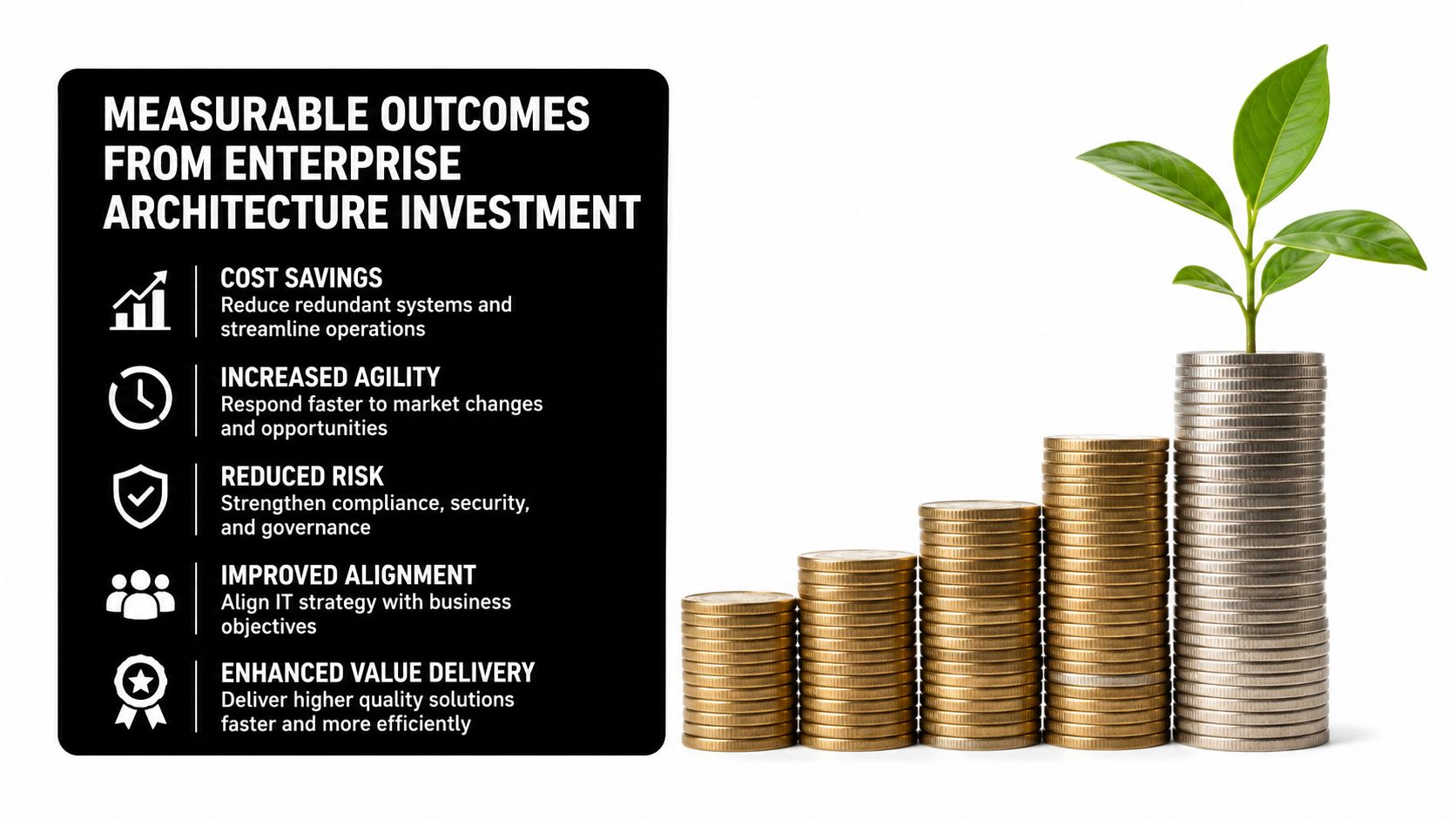
Architecture earns credibility when it improves portfolio decisions and operational performance. A quantitative study of 3,076 IT projects across 28 organizations found that introducing enterprise architecture was associated with a 19% decrease in project budget overruns, a 40% decrease in schedule overruns, a 14.5% increase in successful projects, and a 26.2% reduction in failed projects (study of enterprise architecture and project outcomes).
Those findings don't guarantee identical results in every organization. They do show what architecture can influence: shared principles, dependency visibility, decision controls, and earlier identification of conflicts.
Measure capacity, risk, and investment choices
Technical debt is another area where consultants need more discipline. A 2024 survey estimated a $1.52 trillion technical-debt burden in the U.S. software sector (2024 Software Architecture Technical Debt Survey). The useful response isn't to repeat the headline figure in an executive presentation. It is to create a debt register that separates application, data, integration, infrastructure, security, and architecture debt.
Each item should have an owner, estimated remediation cost, risk exposure, opportunity cost, and business-capability impact. A duplicated integration pattern may deserve urgent action because it increases testing effort and limits future change. A stable legacy component may be less urgent if its risk is controlled and its replacement would disrupt a critical operation.
An EPA case provides a concrete example of architecture tied to operational value. Its TRI-MEweb reporting program recorded $14,869,700 in fiscal-year 2008 cost savings or avoidance during its first four quarters, with $49,394,266 in projected savings for fiscal years 2009 through 2012 (EPA enterprise architecture case studies). The value came from standardized processes and electronic information exchange, not from producing models for their own sake.
Research also distinguishes early indicators, such as improved decision-making and alignment, from delayed outcomes such as measurable cost savings. A sensible roadmap tracks both, without promising that every architecture initiative will produce immediate financial returns.
This video offers another perspective on connecting architecture decisions to business outcomes:
Useful measures include decision latency, duplicate-system reduction, integration lead time, change failure, incident volume, debt-servicing capacity, and progress against transition states. The right metric depends on the decision the engagement is meant to improve.
Enterprise Architecture in Action Across Industries
Architecture becomes useful when it respects operational reality. A healthcare provider, telecom operator, and logistics company may all need data ownership and integration governance, but the consequences of a poor decision differ sharply across their environments.
In healthcare, consultants might map the relationship among electronic health records, medical-device data, scheduling, identity, and compliance obligations. The objective is not just to connect every source. It is to define trustworthy ownership, access boundaries, interoperability patterns, and an operating model that protects clinical workflows.
A telecom operator faces a different constraint. OSS and BSS modernization must support network operations and customer services without destabilizing service continuity. Architecture work can separate capabilities that require real-time resilience from those suited to batch processing, while clarifying how new network services interact with existing customer and billing systems.
Logistics exposes another failure mode. Fleet management, warehouse automation, geofencing, tracking, and last-mile delivery often evolve through separate programs. A capability-based architecture can identify where shared location, identity, event, and shipment data would reduce duplication, while preserving the latency and availability characteristics required by frontline operations.
Data fragmentation changes the consulting question
Recent survey evidence reports that 75% of enterprises use multi-database architectures, 84% lack the ability to store, manage, and index high-dimensional vector data, and architecture limitations consume 17% of AI investment while delaying strategic goals by six months on average (survey findings on data architecture and AI adoption).
Those figures don't mean every database should be consolidated. A regulated workload may need a separate platform. A real-time operation may require a different latency profile from an analytical system. The consulting task is to establish decision rules for when to consolidate, govern data in place, or connect platforms through a shared access layer.
For a logistics enterprise, that may mean assigning ownership for shipment and vehicle data, standardizing metadata and lineage, controlling vector retrieval access, and allocating platform cost to consuming products. For healthcare, it may mean strict identity boundaries and auditable access. For telecom, it may mean event contracts that prevent one modernization stream from breaking another without detection.
Generic advice about a “single source of truth” is too blunt. The better target is reliable, governed access for a defined business decision.
How Faberwork Bridges Traditional EA with Modern AI and Data Platforms
Traditional EA programs often stop at the target-state blueprint. AI exposes the weakness in that boundary. An agent doesn't merely consume architecture. It acts within it, accessing data, invoking services, changing records, and escalating exceptions.
A credible agent operating model must answer practical questions:
- Which decisions may an agent make without approval?
- Which data and tools may it access?
- What evidence must it retain?
- Who reviews exceptions?
- How can an action be rolled back?
- What happens when the model, prompt, policy, or underlying data changes?

A Deloitte survey reports that 78% of technology leaders expect to integrate AI agents into architecture workflows within five years, while only 35% rate their enterprise-architecture governance as very effective and one in four EA functions doesn't measure impact (Deloitte analysis of AI and technology organizations). The implication is uncomfortable: many organizations are preparing to automate decisions before they have defined how to govern them.
Snowflake and agentic workflows need architecture together
Faberwork LLC combines SnowPro Certified expertise with Agentic AI, custom software, data transformation, integration, analytics, and database architecture. Its experience spans healthcare, finance, retail, manufacturing, energy, logistics, and telecom, including Snowflake-centered EMS platforms, fleet geofencing, and smart-building optimization with TensorFlow.
The relevant architecture pattern isn't “put everything into one platform.” It is to define the data products, ownership, access policies, integration contracts, observability, and cost model that let a platform support real business workflows. Snowflake can provide a foundation for analytics, time-series, and IoT data use cases, while application services and operational systems continue to serve their specific responsibilities.
Faberwork's Snowflake partnership and collaboration approach is relevant when an organization needs to connect platform engineering with application delivery and governed automation. The same engagement should make the agent's permissions, audit trail, approval thresholds, and recovery path explicit.
An autonomous agent is an architecture participant. Treating it like a chatbot produces controls that are too weak and operating assumptions that are too vague.
The practical deliverable may be smaller than a multi-year blueprint: an agent decision matrix, data-access policy, observability design, exception workflow, and KPI baseline. That is still enterprise architecture, because it defines how technology, people, controls, and business outcomes work together.
Selecting an EA Consulting Partner and Taking Next Steps
Choose a partner based on the decisions it can improve, not the volume of diagrams it can produce. The right team should understand business capabilities, application and data architecture, platform engineering, security boundaries, delivery constraints, and the economics of technical debt.
Start with a focused assessment. Interview business owners, technology leaders, data stewards, security teams, and delivery managers. Map the capabilities that matter most, identify systems and data products supporting them, and record the constraints that prevent change.
Use these selection tests
Framework judgment matters more than certification language. Ask how the partner would use TOGAF, Zachman, ArchiMate, SABSA, or an internal method in your context. A good answer will explain what the team would leave out and why.
Evidence should connect architecture to outcomes. Request examples of portfolio rationalization, integration simplification, data ownership, governance adoption, delivery predictability, or operational improvement. Avoid accepting a list of completed models as proof of value.
Modern platform capability must be practical. If AI and analytics are priorities, assess whether the partner can design data products, lineage, identity boundaries, vector retrieval, observability, and cost allocation. A strategy team that can't work with delivery engineers will leave you with an attractive gap between intent and implementation.
Governance belongs in delivery. Look for decision rights, exception workflows, automated controls, auditability, and rollback design. Governance that exists only in a review board will be bypassed when delivery pressure rises.
For broader context on selecting a regional technology advisor, this Houston IT consulting guide provides a useful comparison point for evaluating consulting scope and engagement fit.
A practical first engagement
A strong first phase can produce:
- Capability and value-stream baseline: Identify where strategic value, operational risk, and change urgency intersect.
- Architecture and debt register: Link applications, data, integrations, and platforms to owners, capabilities, risks, and investment choices.
- Target and transition states: Define the sequence, dependencies, standards, and decisions required to move from the current environment.
- Agent operating model: Specify autonomous decisions, approvals, permissions, evidence, monitoring, and recovery.
- Measurement plan: Track leading indicators such as decision clarity and roadmap adoption, then connect later measures to cost, cycle time, reuse, risk, and business performance.
Faberwork's enterprise technology services cover architecture-related support, custom software, data platforms, analytics, automation, and testing across the delivery lifecycle. That type of breadth can be useful when the engagement must move from architectural decisions into working systems.
The best partner will also challenge the scope. If a short capability assessment and targeted data or agent initiative can resolve the immediate constraint, don't approve a multi-year blueprint by default. Build evidence through a measurable tranche, establish accountable owners, and expand only when the operating model proves it can support the next level of complexity.
If disconnected systems, fragmented data, or ungoverned AI decisions are slowing your roadmap, start with a capability and architecture assessment rather than another isolated pilot. Contact Faberwork to define the highest-value data, platform, and agent operating-model decisions, then turn them into a measurable delivery plan.


