A data pipeline ETL is an automated factory for your business data. It systematically extracts information from different sources, transforms it into a clean and consistent format, and loads it into a central system for analysis. The outcome is simple: enabling your business to make decisions based on high-quality, reliable insights.
Why a Data Pipeline ETL Is Your Data's Engine Room
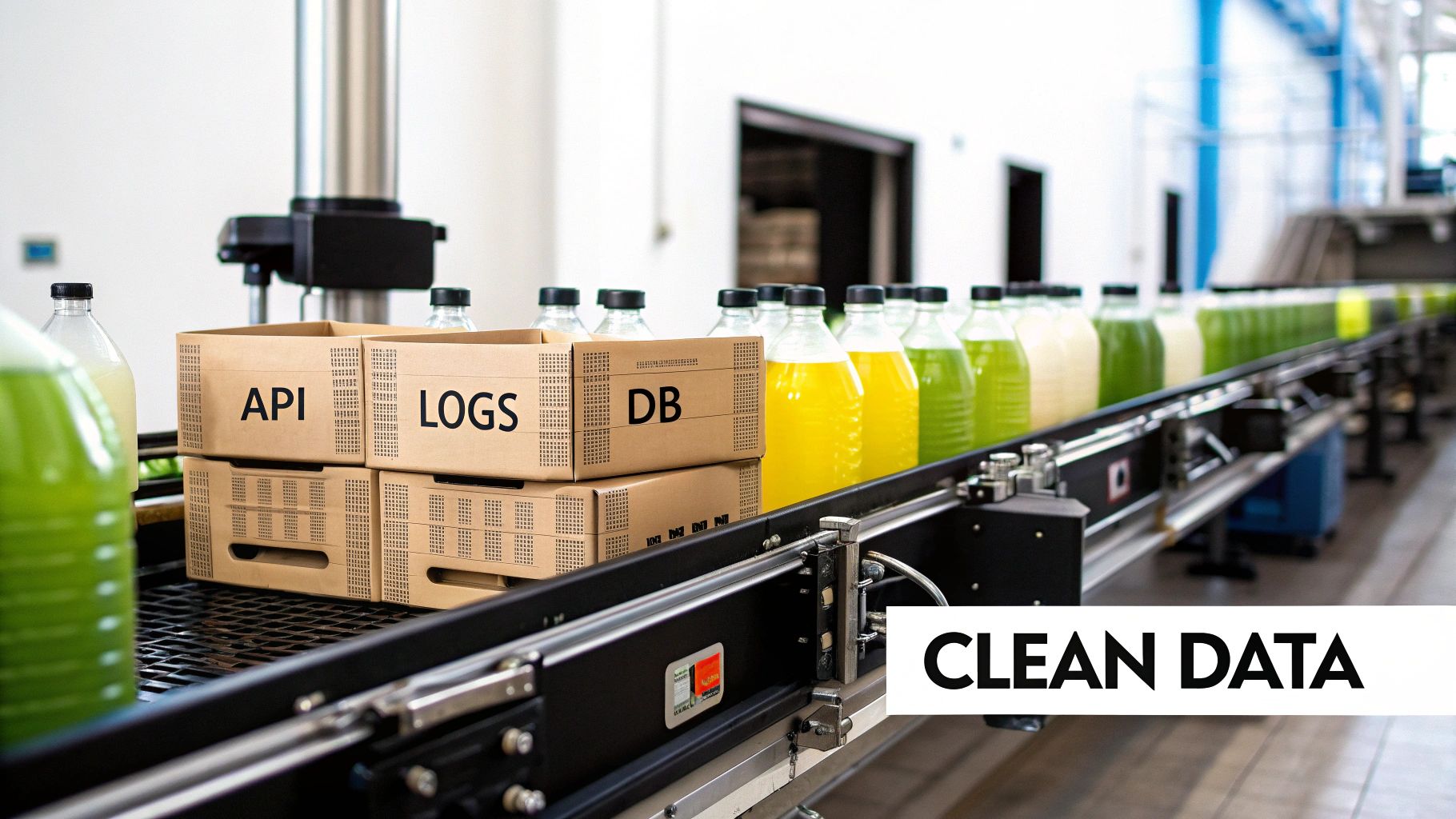
Modern companies generate data from dozens of sources: customer data from a CRM, sales numbers from an e-commerce platform, and website traffic from analytics tools. Each source provides data in a different format and quality.
A data pipeline ETL brings order to this chaos. It automates the process of refining messy, inconsistent information into a standardized asset ready for business intelligence dashboards and machine learning models. This process solves a massive business problem by ensuring the data you rely on is trustworthy. Strong financial data integration techniques, for instance, are at the core of any good pipeline, guaranteeing both accuracy and compliance. Without this automation, teams would be stuck manually cleaning data, leading to delays, errors, and missed opportunities.
Achieve Clear Business Outcomes
A data pipeline ETL isn't a technical novelty; it's a tool for driving tangible business results. By creating a single source of truth, these pipelines enable organizations to:
- Improve Strategic Planning: Give leadership accurate, consolidated reports to improve forecasting, budgeting, and market analysis.
- Enhance Customer Insights: Combine behavioral, transactional, and support data to build a complete 360-degree view of your customers.
- Optimize Operations: Analyze production and supply chain data to identify bottlenecks and improve efficiency.
- Power Advanced Analytics: Provide the clean, structured datasets essential for training predictive models and AI applications.
ETL vs. ELT: A Quick Comparison
While ETL (Extract, Transform, Load) is a long-standing standard, a modern alternative is ELT (Extract, Load, Transform). The only difference is when the "Transform" step occurs, but this small change has big implications for handling data with modern cloud data warehouses.
ELT loads raw data first and transforms it inside the warehouse, offering greater flexibility. Here’s a quick breakdown.
ETL vs ELT At a Glance
CharacteristicETL (Extract, Transform, Load)ELT (Extract, Load, Transform)Process OrderData is cleaned and structured before being sent to the warehouse.Raw data is loaded first, then transformed inside the warehouse.Data StagingRequires a separate staging server to perform transformations.Uses the power of the target data warehouse for transformations.FlexibilityLess flexible; transformations are defined upfront.Highly flexible; analysts can transform raw data as needed for different uses.Data VolumeBest for smaller, structured datasets with well-defined requirements.Ideal for large volumes of unstructured or semi-structured "big data".Use CasesTraditional BI reporting, compliance, operational data.Data science, machine learning, exploratory analytics.
ETL prepares ingredients perfectly before storing them, ensuring only clean, compliant data enters your analytical systems. It's ideal for structured data.
ELT loads raw data directly into a powerful cloud warehouse like Snowflake, allowing data scientists to perform transformations there. This gives them more flexibility to work with raw data. Despite the rise of ELT, traditional ETL data pipelines still hold a significant revenue share in the market due to their effectiveness with structured data in critical industries.
The Three Core Stages of an ETL Pipeline

Every data pipeline ETL process turns raw data into a valuable asset through three stages: Extract, Transform, and Load. The goal is to create a reliable bridge from messy source systems to a clean, centralized data warehouse, ensuring decision-makers get the right data, structured for immediate use.
Stage 1: Extract — Gathering Raw Ingredients
The first stage, Extract, involves gathering raw data from multiple sources. An ETL pipeline connects to various systems to pull in the necessary information, such as:
- Transactional Databases: Systems like PostgreSQL holding sales records and customer orders.
- APIs: Gateways to third-party services like Salesforce for CRM data or Google Analytics for web traffic.
- SaaS Applications: Platforms running your marketing, finance, or HR departments.
- Log Files: User activity and system performance data from apps and servers.
The Extract stage consolidates this raw data into a single staging area, preparing it for the next step. This can occur in scheduled batches or as a continuous real-time stream, depending on business needs.
Stage 2: Transform — Preparing the Data
The Transform stage is where raw data is refined into a usable format. Raw data is often inconsistent, contains errors, or is poorly formatted. This stage applies automated rules to clean and standardize the data, ensuring consistency and accuracy.
The Transform stage directly impacts data quality and reliability, turning potentially misleading raw information into a trustworthy asset for analysis.
Common transformation jobs include:
- Cleansing: Fixing duplicates, null values, and formatting errors (e.g., standardizing "USA" and "United States").
- Standardizing: Ensuring data follows a consistent structure, like a YYYY-MM-DD date format.
- Enriching: Merging data from different sources to create a more complete picture, such as adding demographic details to a customer record.
- Aggregating: Summarizing data, like calculating total monthly sales from individual transactions.
This refinement ensures the data is clean, reliable, and ready for analysis without manual cleanup.
Stage 3: Load — Delivering the Final Product
The final stage, Load, delivers the transformed data to its destination. The polished data is moved from the staging area into a central repository, typically a data warehouse like Snowflake.
Once loaded, the data is ready for action. Business intelligence analysts can connect their tools, data scientists can build predictive models, and executives can view accurate dashboards. This final step turns scattered raw data into a powerful engine for business insight.
Choosing Your ETL Architecture and Tools
Building a data pipeline ETL requires aligning your architecture and tools with specific business outcomes. The right architecture depends on what the data needs to do. A pipeline for monthly financial reporting has different requirements than one for real-time fraud detection. Clarity on the end goal is the most critical first step.
Batch vs. Streaming Pipelines
Choosing between batch processing and real-time streaming is a key decision, as each serves a different business purpose.
- Batch Processing: This traditional approach processes data in large, scheduled chunks (e.g., hourly, daily). It is ideal for operations that do not require immediate data, such as generating end-of-month sales reports. It's reliable and cost-effective for handling large volumes when latency isn't a concern.
- Streaming Processing: This architecture processes data continuously as it’s generated, within seconds. Streaming is essential for use cases requiring immediate action. For example, an e-commerce site uses streaming to offer instant product recommendations, while a bank uses it to detect and block fraudulent transactions.
This decision also involves weighing on-premises vs. cloud infrastructure. Modern cloud platforms offer the scalability and managed services that are often ideal for today's data workloads.
Navigating the Crowded Market of ETL Tools
After choosing an architecture, you must select your tools. To simplify the decision, group tools based on their core strengths.
Your choice of tool directly impacts project speed, cost, and required technical skills. A low-code platform can empower business analysts, while a code-heavy framework gives engineers maximum control.
Here’s a practical breakdown of common tool categories:
- Cloud-Native vs. On-Premise:
- Cloud-Native Tools (like Fivetran or Stitch) are excellent for connecting to SaaS apps and cloud data warehouses, offering easy scalability and pay-as-you-go pricing.
- On-Premise Tools (like Informatica PowerCenter) provide granular control over security, making them common in regulated industries.
- Open-Source vs. Commercial:
- Open-Source (like Talend Open Studio) offers flexibility with no licensing fees, ideal for startups with strong engineering teams.
- Commercial (like Matillion) includes dedicated support and pre-built connectors, reducing development time.
- Code-Heavy vs. Low-Code/No-Code:
- Code-Heavy (like Apache Spark) requires programming skills but offers unlimited customization for complex transformations.
- Low-Code/No-Code (like Hevo Data) features visual interfaces, enabling analysts and business users to build pipelines without coding.
For organizations using a cloud data warehouse like Snowflake, collaborating with a Snowflake partner can ensure your tools and architecture are optimized for performance and scale.
Building a Modern ETL Pipeline in the Cloud
Cloud platforms have transformed how a data pipeline ETL works, shifting the focus from managing infrastructure to orchestrating scalable data flows. Building in the cloud is about services, not servers.
This blueprint uses Snowflake, a leading cloud data warehouse, to illustrate how cloud-native features simplify the traditional ETL process and deliver better performance and cost-efficiency.

Unified platforms like Snowflake integrate data engineering, warehousing, and analytics, making it much more straightforward to build a modern cloud ETL pipeline.
Step 1: Extract and Load with Automation
The modern cloud approach automates the extraction and loading of raw data into your cloud environment. This process begins with dedicated cloud storage services like Amazon S3, Azure Blob Storage, or Google Cloud Storage, which act as a high-performance landing zone.
Using an intermediary cloud storage layer creates a durable and scalable staging area. This allows massive data volumes to be ingested without overwhelming the data warehouse, a core principle of modern data architecture.
From this staging area, Snowflake’s Snowpipe feature automates the loading process. Snowpipe monitors the storage location for new files and automatically loads them into raw data tables in continuous micro-batches, creating a near real-time ingestion flow without manual intervention.
Step 2: Transform Data In-Place
Once the raw data is in Snowflake, the transformation begins. Unlike traditional methods that use a separate server, a cloud data warehouse leverages its own powerful compute engine. This ELT-style approach (Extract, Load, Transform) is far more efficient.
The transformation logic is orchestrated using Snowflake's native features to clean, standardize, and enrich raw information.
A typical transformation workflow includes:
- Defining Data Changes with Streams: Snowflake Streams capture change data (inserts, updates, deletes) on a raw data table, allowing you to process only what has changed.
- Scheduling Transformations with Tasks: Snowflake Tasks run SQL statements on a schedule. You can create a task that checks a stream for new records and applies transformation logic only to the new data.
- Creating a Data Flow: Tasks can be chained to create a dependency graph (e.g.,
TASK_CLEANSE_DATAruns beforeTASK_AGGREGATE_SALES), resulting in a reliable, automated transformation sequence within the warehouse.
This cloud-native model is highly scalable. Snowflake can automatically scale its compute resources up or down to handle the workload, ensuring you only pay for the processing power you use. This creates a resilient and cost-effective data pipeline ETL.
Key Practices for a Reliable and Secure ETL Pipeline
A trustworthy ETL pipeline requires a foundational focus on performance, error handling, and security. Weaving these elements into your design from the start is essential for building a dependable and secure data flow.
Tuning for Performance and Cost Efficiency
Performance tuning aims to move data faster while controlling costs. Two fundamental techniques are crucial.
- Parallel Processing: Breaking a large dataset into smaller chunks and processing them simultaneously radically reduces total processing time. Cloud data warehouses are designed for this, automatically scaling compute resources to handle concurrent jobs.
- Incremental Loading: Instead of reprocessing an entire dataset, incremental (or delta) loading processes only new or changed records. By using timestamps or Change Data Capture (CDC), this can reduce the data volume processed by over 99%, leading to significant cost savings and faster updates.
Ensuring Reliability with Monitoring and Alerting
A pipeline without visibility is a risk. A robust observation system is necessary to monitor performance and alert you when issues arise.
This system relies on three pillars:
- Comprehensive Logging: Log key events, such as job starts, data validation results, and completion status. These logs are essential for debugging.
- Proactive Monitoring: Use dashboards to track vital signs like data latency, job duration, and resource usage to spot problems before they cause an outage.
- Automated Alerting: Set up automated alerts to notify the data engineering team via Slack, email, or PagerDuty as soon as a job fails or a data quality check fails.
Implementing End-to-End Security
Security is non-negotiable in a data pipeline ETL, especially when handling sensitive information. A multi-layered security strategy is needed to protect data in transit and at rest.
Security isn't a single feature but a continuous process. Every step must be secured through encryption, strict access policies, and adherence to compliance standards like GDPR and HIPAA.
Key security measures include:
- Data Encryption: Encrypt all data in transit (using protocols like TLS) and at rest (when stored in your data warehouse or cloud storage).
- Strict Access Controls: Follow the principle of least privilege. Use role-based access control (RBAC) to ensure users and applications only have access to the data they need.
- Compliance and Governance: Regularly audit your pipelines to ensure compliance with regulations like GDPR or HIPAA. This often involves data masking or anonymizing sensitive fields and maintaining clear data lineage.
Data Pipeline ETL Use Cases Across Industries
ETL pipelines solve real business problems by turning raw operational data into a competitive advantage. The goal is always to connect disparate data points to uncover hidden insights. Let's explore how three different sectors use ETL to improve operations and cut costs.
Logistics and Supply Chain Optimization
In logistics, efficiency is paramount. Companies constantly seek to deliver goods faster while reducing costs.
- Use Case: A national delivery company struggled with high fuel costs and missed delivery windows because its data (GPS pings, warehouse inventory, driver schedules) was siloed.
- ETL Solution: They implemented an ETL pipeline to consolidate this data in near real-time. The pipeline transformed raw GPS coordinates into structured route segments, cleaned warehouse data, and integrated live weather and traffic APIs.
- Outcome: The resulting dynamic routing dashboard provided a unified view of operations, enabling planners to identify the most efficient routes. This led to a 15% reduction in fuel costs and a significant increase in on-time deliveries. Learn more about enhancing logistics with Python data analytics.
Telecommunications Network Management
For telecom providers, network stability is critical. Identifying problems before they cause outages is a top priority.
A well-designed data pipeline ETL acts as an early warning system, processing millions of network events to pinpoint anomalies that signal an impending equipment failure or service degradation.
- Use Case: A major mobile operator faced intermittent service disruptions but couldn't connect network performance logs with customer complaints to understand the full picture.
- ETL Solution: They deployed a data pipeline ETL to process call detail records (CDRs), network equipment logs, and customer support data. The pipeline standardized timestamps, grouped error codes, and enriched the data with cell tower locations.
- Outcome: The centralized dashboard for network health allowed analysts to spot towers with high dropped call rates, cross-reference them with error logs, and dispatch maintenance proactively. This reduced customer-facing outages by over 30%.
Frequently Asked Questions About Data Pipeline ETL
Here are answers to some common questions about data integration to help guide your next steps.
What Is the Main Difference Between a Data Pipeline and ETL?
A data pipeline is any process that moves data from point A to point B—it's the overall plumbing system. ETL is a specific type of data pipeline that follows the sequence: Extract, Transform, Load.
All ETL processes are data pipelines, but not all data pipelines are ETL. For example, an ELT pipeline (which loads data before transforming it) is also a data pipeline, just a different type.
How Do I Choose the Right ETL Tool for My Project?
The right tool depends on your project's goals and your team. Focus on these key questions:
- Data Volume & Complexity: For massive, real-time data streams requiring complex transformations, a powerful framework like Apache Spark offers maximum flexibility.
- Team Skills: If your team consists of data analysts and business users, a low-code platform like Fivetran or Hevo Data will enable them to move faster.
- Budget & Infrastructure: Consider the total cost of ownership, whether a subscription-based cloud tool or a self-hosted open-source platform is a better fit.
My advice is to run a proof-of-concept. Test your top contenders with your actual data and a real use case before committing.
The right tool is the one that accelerates your time-to-insight. It should align with your team's existing skills and your company's data strategy, not force you to adapt to its limitations.
Can I Build an ETL Pipeline Without Writing Code?
Yes, absolutely. The no-code and low-code ETL market has grown significantly.
Tools like Stitch or Integrate.io offer visual, drag-and-drop interfaces with extensive libraries of pre-built connectors for databases, SaaS apps, and APIs.
This approach enables non-engineers to build and manage their own pipelines, freeing up development resources and dramatically accelerating data projects.


