Migrating enterprise data to a modern platform like Snowflake is a pivotal business transformation, not just a technical task. A successful migration unlocks superior performance, scalable analytics, and significant cost savings. However, without a meticulous plan, these projects can derail, leading to budget overruns and data quality issues. The key to success is an outcome-focused strategy that treats migration as a strategic imperative.
This actionable data migration checklist provides a detailed roadmap used by top-tier engineering teams. We'll break down 10 essential stages, from initial assessment to post-migration optimization. Each step focuses on practical outcomes that matter to CTOs and technology leaders aiming to modernize their data stack for analytics, automation, and AI.
Instead of a simple "lift and shift," this guide emphasizes a strategic approach. Each checklist item is illustrated with real-world use cases from logistics, telecom, and energy sectors, helping you navigate complexity with confidence. For a deeper dive into foundational principles, review the top database migration best practices that complement this checklist. This blueprint will equip you to not only move your data but transform its value.
1. Assess Current Data Infrastructure and Inventory
The foundational step in any data migration checklist is a thorough assessment of your current data landscape. This phase creates a comprehensive blueprint of your entire data ecosystem, auditing all data sources, storage systems, applications, and the intricate data flows connecting them. The outcome is a clear scope, identified roadblocks, and accurate resource estimates.

This assessment reveals the "four Vs" of your data: Volume, Velocity, Variety, and Veracity. Failing to map these leads to scope creep, budget overruns, and unexpected technical hurdles.
Implementation and Use Cases
A comprehensive inventory provides the clarity needed to de-risk the entire project.
- Use Case: A healthcare organization discovers patient data fragmented across 15+ legacy systems. This inventory allows them to build a unified patient view strategy before migration begins, ensuring the final platform can deliver comprehensive patient analytics.
- Use Case: A manufacturing firm identifies mission-critical IoT sensor data streaming into incompatible platforms. This highlights the need for a standardized ingestion layer in the new architecture, enabling reliable real-time monitoring from day one.
Key Insight: A detailed data inventory is not just a technical exercise; it's a strategic activity. It aligns technical and business teams, ensuring the most critical data assets are prioritized for a successful migration.
Actionable Tips for a Successful Inventory:
- Automate Discovery: Use automated data discovery and cataloging tools to accelerate the inventory process.
- Engage Stakeholders: Involve business users early to understand data criticality and regulatory requirements (e.g., GDPR, HIPAA).
- Map Data Lineage: Document how data moves between systems to understand dependencies and inform the migration sequence.
- Establish Ownership: Assign clear data owners accountable for the quality and definition of their data domains.
- Create a Data Dictionary: Build a detailed data dictionary capturing metadata, formats, and business rules for each asset.
2. Define Clear Migration Goals and Success Criteria
A data migration without clear goals is a journey without a destination. This step establishes the strategic "why" of the project by setting explicit business objectives and measurable outcomes. Defining quantifiable success criteria from the outset creates a framework for tracking progress and making informed trade-off decisions.
These criteria translate abstract goals into tangible targets. Instead of "faster reports," a clear goal is "reducing query response times for key business intelligence dashboards by 50%." This clarity ensures every technical decision supports a specific business outcome.
Implementation and Use Cases
Precise goals provide a North Star for the entire migration team, guiding priorities and measuring success.
- Use Case: A telecom firm's primary goal is a 50% reduction in network performance query response times. This outcome enables near-real-time monitoring and faster incident response.
- Use Case: A logistics company targets sub-second latency for fleet geofencing data updates, directly powering real-time tracking applications and improving delivery accuracy.
- Use Case: An energy utility aims to reduce analytics infrastructure costs by 40% while improving energy demand forecast accuracy by 15%, delivering both cost savings and operational efficiency.
Key Insight: Success criteria must blend technical and business metrics. IT may focus on query performance, but the business needs to see improvements in time-to-insight, operational efficiency, or cost savings to declare the migration a success.
Actionable Tips for Setting Effective Goals:
- Establish Baselines: Measure and document current system performance, cost, and availability to create a concrete baseline for comparison.
- Balance Ambition and Realism: Set ambitious targets that drive significant business value but are grounded in realistic technical capabilities.
- Include Business and Technical Metrics: Define a mix of KPIs, such as query performance, availability SLAs, cost per GB, and user adoption rates.
- Create Executive Dashboards: Develop a simple dashboard that tracks progress against stated goals for all stakeholders.
- Revisit Goals Regularly: Schedule quarterly reviews to assess progress and adjust as the migration unfolds.
3. Design Data Architecture and Snowflake Schema Strategy
After inventorying data assets, the next step is designing the target architecture in Snowflake. This is an opportunity to build a modern, scalable foundation for analytics and AI, not just a lift-and-shift of old structures. This phase defines how data will be organized to maximize performance, governance, and business value.
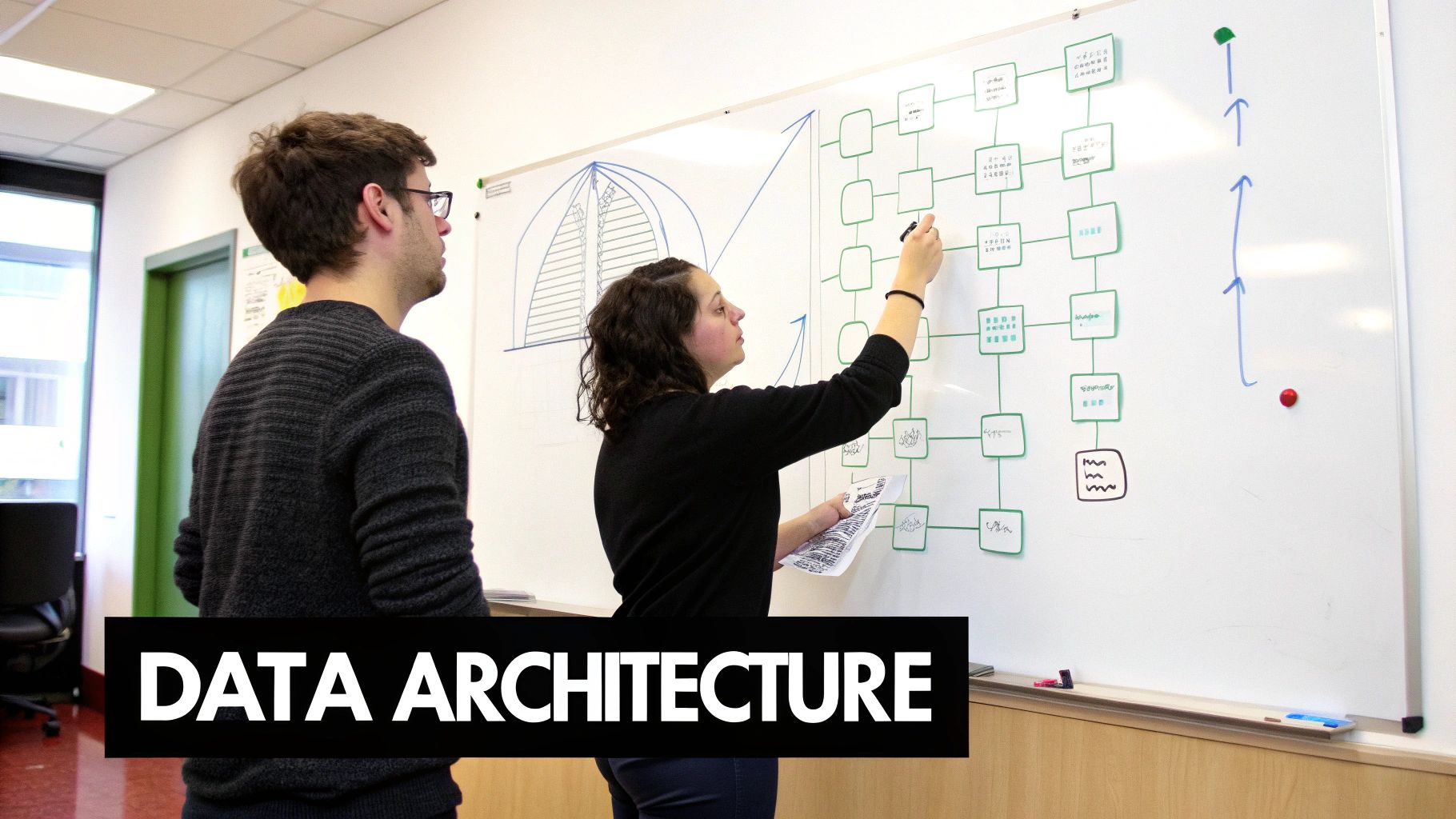
A well-designed architecture handles diverse workloads, from ad-hoc queries to real-time AI model training. Neglecting this phase often leads to a poorly performing system that fails to meet business needs and is costly to refactor.
Implementation and Use Cases
A strategic schema design directly enables powerful business outcomes.
- Use Case: A healthcare system implements a medallion (bronze/silver/gold) architecture to progressively cleanse patient data. The outcome is a trusted "gold" layer for reliable clinical analytics.
- Use Case: A financial services firm uses a star schema to optimize databases for fast compliance reporting and feed curated data into fraud detection AI models, improving both speed and accuracy.
- Use Case: An IoT company structures its data to support real-time anomaly detection and predictive maintenance. Learn more about time-series data with Snowflake.
Key Insight: The target architecture should be driven by business query patterns and future use cases, not just the source data structure. This is the moment to correct past design limitations and build for agility.
Actionable Tips for a Successful Architecture Design:
- Embrace Medallion Architecture: Implement a bronze (raw), silver (cleansed), and gold (business-ready) data progression to systematically improve data quality.
- Conduct Query Workshops: Collaborate with business analysts to understand their query patterns, which will inform your clustering key strategy for better performance.
- Plan for Concurrency: Leverage Snowflake’s multi-cluster architecture to ensure different workloads (e.g., data loading vs. BI reporting) don't interfere.
- Design for Governance: Plan for data retention policies, archival strategies, and metadata management from the start.
- Document Everything: Create comprehensive documentation detailing architectural decisions and schema designs to guide future development.
4. Develop Data Mapping and Transformation Rules
With a clear inventory, the next step is to create detailed, field-level data mapping and define the precise transformation rules. This is where raw, often inconsistent data from source systems is cleaned, standardized, and structured for optimal performance and analytical value in Snowflake.
This blueprint dictates how source fields correlate to target fields, including data type conversions, business logic translations, and strategies for handling nulls. A well-documented mapping plan is fundamental to any data migration checklist, ensuring data integrity and preventing the "garbage in, garbage out" scenario.
Implementation and Use Cases
Effective data mapping translates legacy data into a high-value asset.
- Use Case: A retail organization maps transactional data from dozens of disparate Point-of-Sale (POS) systems into unified dimensions in Snowflake. The outcome is a single source of truth for sales and inventory analytics.
- Use Case: A telecom firm transforms complex Call Detail Record (CDR) data from various network switches into a standardized event structure. This enables deeper analysis of network performance and customer behavior.
Key Insight: Data mapping is not just about moving data; it's about enhancing its value. This stage codifies business knowledge, enforces consistency, and improves the usability of your data for downstream analytics and AI.
Actionable Tips for Effective Mapping and Transformation:
- Visualize the Logic: Use visual mapping tools or structured spreadsheets to clearly document complex transformations for easy validation.
- Involve Domain Experts: Engage subject matter experts to validate the translation of business logic and ensure rules are accurate.
- Test with Real Data: Validate transformation logic against representative samples of historical data to catch errors early.
- Handle Edge Cases Explicitly: Document rules for handling exceptions, null values, and data quality issues to prevent unexpected failures.
- Leverage Snowflake Features: Utilize Snowflake Streams and Tasks for efficient change data capture (CDC) and incremental data loads.
5. Data Validation, Reconciliation, Cleansing, and Quality Remediation
A data migration’s success is measured by the trustworthiness of the data in the new system. This step is a disciplined process to guarantee that migrated data is accurate, complete, and fit for business use. It involves systematically validating data against predefined rules, reconciling key metrics, and executing a targeted strategy to cleanse quality issues.
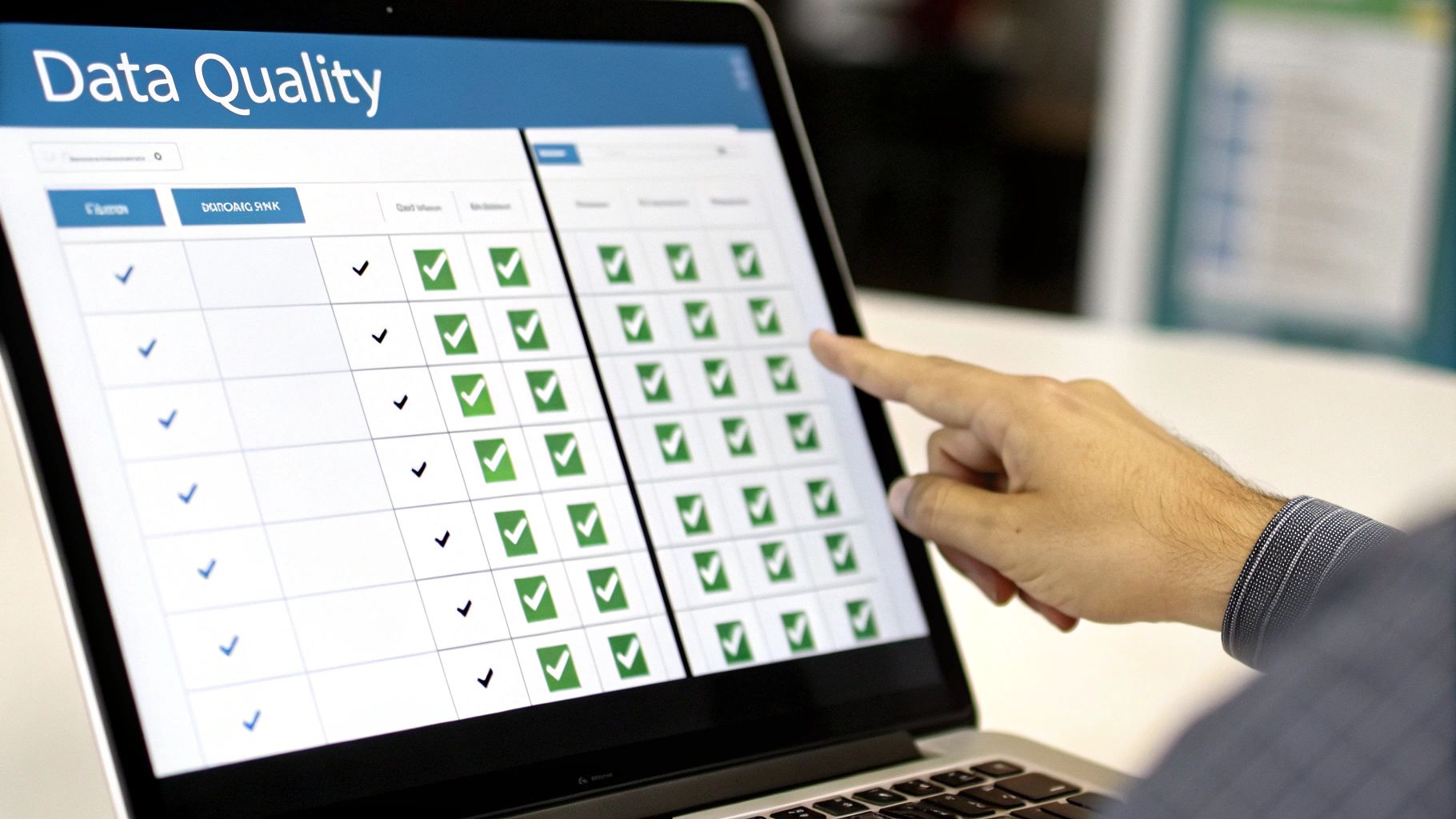
Neglecting this rigorous process leads to failed user adoption, flawed business intelligence, and a loss of confidence in the new platform. It ensures the project delivers not just data, but reliable insights.
Implementation and Use Cases
This validation and cleansing process builds trust and ensures operational continuity.
- Use Case: A financial services firm reconciles transaction counts and customer balances to the cent between systems. The outcome is zero discrepancies, ensuring regulatory audit readiness.
- Use Case: A healthcare provider merges duplicate patient records by reconciling patient counts and clinical outcomes. The result is a true single source of truth for patient care.
- Use Case: A logistics company validates shipment records to confirm they fall within expected ranges, preventing downstream analytics errors that could impact supply chain optimization.
Key Insight: Proactive data validation transforms a migration from a technical move into a value-add opportunity. It allows the organization to actively improve data quality, rather than simply replicating existing issues.
Actionable Tips for Successful Validation and Remediation:
- Integrate Testing Early: Embed validation tests directly into your ETL/ELT transformation pipelines.
- Automate Reconciliation: Create automated SQL queries to compare key metrics (e.g., row counts, sums) between source and target systems, flagging any variance immediately.
- Prioritize Cleansing Efforts: Use data profiling tools to identify and quantify quality issues, then prioritize remediation based on business impact.
- Establish Tolerance Thresholds: Define acceptable variance levels for key data points to guide automated validation.
- Document and Version Rules: Maintain a version-controlled repository of all validation and cleansing rules for auditability.
6. Establish Security, Compliance, and Data Governance Framework
A data migration checklist is incomplete without a robust security and governance strategy. This phase involves proactively designing a comprehensive framework for security controls, role-based access, and compliance adherence before the first terabyte is moved. The outcome is a target environment that is secure and audit-ready from day one.
Failing to build this framework early transforms the migration into a major security risk, exposing the organization to potential breaches and non-compliance penalties. Embedding security into the migration plan safeguards sensitive data throughout its lifecycle.
Implementation and Use Cases
A well-defined governance framework prevents unauthorized access and ensures regulatory adherence.
- Use Case: A financial firm implements strict role-based access control (RBAC) to enforce segregation of duties. Analysts can query anonymized data while compliance officers have audited access to raw PII.
- Use Case: A healthcare provider uses Snowflake's dynamic data masking to automatically redact patient information based on the user's role. This maintains HIPAA compliance without creating multiple data copies.
- For organizations building a holistic security posture, expert resources like A Comprehensive Guide to Information Security Management Systems provide an excellent foundation.
Key Insight: Security and governance are not barriers to migration but enablers of trust. A secure data platform accelerates data democratization by giving stakeholders confidence that data is managed responsibly.
Actionable Tips for a Successful Framework:
- Implement a Role Hierarchy: Use Snowflake’s hierarchical roles to mirror your organizational structure and ensure least-privilege access.
- Leverage Dynamic Data Masking: Automatically protect sensitive columns by creating masking policies that apply protections at query time.
- Classify Data Early: Establish a clear data classification taxonomy (e.g., Restricted, Confidential, Public) to drive appropriate security controls.
- Enable and Integrate Auditing: Activate Snowflake’s audit logging and integrate it with your corporate SIEM platform (like Splunk or Sentinel).
- Control Network Access: Implement Snowflake network policies to restrict access to trusted IP addresses.
- Engage Compliance Teams: Involve your compliance and legal teams early to validate that the new architecture meets all regulatory requirements.
7. Design and Test ETL/ELT Processes and Data Pipelines
The core engine of any data migration is the set of pipelines that move and transform data. Designing and rigorously testing these ETL (Extract, Transform, Load) or ELT (Extract, Load, Transform) processes is a non-negotiable step. This phase involves building repeatable, automated workflows that handle all data patterns, ensuring data arrives accurately and on time in Snowflake.
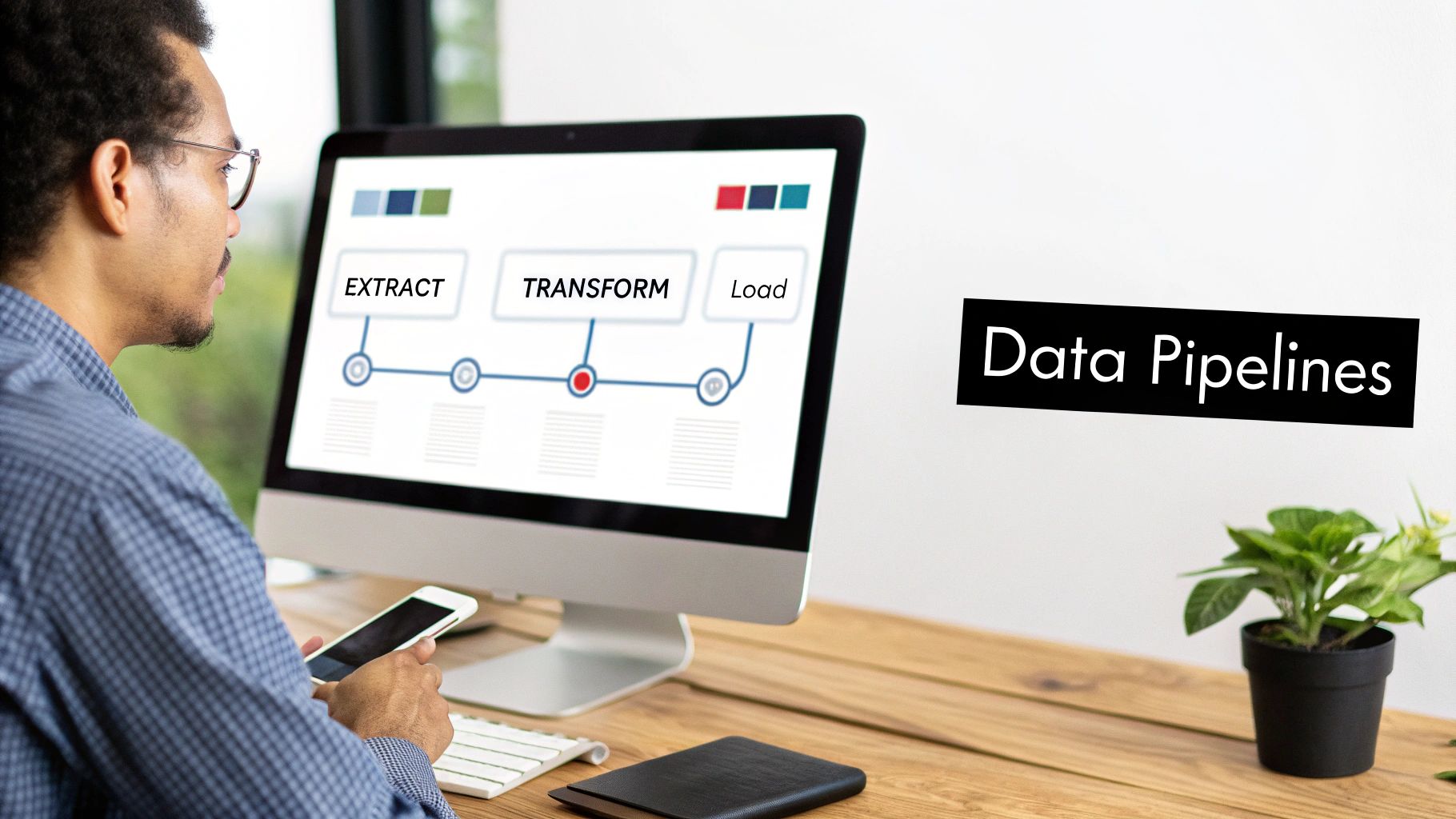
The choice between ETL and ELT is crucial. Modern ELT, favored by cloud platforms like Snowflake, loads raw data first and leverages the target system's power for transformations, offering greater flexibility. A failure to build robust, tested pipelines leads to data corruption and operational downtime.
Implementation and Use Cases
Robust pipeline design directly translates to operational efficiency and real-time insight.
- Use Case: A retail organization uses Snowflake’s Snowpipe to stream transaction data from point-of-sale systems. The outcome is immediate inventory and sales analytics.
- Use Case: A telecom firm implements a complex ETL process to extract and normalize Call Detail Record (CDR) data into a unified format for network performance monitoring.
- Use Case: A manufacturing company leverages Kafka and Snowflake to stream IoT sensor data, providing immediate alerts on production line anomalies.
Key Insight: Data pipelines are the arteries of your data ecosystem. Design them for resilience, observability, and scalability to handle both current and future data demands.
Actionable Tips for Successful Pipeline Design:
- Leverage Native Tools: Utilize Snowflake's native capabilities like Snowpipe for streaming ingestion and Tasks for scheduled orchestration.
- Implement CDC: Use Change Data Capture (CDC) methods to efficiently migrate only incremental changes from source systems.
- Design for Idempotency: Build pipelines that can be safely retried after a failure without creating duplicate data.
- Version Your Logic: Use tools like dbt (data build tool) to manage, version-control, and test your transformation logic as code.
- Test with Realistic Loads: Validate pipeline performance and error handling with production-like data volumes.
8. Plan Parallel Running and Cutover Strategy
The transition from a legacy system to a new data platform is the moment of highest risk. A robust cutover strategy, often including a period of parallel running, is essential for de-risking this final step. This phase involves running both systems simultaneously, feeding them the same data to compare outputs, validate performance, and ensure business continuity.
Failing to meticulously plan this stage can lead to data loss and extended downtime. A well-defined plan ensures a smooth, predictable transition that minimizes impact on daily operations.
Implementation and Use Cases
A well-executed parallel run and cutover strategy builds confidence and ensures stability.
- Use Case: A financial services firm validates transaction processing in both legacy and new systems for a full month-end cycle. By comparing reports, they prove the new system's accuracy before the final switch.
- Use Case: A logistics company opts for a phased cutover by region, migrating its European operations first. This allows the team to stabilize the new platform and apply learnings before moving to more complex regions.
Key Insight: The cutover is not a technical switch flip; it is a carefully orchestrated business event. Success depends on clear communication, pre-defined validation gates, and a tested rollback plan.
Actionable Tips for a Successful Cutover:
- Plan Sufficient Duration: Schedule a parallel run for at least one full business cycle (e.g., 2-4 weeks) to validate all processes.
- Define Success Criteria: Establish clear, measurable criteria for ending the parallel run, such as zero critical reconciliation discrepancies for five consecutive business days.
- Automate Reconciliation: Use automated tools to continuously compare outputs from both systems for rapid identification of differences.
- Schedule Strategically: Plan the final cutover during a low-traffic window to minimize business impact.
- Test Your Rollback Plan: Prepare and test detailed rollback procedures. The ability to revert quickly is your most critical safety net.
- Consider a Phased Approach: Mitigate risk by migrating in stages by business unit, data domain, or geography.
9. Establish Monitoring, Alerting, and Performance Tuning Processes
A data migration doesn't end when the final byte is loaded. Establishing robust monitoring, alerting, and continuous performance tuning is critical for ensuring the new platform delivers on its promises of speed, reliability, and cost-efficiency. This step involves implementing systems to track query performance, warehouse utilization, data freshness, and credit consumption, turning a reactive environment into a proactive, optimized one.
Without this operational discipline, initial successes can erode. Unoptimized queries can drive up costs, and performance can degrade, impacting user trust. This phase safeguards your investment and ensures the long-term health of your new data platform.
Implementation and Use Cases
A well-monitored environment provides the visibility needed to manage costs and maintain service levels.
- Use Case: A retail company tracks data freshness to guarantee its real-time inventory dashboards meet strict SLAs, alerting teams instantly if a data pipeline stalls.
- Use Case: A financial services firm monitors query performance to identify slow-running reports, then optimizes the underlying data structures to slash report generation time.
- Use Case: An e-commerce platform tracks warehouse utilization and downsizes an oversized marketing analytics warehouse, immediately reducing its monthly Snowflake spend by over 25%.
Key Insight: Proactive monitoring is the foundation of cost governance and performance optimization. It shifts operations from firefighting to continuous improvement, ensuring your data platform evolves with business needs while staying within budget.
Actionable Tips for Successful Monitoring:
- Leverage Native Tools: Start with Snowflake's native query history and warehouse metrics to get initial performance baselines.
- Integrate Third-Party Tools: Enhance visibility by integrating with platforms like Datadog, New Relic, or Looker.
- Implement Cost Allocation: Use Snowflake’s resource monitors and tagging to set spending limits and allocate costs by department.
- Establish Performance Baselines: Document initial performance metrics post-migration to create a benchmark for future tuning.
- Create Runbooks: Develop clear, actionable runbooks for common performance issues to enable faster resolution.
10. Plan Post-Migration Support, Documentation, and Team Training
A successful data migration transitions, it doesn't just conclude. The ultimate success is measured by long-term adoption and operational stability. This requires a structured plan for handing over the new system, providing comprehensive documentation, and upskilling users to leverage the new platform effectively.
This process involves creating detailed runbooks, establishing support protocols, and delivering role-specific training. It ensures that the knowledge accumulated during the project is systematically transferred to those who will manage and use the platform daily.
Implementation and Use Cases
A structured handover and training plan maintains business continuity and maximizes value.
- Use Case: A healthcare system trains clinical analysts on building self-service reports to track patient outcomes, directly linking the migration to improved care.
- Use Case: A manufacturing organization upskills its data engineers on Snowflake optimization techniques to manage costs and ensure performance for production line analytics.
- Use Case: A telecom firm establishes a 24/7 operations team equipped with detailed runbooks for managing high-volume call detail record (CDR) ingestion, ensuring system reliability.
Key Insight: The go-live event is the starting point for ongoing value creation. Proactive support, clear documentation, and targeted training ensure the new data platform evolves from a technical success into a strategic business asset.
Actionable Tips for a Successful Handover:
- Create Role-Specific Training: Develop separate training modules for data engineers, analysts, and business users.
- Establish Living Documentation: Maintain documentation in a version-controlled system like Git. For more on this, explore concepts behind the future of technical documentation.
- Plan a Phased Support Transition: Implement an overlapping support period where project and operations teams work together to ensure a smooth knowledge transfer.
- Develop Detailed Runbooks: Create comprehensive operational runbooks that outline standard procedures and troubleshooting steps.
- Document Lessons Learned: Conduct a post-migration review to capture insights and incorporate them into future procedures.
10-Point Data Migration Checklist Comparison
ItemImplementation Complexity 🔄Resource Requirements ⚡Expected Outcomes ⭐📊Ideal Use Cases 💡Key Advantages ⭐Assess Current Data Infrastructure and Inventory🔄 High — extensive discovery across legacy systems⚡ Medium–High — automated discovery tools + cross‑team effort⭐📊 Comprehensive inventory, baseline metrics, identified dependencies💡 Large enterprises with fragmented legacy systems⭐ Prevents scope creep; accurate timelines & cost estimatesDefine Clear Migration Goals and Success Criteria🔄 Medium — stakeholder alignment and metric definition⚡ Low–Medium — executive time and baseline measurement effort⭐📊 Measurable KPIs, decision criteria, prioritized roadmap💡 Projects needing ROI clarity or executive buy‑in⭐ Provides direction, accountability, and objective success measurementDesign Data Architecture and Snowflake Schema Strategy🔄 High — schema design, trade‑offs, and governance⚡ High — architects, modeling, and governance tooling⭐📊 Scalable, performant schema supporting analytics and ML💡 Large‑scale analytics, AI/ML, and regulated reporting⭐ Optimized performance, simplified governance, future-proof designDevelop Data Mapping and Transformation Rules🔄 High — field‑level mapping and complex business logic⚡ High — SMEs, ETL/ELT developers, and mapping tools⭐📊 Accurate source→target mappings and testable transformations💡 Multi‑source consolidation (POS, CDR, EMR migrations)⭐ Reduces post‑migration errors; clear specs for developmentData Validation, Reconciliation, Cleansing, and Quality Remediation🔄 High — comprehensive validation and remediation cycles⚡ High — QA engineers, profiling and remediation tooling⭐📊 Clean, reconciled data with audit trails and quality metrics💡 Healthcare, finance, and other mission‑critical systems⭐ Ensures trust, compliance, and reliable analytics/ML inputsEstablish Security, Compliance, and Data Governance Framework🔄 Medium‑High — policy design and control integration⚡ High — security/compliance teams and enforcement tools⭐📊 Regulatory compliance, fine‑grained access, auditability💡 Regulated industries (HIPAA, GDPR, PCI, SOX)⭐ Reduces breach risk; meets audit and regulatory requirementsDesign and Test ETL/ELT Processes and Data Pipelines🔄 High — fault‑tolerant, scalable pipeline engineering⚡ High — data engineers, orchestration, CDC and streaming tools⭐📊 Automated ingestion with lineage, predictable latency💡 Streaming or hybrid batch/real‑time ingestion scenarios⭐ Reliable automation, scalable throughput, clear data lineagePlan Parallel Running and Cutover Strategy🔄 Medium‑High — synchronization, rollback and validation gates⚡ Medium‑High — cost of parallel ops and coordination⭐📊 Validated cutover with minimized business disruption💡 Mission‑critical systems requiring low‑risk switchover⭐ Provides fallback, early issue detection, safer migrationEstablish Monitoring, Alerting, and Performance Tuning Processes🔄 Medium — tool integration and threshold tuning⚡ Medium — monitoring tools and SRE/ops effort⭐📊 Proactive detection, cost and performance insights💡 Ongoing operations and cost‑sensitive environments⭐ Prevents outages; identifies optimization and cost savingsPlan Post‑Migration Support, Documentation, and Team Training🔄 Medium — knowledge transfer and living documentation⚡ Medium — trainers, documentation effort, support staff⭐📊 Trained teams, runbooks, reduced operational risk💡 Long‑term operations and large user communities⭐ Enables self‑service, faster issue resolution, knowledge retention
From Checklist to Competitive Advantage: Your Next Steps
Completing a comprehensive data migration checklist is about architecting the future of your enterprise's data capabilities. You now possess a detailed, actionable blueprint covering everything from pre-migration assessment to post-migration optimization. This journey transforms your data from a siloed byproduct into a dynamic, strategic asset.
The true victory isn't just a successful data move. It's creating a scalable, secure, and high-performance foundation on the Snowflake Data Cloud, ready to power your most ambitious initiatives in Agentic AI, operational automation, and predictive analytics. This checklist unlocks the potential for innovation previously hindered by legacy infrastructure.
Turning Your Data Migration Checklist into a Strategic Win
As you transition from planning to execution, the details become paramount. The difference between a smooth migration and a costly one often lies in applying these principles to your specific environment.
- For CTOs and CIOs: The items on this list, particularly concerning security, governance, and architecture, are your tools for mitigating risk. A well-executed plan ensures business continuity, satisfies regulatory compliance, and delivers a platform with a clear total cost of ownership (TCO). This is a foundational investment in future business agility.
- For Logistics and Fleet Management: Your focus on mobile app integration and geofencing data demands a migration that prioritizes real-time performance. The sections on ELT pipeline design and performance testing are critical. The outcome is faster route optimization, more accurate ETAs, and a more responsive supply chain.
- For Telecom and Energy Firms: Modernizing OSS/EMS and smart building systems involves handling massive volumes of time-series data. Success hinges on a scalable schema strategy and a validation process that ensures data integrity. This checklist provides the framework to build a system that supports predictive maintenance and enhanced grid management.
Key Insight: A data migration checklist is a strategic enabler. Its ultimate goal is not just to move data but to build a platform that accelerates business outcomes, from hyper-personalized customer experiences to automated operational workflows.
Actionable Next Steps: From Blueprint to Reality
With this detailed data migration checklist in hand, your path forward is clear.
- Assemble Your Cross-Functional Team: Bring together stakeholders from IT, data science, security, and key business units. Use this checklist as a shared language to align on goals and responsibilities.
- Pilot a High-Value, Low-Risk Workload: Select a specific dataset or application to migrate first. This allows your team to test processes and build confidence before tackling mission-critical systems.
- Engage an Expert Partner: Every enterprise migration presents unique challenges. An experienced partner can help tailor this checklist to your unique landscape, avoiding common pitfalls and ensuring your architecture is optimized for your strategic goals from day one.
Ultimately, your data migration is the launchpad for your next wave of innovation. By meticulously following a structured plan, you are not just modernizing your technology stack; you are enhancing your organization's ability to compete and win in an increasingly data-driven world.


