The core difference boils down to the intended outcome. A data warehouse is built to store structured, refined data to power predictable business intelligence and reporting. A data lake, on the other hand, is designed to hold vast quantities of raw, multi-format data—the perfect fuel for machine learning and deep exploratory analysis.
The question isn't which one is "better." It's about which one is right for the job you need to get done.
Choosing Your Data Strategy: A Quick Comparison
Picking between a data lake and a data warehouse is a foundational decision that dictates how your entire organization will access and work with information to achieve its goals.
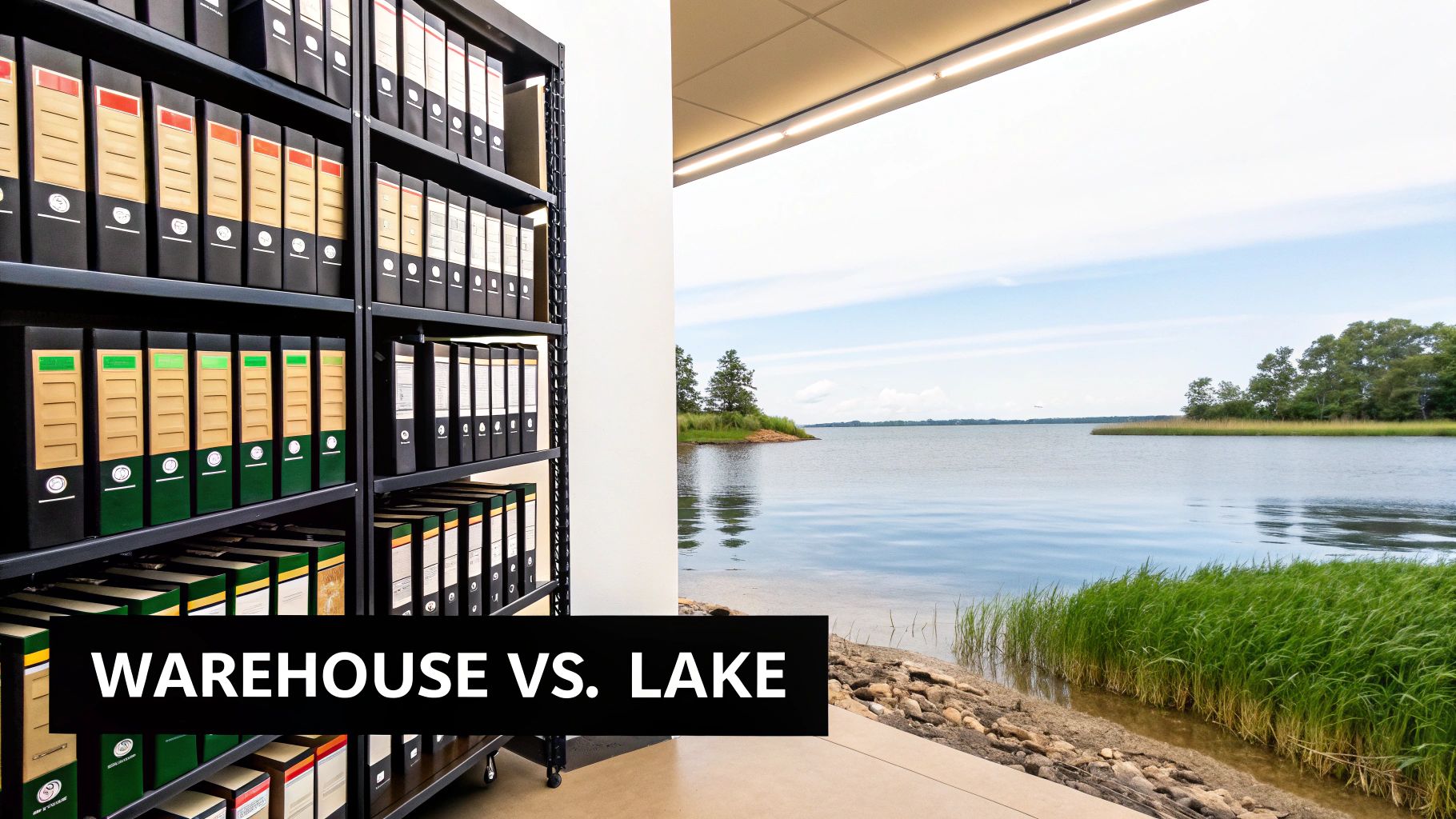
Think of a data warehouse as a meticulously organized library. Every piece of data is cataloged, processed, and placed in a specific section for easy retrieval. The outcome is a highly structured environment perfect for business analysts who need fast, reliable answers to known questions, like, "What were our quarterly sales in the Northeast region?"
A data lake is more like a massive reservoir, collecting data from countless streams in its pure, unfiltered state. It holds everything: structured sales figures, unstructured social media comments, and semi-structured IoT sensor logs. The outcome is raw flexibility, which is invaluable for data scientists who want to discover new patterns or train complex machine learning models.
The market for these structured solutions is booming. The data warehousing market is estimated at $33.76 billion in 2024 and is projected to nearly double by 2029. A huge part of this growth comes from the cloud, with 47% of IT managers reporting their data warehouses are now fully cloud-based to get the scalability they need. You can find more detail on these trends and their business impact over at 99firms.com.
Key Differences: Data Lake vs. Data Warehouse
To quickly see which approach fits your needs, this side-by-side comparison focuses on the distinctions that matter from a business perspective.
AttributeData WarehouseData LakePrimary Data TypeStructured, processed data (e.g., from ERPs, CRMs)Raw data in any format (structured, unstructured, semi-structured)Data ProcessingSchema-on-write (data is structured before loading)Schema-on-read (data is structured when queried)Typical UsersBusiness analysts, finance teams, operations managersData scientists, data engineers, ML researchersPrimary Use CasesBusiness Intelligence dashboards, financial reporting, performance metricsMachine learning, predictive analytics, real-time data exploration
Ultimately, the choice hinges on who needs the data and what they plan to do with it. Warehouses excel at providing clean, consistent data for reporting, while lakes offer the raw, untamed potential needed for advanced analytics and discovery.
Comparing Core Data Architectures
To understand what makes a data lake and a data warehouse different, you have to look at their core architectures. These designs are the foundation for everything—how data is stored, who uses it, and what they can accomplish. The real split comes down to when and how structure, or schema, gets applied.
An easy way to think about it is to picture a data warehouse as a perfectly organized library. Before any book hits a shelf, it’s cataloged, labeled, and put in a specific spot. The outcome is an incredibly fast way for anyone to walk in and find exactly what they’re looking for.
A data lake is like a massive, natural reservoir. It collects water from every source imaginable—rain, rivers, mountain streams—without filtering it first. This raw water can be used for any purpose, from analyzing microscopic organisms to measuring mineral content, giving specialized explorers huge flexibility.
The Warehouse Model: Schema-on-Write
Data warehouses are built on a schema-on-write model. This means data is cleaned, transformed, and forced into a strict structure before it’s loaded. This work, handled by an Extract, Transform, Load (ETL) pipeline, guarantees data is consistent and high-quality from the start.
- Process: Structure is applied to data before it’s written to the warehouse.
- Outcome: Consistent, high-quality data that’s ready for immediate analysis, leading to faster and more reliable business decisions.
- Use Case: A finance team needs to generate a monthly P&L statement. The schema-on-write model ensures revenue and expense data from different systems are standardized. This prevents errors and makes the report accurate and quick to produce.
This highly structured approach is perfect for predictable, operational reporting where the business questions are already known.
The fundamental trade-off of a data warehouse is sacrificing flexibility for performance and reliability. By enforcing structure upfront, it delivers trusted, high-speed analytics for known business questions.
The Lake Model: Schema-on-Read
Data lakes flip the script with a schema-on-read model. Here, data from all sources—structured transactions, unstructured social media text, semi-structured logs—is stored in its original, raw format. No structure is forced on it until it's read for an analysis.
This design delivers maximum flexibility. Data scientists and ML engineers can dive into the raw data, mix and match different datasets, and define structures on the fly to fit their analysis. This flexibility is fueling massive growth; the global data lake market was valued at USD 13.62 billion in 2023 and is expected to hit USD 59.89 billion by 2030. Much of that growth comes from the explosion of unstructured data needed for AI. You can see more on these market projections from Grand View Research.
- Process: Data is stored raw, and a schema is applied only when it’s queried.
- Outcome: Unmatched flexibility for exploratory analysis, enabling the discovery of new insights and the ability to train powerful machine learning models.
- Use Case: A retail company wants to analyze customer sentiment. They combine in-store purchase history (structured) with online product reviews and social media comments (unstructured). A data scientist can load it all into the lake to find correlations that a rigid warehouse could never accommodate.
The architectural difference—schema-on-write vs. schema-on-read—directly shapes what each platform is built to do. The warehouse delivers structured reporting, while the lake enables unstructured discovery.
Analyzing Performance and Cost Implications
When weighing a data lake against a data warehouse, performance and cost aren't just technical specs—they are business drivers that dictate your ROI. The right choice depends on the outcome you need, whether it's powering split-second business reports or fueling massive, exploratory data science projects.
A data warehouse is built for one thing: blazing-fast query performance on structured data. It achieves this with a schema-on-write architecture, where data is cleaned and optimized before it lands in the warehouse. The payoff comes when an analyst pulls a report and gets an answer almost instantly.
A data lake trades that immediate query speed for immense flexibility. Its performance shines when processing massive volumes of raw, multi-format data. For a data science team training a machine learning model, a lake’s capacity to process petabytes of unstructured information is far more critical than sub-second dashboard response times.
Warehouse Performance for BI and Reporting
The structure of a data warehouse is its biggest performance advantage. By organizing data into optimized tables ahead of time, it massively cuts down the work the query engine has to do.
- Use Case Outcome: A finance team runs daily revenue reports. Because the warehouse has pre-linked all sales and customer data, it delivers the consistently fast queries business leaders depend on for making decisions in the moment.
- Best For: Executive dashboards, financial reporting, and operational analytics where speed and consistency are everything.
- Trade-off: Performance drops dramatically with unstructured or semi-structured data; the warehouse simply isn't designed for it.
Lake Performance for Big Data and ML
Querying a data lake is entirely different. Since it stores data in its raw format, the structure is applied on-the-fly (schema-on-read). Performance here isn’t about interactive speed but throughput for huge data processing jobs.
- Use Case Outcome: An e-commerce company analyzes terabytes of customer clickstream data to build a personalization engine. A data lake, combined with a compute engine like Apache Spark, efficiently handles this large-scale job, leading to better product recommendations and increased sales. A simple BI query might be slower, but the power to process enormous, diverse datasets is unmatched.
The performance conversation shifts from "how fast is the query?" to "how effectively can we process massive, varied datasets?" A data lake excels at the latter, making it the foundation for modern AI and machine learning workloads.
Comparing Cost Models
The financial models for each architecture are just as different. On-premise data warehouses once demanded staggering upfront investments. Cloud platforms have changed the game, but the models still differ.
Cloud data warehouses often involve paying for both compute and managed storage. Because that storage is highly optimized, it’s usually more expensive per gigabyte.
Data lakes built on cloud object storage like Amazon S3 or Google Cloud Storage offer an incredibly cheap way to store data. You can store petabytes for a fraction of a warehouse's cost. Costs then shift to the compute side. This pay-as-you-go model is perfect for workloads that aren't running 24/7.
Here’s a practical look at the cost trade-offs:
Cost FactorData Warehouse (Cloud)Data Lake (Cloud)Storage CostHigher, due to optimized and managed storage.Extremely low, based on cheap object storage.Compute CostOften bundled or priced per unit of processing time. Can get expensive for continuous operation.Variable and on-demand. You pay only for the compute you use.Upfront InvestmentLow for cloud models, but costs can scale up quickly.Minimal. Primarily pay-per-use for storage and compute.Ideal ScenarioPredictable, constant BI workloads where performance justifies the steady cost.Unpredictable, large-scale analytics where compute costs are tied directly to usage spikes.
Choosing between a data lake and a data warehouse is a balancing act. You have to weigh the need for interactive query speed against the flexibility to process vast, raw datasets in a way that makes financial sense for your business.
Navigating Data Governance and Security
Data governance and security are where data lakes and data warehouses truly diverge. How you manage, protect, and grant access to your data directly impacts its business value and your organization's risk exposure.
Data warehouses are, by nature, highly governed environments. Their schema-on-write model forces you to cleanse and structure data before analysts can touch it. This built-in structure makes governance far more straightforward.
In stark contrast, a data lake's "store everything" philosophy introduces governance complexity. Without a proactive plan, the sheer volume of raw data can quickly turn your asset into a "data swamp"—a repository so messy that finding trustworthy information becomes impossible, eroding user confidence and wasting budget.

Warehouse Governance: Built for Compliance
For companies under strict regulations like GDPR, HIPAA, or CCPA, the rigid structure of a data warehouse is a massive plus. Because data is processed and categorized on entry, managing access controls, tracking lineage, and enforcing security policies is much simpler.
- Access Control Outcome: You can lock down permissions at the table, row, or column level. A sales analyst might see aggregated revenue but be blocked from viewing personally identifiable information, ensuring both utility and privacy.
- Data Quality Outcome: The ETL process acts as a quality gatekeeper, ensuring the warehouse remains a single source of truth for business intelligence.
- Auditability Outcome: Every record has a clear, traceable history, making it simple to run audits and prove compliance.
This tightly controlled environment establishes the data warehouse as a trusted foundation for mission-critical business reporting.
Taming the Lake: Governance and Accessibility
Securing a data lake demands a different mindset. Governance is layered on top of raw storage using tools and defined processes. The risk of a data swamp is real, but entirely avoidable with the right approach.
A data lake without strong governance isn't a flexible asset; it's a liability. Effective management hinges on making data discoverable, understandable, and secure without sacrificing the agility that makes a lake valuable in the first place.
Successful data lake projects rely on a few key strategies to prevent chaos:
- Data Catalogs: These tools inventory the lake, documenting what data you have, where it came from, and who owns it.
- Metadata Management: Actively managing metadata turns raw files into understandable assets.
- Access Policies: Role-based access control (RBAC) ensures data scientists can explore raw data while business users are guided toward curated zones.
The User Accessibility Divide
Governance directly impacts who can get value from the data. A data warehouse is built for broad accessibility. Business analysts can easily connect BI tools and use standard SQL to build dashboards. It's a true self-service analytics platform.
A data lake usually requires a more specialized skillset. While SQL interfaces are available, unlocking the potential of raw, unstructured data often requires proficiency in languages like Python or frameworks like Apache Spark. This can create a skills gap where data scientists and engineers become gatekeepers, limiting direct access for less technical users.
Matching Your Use Case to the Right Solution
The theoretical lines between a data lake and a data warehouse become clear when tied to real-world business goals. The right choice hinges on the outcome you need, who needs the data, and how fast they need a reliable answer.
Picking the wrong tool for the job leads to frustration. A finance team running month-end reports on a raw data lake will fight with inconsistent data. A data science team stuck with a rigid warehouse won't have the raw material for deep discovery.
When to Choose a Data Warehouse
A data warehouse is your best bet when the priorities are consistency, speed, and reliability for structured data analytics. It’s built to power the routine, operational reporting that keeps a business humming.
Here are scenarios where a data warehouse is the logical choice:
- Executive Dashboards: Your C-suite needs a single source of truth for KPIs like revenue and profit margins. A warehouse delivers the clean, aggregated data needed for fast, accurate dashboards that leadership can trust.
- Financial Reporting: For generating quarterly earnings reports or daily sales reconciliation, data integrity is a requirement. Warehouses enforce the strict structure needed to meet financial compliance and auditing standards.
- Sales Performance Tracking: A sales manager needs to see how their team is tracking against quotas using CRM data. The warehouse structures this data for immediate analysis, letting them get quick answers.
In these cases, the questions are known ahead of time. The warehouse is optimized to answer them with maximum speed and accuracy.
The core benefit of a data warehouse is trust. It provides a highly-governed, high-performance environment where business users can confidently make decisions without needing a data engineer to hold their hand.
When a Data Lake Is the Right Fit
A data lake is the go-to when your goal shifts from reporting on what happened to discovering what could happen. Its power is in handling massive volumes of diverse, raw data for exploratory analysis and machine learning.
This is the platform that fuels innovation. It provides the raw data needed to train predictive models and find patterns a structured system would miss. Consider these use cases:
- Predictive Maintenance in Manufacturing: A factory wants to predict equipment failure by analyzing real-time sensor data. A data lake can ingest and store petabytes of this semi-structured data, which data scientists can then use to train ML models and prevent costly downtime. You can see a real-world example of managing time-series data with Snowflake.
- Customer Sentiment Analysis: A retail brand needs to understand how people feel about a new product. This requires analyzing unstructured data from social media and product reviews. A data lake stores all this raw text, video, and image data in one place for natural language processing (NLP).
- Fraud Detection in Finance: To spot fraudulent transactions, a bank must analyze millions of events in real-time. A data lake is built to handle this massive influx of streaming data, letting algorithms identify anomalies as they happen.
These scenarios demand flexibility above all else. A data lake offers the adaptable, low-cost storage you need to experiment and explore without being locked into a predefined schema.
Use Case Decision Matrix: Lake vs. Warehouse
This matrix maps common business objectives to the best-fit data architecture, helping you align your technical strategy with a business outcome.
Business OutcomePrimary Data TypeRecommended SolutionWhy It FitsOperational BI & ReportingStructured (ERP, CRM)Data WarehouseDelivers speed, reliability, and governance for known questions.Advanced Analytics & MLUnstructured, Semi-StructuredData LakeProvides flexibility and scale for exploratory analysis and model training.Regulatory & Financial ReportingHighly Structured, AuditableData WarehouseEnsures data integrity and meets strict compliance requirements.Real-Time Anomaly DetectionStreaming, Logs, IoTData LakeIngests and processes high-velocity data streams for immediate analysis.Customer 360 AnalyticsMixed (Structured, Unstructured)Hybrid (Lakehouse)Combines raw data exploration with structured customer profiles.Historical Data ArchivingAll Types (Raw)Data LakeOffers low-cost, scalable storage for long-term data retention.
The goal isn't just to pick a platform, but to enable a specific business capability. The right architecture is the one that removes friction and accelerates results.
The Rise of the Data Lakehouse
As the data lake vs. data warehouse debate evolved, a powerful hybrid model emerged: the data lakehouse. This architecture aims to deliver the best of both worlds, combining the low-cost, flexible storage of a data lake with the high-performance queries and governance of a data warehouse, all in a single platform.
Instead of wrestling with two separate systems—one for BI and another for ML—the lakehouse establishes a single source of truth. This move drastically simplifies the data stack, reduces costly data duplication, and eliminates complex ETL pipelines.

Core Technologies Enabling the Lakehouse
The modern data lakehouse is possible because of open-source table formats that bring warehouse-like features directly to data in a lake. These technologies act as a transactional metadata layer on top of standard object storage.
The key players are:
- Delta Lake: An open-source storage layer that brings ACID transactions, scalable metadata, and data versioning to data lakes.
- Apache Iceberg: A high-performance format for huge analytic tables, designed to solve consistency problems and provide reliable transactions.
- Apache Hudi: A framework for managing incremental data processing, making stream processing directly on the lake a reality.
These formats are a huge deal, solving the reliability and performance issues that historically made data lakes a poor fit for direct BI queries.
A Strategic Choice for a Unified Data Strategy
Adopting a lakehouse isn't just a technical upgrade; it's a strategic shift. By supporting both traditional BI dashboards and advanced AI workloads from the same repository, it breaks down walls between data teams. Business analysts and data scientists can now work from the same consistent, up-to-date data.
This unified approach is catching on fast. The global data lakehouse market is projected to skyrocket from USD 14.0 billion in 2025 to USD 112.6 billion by 2035, a clear signal of strong demand for platforms that simplify enterprise data architecture. You can dig into the details of these data lakehouse market projections and their drivers.
Adopting a lakehouse architecture is a forward-looking decision. It positions your organization to handle future data demands by creating a scalable, cost-effective, and governed environment that serves every analytics need, from historical reporting to predictive modeling.
While implementing a lakehouse can seem complex, the long-term rewards of a simpler, more powerful data platform are substantial. For companies looking to build out their capabilities, collaborating with a Snowflake Partner like Faberwork can be a critical first step to design and execute a data strategy effectively.
Common Questions We Hear
When choosing between a data lake and a data warehouse, a few questions always come up. Let's tackle them to clear up any confusion.
What's the Real Difference, in Simple Terms?
Think of a data warehouse as a curated library. Every book (your data) has been vetted, categorized, and shelved so business users can find what they need, fast.
A data lake, on the other hand, is like a massive reservoir. It collects water (data) in its raw, unfiltered state from every source. This is perfect for data scientists who need to study the data in its original form to make new discoveries.
Can We Just Use Both?
Absolutely. Many companies use both in a highly effective pattern. The typical setup involves using the data lake to ingest and store all raw data. From that central pool, specific, cleaned-up datasets are loaded into a data warehouse to power BI dashboards and reports. This hybrid model gives you a space for deep exploration and a polished source for business analytics.
We're seeing a big shift toward the data lakehouse. This newer architecture brings the cheap, flexible storage of a data lake together with the speed and governance of a data warehouse on one platform, getting the benefits of both without managing two systems.
Which One Is Better for Machine Learning?
For machine learning, a data lake is almost always the right choice. ML models thrive on massive amounts of raw, diverse data for training—images, text, or sensor logs. The lake’s "schema-on-read" approach is key, as it lets data scientists experiment with unstructured data in its native format to build and train accurate models.
How Do the Costs Stack Up?
In most cases, a data lake has a lower storage cost because it’s built on inexpensive object storage. The main cost driver becomes compute—you pay only when actively running a query or job.
A data warehouse generally costs more for storage because the data is in a highly optimized format. But that optimization delivers the blazing-fast query speeds business users expect. Your final bill will depend on your unique mix of storage versus computation needs.


