In a data-driven enterprise, connecting disparate systems is a strategic imperative, not just a technical task. The right data integration techniques are foundational to unlocking real-time insights, streamlining logistics, and creating a unified, actionable view of business operations. With a growing array of methods, from traditional ETL to modern event streaming, choosing the correct approach is critical to avoiding performance bottlenecks and missed opportunities.
This guide provides a practical blueprint for modern data architecture. We will demystify the 10 most effective data integration techniques, focusing on the business outcomes each method delivers. You will learn how to:
- Achieve a 360-degree customer view with Master Data Management (MDM).
- Enable real-time fraud detection with event streaming.
- Optimize analytics workloads in Snowflake using ELT patterns.
- Synchronize critical operational systems with Change Data Capture (CDC).
We provide concise insights and real-world use cases to help technology leaders select and implement the perfect technique for their unique business goals. By matching the right integration pattern to the right problem, you can ensure your data architecture is a powerful engine for operational efficiency and intelligent automation.
1. Extract, Transform, Load (ETL)
Extract, Transform, Load (ETL) is a traditional data integration technique that prepares raw data for analysis. The outcome is a highly structured, reliable dataset loaded into a data warehouse for business intelligence. It involves extracting data from sources, cleansing and restructuring it in a staging area, and then loading the finished product into the target system. This pre-processing ensures data quality and consistency before it reaches analysts.
This batch-oriented process is ideal for creating a single source of truth for historical reporting. ETL shines when dealing with legacy systems or when complex business rules and data quality checks must be applied before data enters the analytical environment. By pre-processing the data, ETL offloads computational work from the target data warehouse, which can improve performance for on-premises systems.
Use Cases for ETL
ETL is the preferred method for integrating structured data into a highly governed, centralized repository for historical analysis.
- Enterprise Data Warehousing: Consolidate data from CRM, ERP, and operational databases to create a single source of truth for business reporting.
- Regulatory Compliance: Enforce strict data quality and privacy rules (e.g., GDPR, HIPAA) before data is made available for analysis.
- Complex Financial Reporting: Perform computationally intensive aggregations on large data volumes before loading, ensuring performance for standardized financial reports.
Implementation Best Practices
To maximize the effectiveness of this established data integration technique, enterprise teams should focus on several key areas:
- Modular Transformation Logic: Design transformations as reusable components to accelerate development and ensure consistency.
- Comprehensive Error Handling: Implement robust logging and alerting to capture, report, and manage errors at each stage.
- Performance Monitoring: Regularly monitor job execution times and resource utilization to identify and optimize bottlenecks.
2. Extract, Load, Transform (ELT)
Extract, Load, Transform (ELT) is a modern data integration technique that flips the traditional sequence to accelerate data availability. The outcome is rapid data ingestion into a cloud data warehouse, with transformations happening on-demand. Raw data is extracted from sources and loaded directly into a target like Snowflake. All cleansing, standardization, and enrichment occur after loading, leveraging the warehouse's powerful processing capabilities.
This method empowers data analysts and scientists with immediate access to raw data, enabling more flexible and exploratory analytics. ELT is the cornerstone of modern data architecture, designed for the scale, speed, and elasticity of the cloud. The separation of storage and compute in platforms like Snowflake makes this approach both powerful and cost-effective.
Use Cases for ELT
ELT is the go-to strategy for modern cloud analytics, especially when dealing with large volumes of semi-structured data.
- Cloud Data Warehousing: Use the scalable compute of platforms like Snowflake or BigQuery to handle complex transformations in-database. Collaborating with a Snowflake partner can optimize this architecture.
- Data Lake Architectures: Load raw data into a data lake to allow for schema-on-read flexibility, defining data structures during analysis rather than before loading.
- Big Data Analytics: Quickly ingest high-velocity data streams like IoT sensor data or clickstream logs, enabling immediate access for analysis without transformation delays.
Implementation Best Practices
To successfully implement this powerful data integration technique, enterprise teams should adopt a disciplined approach:
- Govern the Raw Layer: Establish strong governance and access controls on the raw data layer to ensure data integrity before transformations begin.
- Leverage In-database Compute: Write transformations using SQL to push down processing to the data warehouse engine, maximizing parallelization.
- Document Data Lineage: Meticulously track data lineage to visualize how raw data is transformed into curated, analytics-ready datasets.
3. Change Data Capture (CDC)
Change Data Capture (CDC) is an efficient data integration technique that delivers near real-time data synchronization. The outcome is a continuously updated target system that mirrors changes from a source database. Instead of full data loads, CDC identifies and moves only the data that has changed (inserts, updates, deletes). This incremental approach dramatically reduces data transfer volume and minimizes impact on source systems.
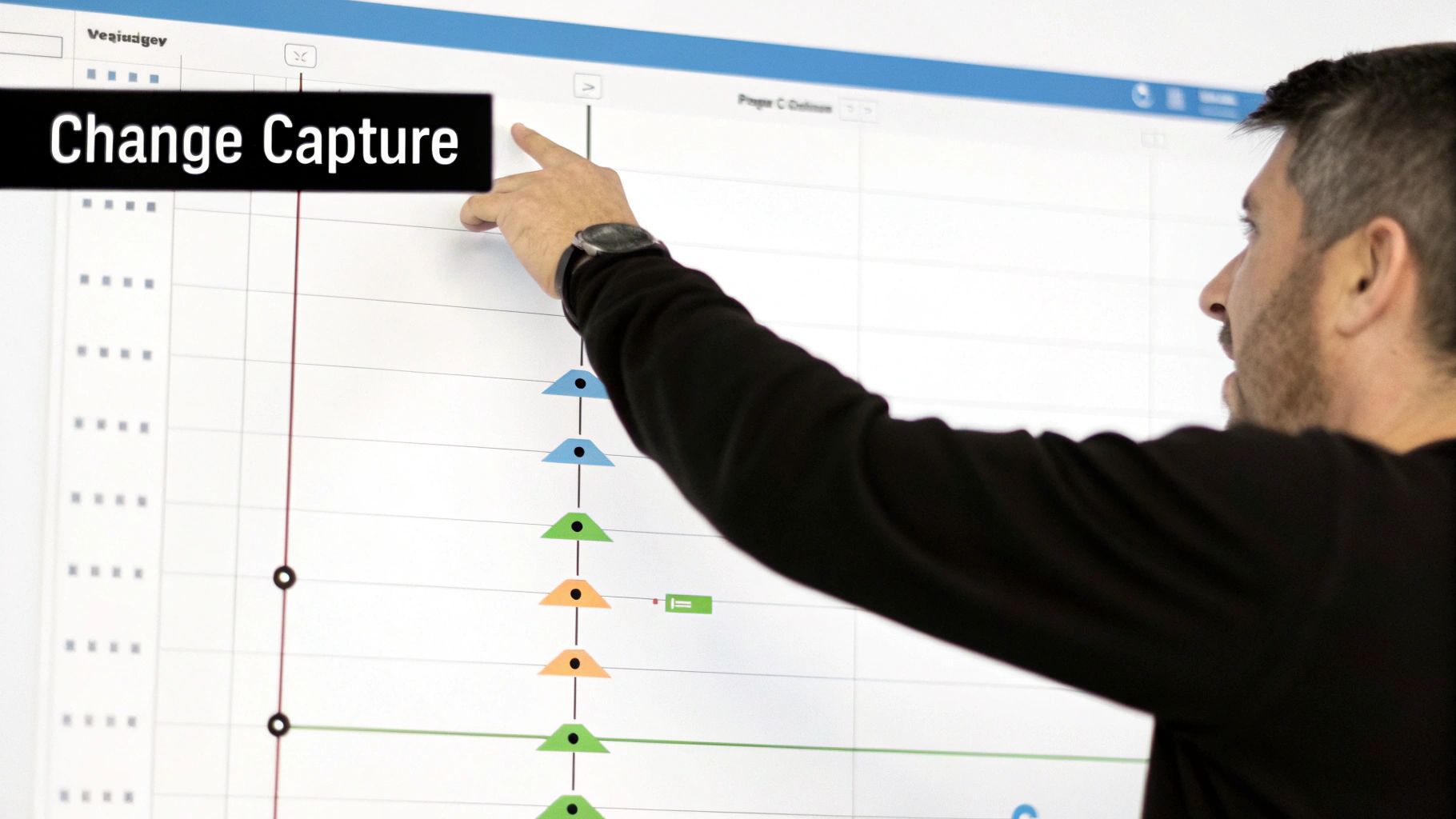
This method is essential for modern architectures that demand fresh, up-to-the-minute data. By capturing changes directly from database transaction logs, CDC pipelines can stream modifications to target systems like data warehouses or data lakes. This allows businesses to operate on the most current information available from their core transactional systems.
Use Cases for CDC
CDC is the ideal choice for scenarios requiring low-latency data synchronization with minimal impact on source systems.
- Real-Time Analytics: Feed live sales data from a transactional database into an analytical platform like Snowflake to power live inventory dashboards.
- Zero-Downtime Database Migration: Continuously synchronize data between on-premises and cloud databases to ensure a seamless migration with no service disruption.
- Microservices Data Synchronization: Keep data consistent across distributed microservices by streaming changes from one service's database to others.
Implementation Best Practices
To successfully implement a robust CDC pipeline, enterprise teams should adhere to the following practices:
- Select the Right CDC Method: Choose a log-based CDC approach where possible, as it has the lowest performance overhead on the source system.
- Monitor Log Accumulation: In log-based CDC, implement monitoring to manage transaction log retention and prevent disk space issues.
- Establish a Schema Evolution Strategy: Plan for how your pipeline will handle source schema changes (e.g., new columns) to avoid failures.
4. API-Based Integration
API-Based Integration is a data integration technique that connects applications in real time through Application Programming Interfaces (APIs). The outcome is immediate, on-demand data exchange between systems, enabling responsive and automated workflows. Instead of batch processing, this method uses standardized protocols like REST to facilitate direct communication, fostering interoperability in modern application ecosystems.
This approach is crucial for building responsive systems where immediate data access is essential. For example, when a customer places an order on a website, an API call can instantly update inventory in the ERP and trigger a shipping request in the logistics system. This real-time capability eliminates data silos and ensures consistency across the business.
Use Cases for API-Based Integration
API-based integration is the ideal choice for scenarios requiring real-time data exchange and seamless connectivity between modern applications.
- Connecting SaaS Applications: Integrate platforms like Salesforce, Stripe, and Slack to create unified workflows, such as syncing a new sale in a CRM to an accounting platform.
- Powering Mobile and Web Applications: Provide front-end applications with secure, real-time access to backend data for dynamic user experiences.
- Enabling Microservices Architectures: Facilitate communication between independent services, allowing them to share data and trigger actions without tight dependencies.
Implementation Best Practices
To successfully implement this powerful data integration technique, enterprise teams should prioritize governance and performance:
- Utilize an API Gateway: Implement an API gateway to centralize security, rate limiting, and request routing, providing a single, secure entry point.
- Implement Caching Strategies: Cache frequently requested, non-volatile data to improve response times and reduce the load on source applications.
- Establish Robust Monitoring: Continuously monitor API availability, error rates, and response times to enable rapid issue resolution.
5. Data Virtualization
Data virtualization is an agile data integration technique that provides a unified view of data without moving it. The outcome is on-demand access to combined data from multiple sources as if it resided in one place. It creates an abstraction layer that receives a query, intelligently retrieves data from the underlying systems, and aggregates the results on the fly.
This real-time approach offers significant flexibility, allowing enterprises to access data from sources like Oracle databases and Salesforce without the latency and cost of traditional ETL pipelines. It is a powerful technique for scenarios requiring rapid data exploration and integration of frequently changing data.
Use Cases for Data Virtualization
Data virtualization is the ideal method when agility and real-time access are more critical than historical data consolidation.
- Rapid Data Exploration: Enable data scientists to quickly query and combine new data sources without waiting for complex ETL development cycles.
- Logical Data Warehousing: Create a unified analytical view across distributed systems, providing a single point of access without building a monolithic physical warehouse.
- Live Operational Reporting: Deliver up-to-the-minute reports that combine data from multiple live systems, such as pulling customer order details from an ERP and shipping status from a logistics app.
Implementation Best Practices
To successfully deploy this powerful data integration technique, organizations should prioritize performance and governance:
- Optimize Query Pushdown: Ensure the virtualization platform pushes as much processing (e.g., filtering, joining) down to the source systems as possible.
- Implement Intelligent Caching: Use caching at the virtualization layer for frequently accessed data to reduce the load on source systems and improve query response times.
- Enforce Centralized Security: Define and manage security policies, including data masking, within the virtual layer for consistent governance.
6. Message Queue Integration (Event Streaming)
Message Queue Integration, or event streaming, is a data integration technique for processing data in real time as a continuous flow of events. The outcome is a highly scalable and responsive system that can react to new information instantly. Platforms like Apache Kafka act as a central hub where data producers publish events, and multiple consumers can process them independently. This is a core component of a modern event-driven architecture (EDA).

This real-time paradigm excels in scenarios requiring immediate data processing, such as fraud detection or IoT sensor monitoring. By treating data as an endless stream, organizations can build systems that react to business events as they happen, providing a significant competitive advantage. The decoupled nature of the architecture also enhances system resilience.
Use Cases for Message Queue Integration
This technique is the go-to choice for building real-time applications that must handle high-throughput, low-latency data streams.
- Real-Time Fraud Detection: Analyze streams of financial transactions as they occur to identify and block fraudulent activity instantly.
- IoT and Time-Series Data: Ingest and process high-volume data from sensors and telematics systems for immediate analysis, such as in fleet management. You can discover more about handling time-series data at scale.
- Live Customer Experience: Track user clicks and behavior on a website in real time to provide personalized recommendations or immediate support.
Implementation Best Practices
To successfully implement this dynamic data integration technique, enterprise teams should adopt several key practices:
- Define Clear Event Schemas: Use a schema registry to enforce a consistent data structure, ensuring downstream consumers can reliably interpret events.
- Implement Idempotent Consumers: Design consumer applications to handle duplicate messages without causing errors or data corruption.
- Monitor Consumer Lag: Actively track the delay between message production and consumption to identify processing bottlenecks.
7. Master Data Management (MDM)
Master Data Management (MDM) is a strategic data integration technique focused on creating a single, authoritative source of truth for critical business data. The outcome is a "golden record" for core entities like customers and products, ensuring every system in the enterprise references the same consistent and accurate information. It involves consolidating, cleansing, and governing master data from across disparate applications.
Unlike transactional data, master data is high-value, relatively static, and widely shared. For example, a retailer uses MDM to maintain a unified product catalog across its e-commerce site, in-store POS, and inventory systems. This technique provides a reliable foundation for all business processes and decision-making.
Use Cases for MDM
MDM is critical when data consistency for core business entities is paramount to operational efficiency and strategic goals.
- Creating a 360-Degree Customer View: Consolidate customer information from sales, marketing, and service systems to enable personalized marketing and improve customer service.
- Streamlining Supply Chains: Ensure consistent product and supplier data across e-commerce, ERP, and logistics applications to prevent order errors and stockouts.
- Regulatory Compliance: Establish clear data ownership and quality for critical data elements required for regulations like GDPR.
Implementation Best Practices
A successful MDM initiative requires a combination of technology, governance, and organizational alignment.
- Establish Strong Data Governance: Define clear ownership, policies, and quality rules for each master data domain.
- Start Small and Deliver Value: Begin with one high-impact domain, such as "Customer," to demonstrate value quickly before expanding the program.
- Leverage Fuzzy Matching: Implement intelligent matching algorithms to identify and consolidate duplicate records where data may vary slightly.
- Plan for Ongoing Stewardship: Treat MDM as an ongoing program with processes for continuous data monitoring and quality improvement.
8. Synchronous Direct Database Integration
Synchronous Direct Database Integration is a point-to-point technique that establishes a live connection between databases for immediate consistency. The outcome is real-time data replication with minimal latency. It uses native database features like replication or database links to propagate changes as they happen, making it essential for applications requiring up-to-the-second accuracy.
This approach is highly effective for scenarios where two systems must remain perfectly in sync, such as a high-availability disaster recovery setup. By directly coupling the databases, this technique minimizes latency and provides strong transactional consistency, though it creates a tighter dependency between the systems.
Use Cases for Synchronous Direct Database Integration
This technique is the go-to choice when real-time data availability and consistency are non-negotiable.
- High-Availability and Disaster Recovery: Create real-time standby replicas of production databases to ensure business continuity during an outage.
- Operational Reporting: Offload read-heavy analytical queries from a primary transactional database to a read replica to maintain production performance.
- Tightly Coupled Systems: Integrate systems where one application must immediately see data committed by another, such as an e-commerce platform and its inventory management system.
Implementation Best Practices
To successfully implement this powerful data integration technique, enterprise teams should prioritize resilience and performance:
- Utilize Connection Pooling: Manage database connections efficiently to reduce the overhead of establishing new connections for every request.
- Implement Robust Failover Plans: Design and regularly test automated failover and recovery procedures to minimize downtime.
- Monitor Network Performance: Closely monitor network latency between the connected databases, as it can become a significant bottleneck.
9. Middleware Integration Platforms (iPaaS)
Middleware Integration Platforms, delivered as an Integration Platform as a Service (iPaaS), provide a centralized, cloud-native way to connect disparate applications. The outcome is accelerated integration development and automated workflows. These platforms offer pre-built connectors and low-code interfaces to build, deploy, and manage integration flows between cloud services and on-premises systems.
iPaaS platforms excel at application-to-application integration, abstracting away the complexity of protocols and data formats. They handle API management, data mapping, and error handling, allowing businesses to create a seamless, interconnected digital ecosystem. This approach significantly reduces development time and empowers more users to build integrations.
Use Cases for iPaaS
iPaaS is ideal for creating an agile, interconnected application network and automating business processes.
- SaaS Application Integration: Synchronize customer data between Salesforce (CRM) and NetSuite (ERP) or connect Workday (HR) to an internal payroll system.
- API-Led Connectivity: Build a governed network of reusable APIs that securely expose data from legacy systems for modern applications.
- Accelerating Digital Automation: Automate workflows between multiple services, such as creating a new project in Asana whenever a deal is closed in HubSpot.
Implementation Best Practices
To successfully leverage an iPaaS as a core data integration technique, enterprise teams should focus on governance and reusability:
- Evaluate the Connector Ecosystem: Prioritize platforms with a rich library of pre-built connectors for your critical business applications.
- Build Reusable Integration Assets: Design reusable APIs and integration templates to prevent point-to-point complexity and promote scalability.
- Govern and Monitor API Usage: Utilize built-in API management features to enforce security, manage access, and monitor usage to control costs.
10. Data Federation with Distributed Queries
Data federation is a data integration technique that provides a unified view of data without moving it. The outcome is the ability to run a single query across multiple, physically separate data sources and receive one consolidated result. A virtual database layer translates the query for the underlying systems, aggregates the results on-the-fly, and returns them to the user.
This "query-in-place" approach provides real-time access to data without the latency and storage costs of ETL. Tools like Trino or Dremio allow analysts to join a table in an on-premises Oracle database with data in a cloud object store like Amazon S3. This technique is ideal for scenarios requiring immediate access to distributed data.
Use Cases for Data Federation
Data federation is best suited for real-time, ad-hoc querying across diverse systems where moving data is impractical.
- Exploratory Data Analysis: Allow data scientists to quickly query and join datasets across different databases (SQL, NoSQL, Hadoop) without waiting for an ETL pipeline.
- Cross-System Operational Reporting: Generate reports requiring live data from multiple systems, such as combining customer data from a CRM with order information from an ERP.
- Logical Data Warehousing: Create a virtual data warehouse layer over existing data marts, avoiding the need for a massive, single physical warehouse.
Implementation Best Practices
To successfully implement this data integration technique, enterprise teams should follow key best practices for performance:
- Push Down Processing: Configure the federation engine to push as much processing (especially filtering) down to the source systems as possible.
- Implement Caching Strategies: Use query result caching to store the results of frequently executed queries, reducing latency and source system load.
- Monitor Source System Performance: Continuously monitor query response times and the performance impact on each data source to identify and resolve bottlenecks.
Data Integration Techniques — 10-Point Comparison
Integration TechniqueImplementation complexity 🔄Resource requirements ⚡Expected outcomes ⭐📊Ideal use cases 💡Key advantagesExtract, Transform, Load (ETL)🔄 High — batch pipelines and complex transforms⚡ Moderate–High — compute for transforms, staging storage⭐📊 High-quality, curated historical datasets with strong lineage💡 Data warehousing, historical analytics, large batch jobsMature tooling; robust data quality, audit trailsExtract, Load, Transform (ELT)🔄 Medium — relies on in-warehouse SQL and orchestration⚡ High — heavy target compute and storage usage⭐📊 Fast data availability; flexible iterative transforms💡 Cloud analytics, big data processing, near real-time ingestionLeverages warehouse compute; reduced data movementChange Data Capture (CDC)🔄 Medium–High — DB config, log-based or trigger setups⚡ Low–Medium — efficient incremental transfer resources⭐📊 Near real-time synchronization; minimal data transfer💡 Real-time replication, operational intelligence, audit trailsIncremental updates; low source impact; efficient syncAPI-Based Integration🔄 Low–Medium — depends on API maturity and versioning⚡ Medium — network, auth, and possible rate limits⭐📊 Real-time/near real-time exchange; flexible consumption💡 SaaS integrations, microservices, real-time data exchangeLoose coupling; platform-agnostic; easy to updateData Virtualization🔄 High — mapping, federation, and caching complexity⚡ Low–Medium — less storage but runtime query cost⭐📊 Unified logical view; on-demand real-time access💡 Ad-hoc analytics, data discovery, heterogeneous sourcesNo replication; centralized access and governanceMessage Queue / Event Streaming🔄 Medium–High — stream infra and consumer design⚡ High — broker throughput and persistence costs⭐📊 High-throughput, low-latency streams with replayability💡 Real-time analytics, event-driven architectures, IoTScalable, decoupled, fault-tolerant; supports replayMaster Data Management (MDM)🔄 Very High — governance, matching, and workflows⚡ High — persistent master store and governance overhead⭐📊 Single source of truth; consistent master records💡 Customer 360, regulatory compliance, enterprise governanceGolden records; improved consistency and trusted dataSynchronous Direct Database Integration🔄 Medium — straightforward but tightly coupled⚡ High — network and DB load for real-time links⭐📊 Immediate consistency and minimal latency💡 High-frequency transactional sync, DR, point-to-pointStrong consistency; minimal end-to-end latencyMiddleware Integration Platforms (iPaaS)🔄 Low — low-code/no-code visual integrations⚡ Medium — cloud runtime and subscription costs⭐📊 Rapid deployment of integrations with monitoring💡 SaaS-to-SaaS, citizen integrators, fast rolloutsPre-built connectors; reduced development effortData Federation (Distributed Queries)🔄 High — distributed query optimization and mapping⚡ Low–Medium — less storage, higher runtime compute⭐📊 Real-time federated results without replication💡 Cross-system reporting, exploratory analyticsQuery multiple sources transparently; reduced storage needs
Building a Future-Proof Data Integration Strategy
The journey through the diverse landscape of data integration techniques reveals a critical truth: there is no single "best" method. The optimal approach is a dynamic strategy tailored to specific business objectives. From the power of ELT for foundational analytics in Snowflake to the real-time responsiveness of event streaming for IoT telematics, the right technique solves your immediate business problem while providing a runway for future growth.
An effective data architecture weaves multiple data integration techniques into a cohesive framework. A logistics enterprise might use ELT to analyze historical shipping data in Snowflake while employing event streaming to process real-time GPS data from its fleet. In parallel, API-based integrations connect its CRM and ERP, and data virtualization provides an on-demand view for customer service. This multi-pronged approach ensures every data need, from strategic reporting to operational alerting, is met with the most efficient solution.
From Technique to Transformation: Your Strategic Next Steps
Choosing the right combination of techniques requires framing the decision around business outcomes. The goal isn't just to move data; it's to accelerate decision-making and unlock operational efficiencies. To translate these concepts into tangible value, your team should focus on a clear, action-oriented plan.
Actionable Framework for Implementation:
- Audit Your Current Ecosystem: Map existing data sources and integration patterns to identify bottlenecks, silos, and areas where latency hurts business performance.
- Align with Business Outcomes: For each initiative, define the data requirements. Does predictive maintenance require sub-second sensor data? This points directly toward event streaming, not batch processing.
- Create a Decision Matrix: Evaluate techniques against core requirements like data latency, data volume, transformation complexity, development cost, and operational overhead.
- Prioritize and Pilot: Select one or two high-impact use cases for a pilot project. Start by implementing an iPaaS solution to streamline SaaS connectivity before tackling a legacy mainframe integration.
- Establish Governance and Best Practices: A successful strategy depends on strong governance. Define clear standards for data quality, security, and metadata from the outset. For further insights, consider these 10 Data Integration Best Practices for 2025.
The Future is Integrated and Intelligent
Mastering these data integration techniques is a core business competency. In an era of intelligent automation, a well-integrated data foundation is the non-negotiable prerequisite for innovation. The ability to seamlessly access, combine, and analyze data from disparate sources is what separates market leaders from laggards.
By thoughtfully selecting and combining these powerful methods, you can build an architecture that is not only robust and scalable but also agile enough to adapt to the next wave of technological change. Your data integration strategy is the engine that will power your analytics, drive your operations, and ultimately, transform your data from a simple asset into your most potent competitive advantage.


