
The popular advice is to start with a catalog, appoint a committee, and document every field. That approach produces paperwork faster than it produces business value. Data governance solutions should be treated as an operational control plane, one that determines whether people, pipelines, analytics, and AI systems can use data safely and confidently.
The shift is already visible. A 2024–2025 industry survey found that 71% of organizations had a data governance program, up from 60% in 2023 (Precisely reports on governance adoption). Yet adoption doesn't mean maturity. Earlier benchmarking found that only 26% reported a widespread program, while 47% had governance in only one or a few departments and nearly 10% had none. Leaders therefore face two questions, not one: how do we govern data, and how do we prove that governance improves the business?
Redefining Data Governance Solutions for the AI Era
Compliance remains a valid reason to govern data, but it isn't a sufficient business case. A catalog that helps an auditor locate sensitive information has value. A control plane that prevents an unreliable dataset from entering a forecasting model, blocks inappropriate access, and shows which reports depend on a damaged pipeline has much greater operational value.
The history of governance reflects this expansion. Industry histories trace formal data governance to the early 1980s, when organizations began treating data as a managed corporate asset rather than an IT byproduct. Regulatory milestones, including HIPAA in 1996, the Sarbanes-Oxley Act in 2002, and the EU's GDPR in 2018, pushed organizations to formalize privacy, security, accuracy, auditability, and lifecycle controls (Mordor Intelligence outlines the evolution of the data governance market).
Today, AI changes the operating problem. Governance must cover structured tables, documents, images, event streams, training datasets, prompts, embeddings, model outputs, and the permissions used at inference time. A policy that stops at a warehouse table won't answer whether a model trained on an exported document corpus can use that information in a customer-facing response.
Practical rule: If governance only describes data after it has been stored, it isn't governing the full path from creation to consumption.
From documentation to active control
A modern platform should connect metadata to action. That means discovering assets, assigning ownership, classifying sensitivity, scoring quality, tracing lineage, and enforcing policies where data enters a platform, moves between domains, or reaches a user or model. The most useful metadata is bidirectional. Changes in a source system should update governance context, while an approved classification or policy should influence downstream controls.
This is why governance adoption is moving from a niche IT discipline toward an enterprise capability. Distributed cloud estates and AI workloads create too many assets for manual documentation to remain reliable. Teams need a shared operating model that makes trusted data easier to find and unsafe data harder to misuse.
The contrarian conclusion is simple. Governance isn't the brake on AI adoption. Weak governance is the brake. Without clear ownership, usable quality signals, and enforceable access rules, every new AI use case creates another round of manual review and uncertainty.
Core Components of a Modern Governance Architecture
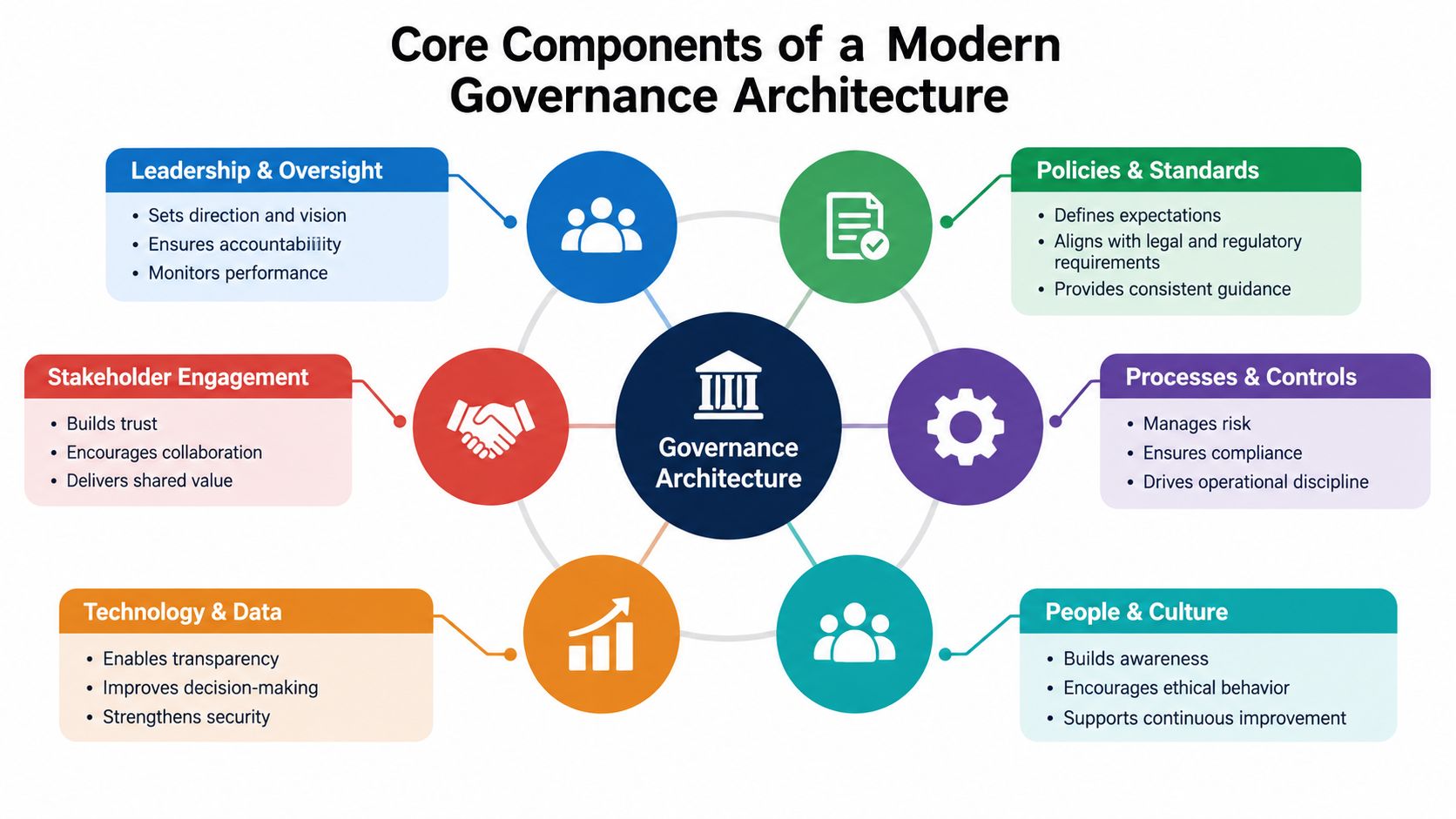
A governance architecture becomes useful when its components work together at the point of decision. A catalog by itself is an inventory. A policy document by itself is an intention. A quality dashboard by itself is a warning. The architecture earns its value when metadata, rules, workflows, and enforcement operate as one system.
The catalog is a metadata operating layer
A data governance catalog combines technical metadata and business metadata. Technical metadata can include the author, creation date, last modified date, source, and size. Business metadata can include classification, taxonomy, and retention period. The AWS enterprise data governance catalog whitepaper explains how this combination supports ownership, discovery, quality, compliance, and broader data use.
The distinction matters because technical context answers “what is this asset?” while business context answers “what does it mean, who is accountable, and what may we do with it?” A customer identifier, for example, needs more than a column name. Users need its definition, sensitivity classification, owner, permitted uses, retention rule, and relationship to related assets.
A practical architecture should connect:
- Ownership: Assign an accountable data owner, operational steward, and technical custodian where those roles differ.
- Classification: Identify personal, confidential, regulated, public, and business-critical data.
- Glossary and taxonomy: Standardize terms so “active customer” has a consistent meaning across departments.
- Lineage: Trace movement and transformation from source to table, report, feature, prompt, or model output.
- Lifecycle: Apply retention, archival, deletion, and exception processes.
Leaders comparing frameworks may also benefit from this practical cloud governance principles guide, particularly when cloud ownership is distributed across teams.
Quality and lineage make trust actionable
Modern catalogs increasingly pair discovery with quality scoring and lineage. Microsoft Purview reports data-quality rules and scores at the asset, data-product, and governance-domain levels, while governance catalogs can present ownership, classifications, lineage, and quality metrics together (Microsoft Purview unified catalog documentation).
That combination changes the user experience. An analyst doesn't merely find a dataset. They can assess whether it meets the intended use, identify the team responsible for a failed rule, and follow the upstream path to a broken pipeline. A data scientist can see whether a training input is complete and approved rather than relying on an informal recommendation from another team.
Policies need enforcement points
Microsoft's Cloud Adoption Framework identifies discovery, profiling, sensitive-data classification, glossary management, policy definition, automated enforcement, and monitoring as core governance processes. It also describes event-driven, on-demand, and batch enforcement across ingestion, access security, privacy, usage, retention, and master or reference data synchronization (Microsoft's governance components guidance).
That is the difference between a documented estate and an orchestrated one. The architecture should answer which control runs when a new asset arrives, when a user requests access, when a classification changes, and when a quality rule fails.
Mapping Governance to Snowflake and AI Workloads
Snowflake-centered architectures make governance easier to centralize, but centralization doesn't remove the need for design. The warehouse, external stages, transformation jobs, BI tools, operational applications, notebooks, feature pipelines, and AI services all create governance boundaries. The solution must connect those boundaries without forcing data teams into manual approval queues.
Start with the data products that drive a business decision. Define the owner, acceptable quality conditions, sensitivity class, retention rule, and approved consumers before expanding coverage across the entire estate. This creates a useful boundary around each product and gives the platform a reason to enforce policy.
Build enforcement into the flow
A practical Snowflake integration follows the lifecycle of data:
- At ingestion, profile incoming data, detect sensitive attributes, attach classifications, and route exceptions to an owner.
- During transformation, preserve lineage across tables, views, streams, tasks, and derived products.
- At access, apply role-based or attribute-aware controls, masking, row filtering, and purpose-based restrictions where required.
- Before consumption, expose quality scores, freshness context, ownership, and permitted use in the catalog.
- After a policy event, trigger an automated response, such as restricting access, opening a stewardship task, or recalculating an approval state.
Use event-driven enforcement for changes that create immediate risk, such as a new sensitive field or a permission change. Use batch controls for broad inventory, periodic profiling, and reconciliation. The combination reduces manual bottlenecks while preserving review for ambiguous cases.
Snowflake's native security capabilities can provide enforcement inside the platform, while a governance layer coordinates definitions, ownership, lineage, and policy intent across the wider estate. The architectural test is whether a policy remains visible and enforceable when data leaves the warehouse for a dashboard, notebook, application, vector store, or model service.
For practical guidance on aligning engineering delivery with Snowflake architecture, teams can review Faberwork's work with Snowflake partnerships. Faberwork LLC offers governance consulting around decision rights, policy design, control points, catalogs, metadata, lineage, BI tools, and cloud platforms.
Extend the boundary to AI
AI introduces assets that traditional governance often overlooks. Define provenance for training inputs, document which datasets are approved for a model, track transformations into features or embeddings, and govern access during inference. Unstructured content needs ownership, classification, retention, and retrieval controls just as structured tables do.
The coverage gap is significant. In a 2025 AI governance survey, only 18% of organizations had clearly defined data governance responsibilities, and just 10% had systematic processes for updating AI models (Atlan's summary of the 2025 governance discussion). These figures point to a design failure, not merely a tooling shortage. Organizations can deploy model monitoring and still lack accountability for the data that shapes model behavior.
Proving ROI and Measuring Business Outcomes
The hardest governance conversation usually happens after implementation begins. Leaders ask what the program changed, while governance teams present catalog coverage, policy counts, and completed stewardship tasks. Those measures describe activity. They don't necessarily demonstrate value.
A stronger business case starts with a trigger that already matters to leadership. Examples include unreliable operational reporting, repeated access reviews, delayed model releases, inconsistent customer definitions, failed audits, or time spent investigating data incidents. Governance becomes measurable when it changes one of those workflows.
Replace activity metrics with outcome chains
Build a simple chain from control to business result:
- Control: Sensitive fields receive classifications and enforceable access policies.
- Operational change: Teams spend less time locating and reviewing permissions manually.
- Business outcome: A reporting or AI initiative reaches production with less friction.
- Executive metric: Track decision latency, deployment throughput, incident exposure, or operating cost.
This approach also handles complex organizational models. A 2025 enterprise governance report found that 39% of data leaders struggle to demonstrate governance impact to leadership, while 54% of modernization efforts focus on embedding governance into workflows and increasing automation (the 2025 State of Enterprise Data Governance report). Centralized, federated, and hybrid structures make attribution difficult, so each domain needs a clear value hypothesis and baseline.
Formal programs are associated with stronger reported outcomes. The following benchmark compares organizations with and without formal governance programs (Precisely's benchmark on governance and AI readiness):
Governance Impact on Enterprise Outcomes
Business MetricWith Formal GovernanceWithout GovernanceHigh trust in data71%50%Operational efficiency19% betterBaseline comparisonRevenue generation16% betterBaseline comparisonModernization15% betterBaseline comparisonRegulatory compliance13% betterBaseline comparison
The table supports an outcome-focused position, but it doesn't prove that governance alone caused every difference. Use it as a benchmark for leadership discussion, then validate value against your own baseline.
AI readiness deserves its own scorecard. In a 2026 survey, 42% of respondents named improved AI readiness as a top governance value, while 39% cited improved quality of AI outcomes (Drexel LeBow and Precisely's AI readiness findings). Track whether approved data products reach models faster, whether quality exceptions are resolved before deployment, and whether teams can explain input provenance during review.
Evaluating Vendors and Building an Implementation Roadmap
Vendor selection fails when buyers compare feature lists without testing operating behavior. Almost every platform can present a catalog, glossary, lineage view, or workflow. The meaningful differences appear when a source changes, a policy conflicts with an existing role, an unstructured repository enters scope, or an AI team needs approved training data quickly.
Evaluate the platform against real scenarios rather than demonstrations. Give vendors a sensitive-data classification task, a broken lineage path, a quality exception, and an access request. Ask who receives the alert, which system enforces the decision, how the metadata updates, and what evidence remains for audit.
Compare capabilities by control depth
Evaluation areaBasic capabilityEnterprise requirementCatalogingAsset inventory and searchTechnical and business metadata with ownership and lifecycle contextQualityRule definitions and dashboardsScores connected to lineage, products, domains, and remediation workflowsPolicyDocumented standardsAutomated enforcement at ingestion, access, usage, retention, and sharing pointsMetadataOne-way harvestingBidirectional orchestration across cloud platforms, BI, pipelines, and AI toolingAI coverageStructured data documentationTraining provenance, unstructured content, inference access, and accountabilityOperating modelCentral administrationCentral standards with federated domain execution and exception authority
A platform that can't connect policy intent to enforcement will leave stewards managing spreadsheets and tickets. A platform that promises agentic AI but can't show approval boundaries, escalation paths, or action logs creates a new control risk.
Roll out in deliberate phases
Phase one should target an expensive problem. Choose a domain with visible executive sponsorship, such as customer data, regulated records, or an AI initiative. Inventory the critical assets, assign owners, classify sensitive data, and establish access controls.
Phase two should connect trust signals. Add profiling, quality rules, lineage, glossary terms, and issue workflows. Make quality visible where analysts and data scientists choose data, not only in an administrator dashboard.
Phase three should automate policy responses. Introduce event-driven controls for new assets and access changes, batch reconciliation for broad estates, and approval workflows for exceptions. Expand into retention, master data, reference data, and unstructured content only after the operating model works in the first domain.
Use the following video as a supplementary visual overview of governance architecture and implementation considerations:
Industry Use Cases and Real-World Applications
Governance earns funding when it improves a decision the business already makes. Each industry applies different controls, but the operating pattern is consistent: identify the data behind an outcome, assign decision rights, and enforce controls where people and systems use that data.

Logistics and fleet operations
A fleet operator may combine vehicle telemetry, driver records, route data, geofencing events, maintenance history, and mobile application activity. The challenge is controlling how those sources support dispatch and safety decisions. Dispatchers need current location data, sensitive driver information must remain restricted, and route definitions must match across operational systems.
A governance solution can classify geofencing data, assign ownership to the operations domain, apply retention rules to historical events, and trace telemetry through a dispatch alert or performance report. Quality rules can flag missing coordinates and implausible timestamps before an optimization model uses the feed.
The outcome is an auditable operating workflow. Dispatch teams locate trusted data faster, developers understand permitted access, and data scientists can separate approved telemetry from incomplete experimental data.
Healthcare and distributed records
Healthcare providers govern records across clinical systems, laboratories, billing platforms, imaging repositories, and analytics environments. The platform must identify protected health information, record permitted uses, assign accountable owners, and preserve lineage when records become reports, features, or model inputs.
Consider a lab result transformed into an analytics feature. The control plane should record which consent basis permitted that use, which transformation produced the feature, and which downstream models consumed it. A privacy reviewer can then reconstruct the path without opening a ticket. A broad “approved” label is insufficient when clinicians, analysts, privacy teams, and auditors need to understand why access was granted and which records were included.
Smart infrastructure and energy
Energy and smart-building programs depend on time-series data from meters, sensors, building management systems, weather feeds, and equipment controllers. Weak controls create conflicting time zones, inconsistent asset identifiers, unclear retention, and models trained on measurements without operating context.
A governed time-series product can define canonical terms for buildings, devices, intervals, and measurements. Lineage connects sensor events to optimization features and operating recommendations. Quality rules identify gaps or anomalous readings before they influence control decisions. The Snowflake time-series data success story provides relevant context for teams designing platforms around high-volume operational data.
Across these scenarios, governance acts as an operational control plane. It makes data usable, explains how it reached a decision, and sets the conditions for safe automation and AI deployment.
Common Pitfalls and the Future of Agentic Enforcement
Most governance programs stall for organizational reasons before they fail technically. Leaders launch a catalog without assigning decision rights, create policies without enforcement points, or ask a central team to understand every domain in detail. The result is a repository that becomes outdated and a stewardship process that users avoid.
What weak implementations get wrong
- They measure completion instead of value. Counting cataloged assets doesn't show whether teams make faster decisions or trust model inputs.
- They treat governance as a project. Ownership, quality, classification, and policy exceptions change continuously.
- They ignore unstructured data. Documents, images, tickets, and messages often reach AI workflows without the same controls applied to tables.
- They centralize every decision. A central council should set standards and resolve exceptions, while domain teams need authority to apply context.
- They automate without escalation. An automated block is useful only when an owner can investigate, approve an exception, and document the decision.
Data collection itself also needs scrutiny. Teams assessing external feeds, automated extraction, or bot-related risks can use resources such as the DataDome scraping benchmark to inform their evaluation of source reliability and collection controls. That assessment belongs inside governance, not in a separate security conversation.
Agentic enforcement needs boundaries
Agentic governance can connect a metadata change to a sequence of actions. An agent might detect a newly sensitive field, propose a classification, identify affected assets through lineage, open a stewardship task, and recommend a masking policy. A human owner can approve or reject the change, while the system records the reasoning and outcome.
That model is promising, but autonomous action should be constrained by policy scope, confidence thresholds, approval rights, and rollback procedures. The agent must know when it can act, when it must ask, and how to prove what it changed.
The future of governance isn't a larger rulebook. It's a smaller number of enforceable rules applied consistently across more data and more decisions.
Start with one business-critical workflow, define its baseline, and connect every governance control to an operational result. If your organization is building a Snowflake platform or preparing AI workloads, engage Faberwork to map ownership, lineage, quality rules, access controls, and automated enforcement into a practical delivery roadmap. Contact Faberwork to turn data governance from an audit exercise into measurable operational infrastructure.


