Building custom software is a journey from a core business idea to a tailored solution that fits your company like a glove. Unlike off-the-shelf products, a custom software development process ensures every feature exists to solve a specific problem, drive efficiency, and give you a powerful competitive edge.
Why a Custom Software Process Matters
Starting a custom software project without a defined process is like building a skyscraper without a blueprint. You might end up with a structure, but it won't be efficient, scalable, or deliver the intended return on investment. A structured process provides the roadmap needed to transform a business need into a high-performing, valuable asset.
This methodical approach isn't a mere checklist; it's a strategic framework that aligns all stakeholders—from executives to end-users—on goals, scope, and what success looks like. For example, a logistics company can use the process to ensure its new driver app directly leads to a 15% reduction in delivery times, a clear, measurable outcome tied to business goals. This initial alignment is crucial for avoiding costly scope creep and ensuring the final product delivers tangible results.
The demand for such tailored solutions is surging. The global custom software development market, valued at USD 43.21 billion, is projected to grow at a compound annual growth rate (CAGR) of 22.71% through 2034. This trend highlights that businesses are moving away from generic tools to gain specific operational advantages. You can explore more data on the custom software development market in recent industry reports.
Understanding the Lifecycle Stages
The custom software development process breaks a complex project into manageable stages, each with a clear objective and specific deliverables. This step-by-step method brings predictability and control to the entire undertaking, ensuring a logical progression from idea to launch and beyond.
For instance, a financial services firm looking to automate its compliance reporting would follow a process that results in:
- Outcome 1 (Discovery): A validated project scope defining how automation will reduce reporting errors by 95%.
- Outcome 2 (Design): An intuitive user interface that cuts down the time analysts spend on reports by 40%.
- Outcome 3 (Development): A scalable and secure platform capable of processing thousands of transactions in real-time.
A well-defined process turns abstract business goals into tangible outcomes. It forces critical questions to be answered early, minimizing risk and maximizing the chances of building a product that truly solves a problem and delivers lasting value.
This guide will walk you through each of these vital stages. We’ll cover the activities and best practices that lead to successful software projects, helping you understand how to build a solution that doesn't just work, but excels.
Overview of the Custom Software Development Lifecycle
StagePrimary OutcomeKey Roles InvolvedDiscovery & StrategyA validated business case and a clear project roadmap with defined ROI.Business Analysts, Project Managers, Product Owners, StakeholdersDesign & PrototypingAn interactive prototype and a technical blueprint for a user-centric solution.UI/UX Designers, Product Managers, Frontend DevelopersDevelopment & CodingA functional, coded application built in iterative, testable increments.Software Developers (Frontend/Backend), DevOps EngineersTesting & QAA stable, secure, and bug-free application ready for real-world use.QA Engineers, Test Automation Specialists, DevelopersDeployment & LaunchThe live software in the hands of users, delivering initial business value.DevOps Engineers, System Administrators, Project ManagersMaintenance & SupportA continuously improving solution that adapts to user feedback and business needs.Support Engineers, Developers, Project Managers
This table maps out the journey. As we dive deeper into each stage, you'll see how this structure brings order to complexity and helps teams deliver exceptional results consistently.
Laying the Groundwork with Discovery and Strategy
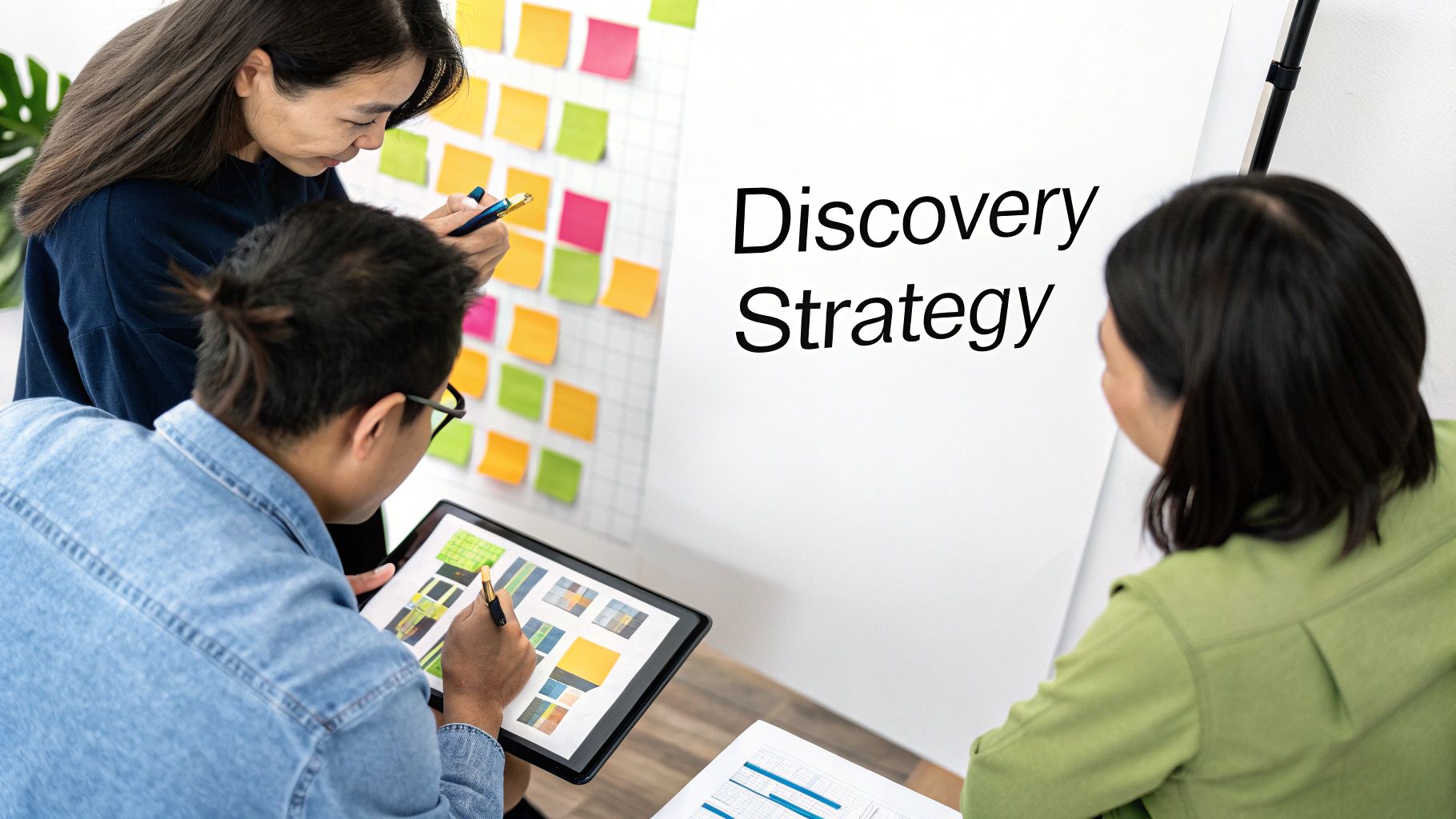
Before writing any code, the most critical part of the custom software development process happens: discovery. This phase isn't just about listing features; it’s a deep dive to validate the business case. The goal is to ensure the final product will solve a real problem and deliver a measurable return.
The entire point is to answer foundational questions: What business challenge are we solving? Who are the users, and what do they need to succeed? How will this software generate revenue or create efficiencies? A healthcare provider, for example, might use this phase to validate that a custom patient portal will reduce administrative overhead by 30% and improve patient satisfaction scores, justifying the investment before it’s made.
Defining the Project's Purpose
This strategic exploration brings together business leaders, technical experts, and future end-users to create a data-backed plan. It’s a collaborative effort to ensure the project is aligned with core business objectives from day one.
Key activities in this phase lead to clear outcomes:
- Stakeholder Interviews: Uncover critical business goals and user pain points, leading to a prioritized list of must-have features.
- Market and Competitor Analysis: Identify market gaps and opportunities, resulting in a unique value proposition for the new software.
- Technical Feasibility Studies: Assess technical requirements and potential roadblocks, producing a high-level technology plan that ensures the project is viable, on time, and within budget.
This methodical investigation ensures the team builds a product that has a genuine market need and is technically achievable.
From Vague Ideas to Actionable Plans
The discovery phase translates broad goals into concrete, actionable documents that guide the entire project. These deliverables act as the project's foundation, ensuring every subsequent decision is strategic and informed.
The most expensive mistake in software development is building the wrong thing. A robust discovery phase is the best insurance against this risk, ensuring every dollar and hour is invested in creating real business value.
The ultimate outcome of this stage is a clear Project Charter or scope document. For the healthcare provider, this document would formalize the project's goals, such as "reduce patient check-in time by 10 minutes" and "achieve a 90% user adoption rate within six months."
Another critical deliverable is a set of initial user stories. These are simple descriptions of a feature from an end-user's perspective, like: "As a patient, I want to book an appointment online so I can avoid calling the clinic." These stories become the building blocks for development, directly linking the code to real-world user needs. This groundwork provides the clarity needed to prevent scope creep and deliver a solution that truly hits the mark.
Blueprint for Success with Design and Prototyping
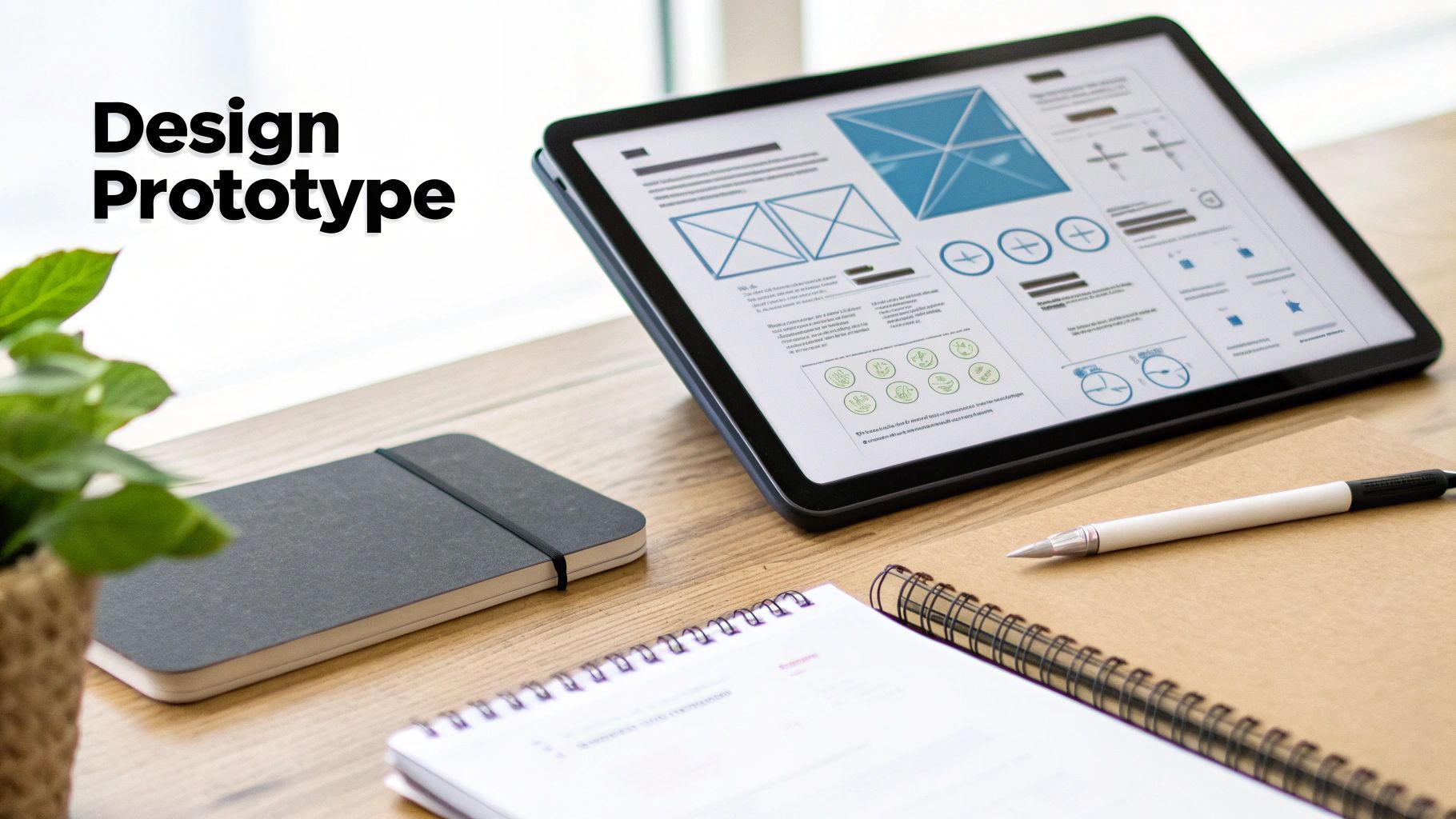
With a validated strategy, the design and prototyping phase translates requirements into a tangible, visual blueprint. This is where the business vision is shaped into a user-centric experience, ensuring the final product is not only functional but also intuitive and engaging.
Think of this as creating the architectural plans for a building. The primary outcome is a clear, visual guide that shows exactly how users will interact with the software to achieve their goals. A well-designed real estate platform, for example, would have a user interface that guides buyers effortlessly from property search to scheduling a viewing, directly increasing user engagement and conversion rates.
Visualizing the User Journey
The design process moves from low-fidelity sketches to interactive models, allowing stakeholders to see and test the application long before development begins. This iterative approach is key to gathering early feedback and reducing costly rework.
The main outcomes produced here are:
- Wireframes: Bare-bones layouts that establish the software's structure and user flow. They focus purely on functionality, answering the question, "Where does everything go?" You can learn more about wireframes and their path from concept to completion.
- Mockups: High-fidelity static visuals that add color, typography, and branding. They provide a realistic preview of the final look and feel.
- Interactive Prototypes: Clickable models that simulate the user experience. Stakeholders can navigate the prototype as if it were the final product, providing invaluable feedback to validate design choices.
Each of these steps serves as a critical checkpoint to refine the product based on user input, ensuring the final build is something people enjoy using.
A prototype is worth a thousand meetings. It allows stakeholders to experience the product firsthand, leading to clearer feedback and a shared understanding that written requirements alone can never achieve.
Architecting a Scalable Foundation
While UI/UX designers focus on the user experience, system architects work in parallel to design the software's technical foundation. The outcome of this track is a robust and scalable architecture that ensures the application is secure, fast, and capable of growing with the business.
Key architectural decisions made at this point include:
- Choosing the Technology Stack: Selecting the right programming languages (Python, Java), frameworks (React, .NET), and platforms to meet the project's specific performance and security needs.
- Designing the Database Architecture: Mapping how data is stored and accessed to guarantee speed and integrity, often using powerful solutions like Snowflake for data-intensive applications.
- Planning for Scalability: Building an architecture that can handle future growth in users and data without requiring a complete overhaul, often leveraging cloud infrastructure and microservices.
The final result is a comprehensive blueprint—a validated UX design and a solid technical architecture. This provides the development team with a clear plan, ensuring the end product is powerful, intuitive, and built to last.
Bringing the Vision to Life Through Development
This is where blueprints and prototypes are transformed into a functional, tangible product. The development phase is the engine room of the custom software development process, where validated designs become clean, efficient, and maintainable code. The primary outcome here is working software, delivered incrementally.
Modern development teams use Agile methodologies to manage this complexity. Instead of one long development cycle, the project is broken into short "sprints," typically lasting two to four weeks. Each sprint has a clear goal and produces a usable piece of the software. For an e-commerce platform, one sprint might deliver a functional user login system, while the next delivers a product search feature.
This iterative approach is a game-changer. It allows the team to deliver value quickly and provides regular opportunities for stakeholders to review progress and provide feedback. This flexibility ensures the final product can adapt to changing business needs, preventing costly rework and guaranteeing a better final outcome.
Building Incrementally with Sprints
The sprint-based workflow creates a predictable rhythm for development. At the start of each sprint, the team selects a set of user stories from the project backlog and works to build, test, and polish those features. Daily stand-up meetings ensure constant communication, helping the team quickly identify and resolve any roadblocks.
This cycle is the core of Agile development. The outcome of each sprint is a high-quality, fully integrated piece of the application that works. For a manufacturing company building a supply chain management tool, one sprint could result in a functional inventory tracking module. The next could deliver a vendor management dashboard. This allows the product to grow and evolve in a structured, transparent way.
The point of Agile development isn't just to move faster; it's about building smarter. By shipping working software in small increments, teams can test their assumptions, act on feedback, and make sure the final product is exactly what the market needs.
The Importance of Clean Code and Automation
Writing code is not enough; the quality of the code determines the software's long-term health and total cost of ownership. That's why top-tier development teams focus on writing clean, maintainable code, making the software easier to update and scale in the future.
To accelerate the release cycle while maintaining high quality, teams implement Continuous Integration/Continuous Deployment (CI/CD) pipelines. This automated process builds, tests, and deploys code without manual intervention.
- Continuous Integration (CI): Every new code commit automatically triggers a build and a suite of tests to catch bugs immediately.
- Continuous Deployment (CD): Once the code passes all tests, it is automatically deployed to a staging or production environment.
At Faberwork, our CI/CD pipelines include extensive test automation. This guarantees that every new feature is rigorously vetted before reaching users. By automating repetitive tasks, our engineers can focus on solving complex problems and building innovative features. The outcome is a faster, more reliable development process that delivers a superior product.
Testing and QA: Building Rock-Solid, Reliable Software
Once functional code is being produced, the custom software development process shifts its focus to ensuring absolute reliability. The Testing and Quality Assurance (QA) phase is more than just a bug hunt; it’s a systematic strategy to guarantee the software is secure, stable, and provides a seamless user experience. The ultimate outcome is a trustworthy product that performs flawlessly under real-world conditions.
Think of QA as the final quality gate that protects your users from flawed code. A robust testing strategy prevents reputational damage, user frustration, and high maintenance costs. For a FinTech application, this means ensuring that a transaction feature not only works but is also 100% secure and accurate, building critical user trust from day one.
A Multi-Layered Approach to Quality
Effective QA is not a single event but a series of checks at different levels of the application. This layered approach catches problems early when they are cheapest and easiest to fix.
The testing pyramid model typically includes:
- Unit Tests: Small, automated tests written by developers to verify that individual pieces of code—like a single function—work correctly in isolation.
- Integration Tests: Tests that ensure different parts of the software work together as expected. For example, confirming that a user's shopping cart correctly updates the inventory database.
- User Acceptance Testing (UAT): Real end-users test the software to confirm it meets their business needs and is useful in their daily workflow. This is the ultimate validation that the right product was built.
This structure embeds quality into every layer of the application, moving from the microscopic (unit tests) to the macroscopic (UAT).
Quality Assurance is not just about preventing defects; it's about building user confidence. A well-tested application demonstrates a commitment to reliability, which is the foundation of user trust and long-term product success.
The Strategic Value of Test Automation
In fast-paced development cycles, manual testing alone is not enough. Test automation is a game-changer. By writing scripts to run repetitive tests automatically, teams get instant feedback on code quality and can significantly shorten release cycles. Some studies show that comprehensive test automation can reduce regression testing time by over 80%.
At Faberwork, we integrate test automation directly into our CI/CD pipelines. Every code change automatically triggers a suite of tests, catching potential issues in minutes instead of days. This proactive approach delivers key outcomes:
- Faster Releases: Automation enables more frequent, predictable, and confident deployments.
- Improved Reliability: It ensures new features don’t break existing functionality, a common and costly problem.
- Smarter Focus: It frees human QA engineers to concentrate on complex exploratory testing and nuanced usability analysis that requires human intuition.
By combining meticulous manual checks with powerful automation, this phase delivers a production-ready application that is stable, secure, and prepared to offer a flawless user experience.
Launching and Evolving Your Software Solution
https://www.youtube.com/embed/HW6HtdyuB-g
The launch is a major milestone, but it marks the beginning of the software's life cycle, not the end. Deployment is a carefully planned process, often done in phases, to ensure a smooth transition for users. The goal is to get the software into the hands of users and kick off a continuous feedback loop that will guide its evolution.
The primary outcome of this phase is a live application that starts delivering business value. The focus then shifts from building the software to growing and refining it based on real-world user interaction.
From Deployment to Continuous Improvement
Once the software is live, performance monitoring becomes the top priority. Teams use specialized tools to track uptime, response times, and error rates to ensure the application remains stable under daily use. This proactive monitoring helps catch and resolve issues before they impact a large number of users.
Simultaneously, the process of gathering user feedback begins to inform future improvements.
- Analytics Tools: We track user behavior to understand which features are most popular and identify areas where users may be struggling.
- Direct Feedback Channels: Surveys, support tickets, and user interviews provide qualitative insights into why users behave a certain way.
- Performance Metrics: We analyze key business metrics to confirm the software is delivering its intended ROI.
This constant flow of data creates a clear roadmap for future updates, ensuring the product continues to evolve and meet user needs.
The Importance of a Long-Term Maintenance Plan
Custom software is a living asset that requires ongoing care to deliver long-term value. Without a solid maintenance plan, any application will degrade over time due to security vulnerabilities, outdated components, or changing business needs. Proactively managing this evolution is a critical part of the custom software development process, and you can learn more about managing technical debt in our detailed guide.
The true value of custom software is realized not at launch, but over its entire lifecycle. A commitment to ongoing maintenance and iteration is what transforms a good application into an indispensable business tool that delivers sustained value year after year.
This is true across all sectors, including public administration. The government sector's adoption of custom software is a major growth driver, with a projected CAGR of 25.9%, driven by the need for modern solutions like digital ID systems that require constant updates to remain secure and effective. You can find more insights about custom software's role in government modernization.
Even well-planned projects can face challenges. Anticipating these risks is key to success.
Common Risks and Mitigation Strategies in Software Projects
Common RiskPotential ImpactMitigation StrategyScope CreepBudget overruns, missed deadlines, and a diluted product focus.Establish a clear, detailed project scope with a formal change control process from day one.Poor CommunicationMisaligned expectations, rework, and team friction.Implement regular check-ins (e.g., daily stand-ups), use centralized communication tools, and maintain transparent documentation.Technical DebtSlower future development, increased bugs, and higher long-term maintenance costs.Prioritize code quality, conduct regular code reviews, and allocate specific time in each sprint to refactor and address debt.Inadequate TestingA buggy final product, poor user experience, and potential security vulnerabilities.Integrate automated testing early and continuously throughout the development cycle. Conduct thorough QA, including user acceptance testing.Unrealistic TimelinesBurned-out teams, compromised quality, and missed business opportunities.Break the project into smaller, manageable milestones. Use data from past projects to create more accurate estimates and build in buffers.Key Stakeholder TurnoverLoss of critical project knowledge and direction, leading to delays and potential pivots.Maintain comprehensive and up-to-date project documentation. Ensure knowledge is shared across the team, not held by one person.
By planning for these possibilities, you can steer your project away from common pitfalls and keep it on track for a successful launch and a long, valuable life.
Ultimately, this final phase ensures your software doesn't just meet today's needs but is ready to adapt to whatever comes next. It’s a cycle of monitoring, learning, and improving that makes sure the solution continues to provide a strong return on your investment and remains a key advantage.
Frequently Asked Questions About Software Development
Diving into a custom software project for the first time? It's natural to have questions. Getting clear answers upfront is one of the best ways to set a project up for success, making sure everyone is on the same page and knows what to expect.
Let's walk through some of the most common questions we hear from business leaders and stakeholders. These cover the big topics—time, cost, and process—that are crucial for making smart decisions from day one.
How Long Does Custom Software Development Take?
This is the classic "how long is a piece of string?" question. The timeline really hinges on the project's complexity, the number of features you need, and how many other systems it has to connect with. There’s no single answer, but we can talk in general terms.
For a Minimum Viable Product (MVP) with just the essential features to get you started, you're typically looking at 3 to 6 months. The whole point of an MVP is to get a working product into the hands of real users as quickly as possible to start learning. A more robust application, say for a single platform like a web app, often lands in the 6 to 9 month range.
On the other end of the spectrum, a complex, enterprise-level system is a different beast entirely. If your project involves tangled workflows, a dozen third-party integrations, and rock-solid security protocols, it could easily take a year or more. The good news is that modern Agile development doesn't make you wait that long to see results. You'll get functional, valuable pieces of the software in short cycles, so you can see tangible progress all the way through.
What Is the Difference Between Agile and Waterfall?
The methodology you choose has a huge effect on how flexible the project is and what you end up with. The two big names you'll hear are Waterfall and Agile, and they're polar opposites in their philosophy.
- Waterfall is the old-school, linear way of doing things. You complete one full phase—like requirements, design, coding, testing—before moving on to the next. Think of it like building a house foundation first, then walls, then the roof. It’s rigid, and changing your mind halfway through is incredibly difficult and expensive.
- Agile is all about iteration and collaboration. The project is broken down into small, bite-sized chunks called "sprints." This structure is built for change. It allows for constant feedback and makes it simple to adjust course as you learn more, ensuring the final product is what the business actually needs, not just what was planned months ago.
Today, almost every high-performing development team runs on Agile. It simply reduces risk, keeps everyone in the loop, and gets working software delivered far more quickly.
How Much Does Custom Software Development Cost?
Cost is directly connected to scope, complexity, and the total time your development team spends on the project. The final price tag is influenced by a few key factors: the size and seniority of the team, the tech stack being used, and the number of third-party APIs that need to be integrated.
A detailed discovery phase is the single most important investment you can make for getting a reliable cost estimate. It’s where a rough idea gets hammered into a well-defined scope, giving you the clarity needed for accurate financial planning and preventing those dreaded budget blowouts later on.
A straightforward MVP might start in the tens of thousands, while large enterprise systems can easily run into the hundreds of thousands or more. The key is to partner with a team that gives you a transparent cost breakdown tied to clear deliverables and milestones. That way, you know exactly what you’re paying for at every step.


