Struggling with logistics software that dictates your workflow? You're not alone. One-size-fits-all platforms often create more problems than they solve, forcing you into rigid processes and inefficient workarounds. In an industry defined by speed and precision, that inefficiency is a liability you can't afford.
Why Generic Software No Longer Works for Logistics
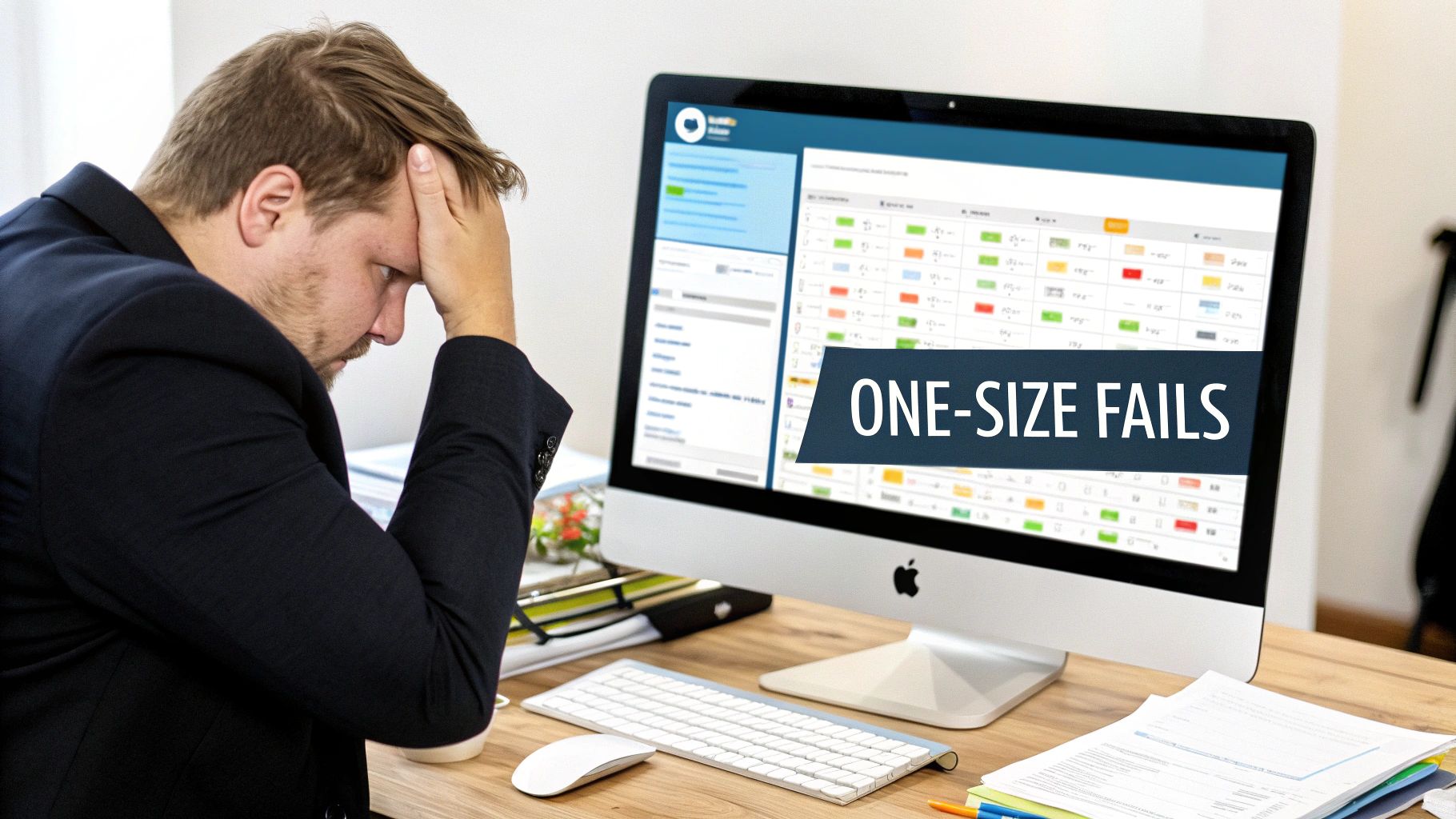
Off-the-shelf logistics platforms promise a quick fix but rarely align with the unique demands of a modern supply chain. You end up forcing your proven workflows into a system that wasn't built for them, leading to manual data entry, disconnected information, and costly operational gaps.
This mismatch becomes a major handicap against today's market pressures. E-commerce has trained customers to expect instant tracking and flawless delivery, while fragile global supply chains demand an agility that generic tools can't provide. A single delay can disrupt your entire operation.
The Limits of One-Size-Fits-All Platforms
Generic software is built for an "average" company, but in logistics, no such company exists. Every business has a unique network of carriers, specific warehouse protocols, and distinct customer requirements. A pre-packaged solution can't manage this complexity, forcing your team to handle critical tasks with spreadsheets and manual workarounds.
This reality has made custom software development for logistics a strategic necessity. The market for this software is projected to hit $33.17 billion by 2031, signaling a clear industry shift away from inadequate, generic platforms. To compete, companies need software built to support their specific operational model, not fight it. You can see more analysis of this shift on Softura.com.
A custom platform adapts to your business, not the other way around. It's the difference between using a generic map and having a dedicated GPS that knows your specific routes, shortcuts, and delivery constraints.
Building a True Competitive Advantage
The ultimate goal is a seamless flow of information from the warehouse floor to the customer's doorstep. This is where generic software often fails, lacking the specific integrations needed to unite your Warehouse Management System (WMS), Transportation Management System (TMS), and customer portals into a single source of truth.
A custom solution directly addresses these pain points. By designing software around your actual processes, you can achieve critical outcomes:
- Automate unique workflows to eliminate manual tasks that off-the-shelf tools can't handle.
- Gain real-time visibility across every link in your supply chain to make faster, better decisions.
- Integrate seamlessly with your existing technology stack, creating a unified operational view.
This transforms technology from a mere operational cost into your most powerful tool for building a lasting competitive advantage.
The Core Features That Drive Real Results
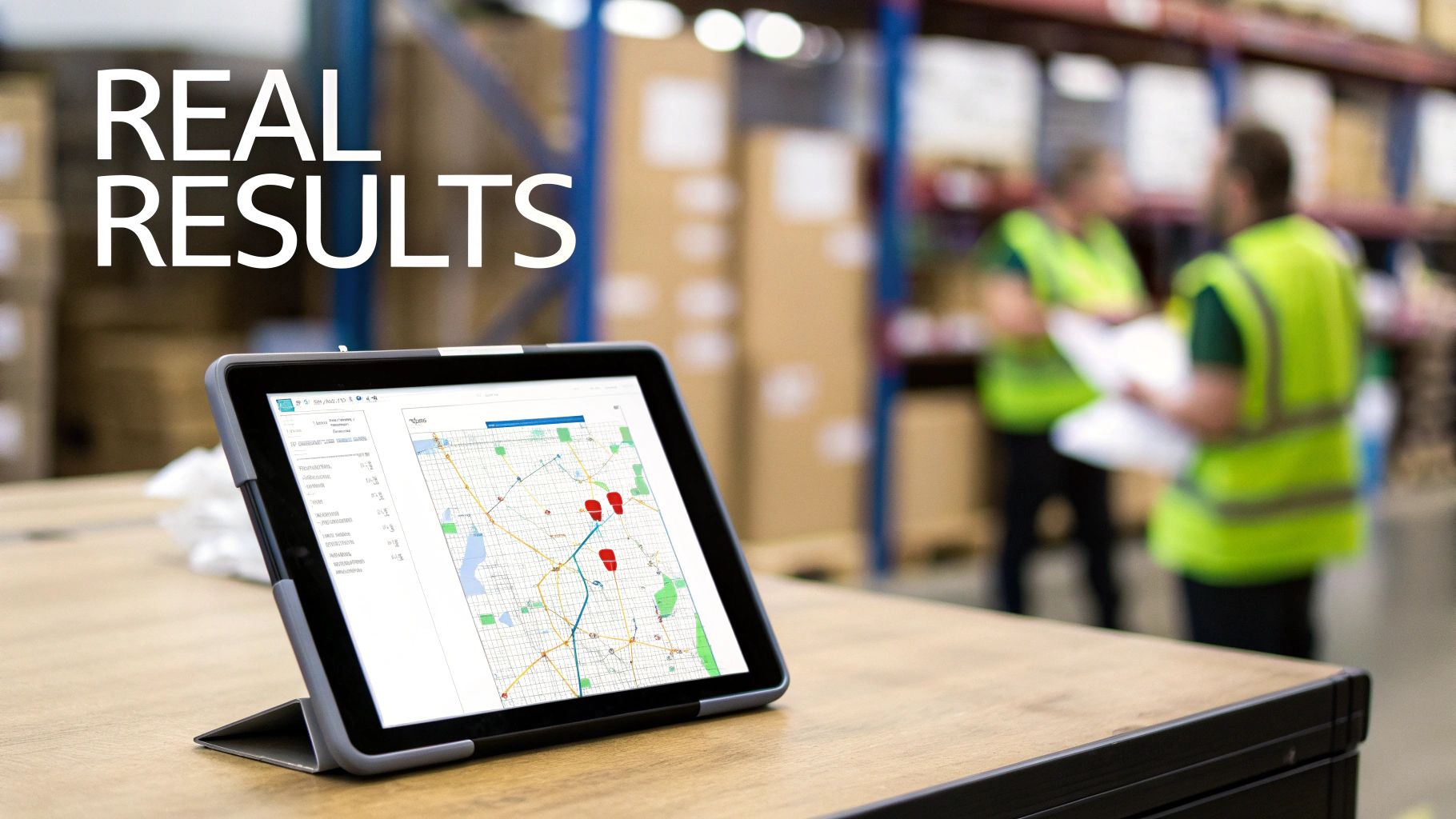
Let's move beyond promises and focus on the features that directly impact your bottom line. A well-built custom logistics platform is a unified system designed to cut costs and boost efficiency. These are the engines that deliver a real return on investment.
This demand for specialized tools is driving a massive industry shift. The global logistics software market is set to grow from $16.24 billion in 2025 to $27.88 billion by 2032. This growth is fueled by e-commerce and complex global supply chains that have outpaced the capabilities of off-the-shelf software. You can explore the market dynamics on Fortune Business Insights.
Real-Time Fleet Tracking and Management
Modern fleet tracking is more than just a dot on a map; it's a tool for superior operations and customer service.
Use Case: A customer calls about a late shipment. Instead of placing them on hold while your dispatcher contacts the driver, your team sees the truck's precise location and live traffic data. They provide an accurate, updated ETA in seconds, turning a potential complaint into a positive customer interaction.
This live visibility also empowers dispatchers to make smarter decisions. They can reroute a truck around an accident or assign a last-minute pickup to a nearby driver, shifting from reactive problem-solving to proactive, dynamic management.
Advanced Route Optimization
In logistics, fuel and labor are your biggest expenses. Advanced route optimization directly reduces both by using algorithms to plan the most efficient multi-stop routes.
The system analyzes numerous variables to find the most cost-effective path:
- Traffic Patterns: Avoiding rush hour and known bottlenecks.
- Delivery Windows: Ensuring arrivals when customers are ready.
- Vehicle Capacity: Packing trucks efficiently to minimize trips.
- Driver Hours: Maintaining compliance and preventing driver fatigue.
The outcome is a significant reduction in costs for every truck that leaves your depot.
A custom platform doesn't just show you where your assets are; it tells you where they should be and how they can get there more efficiently. It’s the difference between having a map and having a dedicated logistics strategist.
Seamless WMS and TMS Integration
Data silos between your warehouse and transportation operations create costly inefficiencies. Custom software demolishes these barriers by tightly integrating your Warehouse Management System (WMS) and Transportation Management System (TMS).
Use Case: The moment a warehouse worker scans a pallet as "ready for shipment," the integrated system automatically assigns it to the correct truck, notifies the driver, and generates the necessary paperwork. This eliminates phone calls, emails, and delays.
This creates a single source of truth for your entire operation. Everyone—from inventory clerks to dispatchers to executives—views the same real-time data, eliminating errors from manual entry and miscommunication. It prevents minor issues from escalating into major operational problems.
Connecting Custom Features to Your Business Goals
This table illustrates how specific custom software features directly improve the logistics KPIs that matter most to your business.
Essential Custom FeaturePrimary Business OutcomeKPIs ImprovedReal-Time Fleet TrackingIncreased operational visibility and customer satisfactionOn-Time Delivery (OTD) Rate, Customer Inquiry Resolution Time, Asset UtilizationAdvanced Route OptimizationReduced operational costs and improved delivery speedFuel Cost per Mile, Labor Costs, Miles per Route, Delivery Time per StopWMS/TMS IntegrationStreamlined end-to-end workflow and data accuracyOrder Accuracy Rate, Dock-to-Stock Time, Inventory Turnover, Order Cycle Time
Ultimately, connecting the right features to your specific business goals is what turns a software project into a strategic advantage. It ensures every dollar you invest is aimed at solving a real-world problem and delivering a measurable return.
Using AI and IoT to Predict Your Next Move
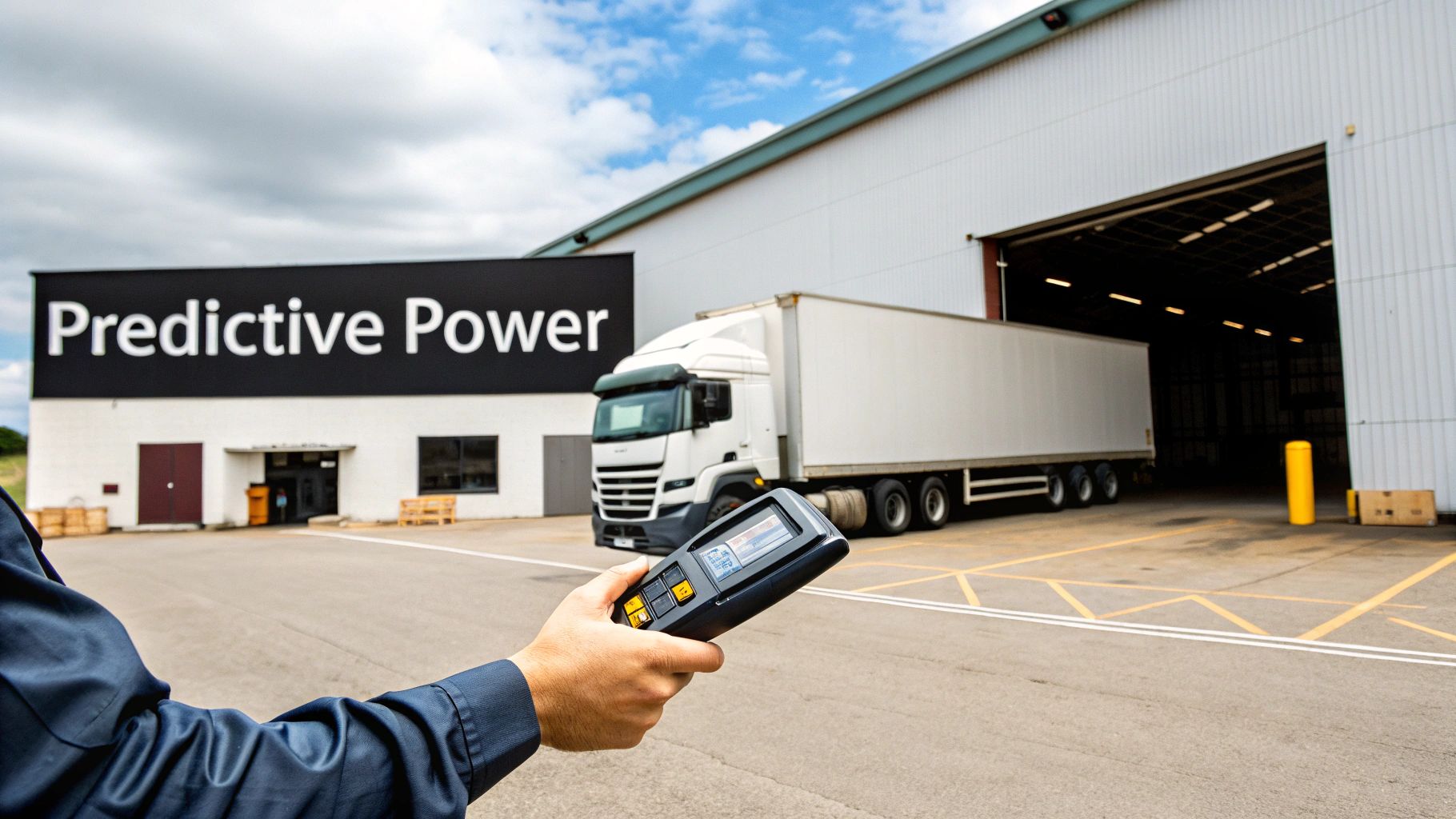
What if you could prevent a delivery truck from breaking down before it happens? Or foresee a supply chain bottleneck weeks in advance? This is the reality when you integrate Artificial Intelligence (AI) and the Internet of Things (IoT) into your logistics software. This powerful combination shifts your strategy from reactive to proactive, preventing problems before they start.
IoT sensors on trucks, containers, and equipment stream a constant flow of data—condition, location, environment—giving you a live, detailed picture of your assets.
From Reactive Repairs to Predictive Maintenance
The old way is to fix a truck when it breaks down, causing expensive downtime and customer frustration. IoT and AI change the game.
Use Case: Sensors on a truck's engine detect subtle changes in vibration and temperature that are invisible to a human inspector. An AI model, trained on vast amounts of engine data, recognizes these patterns as an early sign of failure. It automatically triggers a maintenance alert, identifying the specific part and scheduling service during planned downtime.
The tangible outcomes are clear:
- Reduced Unplanned Downtime: Keep your fleet moving and deliveries on schedule.
- Lower Maintenance Costs: Proactive repairs are far cheaper than emergency fixes.
- Increased Asset Lifespan: Well-maintained equipment lasts longer, maximizing your return on investment.
The Rise of Intelligent AI Agents
Beyond maintenance, custom software development for logistics enables autonomous AI agents that handle complex decisions 24/7.
For example, an AI agent can monitor freight marketplaces in real-time, analyzing carrier rates, reliability, and transit times. It can then autonomously negotiate and book the most cost-effective option for a shipment—a strategic decision made at a speed no human team can match.
AI and IoT don't just give you more data; they give you foresight. It’s like having a team of analysts watching every moving part of your business, 24/7, ready to flag a problem before it even materializes.
Forecasting Disruptions and Optimizing in Real Time
AI models can analyze external data—weather patterns, port congestion, geopolitical news—to forecast potential disruptions.
Use Case: The system flags a high probability of a major storm hitting a key shipping lane. You get an alert days in advance, giving you time to reroute shipments, adjust inventory levels, and proactively communicate with customers. You shift from being a victim of disruption to being prepared for it.
This intelligence also sharpens daily operations. AI can instantly re-calculate packing configurations for last-minute orders, bid on shipping contracts to secure the best rates, and suggest smarter inventory placement to cut last-mile delivery times and costs. Integrating AI and IoT creates a logistics operation that is not just efficient, but resilient.
Building a Platform That Lasts
A powerful logistics platform requires a solid technical foundation. The right architecture ensures your software can grow with your business rather than buckling under pressure. Getting this right from day one is key to building a scalable, secure, and future-proof system.
This focus on flexible architecture is driving major investment. The global custom software development market, where these solutions are born, was valued at $43.16 billion in 2024 and is expected to hit $52.84 billion in 2025. This growth is driven by the need for platforms that can handle complex realities, a trend explored in this detailed market analysis from Grand View Research.
Designing for Scalability with Microservices
Traditional, monolithic software is like one large building; a single update can require shutting down the entire operation. A modern microservices architecture is different. It breaks the application into smaller, independent services—one for route optimization, another for fleet tracking, and a third for warehouse integration.
This design delivers key outcomes:
- Independent Updates: You can upgrade the route optimization service without disrupting anything else, resulting in faster updates and less downtime.
- Targeted Scaling: If fleet tracking demand surges, you can allocate more resources specifically to that service without overprovisioning the entire system.
- Technology Flexibility: Each service can be built with the best technology for its specific job, fostering innovation.
This approach to custom software development for logistics ensures your platform can handle more users, higher transaction volumes, and new features without a costly overhaul.
Non-Negotiable Security and Compliance
In logistics, you safeguard sensitive data. A breach destroys customer trust and costs a fortune. Security must be built into the core of your platform from the start.
Robust security isn't a feature you add at the end; it's the foundation upon which every other feature is built. It ensures data integrity, protects your customers, and defends your reputation.
This means implementing multiple layers of defense:
- Data Encryption: All data, whether stored (at rest) or moving across a network (in transit), must be encrypted to be unreadable to unauthorized parties.
- Strict Access Controls: Role-based access ensures users only see the data and features necessary for their jobs.
- Regular Security Audits: Proactively hunt for and patch vulnerabilities before they can be exploited.
Custom software can also automate regulatory compliance. The system can be designed to generate compliant shipping documents, enforce driver hour-of-service regulations, and maintain perfect audit logs, turning a heavy administrative burden into a seamless background process.
Your Step-by-Step Implementation Roadmap
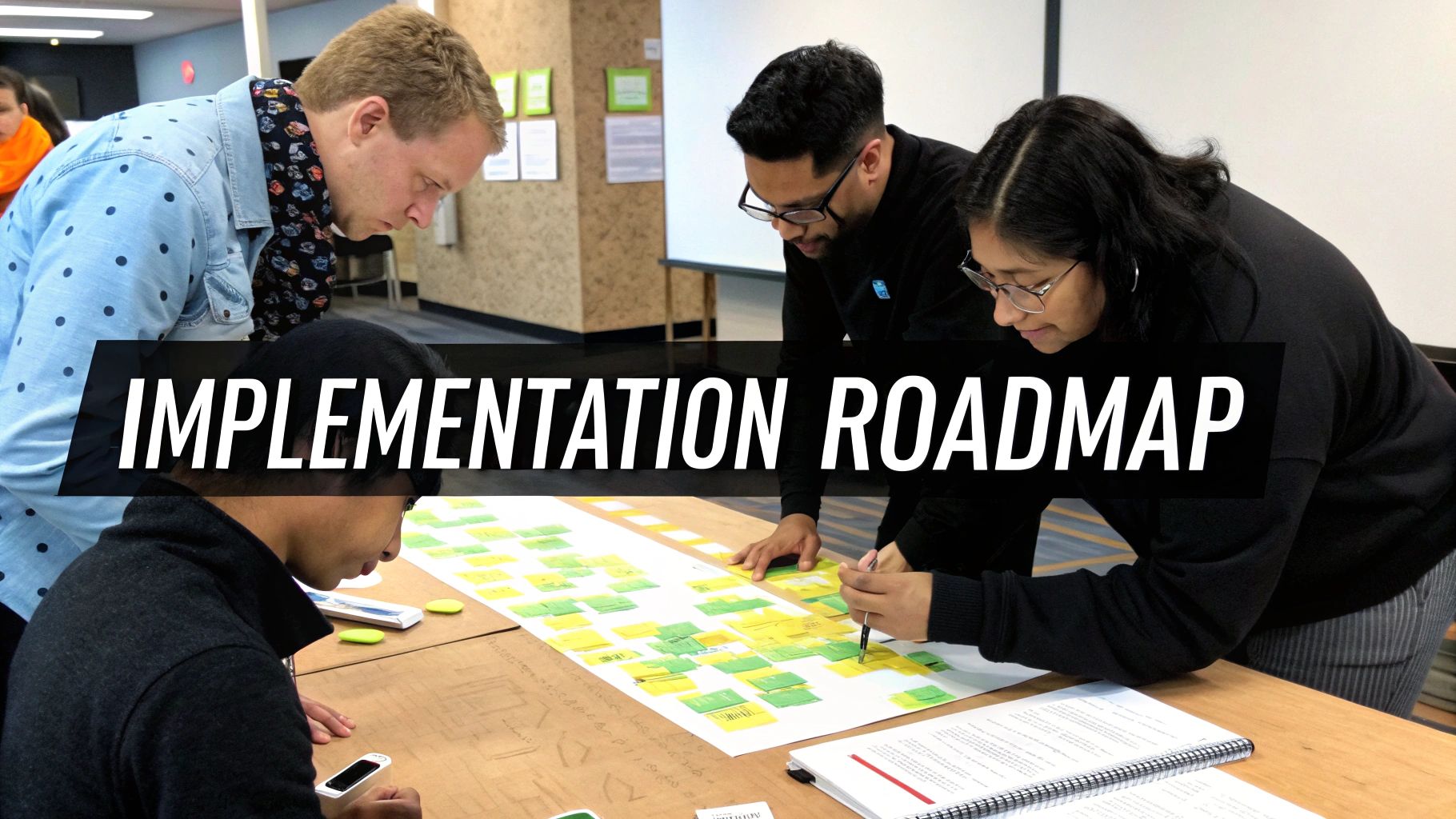
Transforming an idea into a functioning logistics platform requires a clear, structured plan. This roadmap breaks the process into manageable phases to keep your project on schedule, on budget, and aligned with your business goals.
The journey begins with discovery, the most critical phase of any custom software development for logistics project. The development team immerses itself in your operations, sitting down with key personnel to map workflows, identify friction points, and define the specific outcomes the software must deliver.
This collaboration produces a detailed project scope and technical specification, which serve as the guiding documents for the entire development cycle, ensuring everyone is aligned from day one.
Agile Development and Iterative Feedback
Once the plan is set, development begins using an agile methodology. The project is broken into two- to four-week "sprints," with a small, working piece of software delivered at the end of each one.
This iterative process is powerful. Your team can test new features early and provide immediate feedback that shapes the next development cycle. This constant feedback loop ensures the final product is built to solve real-world problems for the people who will use it every day.
A successful implementation isn't a single event; it's a series of well-executed steps. Each phase, from discovery to launch, builds upon the last, turning a strategic vision into a tangible operational tool.
Testing, Deployment, and a Seamless Launch
As development nears completion, the focus shifts to rigorous testing. A Quality Assurance (QA) team stress-tests performance, hunts for bugs, and verifies security protocols. Your own team then conducts User Acceptance Testing (UAT) to confirm the software performs as expected in your environment.
After receiving the green light, the team executes a meticulous deployment, often starting with a small pilot group to resolve any issues before a company-wide rollout. Comprehensive training and documentation are provided to empower your team from day one, minimizing disruption and maximizing adoption.
How to Measure Your Return on Investment
An investment in custom software development for logistics must translate into measurable business value. Proving your return on investment (ROI) requires connecting the software's features directly to key performance indicators (KPIs).
The process is simple: identify the metrics that directly impact your bottom line, establish a baseline before implementation, and track the improvements after the new system is live. This provides a clear, data-backed picture of its real-world impact.
Identifying Your Core KPIs
Before measuring improvement, you need a baseline. Most logistics operations are driven by a core set of metrics related to efficiency, cost, and service quality.
Start by tracking these critical numbers:
- On-Time Delivery (OTD) Rate: The percentage of orders delivered by the promised time. A direct measure of reliability and customer satisfaction.
- Cost Per Mile: Total transportation costs divided by total miles driven. Route optimization should significantly lower this number.
- Order Accuracy Rate: The percentage of orders shipped without errors. High accuracy reduces costly returns.
- Fleet Utilization: The percentage of time your vehicles are generating revenue versus sitting idle. Better scheduling should increase this KPI.
Tracking these metrics gives you the "before" snapshot needed to demonstrate a clear "after" improvement.
Calculating Your Direct ROI
Direct ROI comes from quantifiable cost savings. The formula is straightforward: subtract the initial investment from your total gains, then divide that by the investment cost.
Your primary sources of direct gains will typically be:
- Reduced Fuel Costs: Advanced route optimization can cut mileage by 15-20%, a direct saving reflected in every fuel bill.
- Increased Labor Efficiency: Automation eliminates manual work. If automated dispatching saves your team 10 hours a week, you can calculate the labor cost savings and apply it directly to your ROI.
An investment in custom logistics software isn't just an expense; it's a strategic move to turn your operational data into a profit center. The goal is to see every dollar spent on technology return multiple dollars in efficiency gains and cost reductions.
Accounting for Soft Benefits
While hard numbers are crucial, some of the most significant returns are less tangible. These "soft benefits" drive long-term growth and customer loyalty.
Consider these powerful outcomes:
- Higher Customer Satisfaction: Faster, more accurate deliveries and proactive communication build trust and encourage repeat business.
- Improved Employee Morale: Giving your team tools that work reduces frustration and allows them to focus on high-value tasks.
- Enhanced Brand Reputation: Becoming known as the most reliable provider in your market is a powerful competitive advantage.
Combining direct cost savings with these powerful soft benefits builds a comprehensive case that proves the immense value of your technology investment.
Frequently Asked Questions
Investing in a custom logistics platform is a significant decision. Here are straightforward answers to the most common questions from business leaders.
How Long Does a Custom Logistics Project Take?
The timeline depends on the project's complexity. A simple application might take a few months, while a comprehensive enterprise platform could take a year or more.
Key factors that shape the schedule include:
- Feature Complexity: A basic truck tracking app is a faster build than a system with AI-powered route optimization and predictive maintenance.
- System Integrations: Connecting to a single, modern WMS is straightforward. Integrating with multiple legacy systems, carrier APIs, and external data feeds adds significant time.
- Data Migration: Moving years of historical data from old systems is a meticulous process that must be planned carefully to ensure data integrity.
A typical project runs from 4 to 12 months. We often launch a Minimum Viable Product (MVP) in the shorter end of that range to get critical features into your team's hands quickly while we build out more advanced functionality.
Is Custom Software More Expensive Than an Off-the-Shelf Tool?
While the initial investment for custom software may be higher, it almost always delivers a better long-term Total Cost of Ownership (TCO).
Generic SaaS products involve perpetual subscription fees, per-user licenses that become costly as you grow, and extra charges for customizations that never quite fit your workflow. In contrast, a custom-built platform is a capital asset you own. It's designed to automate your specific processes, eliminating inefficient workarounds and generating a clear return. It becomes a strategic asset that pays for itself.
Can the Software Scale as My Business Grows?
Yes, provided it's built on a scalable foundation from day one. This is a primary advantage of custom development over rigid off-the-shelf systems.
A modern microservices architecture is key. We design the software as a collection of small, independent services (e.g., tracking, routing, inventory). Each service can be scaled independently. If tracking demand surges during your peak season, you can allocate more resources to that service alone without affecting the rest of the platform.
Paired with a powerful cloud platform like AWS or Azure, this provides virtually unlimited room for growth. Your platform can handle increasing shipment volumes, more users, and geographic expansion without requiring a costly and disruptive rebuild.


