When off-the-shelf software creates more problems than it solves, you need a solution built for a specific business outcome. This is where custom software development consulting shines. It’s not about hiring coders; it’s a strategic partnership to build technology that delivers a measurable competitive advantage.
What Custom Software Development Consulting Really Means
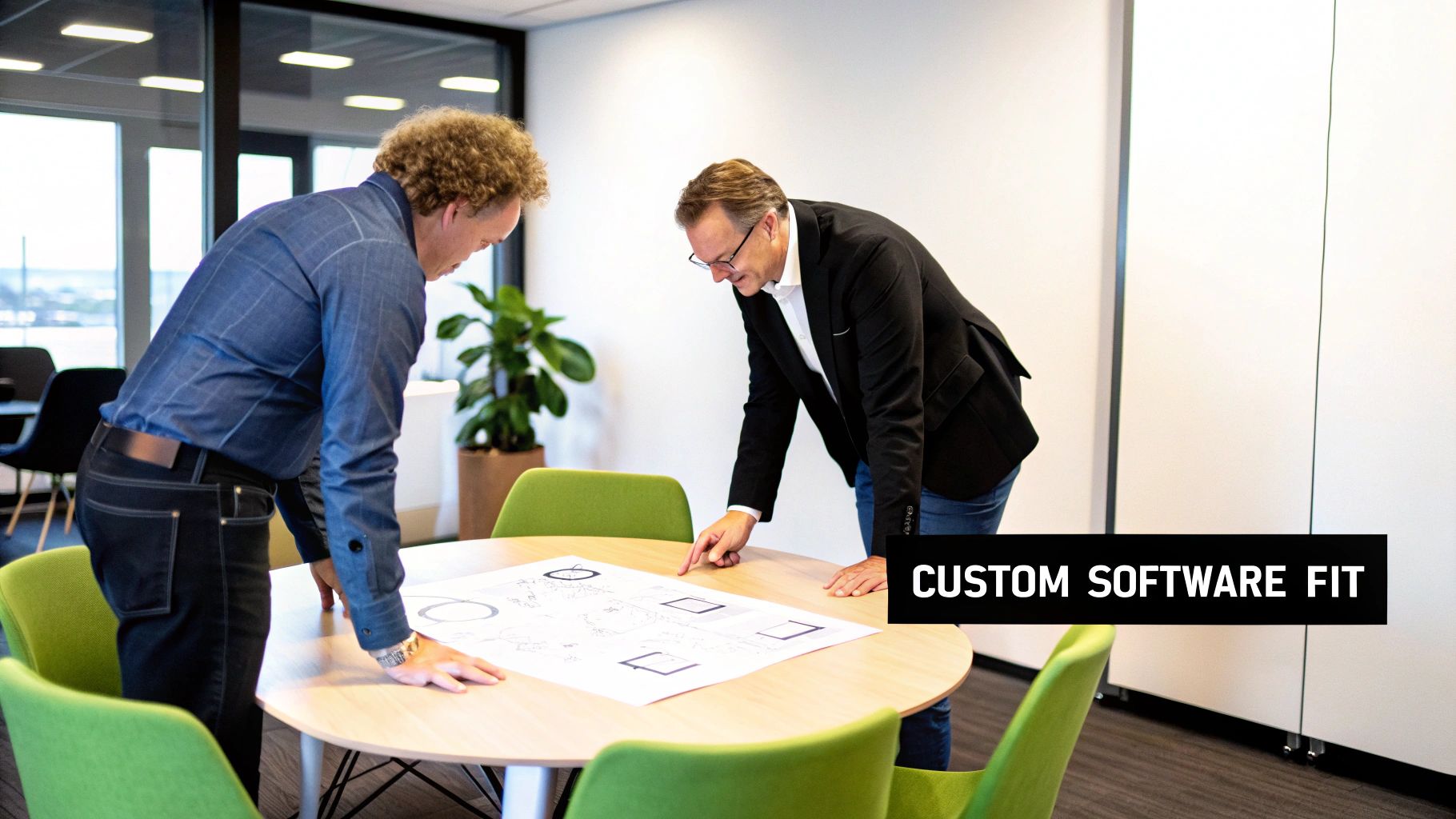
Imagine your sales team is forced to use a generic CRM. It imposes a rigid workflow that ignores your company's proven sales process. The outcome? Friction, manual workarounds, and capped revenue. Off-the-shelf tools often create these exact bottlenecks.
Custom software development consulting delivers the solution. It’s a service focused on understanding your business challenges to design and build technology that produces tangible results. A true consulting partner acts as a strategic advisor, ensuring every feature is tied to a specific business outcome.
Moving Beyond Code to Create Business Value
The mission of a true consulting firm is to solve a business problem with technology, not just deliver a software package. This means the work goes far beyond programming to achieve specific goals.
The process is designed for outcomes:
- Business Process Analysis to identify inefficiencies and unlock automation opportunities.
- Technology Audits to ensure seamless integration and avoid creating new data silos.
- Strategic Roadmapping to build a long-term plan that supports scalable growth.
- Solution Architecture to design a solid foundation that prevents future performance issues.
This outcome-focused approach guarantees the final product is a purpose-built asset that boosts efficiency, slashes operational costs, and delivers a clear return on investment.
While 70% of organizations initially seek tech consulting to cut costs, a Deloitte study found the greatest value comes from leveraging specialized expertise to innovate and fix broken processes.
Use Case: From Inefficient Routes to Cost Savings
A logistics company managed its fleet with a generic maps app, which couldn't account for traffic, vehicle capacity, or priority deliveries. The result was high fuel costs and late shipments.
A custom software development consulting firm analyzed their entire delivery workflow. They then built a custom route optimization engine using real-time variables. The outcome wasn't just a new app; it was a 15% reduction in fuel costs, faster delivery times, and higher customer satisfaction. This focus on tangible business outcomes is the hallmark of a great consultant.
Calculating the Real ROI of a Consulting Partnership
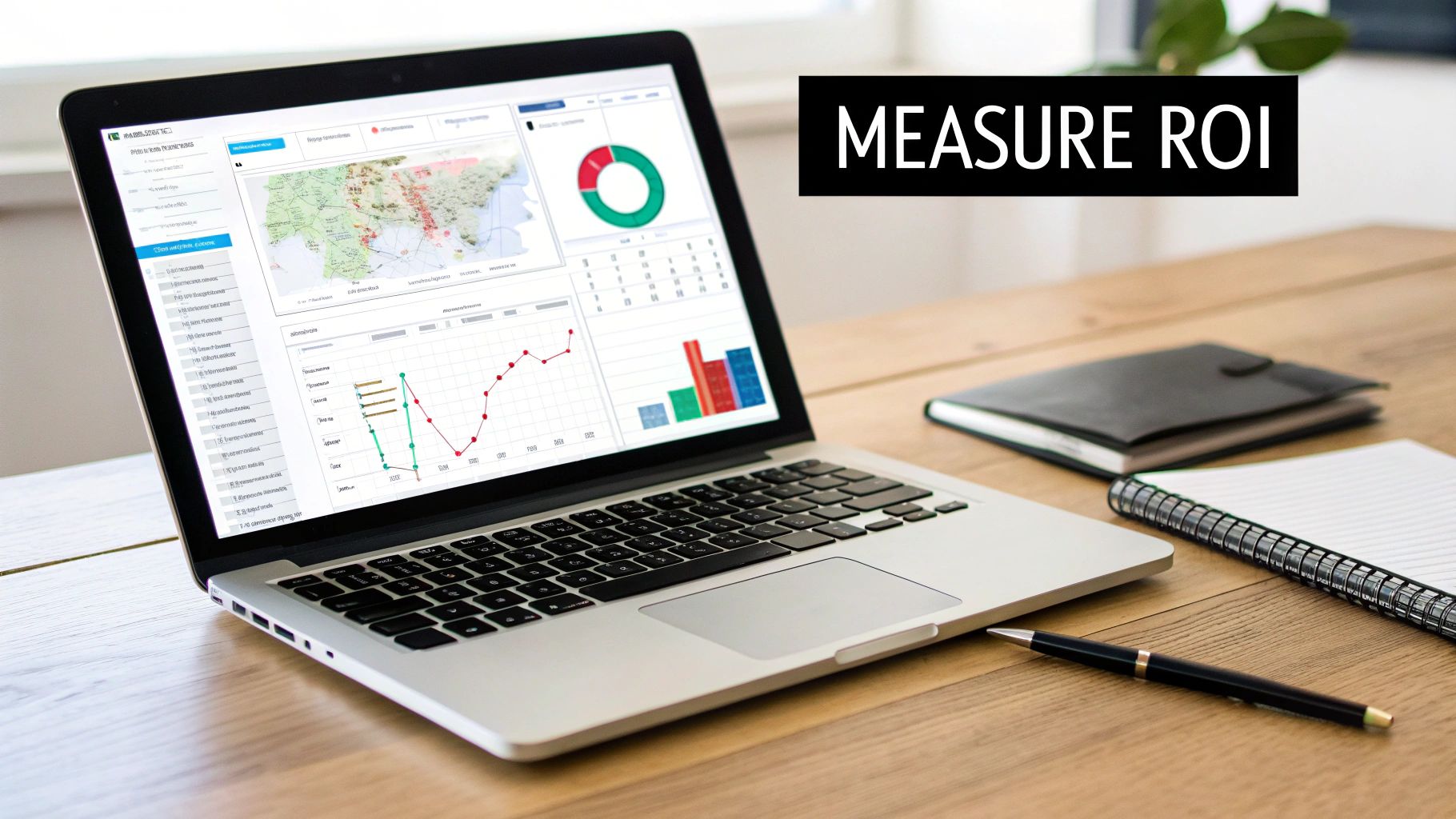
When evaluating a custom software consulting partnership, the conversation must center on tangible results. While the initial investment for a bespoke solution is higher than an off-the-shelf license, the long-term Return on Investment (ROI) is where the real value emerges. The win comes from calculating the full strategic value, not just the upfront cost.
This focus on outcomes is why the market is booming. The global custom software development space is projected to grow from USD 43.16 billion to USD 146.18 billion by 2030. This growth is driven by companies needing specialized tools to solve complex operational problems and gain a competitive edge. You can find the full analysis from Grand View Research.
A Real-World Example of Tangible Returns
Consider a national logistics company losing money on inefficient routing. Their generic GPS couldn’t handle dynamic variables like vehicle load, driver hours, or last-minute priority shipments, leading to wasted fuel and late deliveries.
They partnered with a consultant to build a custom route optimization engine. This system integrated real-time traffic data, vehicle telematics, and order management information. The immediate outcome was a 12% reduction in fuel consumption within six months, saving millions.
But the true ROI extended beyond fuel savings. Fewer late deliveries improved customer retention. Automated scheduling eliminated over 20 hours of manual work per week for dispatchers.
This is how you calculate real ROI: by connecting direct cost savings with the indirect strategic gains that accumulate over time.
Quantifying the Long-Term Strategic Gains
To secure buy-in for a custom project, you must quantify the benefits. These are the areas where a custom solution delivers outcomes that generic software cannot.
Look for measurable wins here:
- Reduced Manual Labor: How many employee hours are spent on repetitive tasks? Automating them provides a direct, calculable cost saving.
- Minimized Operational Errors: What is the cost of mistakes from manual data entry? A custom tool can eliminate these errors and their financial impact.
- Enhanced Scalability: A bespoke system is designed for growth, helping you avoid costly migrations and re-platforming forced by off-the-shelf software limitations.
- Increased Team Productivity: Software built for your team's workflow enables them to achieve more, directly impacting your bottom line.
Comparing Custom Software ROI vs Off-the-Shelf Software TCO
Frame the decision by comparing the Total Cost of Ownership (TCO) of a generic tool with the long-term ROI of a custom build. Off-the-shelf software often includes hidden costs like licensing fees, mandatory upgrades, and customization charges.
This table highlights how an ROI-focused approach delivers more sustainable value.
FactorOff-the-Shelf Software (TCO Focus)Custom Software Consulting (ROI Focus)Initial CostLower upfront license feeHigher initial development investmentAdaptabilityLimited; forces inefficient workaroundsFully aligned with your business processesScalabilityRequires costly tier upgrades to growBuilt to scale with your business from day oneLong-Term ValueValue decreases as needs changeBecomes a more valuable asset as it drives efficiencyCompetitive EdgeUses the same tools as competitorsCreates a unique operational advantage
A custom software development consulting partnership is an investment in your company's operational backbone. When you focus on the measurable returns in efficiency, scalability, and competitive positioning, the initial cost transforms from an expense into an engine for growth.
Choosing the Right Consulting Engagement Model
Finding the right custom software development partner is only half the battle; choosing how you’ll work with them is just as critical. The engagement model impacts your budget, timeline, and control over the project's outcome.
Think of it like building a house: you could hire a specialist plumber, commission a general contractor for the entire build, or retain a property manager for ongoing maintenance. Each model serves a different need.
Staff Augmentation: The Specialist Contractor
In this model, you bring in a specialist—like a senior Python developer—to fill a skill gap on your team. They report to your project manager and integrate into your existing workflow.
- Best Use Case: Your in-house team is building a mobile app but lacks senior-level geofencing experience. A consultant joins for six months to build that feature and mentor your team.
- Core Benefit: You retain full project control while quickly filling a skill gap without the overhead of a full-time hire.
- Potential Drawback: You are managing the individual, not buying a guaranteed outcome. Project success remains your responsibility.
Project-Based Engagements: Commissioning a Custom Home
This is the classic custom software development consulting model. You define the business outcome, and the consulting firm takes complete ownership of delivering it, managing everything from discovery to deployment.
This is ideal when you have a clear business problem but lack the internal resources to build the solution. You are buying a finished product tied to a specific result.
You're not just hiring developers; you're commissioning a self-managed team to deliver a business outcome, like a fully functional inventory management system that reduces stockouts by 30%.
This outcome-focused approach is why the software consulting market is projected to grow from USD 327.59 billion to USD 701.90 billion by 2030. Businesses want the predictable costs and clear deliverables of project-based work. You can explore this trend in Mordor Intelligence's detailed industry report.
Managed Services: The Property Management Firm
Managed services is a long-term partnership where a firm handles the ongoing maintenance and improvement of a software application. This model ensures your mission-critical systems remain secure, updated, and performant.
This is the right choice for applications that demand constant uptime but would drain your internal team’s focus from new initiatives. Your partner handles bug fixes, security patches, and performance monitoring.
This table breaks it down to help you find the right fit:
ModelYour Level of ControlBest ForPrimary GoalStaff AugmentationHighFilling specific, temporary skill gapsAccessing targeted expertiseProject-BasedMediumDelivering a complete, end-to-end solutionAchieving a defined business outcomeManaged ServicesLowLong-term support and maintenanceEnsuring system stability and evolution
The right model isn't about which one is "best"—it's about which one best aligns with your project's goals to deliver the control and accountability you need.
Mapping the Journey from Discovery to Deployment
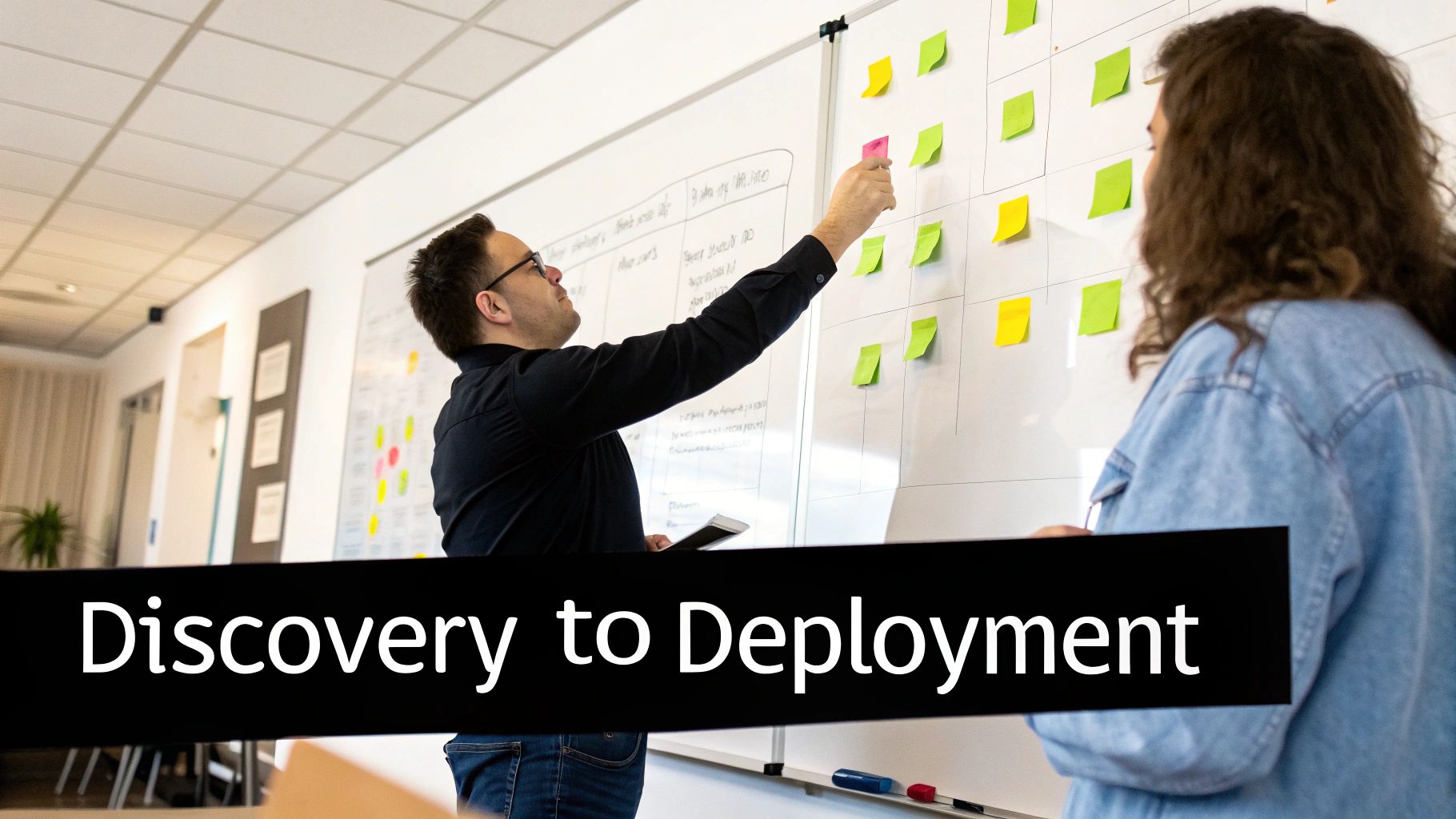
A good custom software development consulting firm uses a structured process that makes the journey from idea to implementation transparent and predictable. They don’t start coding on day one. Instead, they guide you through a lifecycle designed to align technology with business goals at every step.
This is like commissioning a custom car. The builder first needs to know if the goal is to haul heavy loads or win a drag race before they start welding the frame.
Stage 1: Discovery and Business Analysis
This foundational phase is about understanding the core business problem you need to solve. It’s a strategic deep dive, not just a technical checklist.
Key activities include:
- Stakeholder Interviews: Capturing the needs and pain points of everyone who will use the software.
- Business Process Mapping: Visualizing workflows to pinpoint the exact bottlenecks to eliminate.
- Technical Audits: Reviewing existing systems to ensure seamless integration.
The outcome of this stage is a shared understanding of the "what" and the "why," ensuring perfect alignment before development begins.
Stage 2: Strategy and Design
Here, the solution takes tangible shape. Your partner translates business requirements into a technical plan and a visual prototype of the final product.
This stage turns ideas into blueprints. The goal is a plan so clear that development becomes an exercise in execution, not exploration.
Deliverables typically include a technology roadmap and clickable wireframes. These interactive models let you experience the user interface long before development starts. To understand how these visual guides work, you can explore how wireframes pave the path from concept to completion.
Stage 3: Development and Quality Assurance
This is the execution phase, where blueprints become a functional product. Modern consulting firms use an agile development methodology, breaking the project into small cycles called "sprints." Each sprint delivers a working piece of the software, allowing for continuous feedback.
This iterative approach provides key benefits:
- Transparency: You see progress in real-time through regular demos.
- Flexibility: It's easier to adapt to shifting business priorities without derailing the project.
- Quality: Testing is integrated into every sprint, catching bugs early.
Stage 4: Deployment and Ongoing Support
The final stage turns the development project into a live business asset. A well-planned launch strategy ensures a smooth transition with minimal operational disruption.
This includes critical activities like user training and creating thorough documentation. The partnership often continues post-launch with support and maintenance plans to handle bug fixes, security patches, and future enhancements, ensuring your software continues to deliver value.
How Top Companies Use Consulting to Innovate

The true power of custom software development consulting is seeing how it solves real-world business problems. Leading companies build custom software not for the sake of technology, but to achieve specific, measurable goals that create a competitive advantage.
This outcome-driven mindset is becoming widespread. The global market for software development outsourcing is expected to climb from USD 534.9 billion to around USD 940 billion by 2034. Over 70% of companies that outsource development report faster project delivery and a renewed focus on their core business. You can explore this trend in the full market analysis on market.us.
Use Case 1: Boosting Retail Traffic with Geofencing
A national retailer faced declining foot traffic as generic email and social media ads failed to engage nearby shoppers. They needed to deliver the right offer at the right time to drive in-store visits.
A consulting partner helped them build a custom mobile app with a smart geofencing feature. The app sends hyper-personalized push notifications when a customer enters a virtual perimeter around a store.
- The Challenge: Generic marketing failed to drive immediate, local sales.
- The Solution: A custom mobile app delivering location-based offers, like a "20% off for the next hour" alert, to nearby shoppers.
- The Outcome: The brand achieved a 22% increase in store visits from app users and a significant lift in coupon redemptions within three months.
Use Case 2: Streamlining a Supply Chain with a Custom EMS
A mid-sized manufacturer’s supply chain was a chaotic mix of spreadsheets and emails, leading to stockouts and over-ordering. They lacked real-time visibility into their operations.
They partnered with a consultant to build a custom Enterprise Management System (EMS). The new system unified all supply chain functions onto a single dashboard.
This wasn't just about replacing spreadsheets; it was about building a central nervous system for their operation, turning data chaos into actionable intelligence.
By automating purchase orders and using predictive analytics, the custom system provided a complete view of the supply chain. Maintaining a large system like this is crucial; our guide on managing technical debt in risk control offers more insight.
Use Case 3: Unlocking Insights with a Snowflake Data Platform
A financial services firm had vast amounts of customer and market data locked in separate legacy systems. Analysts spent weeks cleaning data for basic reports, preventing fast, data-driven decisions.
The firm hired a consulting team to build a centralized Snowflake data platform. The project involved creating automated data pipelines to funnel information from all sources into a single data warehouse.
- The Challenge: Siloed data made business intelligence slow and unreliable.
- The Solution: A custom Snowflake platform with automated data pipelines and self-service analytics tools.
- The Outcome: The time to generate critical business reports dropped from two weeks to under five minutes, enabling near real-time customer segmentation and risk analysis and opening new revenue streams.
Selecting the Right Consulting Partner for Your Business
Choosing a custom software partner is one of the most critical decisions you'll make. The right firm becomes an extension of your team, driving real business outcomes. The wrong one leads to blown budgets, missed deadlines, and a product that fails to solve the core problem.
This isn't about finding the lowest hourly rate. It's about finding a partner with the right mix of technical skill, industry knowledge, and a collaborative culture. A great partnership is built on trust and transparency, with everyone focused on your company's success.
Your Essential Evaluation Checklist
Use this checklist to move beyond surface-level questions and identify firms that can deliver tangible results.
- Proven Industry Experience: Have they achieved measurable outcomes in your industry? Ask for case studies or client references. A team that understands the nuances of logistics or healthcare provides value from day one.
- Technical Expertise in Your Stack: Ask for detailed, hands-on experience with the technologies critical to your project. Vague answers are a major red flag.
- Clear Communication Practices: How will they keep you informed? Look for a commitment to regular check-ins, transparent progress reports, and direct communication with the project team.
- Cultural Fit and Collaboration: A true partnership thrives on open collaboration, not a rigid client-vendor relationship. Can you see yourself working with them every day?
Selecting a consulting partner is like hiring a key executive. You are investing in a relationship and entrusting them with a critical part of your company's future.
Red Flags You Cannot Ignore
Knowing what to avoid is as important as knowing what to look for. These warning signs should prompt hard questions before you sign a contract.
- Vague or Cookie-Cutter Proposals: A strong proposal is tailored to your specific problem. A generic template indicates they weren't listening.
- Lack of Senior-Level Involvement: If senior partners disappear after the sales process, it’s a classic bait-and-switch. Know who is actually guiding your project.
- An Inflexible, Rigid Process: A partner unwilling to adapt to unexpected challenges will create friction. Look for flexibility.
- Over-promising on Timeline or Budget: Unrealistic promises often lead to cut corners and a low-quality product. A realistic plan that includes time for discovery and feedback is the sign of a trustworthy firm.
Ultimately, you’re looking for a custom software development consulting firm that acts as a strategic advisor. This evaluation framework will help you select a partner who will deliver genuine, lasting value.
Got Questions? We've Got Answers.
Even experienced tech leaders have questions before starting a new partnership. Here are some of the most common inquiries from CTOs and CIOs about custom software development consulting.
Freelancer vs. Consulting Firm: What's the Difference?
The difference lies in strategic depth and accountability for the outcome. A freelancer is an individual you manage directly, ideal for a specific, well-defined task. You are hiring a specialist to execute a known plan.
A consulting firm provides a fully managed team, including project management, architecture, and QA. You partner with a team responsible for delivering a complete business solution, not just lines of code. They own the outcome.
How Much Does Custom Software Consulting Cost?
The cost depends on project complexity and the engagement model, but the conversation should focus on value and ROI. We can work with hourly rates for flexibility, a fixed price for clearly scoped projects, or a retainer for ongoing support.
A good partner will analyze the total cost of ownership and map out the expected ROI. The investment is for a specialized team, proven development practices, and a shared commitment to hitting measurable business goals, from slashing operational costs to capturing new market share.
The real cost isn't the initial investment; it's the price of building the wrong solution. A quality consulting partnership de-risks the process by tying technology directly to business outcomes from day one.
How Is My Intellectual Property Protected?
Protecting your IP is non-negotiable. Reputable firms operate under ironclad legal agreements guaranteeing you retain 100% ownership of all code and assets created for you.
Here’s how we ensure your IP remains yours:
- Non-Disclosure Agreements (NDAs) are signed by every team member before the project begins.
- Clear IP Assignment Clauses are included in our master services agreement, leaving no ambiguity.
- Secure Development Practices, such as private code repositories and controlled access permissions, are standard procedure.


