Custom software development consultants don’t just write code; they build strategic assets. By analyzing your unique workflows, they pinpoint operational bottlenecks and craft applications that turn those challenges into growth opportunities. Think of them as partners who deliver measurable business outcomes, not just lines of code.
Why Off-The-Shelf Software Hits a Wall
Off-the-shelf software works well when you're starting out. But as your business scales, its rigidity becomes a major constraint. Teams invent clunky workarounds, data gets trapped in disconnected silos, and what once seemed efficient becomes a source of daily friction.
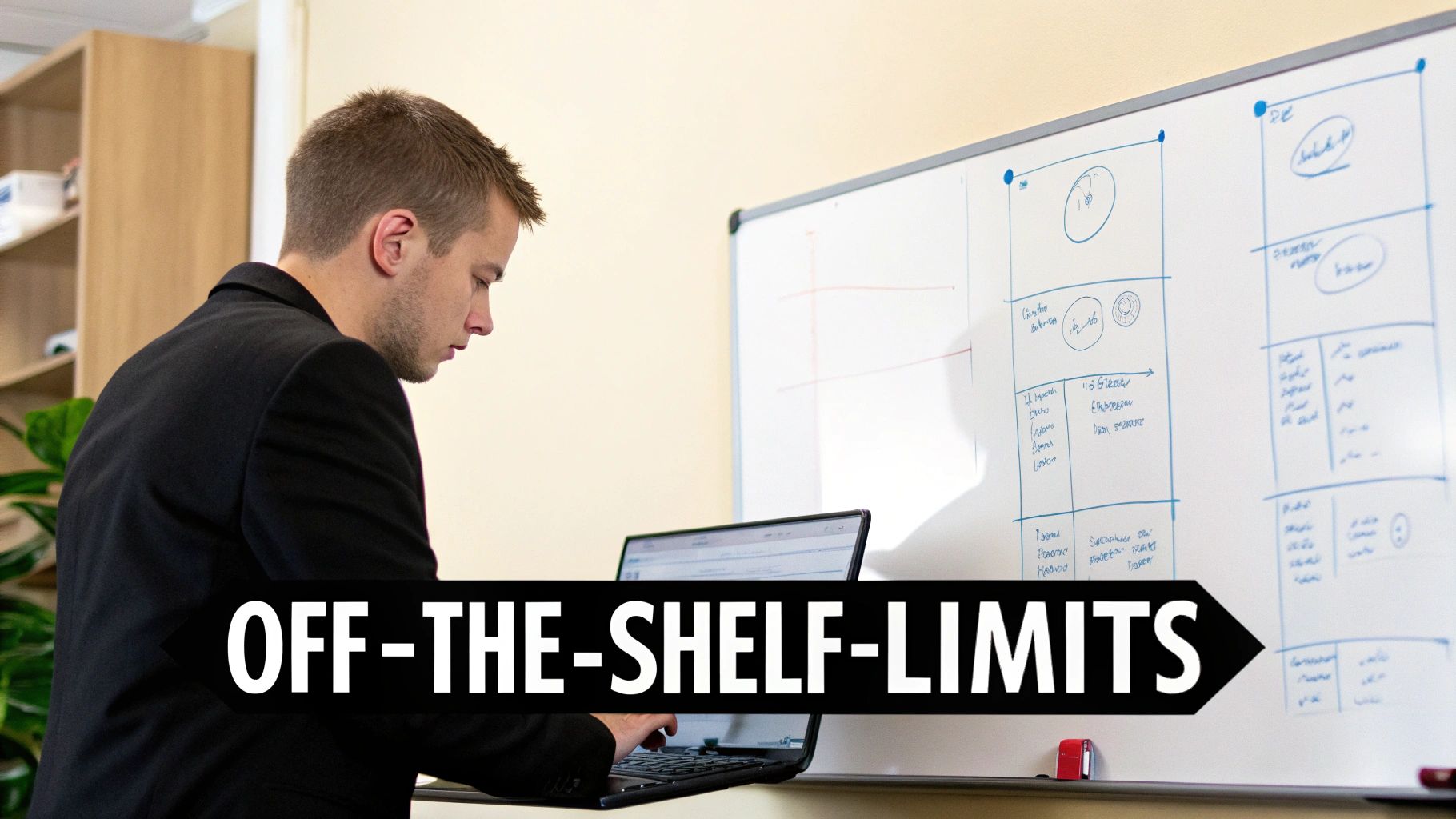
Manual data entry, endless spreadsheet reconciliations, and toggling between multiple dashboards are symptoms of a larger problem. These small inefficiencies add up, stifling innovation and giving agile competitors the upper hand.
Off-The-Shelf vs Custom Software Outcomes
The difference between generic and custom software isn't about features—it's about results. Here’s how they compare in critical business areas.
Business AreaOff-the-Shelf Software OutcomeCustom Software OutcomeEfficiencyManual workarounds, time lost on routine tasksAutomated workflows, less human interventionData IntegrationDisconnected silos, repetitive exportsUnified data layer, real-time insightsUser ExperienceGeneric interfaces, lower adoption ratesIntuitive UI, tailored to user rolesScalabilityLicense tiers and feature gatesModular architecture, grows with youDecision-MakingLag in reports, outdated dashboardsDynamic analytics, proactive alerts
The takeaway is clear: custom software is built to remove the exact roadblocks that are silently eroding your bottom line.
Identifying the Breaking Point
How do you know when it's time for a custom solution? Look for these real-world scenarios:
- Use Case: Logistics A logistics firm is hamstrung by a basic fleet app. It can't sync with their inventory database or calculate fuel-efficient routes, leading to costly delays and wasted resources. The outcome they need is an integrated system that cuts fuel costs and improves delivery times.
- Use Case: Retail A retailer's generic e-commerce platform can't support a custom loyalty program, a key differentiator for their brand. They're losing customers to competitors with more personalized experiences.
- Use Case: Operations Cross-functional teams spend hours each week manually reconciling data between sales, marketing, and finance spreadsheets instead of focusing on strategic initiatives.
Each scenario highlights a ceiling imposed by off-the-shelf tools—a ceiling that custom software is designed to break through.
The decision to build custom software is rarely about adding features. It’s about removing business constraints and unlocking revenue that is currently trapped by inflexible technology.
The Market Shift Towards Custom Solutions
Companies are increasingly investing in bespoke technology because they recognize that their unique processes are a competitive advantage. The global custom software development consulting market is projected to grow from USD 43.21 billion in 2024 to USD 53.02 billion in 2025, a surge driven by businesses demanding solutions tailored to their specific operational needs.
Engaging custom software development consultants is a strategic investment in agility and efficiency. When one-size-fits-all no longer fits, building your own tools is the smartest path forward.
Translating Business Goals Into a Project Blueprint
Hiring consultants without a clear business outcome is a recipe for failure. The conversation shouldn't start with "We need a mobile app," but with "How can we increase customer retention by 20%?" This outcome-first approach aligns stakeholders and transforms a potential cost center into a strategic investment.

Defining the "why" before the "what" ensures you build a solution that delivers real commercial value, not just a technically sound but ultimately useless application.
From Vague Ideas to Actionable Requirements
The best projects begin with focused conversations that uncover the true business need. Steer stakeholders away from listing features and toward describing desired outcomes.
Ask questions that tie directly to business value:
- Process Improvement: "Which manual task consumes the most staff hours, and what is the dollar value of automating it?"
- Customer Experience: "What is the single biggest point of friction in our customer journey that software could eliminate?"
- Revenue Growth: "How can this system help our sales team identify and act on cross-sell opportunities more effectively?"
- Data-Driven Decisions: "What critical business question can't we answer today because our data is siloed?"
These questions transform a generic request for a "reporting dashboard" into a specific need for a system that provides real-time inventory alerts, preventing stockouts that cost the company $50,000 a month. That is a problem a consultant can solve.
The success of a custom software project is measured by its impact on the business, not the number of features it contains. A project blueprint rooted in clear, measurable outcomes is the single greatest predictor of a positive ROI.
Distinguishing Must-Haves from Nice-to-Haves
Once outcomes are clear, ruthlessly prioritize features. For every proposed function, ask: "Does this directly help us achieve our primary business goal?" This focus ensures you build a Minimum Viable Product (MVP) that delivers value quickly.
Use Case: A Logistics Company's Driver App
A fleet management company wanted to build a new driver app to cut fuel costs by 15% and improve on-time delivery from 88% to 95%.
- Initial Request: An all-in-one app with dozens of features, including gamification and social messaging.
- Outcome-Focused Goal: Reduce fuel costs and improve delivery rates.
- Must-Have MVP Features:
- Real-time route optimization based on live traffic.
- Automated delivery confirmation with photo capture.
- Simple geofencing alerts for arrivals.
- Nice-to-Have Features (Phase 2):
- Driver-to-driver messaging.
- Advanced performance leaderboards.
By focusing on the core business outcomes, the company launched an MVP in three months that generated an immediate ROI. The "nice-to-have" features were added later, funded by the savings the initial version created. This lean approach lets you vet custom software development consultants based on their ability to solve business problems, not just write code. You can learn more about how concepts become reality by exploring the role of wireframes in the path from concept to completion.
How to Vet a Consultant's Real-World Expertise
Choosing the right partner is about more than technical skills. You need a strategic ally who understands why you're building software and can help you achieve your business goals. Your vetting process should be designed to uncover their problem-solving abilities and strategic thinking.

Dig deeper than the sales pitch to see how they react under pressure and whether they can translate your challenges into valuable technology.
Beyond the Technical Checklist
Any decent firm can list their tech stack. To find a true partner, ask questions that reveal their problem-solving approach.
Instead of asking, "Do you know Snowflake?" try these outcome-focused questions:
- "Tell us about a project where the client's initial requirements were unclear. How did you work with them to define a focused MVP and what was the outcome?"
- "Describe a time a project's scope had to pivot due to a market shift. How did you adapt, and what was the result for the client?"
- "Show us a project where you balanced aggressive scalability needs with a tight initial budget. What trade-offs did you recommend and why?"
Their answers will reveal their communication style, risk management approach, and ability to stay focused on business value when challenges arise.
Assessing Industry and Project Management Acumen
A consultant's project management process is as critical as their code. An Agile methodology is essential for custom projects, as it allows for flexibility and iterative feedback, preventing you from investing heavily in a solution that misses the mark.
Ask directly about their process:
- How do you structure development sprints?
- What tools do you use for communication and progress tracking?
- How often will our team see demos and provide feedback?
A great partner will have a transparent process that involves your team every step of the way. Vague or rigid answers are a major red flag.
The best custom software development consultants don't just build what you ask for. They challenge your assumptions and bring new ideas to the table. They become an extension of your team, not just a vendor executing a statement of work.
From Portfolios to Strategic Partnerships
When reviewing a consultant's portfolio, look beyond slick screenshots. Ask to see success stories relevant to your industry or the specific problem you're solving.
Look for evidence of long-term client relationships. A history of multi-year partnerships indicates they are trusted strategic advisors, not just one-off project implementers. This is the kind of partner you want—one focused on delivering sustained value.
Spotting a True Partner vs. a Code Factory
Ultimately, you need to determine if a consultancy is a "code factory" that simply executes instructions or a strategic partner that co-creates solutions.
Here’s how to tell the difference:
Strategic PartnerCode FactoryAsks probing questions about your business goals and KPIs.Focuses exclusively on technical specs and features.Suggests alternative approaches that could save time or money.Accepts requirements without challenge or creative input.Prioritizes features based on their potential business impact.Builds features in the order they are listed in the SOW.Proactively communicates about risks, challenges, and opportunities.Provides updates only when asked and is reactive to problems.Measures success by your business outcomes (e.g., increased revenue).Measures success by delivering code on time and on budget.
Choosing the right custom software development consultants is a critical business decision. By focusing your vetting process on real-world expertise and a strategic mindset, you'll find a partner who will not only build great software but also help drive your business forward.
Structuring the Right Financial Engagement
Getting the financial framework right is as important as vetting technical skills. The engagement model you choose dictates budget, scope flexibility, and the overall tone of your partnership. The right model builds trust and transparency; the wrong one creates friction.
https://www.youtube.com/embed/B7YjIGZiA-Q
The three common models—Fixed Price, Time & Materials, and Dedicated Team—are not one-size-fits-all. Align the financial structure with your project's goals and your company's risk tolerance.
The Fixed Price Model: Predictability at a Cost
A Fixed Price model offers budget certainty for projects with a locked-in, unchanging scope. It's ideal for a well-understood Minimum Viable Product (MVP) or a simple internal tool where every feature is already mapped out.
Use Case: Logistics MVP A delivery company needs a proof-of-concept app for drivers to confirm drop-offs with a photo. The scope is small and completely defined. A Fixed Price model is perfect here, as it eliminates budget risk for a project with no variables.
However, its strength is its weakness. Any change requires a formal, time-consuming change order, stifling innovation. This rigidity makes it unsuitable for projects requiring flexibility and exploration.
Time & Materials: Flexibility for Evolving Projects
Under a Time & Materials (T&M) model, you pay for the actual hours worked. This provides maximum flexibility, making it ideal for agile projects where requirements evolve based on user feedback and market changes.
The choice between Fixed Price and T&M is a trade-off between budget certainty and project flexibility. Neither is better; they solve for different business priorities.
Use Case: E-commerce Platform A retail brand is launching a new e-commerce site. The initial version needs a product catalog and checkout, but future features like a loyalty program will be determined by user testing. T&M allows them to adapt their roadmap based on real data, ensuring they build a platform customers love.
Dedicated Team: An Extension of Your Own
The Dedicated Team model is a long-term strategic alliance. You engage a complete, cross-functional team (developers, designers, PMs) that works exclusively on your projects for a monthly retainer. This is best for large-scale, ongoing development where deep institutional knowledge is a competitive advantage.
Choosing the Right Engagement Model
Here’s a breakdown to help you choose:
ModelBest ForRisk LevelTypical PricingFixed PriceSmall, well-defined projects with zero scope ambiguity (e.g., MVPs).Low (for budget) / High (for flexibility)One-time project fee.Time & MaterialsAgile projects with evolving requirements and a need for flexibility.Medium (budget can fluctuate)Billed hourly or daily rates.Dedicated TeamLong-term, complex projects needing deep integration and ongoing support.Low (predictable monthly cost)Monthly retainer fee.
Choosing the right model ensures financial incentives are aligned with your project's reality, setting up you and your custom software development consultants for a successful partnership.
Structuring Your Partnership For Success
A successful partnership requires a clear framework that aligns expectations, responsibilities, and measures of success. A robust Statement of Work (SOW) and a detailed Service Level Agreement (SLA) are your project's constitution and performance handbook, turning high-level goals into concrete milestones.

Skipping this step is a common cause of scope creep, budget overruns, and strained relationships.
The Power Of A Paid Pilot Project
Before committing to a long-term contract, run a small, paid pilot project. This is the single best way to de-risk your investment. It allows you to see the team in action—how they communicate, solve problems, and fit with your culture.
Use Case: A Paid Pilot Showdown A logistics company needed a new delivery confirmation feature. They commissioned a four-week paid pilot with two consulting firms to build a working prototype.
- Team A delivered a functional but clunky prototype.
- Team B delivered a seamless prototype and suggested a workflow improvement that cut three clicks per delivery.
Team B won the contract because they demonstrated a focus on business outcomes, not just on completing the technical task. Data-driven proof from a pilot always beats a sales pitch.
Non-Negotiables For Your SOW And SLA
Your SOW and SLA must be crystal clear. Here are the essentials:
- Intellectual Property (IP) Rights: The contract must state that your company owns 100% of the IP and source code. No exceptions.
- Clear Acceptance Criteria: Define "done" with measurable benchmarks (e.g., "User login authenticates in under 500ms").
- Data Security & Compliance: Specify all applicable standards (GDPR, HIPAA, SOC 2) and assign responsibility for securing data.
- Change Control Process: Formalize how scope changes are handled to prevent surprise costs. Every adjustment must be documented and signed off.
- Support & Maintenance Terms: Define post-launch support, including bug-fix response times, uptime guarantees (e.g., 99.9% availability), and update schedules.
A strong SOW and SLA are your best insurance against misunderstandings. They align both parties on the definition of success before the first line of code is written, creating a framework for transparency and mutual accountability.
By structuring these legal and operational guardrails, you transform a vendor relationship into a true collaboration focused on delivering measurable business impact.
Got Questions About Hiring a Consultant? Let’s Clear Things Up.
Hiring a custom software development consultant is a high-stakes decision. You're not just buying a service; you're investing in a strategic partner. It’s natural to have questions about cost, ownership, and red flags. Getting straight answers is key to making a confident choice.
What’s This Going to Cost, Really?
Costs vary based on location, expertise, and project complexity. Offshore developers might charge $50/hour, while a specialized onshore team could be $300/hour. A simple proof-of-concept may cost $25,000–$75,000, whereas a full enterprise system can exceed $500,000.
LocationHourly RangeTypical Project SizeOffshore$50–$100$20,000–$200,000Nearshore$75–$150$30,000–$300,000Onshore Specialized$200–$300$100,000–$1M+
Pro-tip: Focus on ROI, not the hourly rate. A higher rate that delivers significant business value is a better investment than a low rate that produces a failed project.
Do I Need a Freelancer or a Full Firm?
A freelancer is suitable for a small, well-defined task. For anything more substantial, a firm is the better choice. A firm provides a complete team—project managers, UX/UI designers, and QA analysts—offering the strategic oversight and scalability that complex projects require.
Who Owns the Intellectual Property (IP)?
This is non-negotiable: You must own 100% of the intellectual property. Ensure your legal team reviews the contract to confirm that all IP and source code are assigned to your company, with no hidden licensing fees or retained rights.
What Are the Big Red Flags?
You can spot a poor partner if you know what to look for. Beware of:
- Vague proposals that lack detailed cost breakdowns.
- An inability to provide relevant case studies or client references.
- Pressure to sign a contract without a proper discovery phase.
- A sales process that focuses on technical jargon instead of your business outcomes.
My Go-To Evaluation Checklist:
- Get detailed proposals from at least three firms.
- Always ask for—and call—client references.
- Run a small, paid pilot project to see them in action.
- Ensure alignment on the KPIs that define success.
A Quick Real-World Example
A mid-market retailer ran a two-week paid pilot with three potential firms. One team returned with a functional prototype that included unsolicited UX improvements. These tweaks ultimately cut user errors by 45%. The pilot provided clear, data-driven proof of which partner was focused on delivering business outcomes, making the final choice easy and leading to a 30% faster customer onboarding process post-launch.
Making the Final Call
Use a simple decision matrix to score each firm on your key criteria: cost, relevant expertise, communication, and cultural fit. This structured approach turns gut feelings into data, helping you make a strategic choice.
- Define your KPIs and scoring system.
- Compare proposals side-by-side.
- Incorporate notes from reference checks.
This process ensures you select a partner that aligns with both your budget and your long-term business goals.
Ready to find that partner? Explore Faberwork’s approach and download our vetting checklist at faberwork.com. Our team of 50 engineers and SnowPro certified experts is ready to help guide you through a successful pilot.


