A custom software development company designs, builds, and maintains software applications tailored to an organization's specific needs and business outcomes. Instead of forcing your business to fit off-the-shelf software, you get a solution built to match your workflows, accelerate your goals, and give you a distinct competitive advantage.
When Off-the-Shelf Software Hits a Wall

Generic software often seems like a quick fix, but it frequently creates more problems than it solves. Forcing unique business processes into a rigid, pre-built box leads to operational bottlenecks, frustrated teams, and stalled growth. The very efficiency you sought is sacrificed.
The limitations become clear in practice. For example, a logistics company using a standard CRM can't integrate its specialized routing algorithms or fleet management tools. The outcome is manual data entry, a spike in human error, and costly delivery delays—the exact problems technology is meant to prevent. This is where a custom solution delivers a measurable ROI.
The True Cost of "Good Enough" Solutions
The real cost of off-the-shelf software isn't the subscription; it's the lost opportunity and inefficiency. When tools don’t support how your team works, they invent cumbersome workarounds, killing productivity and opening security holes. These small frictions compound, putting you at a major disadvantage.
This is when partnering with a custom software development company becomes a strategic imperative. The goal is to build a tool that delivers specific outcomes.
- Outcome: Automate Complex Workflows. A custom system mirrors your exact business logic, eliminating manual steps. A financial firm could build an app that automates 95% of its compliance checks, freeing up analysts for high-value strategic work.
- Outcome: Create Unique Customer Experiences. A bespoke e-commerce platform can offer personalized recommendations far beyond what a generic Shopify plugin can do, directly increasing customer lifetime value.
- Outcome: Achieve Seamless Integration. A manufacturer can build a custom dashboard that pulls data from production-line sensors, ERP systems, and supply chain software into a single view, enabling real-time decision-making.
Choosing custom software isn’t about buying features; it's about driving outcomes. The right solution directly tackles your core business challenges and unlocks measurable growth that off-the-shelf products simply can't deliver.
From Tactical Fix to Strategic Advantage
Moving to custom development is a shift from tactical problem-solving to strategic asset-building. You're no longer plugging holes with temporary fixes. You're creating a scalable tool that grows with your business and provides a lasting competitive advantage.
The right software partner doesn't just write code; they engineer a solution designed to achieve your business objectives. This guide will show you how to find that partner.
Defining Your Project Scope and Core Needs
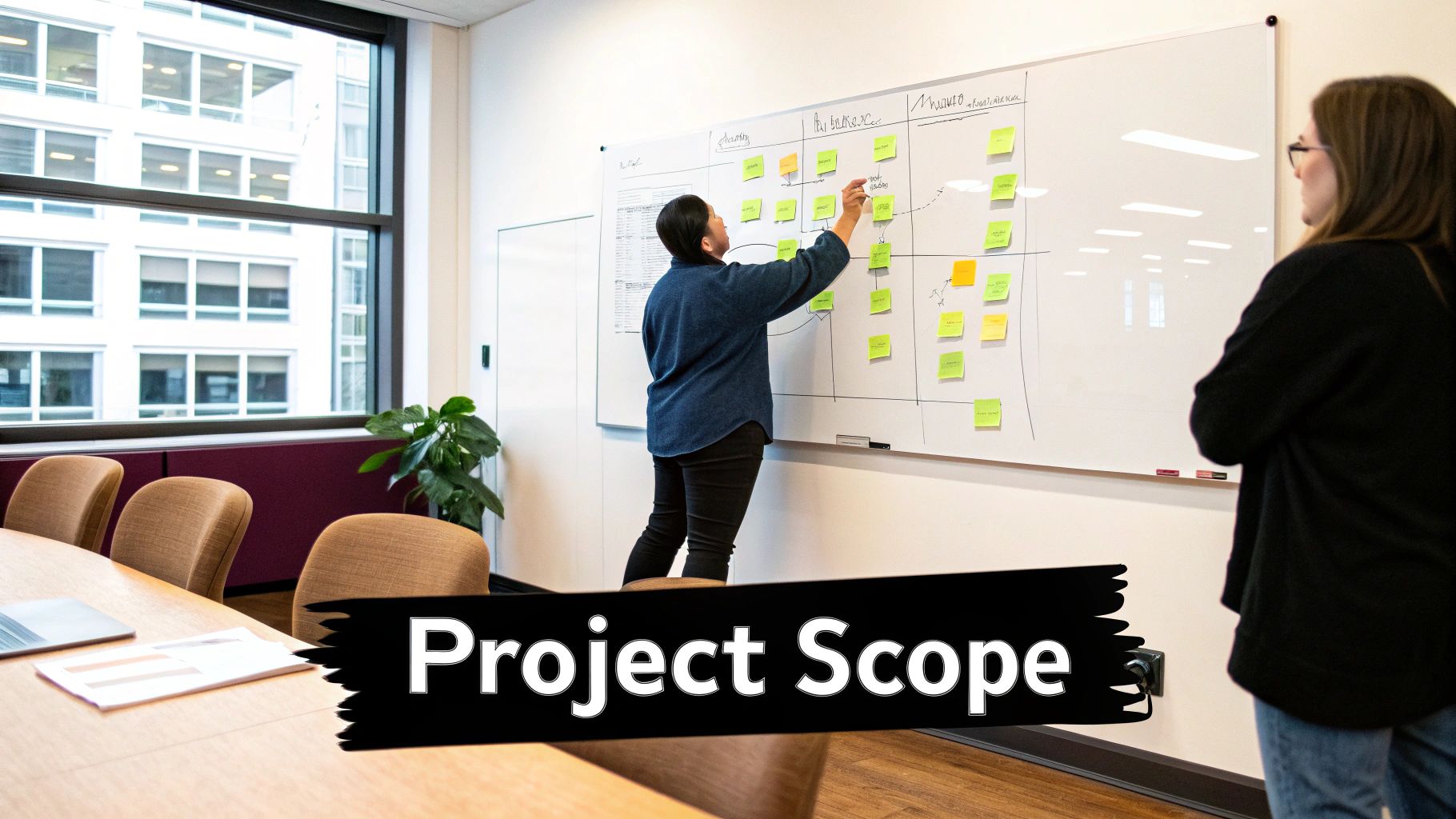
Before contacting a custom software development company, you need a clear vision of what you’re building and why. A well-defined scope is the bedrock for productive conversations, preventing misunderstandings, blown deadlines, and budget overruns.
You must translate broad goals into specific requirements. "We need a better CRM" is too vague. A better goal is: "We need a CRM that reduces our sales team's data entry time by 50% by automating lead capture from all social channels." This sharp, outcome-focused goal prevents scope creep and keeps the team focused on delivering business value.
Capturing Essential Requirements Through Stakeholder Interviews
The real requirements for your project live with the people who will use the software every day. Conduct thorough interviews with stakeholders from all relevant departments—from managers to frontline employees and even customers.
Ask outcome-focused questions. Instead of, "What features do you want?" ask, "What task eats up most of your time that a computer could do?" or "What is the biggest bottleneck in your current workflow?"
For example, a logistics manager won't ask for a "geofencing alert system." They will describe the costly problem of drivers going off-route. Your job is to translate that business pain into a technical requirement that solves it. This approach ensures the final product addresses real-world challenges and delivers tangible improvements.
Distinguishing Must-Haves from Nice-to-Haves
Once you have a list of desired features, you must prioritize. The MoSCoW method (Must-have, Should-have, Could-have, Won't-have) is an effective framework for this.
- Must-Haves: Non-negotiable features for the first version. A field service app must have job scheduling and real-time location tracking to be viable.
- Should-Haves: Important features that add significant value but aren't critical for day one. For the service app, an offline mode for technicians in low-connectivity areas would be a "should-have."
- Could-Haves: Desirable features that can wait. A dashboard with historical performance analytics could be added later.
- Won't-Haves: Features explicitly excluded from the initial scope to maintain focus.
This process creates a phased roadmap. You launch a powerful Minimum Viable Product (MVP) first, get it into users' hands, and gather feedback before investing in secondary features. This de-risks the project and ensures you're building what users actually need.
Approaching a development partner with this level of clarity demonstrates you've done your homework and allows them to provide a much more realistic estimate.
Planning for Future Growth and Scalability
A common mistake is building software that only solves today’s problems. Your business is dynamic, and your software must be built to scale with it. Think a few years ahead: Will your user base double? Will you expand into new regions?
Discuss scalability upfront. A retail company building an e-commerce platform must plan for holiday traffic spikes. A good vendor will propose a scalable cloud architecture, not a limited on-premise server that will buckle under pressure. Building for future growth ensures your investment remains valuable for years to come.
Evaluating Technical Skills and Industry Insight

A slick website and sales pitch are easy to create. The true test of a partner is their technical depth and genuine understanding of your industry. You're not just hiring coders; you're entrusting a core part of your business to a team that must grasp both the technology and the real-world context where it will operate.
A top-tier custom software development company can demonstrate how they've used specific technologies to solve complex business problems, whether it's building AI-driven automation, architecting a data platform on Snowflake, or creating a seamless mobile app. The custom software market is projected to reach USD 334.49 billion by 2034, driven by advancements that make deep technical expertise more critical than ever.
Moving Beyond The Portfolio
Case studies show the "what," but you need to understand the "how" and "why." Ask pointed, open-ended questions that force them to go beyond their marketing materials.
Instead of, "Have you worked with AI?" try being specific to your use case:
- "We need to automate our customer support triage. Describe a project where you implemented an Agentic AI workflow to handle a similar task. What was the outcome in terms of response time and agent workload reduction?"
- "Our goal is to consolidate sales data from five different sources. Walk me through how you’ve used Snowflake to build a single source of truth for a client and the business intelligence improvements they saw."
- "We want to reduce our app's bug rate by 40% before each release. Detail a test automation strategy you implemented that achieved this kind of result. What frameworks did you use?"
Their answers reveal their problem-solving capabilities. The best partners discuss trade-offs, challenges, and lessons learned, demonstrating battle-tested experience.
A great partner explains technical complexity in terms of business outcomes. If they get lost in jargon without connecting it back to your goals, it’s a major red flag that they may not see the bigger picture.
The Critical Role of Domain Knowledge
Technical skill alone is not enough. A team that understands your industry's regulations, competitive pressures, and customer expectations will deliver a superior product faster.
Use Case: Healthcare. A healthcare startup needs a patient data app. A generic developer might build a functional app. But a partner with deep HIPAA compliance knowledge will build security and privacy into the architecture from day one, preventing a potential compliance disaster. They’ll understand clinical workflows, resulting in a user experience that feels intuitive and drives adoption among medical staff.
Industry knowledge is non-negotiable in many fields:
- Finance: Understanding regulations like PCI DSS for payment processing.
- Logistics: Grasping the complexities of route optimization and supply chain visibility to reduce fuel costs and delivery times.
- Manufacturing: Familiarity with concepts like Overall Equipment Effectiveness (OEE) to increase production output.
This specialized knowledge accelerates development because you spend less time explaining your business fundamentals. The right partner already speaks your language. When reviewing potential vendors, check their custom software development services to see if their expertise aligns with your industry needs. Your goal is to find a partner who brings not just code, but context.
Key Technology Expertise Checklist
Use this checklist to systematically evaluate a partner's technical capabilities during your conversations.
Area of ExpertiseKey Questions to AskWhat to Look For (Red Flags & Green Flags)Agentic AI- "Describe your process for training AI agents to achieve a specific business outcome, like lead qualification."
- "How do you handle unexpected agent behavior to ensure it doesn't negatively impact the user experience?"Green Flag: Discusses specific frameworks (e.g., LangChain, AutoGen), monitoring strategies, and human-in-the-loop processes for quality control.
Red Flag: Gives vague answers about "using AI" without detailing the mechanics.Snowflake- "Walk me through a data architecture you designed on Snowflake. How did it help the client achieve faster reporting and lower data processing costs?"
- "How have you implemented data sharing and governance for multiple business units?"Green Flag: Talks about cost optimization (e.g., warehouse sizing), role-based access control (RBAC), and specific features that solve business problems.
Red Flag: Only mentions it as a database they've used, with no architectural depth.Mobile/Web- "For our goal of reaching the widest audience, which cross-platform framework would you recommend and why?"
- "How do you ensure a consistent user experience that drives high engagement across all devices?"Green Flag: Discusses trade-offs between native, React Native, or Flutter and talks about responsive design and performance testing.
Red Flag: Pushes one technology for everything, regardless of the project's needs.Test Automation- "What's your approach to the testing pyramid? How do you balance different tests to maximize code quality and release speed?"
- "Show me an example of a test automation report. How do you track metrics that matter, like bug escape rates?"Green Flag: Mentions specific tools (e.g., Selenium, Cypress, Playwright) and can explain how automation improved a past project's ROI.
Red Flag: Vague about their process or treats testing as an afterthought.
This framework helps you drill down into the technical details that truly matter. You're looking for evidence of deep, practical experience, not just a list of buzzwords.
Comparing Engagement Models and Pricing
Finding the right custom software development partner isn’t just about their tech stack; it's about finding a commercial model that fits your project's reality. The engagement model you pick drives everything from budget predictability to your team’s ability to pivot. It’s crucial to understand the trade-offs.
This is where you shift from the "what" of your project to the "how" of your partnership. The right model builds a transparent, successful financial relationship. The wrong one? It can lead to friction, missed expectations, and painful budget overruns. Let's dig into the common models with some real-world context.
Fixed Price Contracts
The Fixed Price model is exactly what it sounds like: one price for a clearly defined scope of work. It’s a favorite for finance departments because it offers what seems like perfect budget certainty.
This model works best for smaller, well-understood projects where the requirements are set in stone. Think about building a simple Minimum Viable Product (MVP) or a marketing microsite with features you can document from A to Z before any code is written. If there’s zero ambiguity, Fixed Price can be a solid choice.
But its greatest strength is also its greatest weakness. The rigidity means any change, no matter how small, triggers a formal change request. And that usually means more cost and more delays.
A Fixed Price model locks in the cost, but it also locks in the scope. It’s great for projects with zero ambiguity but can become a bottleneck when you need the flexibility to innovate or react to user feedback.
Time and Materials Flexibility
With a Time & Materials (T&M) model, you pay for the actual hours the development team puts into your project. This approach gives you maximum flexibility, which is exactly what you need for complex, long-term projects where requirements are guaranteed to evolve.
Imagine you’re building a new enterprise platform where user feedback will heavily shape the final product. A T&M model lets you pivot, add features, and reshuffle priorities sprint-by-sprint without getting bogged down in contract renegotiations. You're paying for the team's brainpower and time, not a rigid checklist of deliverables.
Of course, this flexibility requires more trust and involvement from your end. You have to be in the driver's seat, managing the backlog and prioritizing tasks to make sure the team is always focused on what delivers the most business value. The whole thing hinges on transparent communication and regular check-ins to keep the budget on track.
Dedicated Team Integration
The Dedicated Team model is the deepest form of partnership. Here, the custom software development company provides a full crew—developers, QA engineers, project managers—who work only on your projects. They effectively become an extension of your in-house team, sinking into your processes and culture.
This is the best route for long-term, large-scale product development or for companies that need to beef up their internal capacity without the headache of direct hiring. For example, a fintech firm that needs to constantly innovate its core trading platform would benefit hugely from a dedicated team that builds deep domain expertise over months and years.
This model builds a real sense of ownership and can lead to major productivity wins. The team isn't just checking off tasks; they become strategic partners who get your business goals and proactively bring ideas to the table. It's no surprise that over 83% of companies now use custom software. This is largely driven by long-term savings of 30-50% from ditching licensing fees, making dedicated teams a smart play for continuous development. You can get more details on software development trends from Mindinventory.com.
Vetting Partners and Identifying Red Flags
You have a shortlist. Now, you must separate true partners from polished pretenders. This is where you move past the sales pitch and discover what it’s really like to work with a potential custom software development company. Diligence at this stage prevents costly mistakes later.
You're trying to get a feel for their communication style, problem-solving approach, and project management discipline. A slick portfolio means nothing if the team behind it is a disorganized mess.
Digging Deeper than Case Studies
Case studies are marketing materials. To get the real story, talk to their past or current clients. A reputable firm will happily provide references.
When you speak with a reference, ask pointed questions to understand the working relationship:
- "How did the team handle unexpected roadblocks or changes in project scope?"
- "Describe their communication process. Did you always feel informed about progress?"
- "Did the project achieve the intended business outcome on time and on budget? If not, why?"
- "What was the single biggest strength of their project manager?"
The answers will reveal more about their process and reliability than any case study. When reviewing their portfolio, look for measurable business impact—did the software increase revenue, cut operational costs, or improve efficiency?
A great partner is proud of their process, not just their final product. They should be transparent about how they manage projects, who will be on your team, and how they handle challenges when they inevitably arise.
Common Red Flags to Watch Out For
As you finalize evaluations, certain warning signs should give you pause. Spotting these early can save you from a doomed partnership.
High-pressure sales tactics often mask a lack of substance. A competent team will give you space to make an informed decision. Be wary of any company that is cagey about who will be on your team. You have the right to know their experience level and location. A refusal to share this or provide client references is a dealbreaker.
Other critical red flags include:
- Vague technical answers: If they can't clearly explain how they'd approach your specific challenges, they may lack the necessary expertise.
- A "one-size-fits-all" approach: A good partner listens first, then proposes a tailored solution, not a pre-packaged tech stack.
- Poorly written proposals: A proposal with typos or generic language suggests a lack of attention to detail that will likely extend to their development work.
- No questions for you: A strong partner will interview you as much as you interview them. They need to understand your business to build an effective solution.
The custom software market is booming, with enterprises comprising roughly 61% of the market share in 2024. More options make this vetting process more critical. You can read more about the custom software development market forecast on codewave.com.
Being methodical and observant during this final stage helps you choose a genuine strategic partner. Digging into a team's history can also offer some great insight; feel free to learn more about the story behind our team at Faberwork.
Building a Strong and Successful Partnership

Signing the contract is the starting line, not the finish. The quality of your partnership with the custom software development company will determine the project's success. A strong launch sets the tone, shifting the relationship from vendor-client to a true strategic alliance.
The first few weeks are about establishing a shared rhythm. This involves structured onboarding and detailed knowledge transfer sessions so the development team understands your business logic, existing systems, and long-term goals.
Establishing Clear Communication and Roles
Great collaboration depends on clear, consistent communication. Establish dedicated channels from day one to avoid productivity-killing delays.
- Dedicated Slack Channel: A shared space for quick questions, daily updates, and informal problem-solving keeps communication fluid and transparent.
- Recurring Demos: Schedule weekly or bi-weekly demos where the team shows what they’ve built. This makes progress tangible and creates a natural feedback loop.
- Defined Roles: Clearly document who is responsible for what. A simple roles and responsibilities matrix eliminates confusion and creates accountability.
This structure removes ambiguity. Everyone knows who to contact when a problem arises, leading to faster resolutions and keeping the project on track.
A partnership thrives on transparency and a shared definition of success. Without agreed-upon metrics, you're just hoping for the best. With them, you're engineering a predictable and positive outcome.
Defining and Measuring Success
You and your partner must agree on what success looks like. Define a set of Key Performance Indicators (KPIs) to track progress and quality. These metrics must be quantitative, measurable, and tied directly to your business goals.
For instance, instead of aiming for "good code," track specific metrics that tell a real story:
- Code Quality Scores: Use tools like SonarQube to measure code complexity, duplication, and potential bugs.
- Sprint Velocity: In an Agile framework, this metric shows how much work the team completes each sprint, helping forecast delivery timelines.
- Budget Adherence: Regularly compare actual spend against the budget to catch deviations early.
- Cycle Time: Measure how long it takes for a task to go from "in progress" to "done." A decreasing cycle time indicates improving efficiency.
By setting these KPIs from the outset, you build a framework for objective, data-driven conversations. Progress reviews become focused on real performance, ensuring your investment delivers the powerful results you need.
Burning Questions About Custom Software Partners
Walking through the process of choosing a partner always kicks up some important questions. Getting straight answers is the only way to feel confident you're making the right call. Here are a few of the big ones we hear all the time.
What's the Real Cost of Custom Software Development?
This is the classic "it depends" answer, but for good reason. The price tag swings wildly based on how complex the project is, the size of the team you need, and the tech they'll be using. A simpler app might get off the ground for around $50,000, but a full-blown enterprise system can easily push past $500,000.
Your choice between a Fixed Price or Time & Materials model will also make a huge difference. The key is to demand a detailed cost breakdown. You need to see exactly where your money is going to avoid any nasty surprises down the road.
A partner worth their salt will give you a transparent estimate. It should clearly map out the costs for every single phase, from the initial discovery and design all the way to deployment and support.
How Long Does a Custom Software Project Actually Take?
The timeline is a direct reflection of the project's scope. If you're building a focused Minimum Viable Product (MVP), you could be looking at a launch in as little as 3-6 months.
For more ambitious, enterprise-grade software with a ton of features and integrations, you need to be more patient. These projects typically stretch from 9 months to a few years. The biggest levers on the schedule are the project's complexity, the number of developers on it, and the methodology you're using, like Agile.
Who Owns the Intellectual Property?
This one is a deal-breaker and needs to be sorted out before a single line of code is written. The standard, and frankly the only acceptable answer, is that the client—the one paying the bills—owns 100% of the intellectual property (IP).
That ownership must cover everything: all the source code, every design file, and any other asset created for the project.
Don't Sign Anything Without Checking These IP Clauses:
- Ownership Transfer: The contract must have a clause explicitly stating that all IP transfers to you once you've paid.
- Third-Party Components: Get clarity on the licensing for any outside tools or libraries they plan to use. You don't want someone else's licensing issue becoming your problem.
- Confidentiality: A rock-solid non-disclosure agreement (NDA) is a must to protect your ideas and business data.
Getting this all in writing isn't just a formality; it's essential for protecting your investment and preventing massive headaches later on.


