Custom enterprise software development is the strategic choice for businesses aiming to operate at their peak potential. While off-the-shelf software forces you to adapt your processes to its limitations, a custom solution is meticulously crafted to fit your company’s unique workflows, solve specific challenges, and accelerate your goals. It’s not just a tool; it’s a competitive asset.
From Generic Tools to Strategic Assets
Many businesses eventually hit a wall with pre-packaged software, finding themselves twisting proven workflows to fit a generic tool's constraints. This is the moment custom enterprise software development transitions from a cost to a critical investment in growth. It’s about building a strategic asset designed to produce tangible business outcomes.
You stop compromising and start building a system that solves your specific problems. The global market for custom software is projected to reach USD 146.18 billion by 2030, with enterprise solutions making up over 60% of that demand. You can explore data on this growth from recent industry analysis.
The Focus on Business Outcomes
The true measure of great custom software isn’t its feature list but its impact. The goal is to deliver tangible value that strengthens your competitive position by tackling your biggest operational headaches and unlocking new opportunities.
Companies invest in custom solutions to achieve specific outcomes:
- Increased Operational Efficiency: Automating unique, repetitive tasks frees your team to focus on high-value work. For example, a custom logistics platform could automate route planning, reducing fuel costs by 15% and freeing up dispatchers to handle more complex client needs.
- Enhanced Data Integration: A custom build connects disparate systems—like CRM, ERP, and logistics—into a single source of truth. A manufacturer, for instance, could integrate its supply chain and sales data to achieve a 30% more accurate demand forecast, cutting inventory waste.
- A Unique Competitive Edge: Build features your competitors, using off-the-shelf tools, can't replicate. A financial services firm might develop a proprietary risk analysis tool that provides clients with faster, more accurate insights, creating a powerful market differentiator.
Ultimately, custom enterprise software development is about building a durable competitive advantage. It empowers your organization to operate at its full potential by providing tools that are a perfect fit for its strategic objectives and unique operational DNA.
To make the choice clearer, it helps to see the two options side-by-side. Each path has its own set of trade-offs, and the right one depends entirely on your specific business needs and long-term vision.
Custom vs Off-The-Shelf Software at a Glance
FeatureCustom Enterprise SoftwareOff-The-Shelf SoftwareFunctionalityBuilt precisely for your specific business processes and needs.Generic features designed for a broad audience; may require process changes.Initial CostHigher upfront investment for development and implementation.Lower initial purchase or subscription cost.ScalabilityDesigned to scale with your business's growth and changing needs.Scalability is often limited by the vendor's product tiers and roadmap.IntegrationCan be seamlessly integrated with your existing systems and data sources.Integration can be complex, often requiring third-party connectors or workarounds.Competitive EdgeCreates a unique asset that competitors cannot easily replicate.No competitive advantage, as competitors can use the same software.Maintenance & SupportYou control the maintenance schedule; support is dedicated to your system.Dependent on the vendor for updates, support, and bug fixes.Time to DeployLonger, as it requires a full development lifecycle (design, build, test).Faster, as the software is ready to be installed and configured.
Choosing between custom and off-the-shelf software isn't just a technical decision—it's a strategic one. While the immediate cost of a pre-built solution is tempting, a custom application is an investment in your company's future efficiency, agility, and competitive power.
When to Invest in a Custom Solution

The right time to invest in custom enterprise software development is when your off-the-shelf tools create more problems than they solve—when workarounds become the norm and your team spends more time fighting software than doing their jobs. This isn't just a big-corporation problem; small and medium-sized enterprises (SMEs) are increasingly adopting custom solutions to gain a competitive edge. You can find more insights on the rise of SMEs in the custom software market.
Identifying the Triggers for Custom Development
How do you know you’ve hit the tipping point? These common business pains are strong indicators that a tailored solution is needed.
- Your Workflows Are Too Unique: If your competitive advantage comes from a one-of-a-kind process, forcing it into a generic tool sacrifices efficiency and value. A custom solution protects and enhances what makes you different.
- Integration Is a Nightmare: When your business runs on a patchwork of disconnected systems (CRM, ERP, etc.), manual data entry creates errors and slows you down. A custom hub can automate data flow, creating a single source of truth.
- Scalability Is a Major Concern: Packaged software often has rigid limits on users, data, or transactions. If your growth plans will exceed these limits, you need a system designed to scale with you, not hold you back.
Key Questions to Guide Your Decision
To build a strong business case, ask these pointed questions. The answers will reveal whether the upfront investment will deliver long-term returns.
- Are Generic Tools Forcing Us to Abandon Our Proven Processes? If yes, you are undermining your own efficiency. A custom solution turns your unique operational DNA into a digital asset.
- Is Our Ability to Scale Tied to Owning Our Software's IP? Owning the intellectual property means you control the roadmap. You decide when and how to adapt to market shifts, ensuring your core systems always align with your business vision.
- Do We Handle Data That Requires Strict Security and Compliance? For industries like finance or healthcare, meeting standards like GDPR or HIPAA is non-negotiable. Custom software allows you to build security and compliance directly into the architecture from day one.
A custom solution is justified when your software needs to be a source of competitive differentiation, not just a tool for operations. It’s an investment in owning your future, securing your data, and empowering your unique business model to thrive without constraints.
The Custom Software Development Lifecycle
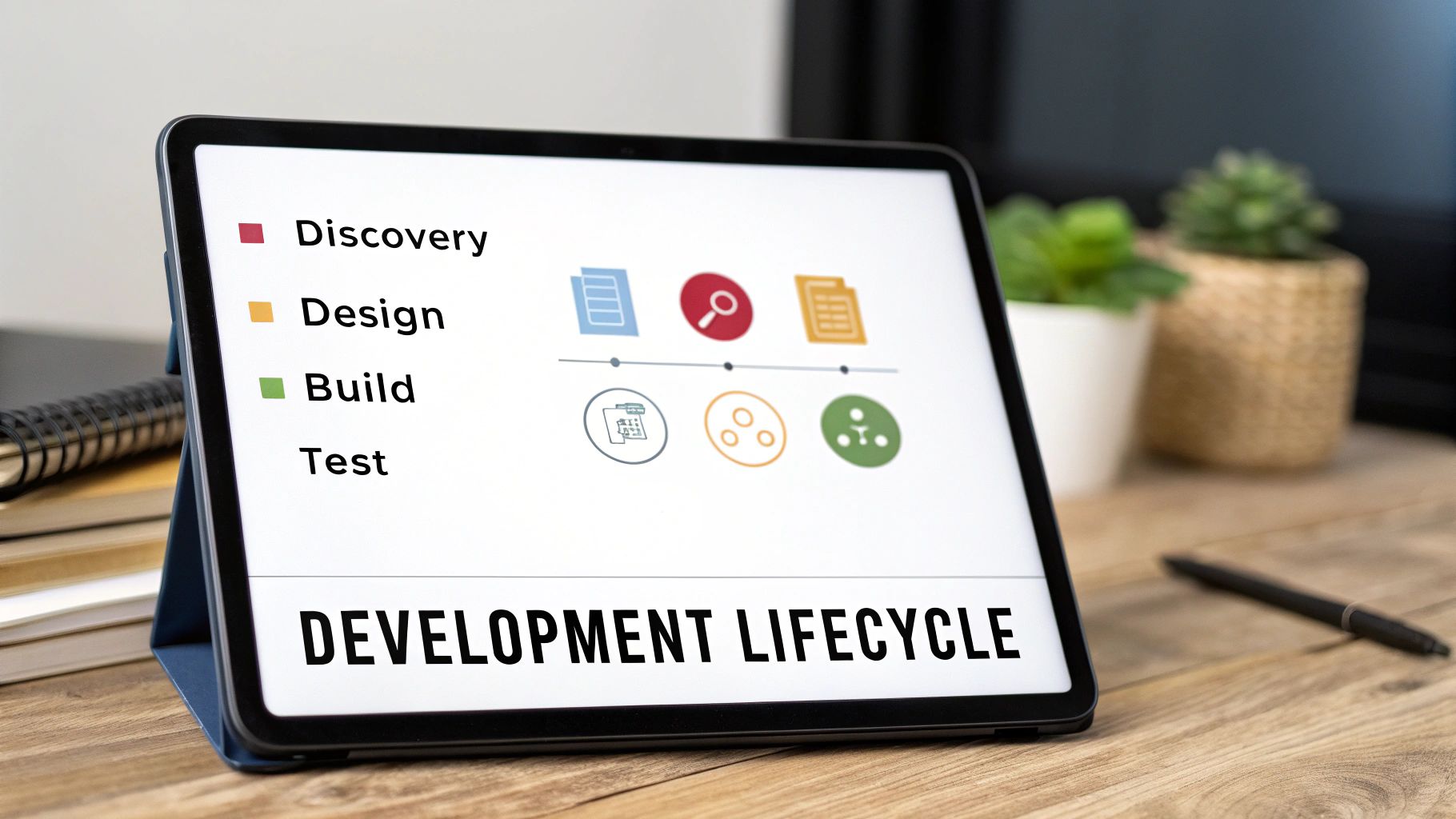
Embarking on a custom enterprise software development project follows a logical roadmap designed to turn a business concept into a high-value asset. Each stage ensures the final product solves the right problem, is built to last, and delivers a clear return on investment.
Discovery and Strategy: The Blueprint for Success
The process begins not with code, but with conversation. The Discovery and Strategy phase is crucial for defining what success looks like in measurable terms. Through collaborative workshops, stakeholders, analysts, and tech leads map workflows, pinpoint pain points, and define the project’s goals.
- Use Case: A logistics company identifies that inefficient delivery routing drives up fuel costs and hurts customer satisfaction. The discovery phase quantifies these issues and defines success as a 15% reduction in fuel consumption and a 20% improvement in on-time delivery rates. This clarity ensures the project stays focused on delivering tangible business value.
Architecture and Design: Creating a Scalable Foundation
With the "what" and "why" defined, the Architecture and Design phase translates the strategic plan into a technical blueprint. This is where key decisions about the technology stack, data structures, and integrations are made to ensure the system is built for the long haul. A solid architecture prioritizes:
- Scalability: The system must handle growth in users, data, and transactions without requiring a costly overhaul.
- Security: Security is baked into the design from day one, including data encryption, access controls, and compliance standards.
- Maintainability: The code is organized logically to simplify future updates and prevent technical debt, a concept detailed in our guide on managing technical debt in risk control.
The architectural blueprint is the software’s DNA. A strong design ensures the application is not only functional at launch but also resilient, secure, and adaptable enough to evolve with your business needs.
Agile Development and Integration: Building in Iterative Cycles
Instead of a single, high-risk push, Agile Development breaks the work into small, manageable "sprints." Each two-to-four-week sprint delivers a specific set of tested features, creating a constant feedback loop with stakeholders. This iterative approach delivers value faster, often starting with a Minimum Viable Product (MVP) to gather early user feedback.
Integrations are built and tested within these sprints. For instance, a custom CRM might pull real-time analytics from a Snowflake data warehouse or integrate Agentic AI to automate complex scheduling, ensuring all components work together seamlessly.
Quality Assurance Testing: Ensuring Rock-Solid Reliability
Running parallel to development, Quality Assurance (QA) Testing is a continuous process to ensure the application is reliable and bug-free. This multi-layered process includes:
- Functional Testing: Verifying that each feature works as specified.
- Performance Testing: Assessing system speed and responsiveness under heavy load.
- Security Testing: Actively identifying and patching vulnerabilities to protect data.
- User Acceptance Testing (UAT): Allowing end-users to confirm the software solves their problems in a real-world context.
This rigorous cycle guarantees that when the software goes live, it provides a stable and dependable experience, driving user trust and adoption.
Building for Scalability, Security, and Compliance
Every great custom enterprise software solution is built on three pillars: scalability, security, and compliance. These aren't just technical features; they are the foundational principles that protect your investment, data, and reputation. They must be woven into the software's DNA from day one to avoid costly redesigns and mitigate business risks.
Designing Software That Grows with You
Scalability means your software can handle increased demand without failing. For example, an e-commerce platform must handle a Black Friday traffic surge without crashing. A cloud-native architecture is a common strategy to achieve this, allowing the application to scale resources automatically. The cloud segment now dominates with 57% of the custom software market, a trend explored in these market trends in custom software deployment.
This cloud-first approach delivers two key business outcomes:
- Cost Efficiency: Pay only for the resources you use, avoiding large upfront hardware investments.
- Business Agility: The software scales seamlessly as your business expands into new markets or launches new products.
A Security-by-Design Mindset
A "security-by-design" approach embeds security practices into every stage of the development lifecycle. Instead of a last-minute check, developers proactively identify and mitigate potential vulnerabilities from the start.
- Use Case: A healthcare app handling sensitive patient data would implement HIPAA-compliant measures from day one. This includes threat modeling to anticipate risks, end-to-end data encryption to protect patient information, and strict access controls to ensure only authorized personnel can view records.
Adopting a security-by-design philosophy transforms security from a reactive checklist item into a core, proactive discipline. It’s the most effective way to protect sensitive data, maintain customer trust, and avoid the crippling financial and reputational damage of a data breach.
Navigating the Complexities of Compliance
Compliance means ensuring your software adheres to industry-specific laws and regulations, such as PCI DSS for financial data or GDPR for customer privacy. Non-compliance can lead to massive fines and legal risks. Custom software allows you to build compliance rules directly into the application's logic.
For instance, a custom CRM for a financial advisory firm can automate data retention policies, ensuring client data is archived or deleted according to regulatory schedules. This built-in compliance is far more reliable than manual processes and significantly reduces the risk of human error.
Core Pillars of Enterprise Software Success
This table summarizes the essential non-functional requirements, their business impact, and key implementation strategies for each, providing a quick reference guide for project planning.
PillarBusiness ImpactKey StrategyScalabilityEnsures performance under heavy load, supports business growth, and improves user experience.Adopt a cloud-native architecture, use microservices, and load-balance traffic effectively.SecurityProtects sensitive data, prevents financial loss, and builds customer trust.Implement a "security-by-design" approach, conduct regular threat modeling, and use robust encryption.ComplianceAvoids legal penalties and fines, simplifies audits, and maintains corporate reputation.Build regulatory rules directly into software logic, automate data governance, and maintain detailed logs.
By addressing scalability, security, and compliance from the start, you are not just building software; you are building a resilient, trustworthy, and future-proof business asset.
Understanding Your Investment and ROI
A discussion about custom enterprise software development must address cost, timeline, and return on investment. Viewing custom software as a strategic investment, rather than just an expense, is key. The cost depends on factors like project complexity, team size, and the number of integrations.
From Cost to Investment
The business case for a custom build moves beyond cost to focus on delivered value. Calculating the return on investment (ROI) is crucial for securing stakeholder buy-in, as it connects the project directly to bottom-line improvements.
The core idea behind ROI for custom software is simple: a successful project has to either save the business more money than it cost to build or bring in new revenue that dwarfs the initial investment.
This requires identifying specific key performance indicators (KPIs) before development begins and tracking them diligently post-launch.
How to Measure Real Business Value
The value of a custom application ripples across the entire business. To get a full picture, measure its impact across several key areas.
- Increased Operational Efficiency: Track the hours your team reclaims from automated tasks. If a new tool saves 10 employees five hours per week, you gain 200 hours of productive time monthly for higher-value work.
- Reduced Manual Errors: Quantify the cost of mistakes from manual data entry. A custom solution that automates invoicing or order fulfillment can cut costly errors by over 90%.
- New Revenue Streams: Measure income from new products or services enabled by the software. A custom e-commerce platform could open a new direct-to-consumer channel, creating a significant new revenue stream.
- Higher Customer Satisfaction and Retention: Track metrics like Net Promoter Score (NPS) or reductions in customer support tickets. Happier customers have a higher lifetime value and lower churn rates.
Focusing on these concrete results demonstrates that custom enterprise software development is not a cost center, but a high-yield investment in your company's future.
How to Choose the Right Development Partner
Selecting the right partner is a critical strategic decision. You need a team that acts as a strategic ally, understanding your business vision to build a solution that delivers measurable results. A true partner invests time upfront to understand your workflows, long-term goals, and what success looks like for you.
Look Beyond the Code
While strong engineering skills are essential, a great partner excels at translating business needs into a functional, scalable application. Your vetting process should focus on outcome-oriented criteria:
- Proven Industry Experience: A partner familiar with your sector understands its unique compliance hurdles and operational quirks, enabling them to anticipate challenges and build better solutions faster.
- A Portfolio of Relevant Case Studies: Request detailed case studies that outline the business problem, the solution built, and the measurable outcomes delivered.
- Commitment to Agile and DevOps: These methodologies signal a commitment to transparency, continuous feedback, and iterative value delivery, which reduces project risk.
- Strong Communication and Collaboration: Look for a team that prioritizes clear, regular communication and treats you as a core part of the development process.
A strong development partner acts as an extension of your own team. Their success is tied directly to your success, and they should be as invested in achieving your business outcomes as you are.
Success Snippets Tell the Story
Anonymized examples often reveal more than a sales pitch. Consider a logistics company struggling with high fuel costs. A great partner didn't just build a mapping tool; they engineered a route optimization engine that cut fuel consumption by 18%. That is the kind of outcome-driven partnership you should seek. Exploring a firm's custom software development services can provide a clearer picture of their capabilities.
Frequently Asked Questions
Here are straightforward answers to common questions about custom enterprise software.
What's the Real Difference Between Custom Software and Customizing an Off-the-Shelf Platform?
Customizing an off-the-shelf platform like Salesforce is like renovating a house—you work within the existing structure and are bound by the vendor's rules.
True custom enterprise software development is like building a house from the ground up. You have complete control over every feature and workflow, ensuring a perfect fit for your business. Crucially, you own all the intellectual property.
How Long Does a Typical Custom Software Project Take?
Timelines vary with complexity. A simple departmental tool might take 3-6 months. A complex enterprise system with multiple integrations could take 9-18 months or longer. With an agile approach, a Minimum Viable Product (MVP) can be released early to start delivering business value while development continues on more advanced features.
A successful custom software project really boils down to three things: a clear scope from the start, experienced project management, and an open line of communication. Agile methods are key here, as they allow for constant feedback, heading off costly surprises and making sure the final product is exactly what your business needs to grow.
How Can I Be Sure My Project Stays on Budget?
Staying on budget starts with a clear and detailed scope defined during the discovery phase. Working with a partner that uses agile methodology is also critical. Agile's iterative sprints and constant feedback loops prevent "scope creep" and ensure every dollar is spent on features that deliver tangible business value.


