Business intelligence in healthcare turns a flood of raw data into sharp, actionable insights. It connects information from countless sources—like electronic health records (EHRs), patient monitors, and billing systems—to help organizations make strategic decisions that genuinely improve patient care, cut costs, and streamline operations.
The goal is to shift from reactive problem-solving to proactive, data-driven improvement, creating better outcomes for patients and the organization.
From Data Overload to Decisive Action
Healthcare organizations are swimming in data—patient histories, real-time vitals, financial claims, and staffing schedules. Without the right tools, this information is just noise. Business intelligence in healthcare is designed to find the signal in that noise, turning data into a strategic asset.
Think of a hospital's data as its central nervous system. Business intelligence synthesizes signals from clinical, financial, and operational areas into a single, coherent picture. This allows leaders to break down silos and make coordinated decisions that benefit the entire system.
The Shift From Reporting to Intelligence
Traditional reports tell you what happened last month. Business intelligence explains why it happened and helps predict what will happen next, moving you from static spreadsheets to dynamic, interactive analytics.
This shift delivers tangible outcomes:
- Improved Patient Care: Analyzing treatment outcomes across thousands of patients helps clinicians identify best practices and refine care protocols, leading to better patient health.
- Lower Costs: Administrators gain a clear view of financial waste in supply chains or revenue cycles, enabling targeted cost-reduction strategies.
- Streamlined Operations: Managers can optimize operating room schedules or predict patient admission surges to ensure resources are in the right place at the right time.
Business intelligence isn't just technology; it's a strategic capability that connects operational efficiency with financial health and better patient outcomes.
The market reflects this growing need. The global healthcare business intelligence market is valued at over $10 billion, driven by the adoption of EHRs and the urgent need for data-driven decision-making. To see how data is transformed into actionable insights, exploring business intelligence dashboard examples can provide practical inspiration. Ultimately, BI is the essential toolkit for thriving in an industry that demands both top-tier quality and efficiency.
Driving Outcomes Across Your Healthcare Enterprise
Effective business intelligence in healthcare is more than just software; it's a core driver of institutional success. When implemented correctly, BI weaves together patient care, daily operations, and financial performance, delivering measurable value across the board.
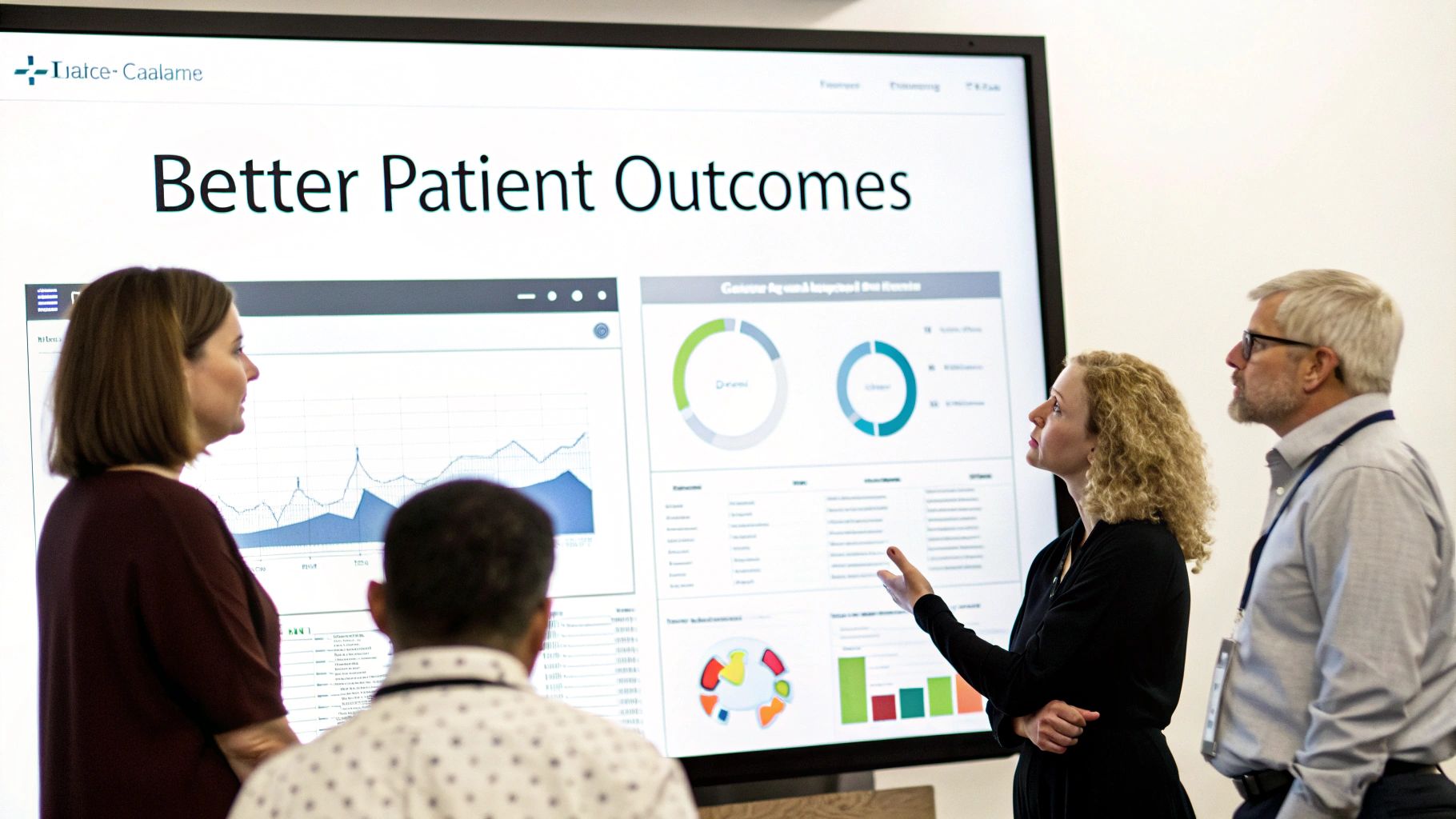
The true power of BI emerges when applied to high-impact areas. Its application can be broken down into three interconnected pillars: clinical, operational, and financial intelligence.
Enhancing Clinical Outcomes
Clinical intelligence uses data to support the core mission: achieving the best possible patient outcomes. By analyzing historical data and treatment results, providers can move from reactive treatment to proactive care.
A prime use case is predicting patient readmission risk. BI tools analyze hundreds of data points—comorbidities, medication history, socioeconomic factors—to flag high-risk individuals before discharge. This enables care teams to arrange proactive follow-ups or home health visits, an intervention that directly reduces costly readmissions and improves a patient's quality of life.
Optimizing Operational Efficiency
Hospitals are complex logistical operations where small inefficiencies can cause major disruptions. Operational intelligence smoothes out these processes to improve resource management and patient flow.
Consider operating room (OR) scheduling. An underused OR is a significant revenue leak, while poor scheduling causes frustrating delays. By analyzing historical surgery times and surgeon patterns, BI platforms build optimized schedules that increase OR utilization, boost revenue, and reduce wait times for patients. Similarly, BI helps manage bed occupancy by forecasting admissions, cutting emergency department wait times, and ensuring beds are ready when needed.
An integrated BI strategy creates a holistic view where operational improvements are directly tied to financial stability and superior patient care. The pillars don't work in isolation; they reinforce each other.
Strengthening Financial Health
Financial stability makes quality care possible. Financial intelligence provides clarity into billing, claims, and revenue cycles to plug financial leaks.
A key use case is revenue cycle management. BI dashboards allow finance teams to track metrics like Days in Accounts Receivable in near real-time. By analyzing claims denial patterns, they can pinpoint and fix root causes, such as coding errors or payer issues. The direct outcome is faster payments, improved cash flow, and a healthier financial footing.
The industry's investment in these solutions is clear. The hospital and clinic segment of the market alone grew from USD 3.40 billion to USD 3.90 billion in one year, showing a strong commitment to data-driven improvement. You can explore the growth in the healthcare business intelligence market to see the full trend.
Practical BI Use Cases in Healthcare
This table illustrates how BI is applied to achieve specific, measurable outcomes.
DomainUse Case ExampleKey OutcomeClinicalIdentifying patients at high risk for chronic diseases using predictive analytics.Proactive care management, reduced hospital admissions, and improved long-term patient health.OperationalOptimizing operating room schedules based on historical procedure data.Increased OR utilization, reduced surgical delays, and higher patient and surgeon satisfaction.FinancialAnalyzing claims denial patterns to identify and fix root causes.Increased clean claim rate, accelerated payment cycles, and significantly improved revenue capture.
These practical applications are tied directly to the core mission: delivering excellent care efficiently and sustainably.
Building a Modern Healthcare Data Platform
To realize the full value of business intelligence in healthcare, you need a powerful engine. A modern data platform is that engine, providing the foundation to gather, organize, and serve up reliable data for analytics.
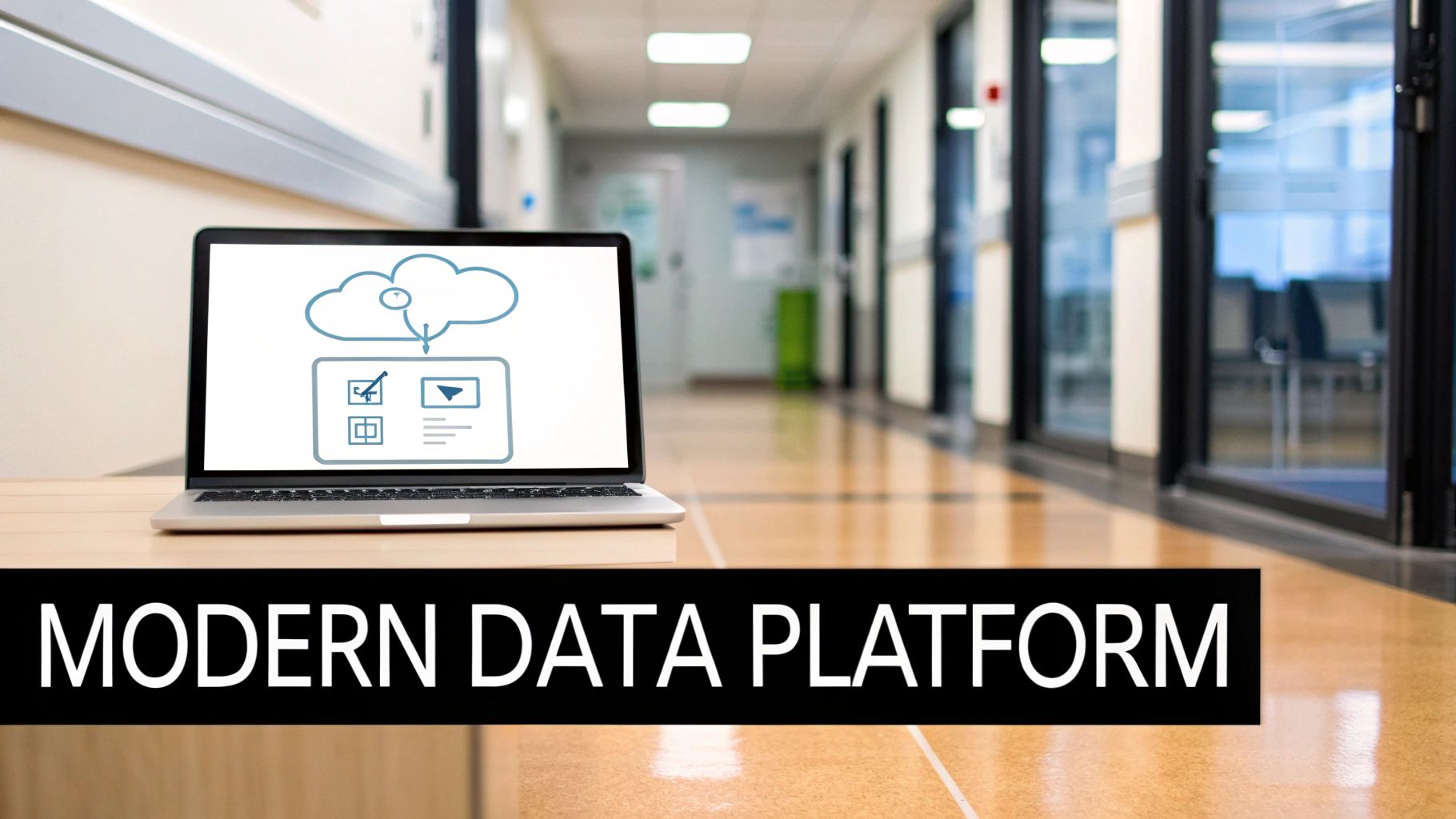
This platform isn't just a database; it’s a dynamic environment where all your disconnected data streams come together to tell a clear, coherent story. It enables you to model scenarios and analyze performance without disrupting daily patient care.
The Core Components of a Healthcare Data Platform
A robust data platform is a connected system of specialized components working together. It can be broken down into three essential layers.
- Data Ingestion Layer: This is the entry point for all data, connecting to sources like EHRs, IoT medical devices, lab systems, and billing software. Its job is to reliably pull in this information for processing.
- Central Data Cloud: This is the heart of the platform. Using a cloud-native data warehouse like Snowflake, this layer acts as a single source of truth. Its ability to separate storage from compute allows you to store vast amounts of data affordably and scale processing power on demand—a crucial feature for healthcare analytics.
- Analytics and Visualization Layer: This is where data becomes insight. Clean data is piped to BI tools like Tableau or Power BI, where clinicians and administrators can interact with it through user-friendly dashboards to get answers to their most critical questions.
A modern, cloud-native data platform provides the elasticity and performance that legacy on-premise systems can't match. It's built for scale, security, and speed to insight.
Why a Cloud-Native Approach Is Essential
A cloud-based architecture offers clear advantages over traditional on-premise solutions, directly contributing to better patient outcomes and more agile operations.
Scalability and Elasticity
Healthcare data is exploding. A cloud platform scales storage and computing power on demand, so you only pay for what you use. This flexibility is essential for handling massive query loads during peak times without performance degradation.
Performance at Scale
Modern cloud data warehouses are built for speed, running complex queries across billions of rows in seconds. This performance is critical when a clinician needs to quickly analyze treatment outcomes or an operations leader needs an immediate view of bed occupancy. To see this in action, the story of how an EMS organization utilized Snowflake demonstrates how the platform handles mission-critical data at scale.
Secure and Governed Data Sharing
Cloud data platforms enable secure data sharing without moving or copying data. Healthcare organizations can grant live, read-only access to specific datasets to partners or researchers, governed by strict access controls. This speeds up collaboration while maintaining the highest levels of security and compliance.
Ensuring Data Security and HIPAA Compliance
In healthcare, data represents a person's privacy and trust. Using business intelligence requires an unwavering commitment to protecting this sensitive information. A data breach can erode patient confidence and lead to severe penalties.
Fortunately, modern data platforms are designed with security at their core.

This means compliance with the Health Insurance Portability and Accountability Act (HIPAA) is a foundational principle, not an afterthought. When security is a pillar of your analytics strategy, compliance becomes an asset that builds trust with patients and stakeholders.
Safeguarding Protected Health Information
Effective clinical BI depends on the responsible handling of Protected Health Information (PHI). This requires multiple layers of technical and procedural safeguards to ensure data is only accessed by authorized individuals for legitimate purposes.
Key security measures are non-negotiable:
- End-to-End Encryption: All data must be encrypted, both when it's moving between systems (in transit) and when it's stored in the data warehouse (at rest).
- Role-Based Access Control (RBAC): This ensures people only see the data they need to do their jobs. A billing specialist should not have access to clinical notes, and a clinician does not need to see detailed financial reports.
- Data Masking and De-identification: For research and analytics, data masking techniques automatically obscure or replace personal identifiers like names and Social Security numbers. This allows analysts to work with valuable datasets while preserving patient anonymity.
A strong data governance framework is the rulebook for your data ecosystem. It defines who can access what data and creates clear accountability for data quality and security.
Turning Compliance into a Strategic Advantage
A well-architected data platform simplifies compliance audits. Comprehensive logging provides a clear record of who accessed what data and when. This not only satisfies regulatory demands but also strengthens your internal security posture.
Ultimately, a robust security framework fosters a culture of trust where clinicians feel confident using BI tools, knowing patient data is secure. To better understand the details of data protection, you can explore a practical guide to HIPAA compliance for small businesses. By embedding security into every layer of your BI strategy, you build a system that is both powerful and trustworthy.
Measuring Success and Demonstrating ROI
A business intelligence program is a significant investment, and stakeholders will want to know if it's delivering results. To prove its worth, you must measure success with a clear focus on outcomes in patient care, operational efficiency, and financial stability.
When you can draw a straight line from a dashboard to a positive result—like a drop in patient readmission rates—BI becomes a core part of your strategy, not just a "nice-to-have."
Defining Your Key Performance Indicators
The first step is selecting the right Key Performance Indicators (KPIs). Good KPIs are specific, measurable, and tied directly to your organization's goals. They should tell the story of how business intelligence in healthcare is making a real-world difference.
Think in three main buckets: clinical, operational, and financial.
- Clinical and Patient Care KPIs:
- Patient Readmission Rates: A key metric showing the effectiveness of post-discharge care. A 5% reduction in 30-day readmissions can save millions and improve patient outcomes.
- Average Length of Stay (ALOS): Data-driven treatment paths and discharge planning can safely shorten hospital stays, freeing up beds.
- Hospital-Acquired Infection (HAI) Rates: BI helps spot patterns and high-risk areas, enabling targeted interventions that improve patient safety.
- Operational Efficiency KPIs:
- Operating Room (OR) Utilization: Optimizing scheduling for expensive surgical suites directly boosts revenue.
- Emergency Department (ED) Wait Times: Better patient forecasting helps align staffing with demand, reducing wait times.
- Financial Health KPIs:
- Claims Denial Rate: Analyzing denial root causes allows you to fix systemic issues, ensuring more claims are approved on the first submission.
- Days in Accounts Receivable (A/R): BI helps identify and resolve bottlenecks in the revenue cycle, speeding up collections.
The most compelling ROI stories connect these dots. For example, show how optimizing OR utilization (operational win) boosted revenue (financial win) and reduced the surgical backlog (clinical win).
The table below summarizes critical KPIs used to track the success of a healthcare BI initiative.
Key Performance Indicators for Measuring BI Impact
A summary of critical KPIs used to measure the success and return on investment of a business intelligence initiative in a healthcare setting.
CategoryKPI ExampleBusiness ImpactClinical OutcomesPatient Readmission RatesMeasures care quality and post-discharge effectiveness, directly impacting patient health and cost avoidance.Clinical OutcomesAverage Length of StayIndicates efficiency of care delivery and resource management, freeing up bed capacity.Operational FlowOperating Room UtilizationMaximizes the use of high-value assets to increase revenue and reduce patient wait times.Operational FlowED Wait TimesReflects patient experience and resource allocation efficiency, helping to manage patient flow.Financial HealthClaims Denial RateHighlights revenue cycle inefficiencies; reducing it accelerates cash flow and cuts administrative waste.Financial HealthDays in Accounts ReceivableMeasures the speed of revenue collection; improvements show a more efficient billing and collections process.
Tracking these indicators transforms BI from a technical project into a strategic business driver.
Building a Compelling Business Case
Once you have your KPIs, you need to tell a story that proves the ROI. Frame it as a simple "problem-solution-outcome" narrative.
Consider a hospital struggling with a high claims denial rate:
- The Problem: Their denial rate was 12%, causing delayed revenue and significant administrative rework.
- The BI Solution: They built a dashboard to analyze denial data in real time. It quickly revealed that 40% of all denials stemmed from coding errors in one specific department.
- The Outcome: The department received targeted retraining. Six months later, the hospital’s overall denial rate dropped to 7%, boosting annual cash flow by $2.1 million.
This kind of story turns abstract data into a clear success, making the value of the investment undeniable.
A Practical Roadmap for BI Implementation
Implementing a business intelligence platform is a journey that requires a clear plan. An agile, value-first approach helps secure early wins, build momentum, and avoid common pitfalls like a lack of clinical buy-in. By focusing on tangible results from day one, you prove the power of business intelligence in healthcare across the organization.
We recommend a four-stage process.
Stage 1: Strategy and Discovery
This phase is about defining what success looks like. Sit down with leaders from clinical, operational, and financial departments to pinpoint the most pressing problems that data can help solve.
During this stage, you will:
- Define Clear Goals: Move beyond vague ideas. A specific goal is: "reduce 30-day patient readmissions for congestive heart failure by 10% within nine months."
- Identify Key Data Sources: Map out critical systems like EHRs, billing platforms, and lab information systems (LIS).
- Secure Stakeholder Buy-in: Clinicians and department heads must be active participants. Their expertise is essential for setting the right goals and interpreting the data.
Stage 2: Foundational Build
With a clear strategy, you can begin building the technical backbone of your BI program. This stage focuses on setting up a secure, reliable data platform to act as your single source of truth.
Key activities include establishing your central data cloud, building data ingestion pipelines, and implementing robust security and governance controls to protect PHI.
Stage 3: The Pilot Program
This is where you demonstrate value quickly. Instead of a massive, enterprise-wide rollout, launch a focused pilot project targeting a single, high-impact use case.
A successful pilot program is your most powerful tool for building momentum. It provides a concrete success story that silences skeptics and generates enthusiasm.
For example, create a dashboard to analyze claims denial patterns. This type of project offers a clear financial return, uses readily available data, and delivers immediate value. A win here validates your technology and your entire approach. Case studies like this one on test automation in healthcare can offer valuable lessons.
Stage 4: Scale and Optimize
With a successful pilot complete, it's time to expand. Methodically roll out new BI solutions to other departments, applying lessons learned from the pilot to refine your process.
This phase is ongoing. As your organization becomes more data-driven, you'll continue to optimize dashboards, introduce more advanced analytics, and empower more users with self-service tools. The ultimate goal is to embed data-driven decision-making into your organization's culture.
Common Questions About BI in Healthcare
Stepping into healthcare BI brings up many questions. Here are answers to some of the most common ones.
We'll focus on the real-world differences BI can make, clarifying its role and setting practical expectations.
EHR vs. Healthcare BI Platform
What’s the real difference between an EHR and a healthcare BI platform?
An Electronic Health Record (EHR) is a transactional system designed to document patient data at the point of care. It answers the question, "What happened with this specific patient today?"
A healthcare BI platform is an analytical system. It integrates data from the EHR and many other sources—financial, lab, and operational systems—to spot trends across the entire organization. It helps answer bigger questions like, "Why are our readmission rates climbing?" or "How can we shorten patient wait times?"
The EHR tells you what happened. The BI platform helps you understand why it happened and what’s likely to happen next, enabling strategic action.
Expected Time to Value
How long until we see a return on our BI investment?
You don’t have to wait years. With a phased, use-case-driven approach, you can demonstrate initial value within three to six months. Start with a pilot project targeting a high-impact, well-defined problem.
A project focused on reducing claims denials or optimizing OR schedules can deliver a quick financial return. While enterprise-wide ROI is a longer-term goal, a smart roadmap delivers value in stages, building momentum along the way.
Team and Skill Requirements
Do we need to hire a team of data scientists to use these BI tools?
Not necessarily, especially at the beginning. Modern BI platforms are designed to be user-friendly, with intuitive dashboards and self-service tools that empower your existing clinical and operational staff.
While data scientists are crucial for building sophisticated predictive models, much of the initial value comes from giving your frontline teams access to clean, reliable data. This approach helps build a data-savvy culture where insights are a shared responsibility, not a siloed one.


