Business intelligence in healthcare is about turning the mountains of clinical and operational data you already have into sharper, faster decisions. It’s the engine that refines raw information from EHRs, billing systems, and patient records, transforming it into a strategic asset that directly improves patient outcomes, streamlines hospital efficiency, and strengthens the bottom line.
Why Business Intelligence in Healthcare Is a Game-Changer
For years, healthcare data was stuck in silos—full of potential but practically useless. Business intelligence for healthcare is the refinery that processes this information into high-octane fuel for your organization. This isn't just about building dashboards; it's about embedding a core capability for making evidence-based decisions that fortify the entire organization.
For any CTO or CIO, BI is a non-negotiable part of the strategic toolkit. It brings clarity to critical questions that were once buried in endless spreadsheets, allowing leadership to operate on data, not gut feelings.

From Raw Data to Measurable Outcomes
The real value of BI is its ability to draw a straight line from data points to tangible results. The global healthcare business intelligence market, valued at USD 9.92 billion, is projected to hit USD 31.8 billion by 2033, growing at a 13.9% CAGR. This explosion highlights how organizations are leaning on data to solve their most fundamental challenges. You can read the full research about the healthcare BI market to see the numbers for yourself.
With a solid BI strategy, you can move beyond reactive problem-solving to predict future needs and get ahead of them.
Business intelligence bridges the gap between having data and using it to make a difference. It's the mechanism that translates numbers into better patient care, reduced costs, and smarter resource allocation.
Ultimately, adopting BI in healthcare is about achieving three core outcomes:
- Improving Patient Outcomes: Identify at-risk populations, predict disease outbreaks, and monitor care quality in real time to prevent adverse events.
- Streamlining Hospital Operations: Optimize patient flow, predict staffing needs based on demand, and automate administrative tasks to cut waste.
- Strengthening Financial Health: Pinpoint and plug revenue leaks, increase clean claim rates, and optimize the entire revenue cycle for better cash flow.
When you focus on these outcomes, business intelligence becomes a fundamental pillar of a modern, resilient healthcare organization.
Seeing BI in Action with Real-World Healthcare Use Cases

The value of business intelligence healthcare solutions comes to life when they solve tangible, high-stakes problems. Here’s how abstract data becomes a powerful tool that improves patient lives and boosts the bottom line.
Use Case 1: Proactive Population Health Management
The Challenge: Healthcare has traditionally been reactive. The goal of population health management is to identify and support at-risk groups before they become high-cost, high-acuity patients.
The BI Solution: A BI platform analyzes massive datasets—EHRs, claims, and socioeconomic information—to find hidden patterns. It can flag patients with pre-diabetes who consistently miss appointments or those with congestive heart failure who lack access to healthy food.
The Outcome:
- Targeted Interventions: Care managers can roll out automated reminders for preventative screenings or create personalized support programs for patients with chronic conditions.
- Reduced Readmissions: By proactively managing patient health, hospitals lower expensive emergency room visits and hospital readmissions. This improves community health and the organization's financial stability.
Use Case 2: Revenue Cycle Optimization
The Challenge: The healthcare revenue cycle is a tangled web of delayed payments, denied claims, and revenue leakage. Pinpointing where and why these problems occur is a constant struggle.
The BI Solution: BI tools act as a diagnostic scanner for the entire revenue cycle. By integrating data from billing systems, payors, and registration, dashboards provide a real-time, consolidated view of financial health.
Instead of waiting weeks for manual reports, finance teams can instantly see the root causes of revenue problems. That visibility is the first step toward building a resilient financial foundation.
The Outcome:
- Increased Clean Claim Rate: A dashboard might reveal that 25% of denials from a specific insurer stem from a single coding error. The billing team can correct the process on the spot, immediately boosting revenue.
- Improved Cash Flow: Analytics could show that the time between discharge and final bill submission is 12 days longer in one department. This points to a workflow bottleneck that can be fixed, accelerating payments. As seen in our work on test automation in healthcare, streamlining these complex operations has a direct impact on the bottom line.
Use Case 3: Empowering Clinical Decision Support
The Challenge: At the point of care, clinicians are often drowning in information, increasing the risk of medical errors and inconsistent care.
The BI Solution: A BI-powered clinical decision support (CDS) system integrated with the EHR delivers relevant insights directly within the clinical workflow. It can analyze a patient's history, flag potential drug interactions, or suggest evidence-based treatment protocols.
The Outcome:
- Reduced Medical Errors: The system acts as a vigilant co-pilot, helping clinicians make safer, more informed decisions faster.
- Improved Quality of Care: By promoting adherence to best-practice guidelines, CDS tools lead to more accurate diagnoses and personalized treatment plans, resulting in better patient outcomes.
The table below summarizes how these applications turn challenges into measurable value.
Use CaseChallenge AddressedKey OutcomePopulation Health ManagementMoving from reactive to proactive care; identifying at-risk patients before they become high-cost.Reduced hospital readmissions; improved community health metrics; lower overall cost of care.Revenue Cycle OptimizationHigh claim denial rates; revenue leakage from billing errors and process bottlenecks.Increased clean claim rate; reduced days in accounts receivable; improved cash flow and profitability.Clinical Decision SupportClinician information overload; risk of medical errors; inconsistent adherence to best practices.Fewer adverse drug events; better patient safety; higher quality of care through data-driven decisions.
Each use case demonstrates a core principle: when data is made accessible and actionable, it becomes a powerful force for both clinical and operational excellence.
Building Your Modern Healthcare Data Platform
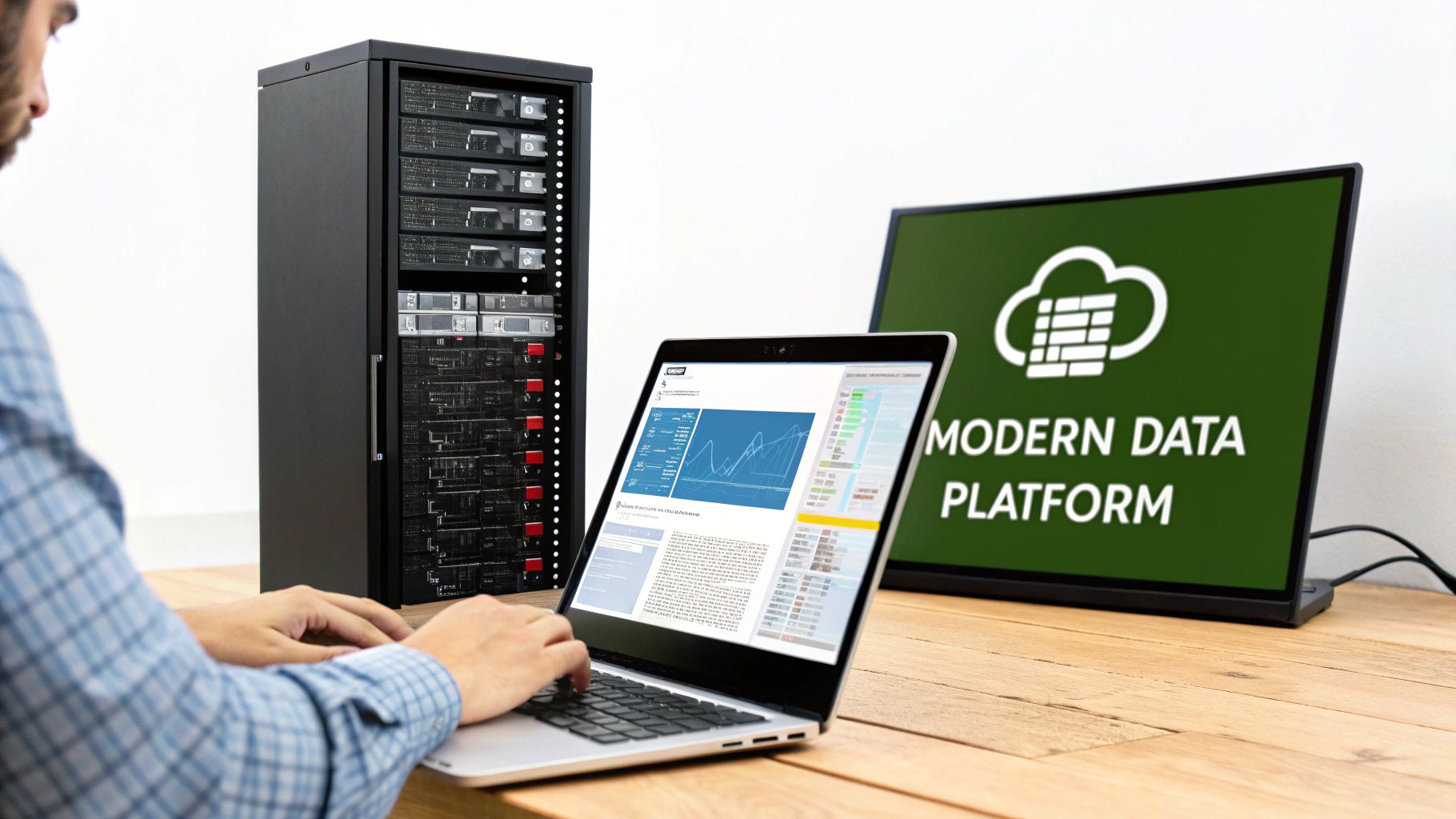
A powerful business intelligence healthcare strategy rests on a modern data platform—an architecture built to handle the scale, variety, and speed of healthcare data. Moving away from rigid, on-premise data warehouses isn’t just an option; it's a necessity for creating a single source of truth that powers everything from operational dashboards to AI forecasting models.
The Shift to Cloud-Native Platforms
The future of healthcare data is in the cloud. Cloud-native platforms offer the elasticity needed to handle the explosion of health data, from structured EHR fields to unstructured clinician notes. This isn't just a theory; cloud-based deployment now captures 57.9% of all revenue in the healthcare BI market. The shift is driven by cost-effectiveness and the interoperability needed for AI and machine learning. You can get more insights on the rise of cloud BI in healthcare.
This move allows you to pay only for the compute and storage you use, turning a huge capital expense into a predictable operational one and providing the agility to scale analytics projects without costly infrastructure overhauls.
Unifying Data with a Platform Like Snowflake
At the center of this modern architecture are platforms like Snowflake. These cloud data platforms were designed to demolish the data silos that have held the industry back. Their key feature is the separation of storage and compute, meaning data science, finance, and clinical teams can all query the same centralized data simultaneously without slowing each other down.
This unified approach allows a single platform to ingest, store, and process everything from billing codes to genomics data, creating a holistic dataset for analysis.
This enables a health system to:
- Combine EHR and claims data to pinpoint high-cost patient groups.
- Integrate unstructured clinician notes to understand the context behind diagnoses.
- Analyze real-time data from patient monitoring devices to predict adverse events.
This is how you build a true 360-degree view of both the patient and the organization. For a real-world look at this, see our story on how we helped an EMS provider utilize Snowflake to manage their complex data needs.
A modern data platform isn't just a repository; it's a dynamic ecosystem designed to serve everyone from business analysts to data scientists.
By building this agile and scalable foundation, healthcare organizations can answer today's questions and be ready for tomorrow's challenges, turning data into a strategic asset that drives better outcomes.
Moving From Basic Reports to Predictive Insights
A successful healthcare BI strategy is an evolution, moving from simple reporting to a strategic engine that can predict and shape future events. This journey typically happens in four stages, each building on the last to provide deeper insights and control.
Stage 1: Descriptive Analytics — Answering "What Happened?"
This first stage summarizes historical data to get a clear picture of past events. Standard dashboards and reports answer the basic question, "What happened?" This provides the visibility needed for day-to-day operations.
Use Case: A hospital dashboard shows that the 30-day readmission rate for congestive heart failure (CHF) patients was 18% last quarter, with the highest volume coming from two specific campuses. This provides a clear, factual baseline.
Stage 2: Diagnostic Analytics — Understanding "Why It Happened"
Once you know what happened, the next question is why. Diagnostic analytics digs deeper into the data to find root causes and connections, shifting from observation to investigation.
Use Case: An analyst drills down into the 18% readmission rate and finds a pattern: 70% of readmitted CHF patients were discharged on a Friday and lacked a follow-up appointment within seven days. This pinpoints a specific process gap.
Stage 3: Predictive Analytics — Determining "What Will Happen Next"
Predictive analytics uses statistical models and machine learning to forecast future events. Instead of looking backward, you start looking forward, answering, "What's likely to happen?"
Predictive models are the bridge between reactive problem-solving and proactive intervention. They empower organizations to anticipate needs and mitigate risks with precision.
Use Case: A data science team develops a predictive model that generates a real-time "readmission risk score" for each new CHF patient. The model flags a new patient with an 85% probability of being readmitted under the standard discharge plan.
Stage 4: Prescriptive Analytics — Guiding "What We Should Do"
The most advanced stage, prescriptive analytics, not only predicts what will happen but also recommends specific actions to achieve a better outcome. It answers the ultimate question: "What should we do about it?"
Use Case: When the model flags a patient with an 85% readmission risk, a prescriptive engine automatically triggers recommendations in the EHR:
- Schedule a telehealth follow-up with a cardiologist three days post-discharge.
- Enroll the patient in a remote monitoring program.
- Arrange a home health nurse visit within 24 hours of discharge.
By following these data-driven prompts, the health system actively lowers the patient's readmission risk, improving their health while cutting costs.
Implementing Data Governance You Can Trust
In healthcare BI, data is the fuel, but trust is the engine. A solid data governance framework—a system of clear rules, roles, and processes—is the absolute foundation of a lasting data strategy. It ensures data is accurate, consistent, and used responsibly, giving clinicians and leadership confidence in the insights they act on.

Navigating HIPAA and Security in the Cloud
Moving Protected Health Information (PHI) to the cloud demands a security-first approach to navigate the Health Insurance Portability and Accountability Act (HIPAA). The starting point is partnering with cloud providers like Snowflake that offer HIPAA-eligible services and sign a Business Associate Agreement (BAA).
But a BAA is just the beginning. Real compliance comes from strict internal controls. Key security measures include:
- End-to-End Encryption: Data must be encrypted both in transit and at rest.
- Data Masking and Tokenization: Automatically obscure sensitive PHI in non-production environments to allow for safe development and analysis.
- Comprehensive Audit Trails: Maintain immutable logs of who accessed what data, when, and why for security and compliance audits.
Implementing Practical Access Controls
Strong governance requires controlling who can access what data. Role-Based Access Control (RBAC) is the most practical and scalable solution.
Think of RBAC as giving out keys that only open specific doors. A billing specialist gets access to financial data, a clinician gets access to their patients' records, and a data scientist gets access to de-identified data for research.
This is the principle of least privilege in action: users only get access to the minimum data needed for their jobs. For instance, dynamic data masking allows an analyst to see an entire dataset while the platform automatically redacts columns containing PHI. This structured approach empowers teams by eliminating security bottlenecks, balancing the freedom to innovate with the need to protect patient trust.
Your Action Plan for BI Implementation
Getting from a BI strategy to a tool people actually use requires a clear, practical roadmap. This action plan is for leaders ready to get their business intelligence healthcare projects off the ground and delivering real wins, fast.
The journey starts not with software, but with a problem. The most effective BI projects are laser-focused on solving a single, high-impact clinical or operational challenge. Resist the urge to boil the ocean; instead, find one pain point where data can create a clear victory.
Phase 1: Define the Problem and Assemble Your Team
First, establish a razor-sharp problem statement. Are you trying to cut patient readmissions or find bottlenecks in your revenue cycle? This clarity will be your North Star.
Next, build a cross-functional team that includes:
- A Clinical Champion: A respected physician or nurse who understands the workflow.
- An Operational Stakeholder: The department head who owns the business process.
- A Data Governance Steward: The person responsible for data accuracy and security.
- Technical Experts: Data engineers and BI developers who will build the solution.
This blend of expertise is non-negotiable to ensure the final product is clinically relevant and operationally useful.
Phase 2: Launch a High-Impact Pilot Project
The best way to build momentum is to start small and score an early win. A pilot project acts as your proof-of-concept. Pick a project that is highly visible, achievable in three to six months, and tied to a key organizational KPI.
A successful pilot does more than solve one problem—it becomes internal marketing for your entire data strategy. When a leader can point to a 15% reduction in claim denials, others will be lining up to be next.
This approach keeps initial risk and investment low while you learn, providing a controlled environment to iron out kinks and get feedback from real users.
Phase 3: Mitigate Common Pitfalls
Even with the best plan, you'll hit roadblocks. The two biggest tripwires are poor data quality and low user adoption.
Tackle bad data by dedicating resources to data cleansing and validation from the start. Your pilot will inevitably highlight data inconsistencies—address them head-on to build a foundation of trust.
For driving adoption, focus on user experience. Involve clinical staff in the design process to ensure dashboards are intuitive and fit into their workflows. Success isn't measured by the tech's sophistication, but by its daily use in making better decisions.
Answering the Tough Questions
Leadership will have pointed questions about cost, time, and value. Here are the straight answers.
How Much Does a Healthcare BI Implementation Cost?
There's no single price tag. A focused pilot project might run from $50,000 to $150,000. A full-blown, enterprise-wide system can easily exceed $500,000. The final figure depends on data complexity, your technology stack, and the size of your team.
What Is a Realistic Implementation Timeline?
Scope is everything. A targeted pilot project can deliver value in as little as three to six months. This is the best way to build momentum.
A comprehensive, organization-wide rollout is a major undertaking that can take 12 to 18 months or longer. These projects involve untangling legacy systems and establishing robust data governance.
The winning strategy is phased implementation. Score quick wins with pilots, then use those successes to justify a broader, incremental rollout.
How Do You Measure the ROI of Business Intelligence in Healthcare?
Measuring ROI isn't about counting dashboard logins; it's about connecting BI to tangible financial and clinical improvements.
Tie your efforts to clear outcomes in areas like:
- Operational Efficiency: Reduced patient wait times, optimized operating room utilization, and decreased administrative waste.
- Financial Performance: Increased clean claim rates, reduced days in accounts receivable, and quantified supply chain savings.
- Clinical Outcomes: Lower readmission rates for key conditions, improved adherence to clinical best practices, and better patient safety metrics.


