Business intelligence (BI) in healthcare turns vast amounts of raw data into actionable insights. It's the essential tool for making smarter, evidence-based decisions that directly improve patient outcomes, streamline operations, and ensure financial stability. In today's value-based care environment, using data effectively isn't optional—it's a core function for survival and success.
Why Business Intelligence Is Essential for Modern Healthcare
A modern hospital generates a staggering amount of data from electronic health records (EHRs), medical devices, billing systems, and patient feedback. Without BI, this information remains siloed and unused, offering little value. Business intelligence unlocks the patterns hidden in that data, translating complex information into a clear diagnosis of an organization's health.
Operating without BI is like diagnosing a patient with an incomplete chart—decisions are based on guesswork instead of the full picture. This is unsustainable when reimbursement is tied to patient outcomes, not just the volume of services provided.
Moving from Guesswork to Guided Action
The true purpose of business intelligence and healthcare analytics is to answer why things are happening. Knowing patient readmission rates are high is one thing; using BI to discover that a specific post-discharge plan is failing for a certain patient demographic is a game-changer. This insight allows for proactive intervention rather than reactive problem-solving.
BI gives healthcare leaders the clarity to achieve specific outcomes:
- Improve Patient Outcomes: Identify at-risk patient groups and intervene before their conditions worsen, leading to better health and fewer complications.
- Optimize Operations: Pinpoint bottlenecks in patient flow to reduce wait times and allocate staff and resources more effectively.
- Strengthen Financial Performance: Analyze revenue cycles to find and fix issues causing claim denials, improving cash flow.
Business intelligence makes data the central nervous system of the healthcare organization, ensuring every decision—from clinical protocols to staffing—is an evidence-based step toward better performance.
A Growing Strategic Imperative
The global healthcare BI market is projected to grow from USD 9.92 billion in 2024 to USD 31.8 billion by 2033, signaling a clear industry consensus: data-driven insights are critical. This shift is fundamental for building a resilient and effective healthcare system. For more context, it's helpful in understanding industry-specific IT needs, including those for Health Care Services. You can also learn more about healthcare business intelligence market projections to see where the industry is headed.
Driving Measurable Results with Healthcare BI
Business intelligence in healthcare isn't about abstract reports; it's about delivering measurable improvements. It connects analytics investments directly to better patient outcomes, stronger financials, and smoother operations. Instead of relying on intuition, leaders get the hard evidence needed to drive meaningful change.
The real value emerges when data fuels action. For example, a dashboard can predict which patients are at high risk for readmission before they leave the hospital. This allows care teams to implement targeted follow-up plans, directly reducing costly and preventable return visits.

This shift from reactive reporting to proactive intervention is where the return on investment becomes clear. Every insight is an opportunity to refine a process, improve a clinical protocol, or plug a financial leak.
Connecting BI to Key Performance Indicators
The impact of business intelligence and healthcare is clearest when tracked against Key Performance Indicators (KPIs). By focusing on specific metrics, organizations can quantify their progress and demonstrate success.
- Clinical KPIs: BI tools monitor metrics like patient length of stay, hospital-acquired infection (HAI) rates, and medication adherence. For instance, a BI system can flag a department with a spike in infection rates, triggering an immediate review of sanitation protocols and leading to a measurable decrease in HAIs.
- Financial KPIs: BI provides a clear view of the revenue cycle, tracking metrics like days in accounts receivable (A/R) and claim denial rates. This empowers finance teams to quickly fix billing bottlenecks, resulting in faster payments and a healthier bottom line.
- Operational KPIs: BI helps streamline hospital operations by analyzing patient flow, operating room utilization, and staffing. An analytics platform might reveal that the emergency department is consistently overwhelmed at specific times, allowing managers to adjust staffing, reduce wait times, and improve patient satisfaction.
Business intelligence transforms KPIs from static numbers into dynamic tools for continuous improvement, providing the context needed to understand performance and take decisive action.
The Tangible Impact on Operations and Finance
The link between BI and better outcomes is proven. In North America, healthcare BI spending grew from US$ 3.44 billion in 2022 to US$ 3.96 billion in 2023. This investment yields significant returns, with studies showing 10–20% reductions in avoidable readmissions and 15–30% improvements in claim denial management when BI is integrated into daily workflows. You can discover more insights about healthcare BI market trends and their financial impact.
This data confirms that effective BI implementation is directly tied to financial stability and higher-quality care.
How Business Intelligence Transforms Healthcare KPIs
This table illustrates the direct impact of BI on critical healthcare metrics, showing the 'before' problem and the 'after' outcome driven by data insights.
Healthcare DomainCommon Challenge Without BIBI-Driven SolutionMeasurable KPI ImprovementPopulation HealthDifficulty identifying at-risk patient groups; reactive care after a health event.Predictive models identify patients at high risk for chronic diseases like diabetes or heart failure.15% reduction in emergency visits for managed chronic conditions.Revenue CycleHigh claim denial rates due to manual errors; slow A/R cycles delay cash flow.Dashboards track denial reasons in real-time, flagging common errors for correction.20% decrease in claim denial rate; Days in A/R reduced by 10-15 days.Hospital OperationsOvercrowded emergency departments and long patient wait times.Patient flow analytics predict peak hours, enabling proactive staff scheduling.25% reduction in average patient wait times.Clinical OutcomesHigh rates of hospital-acquired infections (HAIs) with no clear source.BI tools analyze patterns to correlate infections with specific rooms or procedures.10% decrease in HAI rates within targeted departments.
As the table shows, the right data doesn't just inform—it drives specific, positive changes that can be tracked and quantified.
Real-World Business Intelligence Use Cases
The true value of business intelligence in healthcare is demonstrated through practical application. BI is a tool for solving complex, everyday problems that impact patients and financials. Let's examine three use cases where BI delivers measurable results. For a deeper dive, explore specific healthcare BI use cases to see how tangible the outcomes can be.
Use Case 1: Improving Population Health Management
The Challenge: Managing chronic conditions like diabetes reactively, treating patients only after complications arise, leading to high costs and poor outcomes.
The BI Solution: A BI platform integrates data from EHRs, labs, and pharmacies to create a unified view of the diabetic patient population. Predictive models then identify individuals at the highest risk of complications. Care managers use these insights to intervene proactively with personalized outreach, education, and resources.
The Outcome:
- Fewer Hospitalizations: Proactive care prevents acute events, significantly reducing ER visits and hospital stays.
- Lower Costs: Preventing a complication is far less expensive than treating one, lowering the total cost of care.
- Healthier Patients: Individuals receive targeted support, leading to better self-management and a higher quality of life.
Use Case 2: Optimizing the Revenue Cycle
The Challenge: High claim denial rates (e.g., 15%) due to manual errors and complex coding, choking cash flow and creating administrative burdens.
The BI Solution: A BI tool analyzes billing data in real-time. Dashboards pinpoint the most common reasons for denials and trace them to specific departments or procedures. For example, the tool might discover that 80% of denials for a specific procedure originate from a single department.
The Outcome:
- Reduced Denials: The finance team can provide targeted training to the identified department, fixing the problem at its source and reducing the overall denial rate.
- Faster Payments: Resolving billing issues quickly shortens the revenue cycle and improves cash flow.
- Increased Efficiency: Automation and targeted fixes reduce the manual rework required by billing staff.
By turning denial data into actionable intelligence, a BI platform transforms the revenue cycle from a source of friction into a smooth, predictable process. This approach is also seen in other data-intensive fields, like in success stories of EMS systems utilizing Snowflake.
Use Case 3: Boosting Operational Efficiency
The Challenge: Long wait times and overcrowding in the emergency department (ED) due to a mismatch between staffing levels and unpredictable patient arrivals.
The BI Solution: A BI platform analyzes historical patient flow data to identify hidden patterns, such as peak arrival times by day and hour. It also maps the patient journey to highlight bottlenecks, like delays in the imaging department.
The Outcome:
- Shorter Wait Times: Administrators use the data to schedule staff proactively, aligning resources with predictable patient surges.
- Improved Patient Satisfaction: A smoother, faster ED experience leads to higher satisfaction scores.
- Reduced Staff Burnout: Appropriate staffing prevents teams from being overwhelmed, improving morale and retention.
These use cases show that BI is a strategic asset that provides the evidence needed to refine clinical care, strengthen financial health, and build a more efficient healthcare system.
Building Your Modern Healthcare Data Platform
Effective business intelligence is built on a modern data foundation. For too long, healthcare data has been trapped in silos—EHRs, billing systems, and labs that don't communicate. This fragmentation makes it impossible to get a complete view of a patient or the organization.
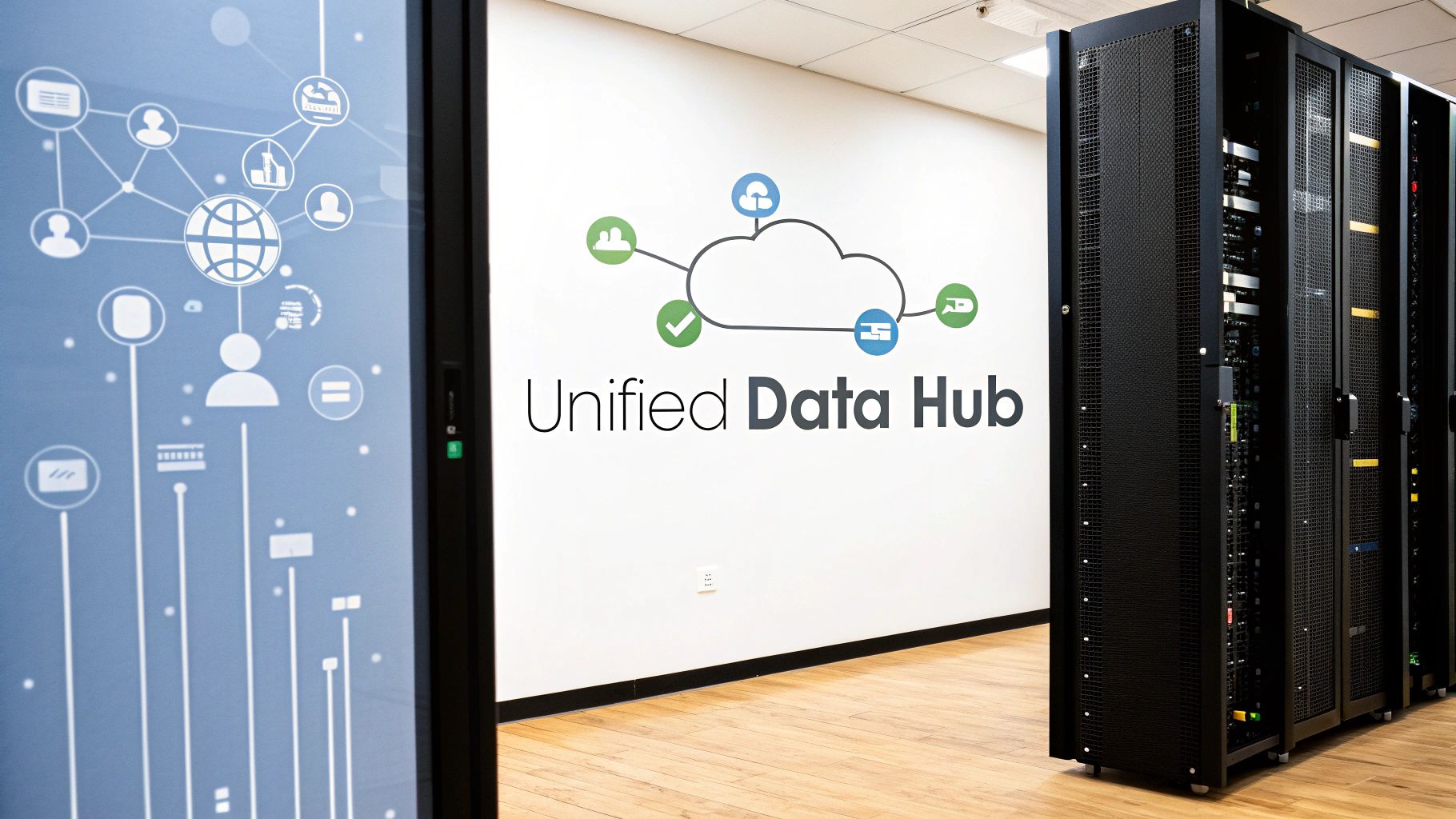
The solution is a centralized, cloud-based data platform that acts as a single source of truth. This hub ingests, processes, and analyzes all types of data, breaking down silos and enabling powerful insights.
From Silos to a Unified Data Hub
A modern data platform creates a perfectly organized digital library where every piece of information—structured, unstructured, and real-time—is indexed and instantly accessible.
This unified hub is designed to handle the full spectrum of healthcare data:
- Structured Data: Organized information from EHRs, billing codes, and lab results.
- Unstructured Data: Valuable content like doctors' handwritten notes, clinical images, and patient emails.
- Real-Time Data: Continuous streams from patient monitors, wearables, and other IoT devices.
By integrating these sources, you can link a patient's clinical history with their billing records and real-time vitals, uncovering insights that were previously hidden.
The Role of Cloud Platforms Like Snowflake
Cloud data platforms like Snowflake provide the scale, speed, and security needed to manage massive healthcare datasets without the burden of on-premise infrastructure.
A cloud-native platform eliminates the technical bottlenecks that have hindered healthcare analytics, providing the elastic computing power to run complex queries in seconds instead of hours.
This enables forward-looking analysis, such as using historical patient data to predict flu season surges and proactively allocate resources. Managing this level of data requires expertise, as demonstrated in projects that successfully handle time-series data with Snowflake, where performance at scale is critical.
Ensuring Security and HIPAA Compliance
Centralizing sensitive patient data demands an unwavering commitment to security. A modern platform must have HIPAA compliance built into its core architecture.
Key security features include:
- Data Encryption: All data, at rest and in transit, must be encrypted to prevent unauthorized access.
- Role-Based Access Controls: Ensures users can only view the specific data they are authorized to see, separating clinical and financial information appropriately.
- Comprehensive Audit Trails: Logs every action, creating a clear record of who accessed what data and when for accountability and compliance audits.
This secure-by-design approach allows organizations to leverage data confidently, turning their platform into a trusted asset that powers better decisions.
Powering Your BI with AI and Automation
A strong BI platform provides a clear view of the past, but the future of healthcare BI lies in prediction and automation. Layering artificial intelligence (AI) and automation on top of BI shifts analytics from descriptive (what happened) to predictive (what will happen) and prescriptive (what to do about it). This transforms insights into immediate, intelligent actions.
This combination enables healthcare systems to become truly proactive and efficient, moving beyond manual analysis to automated interventions that improve patient outcomes.
From Predictive Insights to Automated Interventions
AI, particularly machine learning (ML), excels at identifying subtle patterns in vast datasets. An ML model can analyze thousands of patient records to flag individuals at high risk for sepsis or hospital readmission based on factors a human might miss.
Once a high-risk patient is identified, automation takes over, triggering a workflow without manual intervention.
The process looks like this:
- Prediction: An AI model analyzes real-time data and flags a high-risk patient.
- Alerting: The system sends an instant, secure alert to the appropriate clinician with relevant patient context.
- Action: An automated agent schedules a follow-up telehealth visit or enrolls the patient in a specialized care program.
By fusing AI's predictive power with automation, healthcare organizations close the loop between insight and action, reducing administrative burdens and ensuring critical interventions happen precisely when needed.
This proactive model transforms data from a reporting tool into an active instrument for improving patient safety and outcomes.
Unlocking Unstructured Data with AI
A significant amount of clinical insight is trapped in unstructured data like doctors' notes, radiology reports, and patient messages. Standard BI tools cannot process this text-based information.
Natural Language Processing (NLP), a type of AI, solves this problem. NLP algorithms can "read" human language to extract critical details from unstructured text.
For example, an NLP tool could scan patient records to:
- Identify patients with specific symptoms not formally coded in the EHR.
- Detect mentions of adverse drug reactions buried in free-text notes.
- Analyze patient sentiment from survey comments to pinpoint service improvement opportunities.
This adds a rich layer of qualitative context to quantitative data, enabling more precise population health strategies and clinical research.
Automating the Administrative Burden
AI and automation also streamline administrative tasks. Repetitive, rules-based processes like prior authorization—a notorious bottleneck—are ideal for automation.
Instead of staff spending hours on manual forms and phone calls, an AI-powered agent can manage the process. It can automatically pull necessary clinical documentation from the EHR, complete submission forms, and track the request's status.
This frees up administrative teams to focus on complex cases that require human expertise. The result is a faster revenue cycle, lower operational costs, and reduced staff burnout. This intelligent automation, built on a data-driven BI foundation, empowers your organization to make better, faster decisions at every level.
Your Roadmap to Successful BI Implementation
Implementing business intelligence is a strategic journey, not an overnight project. A successful rollout can fundamentally change how care is delivered, creating a culture where decisions are guided by data.
The key is to avoid a "big bang" approach. Instead, start small with a focused pilot project that solves a specific, high-impact problem. This approach minimizes risk and delivers early, tangible wins that build momentum and secure buy-in from stakeholders.
Start with a Focused Pilot Project
Select a single, well-defined business challenge, such as reducing readmission rates for a specific condition or resolving bottlenecks in the emergency department.
By concentrating on one area, you can demonstrate the power of business intelligence and healthcare analytics in a concrete way. A successful pilot serves as a powerful internal case study, showing leadership and clinical staff what is possible.
The goal of a pilot is to deliver a measurable outcome. A 10% reduction in 30-day readmissions from one project speaks louder than a lengthy strategy document.
Assemble the Right Team and Partner
Building the right team is crucial. This is not just an IT project; it requires a cross-functional group with diverse skills.
Your team should include:
- Clinical Champions: Respected doctors or nurses who understand daily workflows and can advocate for the new tools.
- Data Analysts: The technical experts who build dashboards and ensure the insights are accurate.
- Operational Leaders: Department heads and managers who will use the BI tools to make daily decisions.
- IT Specialists: The team responsible for data integration, security, and platform architecture.
Choosing the right technology partner is equally important. Look for a partner with deep healthcare experience, a strong understanding of HIPAA compliance, and a proven track record. A good partner provides strategic guidance in addition to technology.
Measure Success and Scale Intelligently
After a successful pilot, it's time to scale. Use the lessons learned to create a repeatable playbook for other departments. Define success from the start by focusing on KPIs tied to your organization's top priorities:
- Improvements in patient outcomes (e.g., lower infection rates).
- Gains in operational efficiency (e.g., shorter wait times).
- A positive financial impact (e.g., fewer claim denials).
Scale intelligently by prioritizing projects that will deliver the most impact, building on previous successes. This methodical expansion transforms a promising pilot into an essential, organization-wide capability.
Common Questions We Hear
Adopting business intelligence in healthcare raises important questions. Here are answers to some of the most common ones.
What's the First Step to Implementing BI in a Hospital?
Start with a single, high-impact problem. Focus on a specific challenge, like reducing patient readmissions for one condition or optimizing operating room scheduling.
A focused pilot project allows you to demonstrate tangible value quickly, which is the best way to gain executive buy-in and learn what works before scaling up.
How Does Healthcare BI Keep Patient Data Private?
Modern BI platforms are built with security and compliance as core principles, not afterthoughts. Key features include end-to-end data encryption, strict role-based access controls (so users only see authorized data), and comprehensive audit logs that track all activity.
This layered security ensures all patient data is protected and all actions comply with HIPAA regulations, allowing you to leverage powerful analytics without compromising privacy.
A healthcare BI platform's purpose is to deliver actionable insights without ever compromising patient confidentiality. Security is the foundation on which everything else is built.
Can BI Work with Our Existing EHR System?
Yes, absolutely. A core function of a modern BI platform is to integrate data from disparate systems, especially your Electronic Health Record (EHR).
The platform uses secure connectors to pull data from your EHR and combine it with information from other sources, such as billing or pharmacy systems. This creates a single, unified view of your organization's performance.


