
A pricing bug reaches production, someone ships a hotfix at night, and the manual regression run that could have caught it takes three days to schedule. Meanwhile, your team already has browser scripts, but nobody trusts a red result enough to stop a release.
Building a test automation framework from scratch should solve that trust problem, not create a larger script collection. The useful outcome is a repeatable signal that reaches the right engineer quickly, with maintenance costs your team can sustain.
Why Early Feedback Justifies the Build
The economic case starts with when you discover defects, not how many tests you automate. In its historical assessment of U.S. manufacturing and service industries, NIST estimated that inadequate software-testing infrastructure cost approximately $59.5 billion annually, with more than half of software bugs discovered only downstream in development.
Those are historical estimates, not a forecast of your savings. The practical mechanism still matters: when developers discover a pricing error after release, they must investigate the change, repair it, retest it, deploy it, and assess affected transactions. An automated check against the pricing service can expose the same error while the developer still has the relevant code open.
Your framework needs three properties from the beginning:
- Feedback at the point of change. Run unit, service, and targeted regression checks where developers introduce changes.
- Repeatable results. The same commit, inputs, and environment should produce the same outcome.
- Traceable failures. Engineers should be able to connect a failure to a business rule, execution context, and likely cause.
Investment test: A framework earns its place by shortening the distance between a change and a trustworthy decision.
Don't use browser coverage as a substitute for this outcome. A checkout journey may need a browser test, but its discount calculations belong closer to the underlying logic.
This week, trace a recent critical change from commit to confirmed regression result. If your team takes more than a working day to learn that it broke a critical journey, I'd treat that as a strong reason to fund the build, provided someone owns the resulting signal.
Phase Plan From Scoping to Rollout
Use the following as a proposed planning calendar for a mid-size enterprise team, not an industry benchmark. The durations are working estimates; exit criteria determine whether you advance.
PhaseGoalExit criterionTypical duration1. ScopePick 20-40 stable, high-risk journeysSigned-off list with pass definitions1 week2. Environment and dataStandard config and isolated test dataSame test passes 3 times on one commit1-2 weeks3. Core frameworkDriver layer, reusable actions, reportingSample suite green in CI2-3 weeks4. PilotRun with one or two teamsFlake rate under the agreed threshold4-6 weeks5. RolloutExtend to remaining teamsNamed owners and live dashboardsOngoing
Gate progress on evidence
Start scoping with business risk, not whichever screen is easiest to automate. For a logistics platform, shipment creation, dispatch assignment, and proof-of-delivery processing deserve attention before cosmetic dashboard checks. Write the expected outcome precisely enough that developers and business owners agree on a pass.
Next, establish a known environment and controllable data. Repeated successful execution is an initial sanity check, not proof that a test can never flake. Record dependency versions and feature flags so later failures have an interpretable context.
Build only enough infrastructure to execute a representative sample through CI. A green local demonstration doesn't establish that credentials, networking, artifact collection, or cleanup work on a pipeline worker.
Use the pilot to test usability
The pilot should reveal whether another team can add, execute, and diagnose tests without the framework author sitting beside them. Include onboarding instructions, a contribution example, and a failure-triage exercise.
A systematic review of test-automation practices identifies inadequate architecture, documentation, maintainability practices, and uncontrolled test-bed configuration as recurring problems. Treat those as build risks rather than documentation chores.
Don't begin with unstable requirements or a surface that changes weekly. You'll measure product churn instead of framework quality, then mistake constant repairs for an architectural failure.
Check the scoping exit criterion first: can an engineer implement each selected journey without inventing its expected result? If not, resolve that ambiguity before opening the IDE.
Choose Tools Against Your Stack and Team
Choose one appropriate tool per layer, not one tool for every problem. Evaluate candidates against the language your developers already write, required browser or device coverage, parallel execution support, and integration with your CI system.
Debuggability matters as much as authoring convenience. Before committing, deliberately fail a sample test and inspect its stack trace, network evidence, and pipeline report.

Test layerCandidate toolsChoose whenWatch forWeb UIPlaywright, Selenium, CypressPlaywright for multi-browser parallel runs; Selenium where a grid exists; Cypress for JavaScript front-end teamsGrid upkeep for Selenium; Cypress constraints around multiple tabs and cross-origin workflowsAPI and serviceREST Assured, pytest with requests, Postman with NewmanJava teams use REST Assured; Python teams use pytest; Postman suits contract checks maintained by non-developersData setup and cleanup across servicesMobileAppiumNative or hybrid apps that must run on real device typesDevice lab cost and slower runsData pipelinepytest with SQL checks, dbt testsWarehouse or lakehouse pipelines feeding dashboardsSchema drift breaking assertions
Keep useful investments
Say your developers use Java and already operate a Selenium grid. Keeping that browser infrastructure and adding REST Assured for service validation may be more sensible than introducing a different language and replacing everything.
A TypeScript team starting without existing infrastructure may get a cleaner path with Playwright. For Cypress, prototype your actual authentication and cross-origin flows before choosing it; don't decide from a generic feature checklist.
For a broader view of regression-tool selection, TekRecruiter's guide to regression test automation provides useful strategy context. For a transport-specific use case, consider Faberwork's discussion of test automation in transportation using Python.
Make replacement affordable
Keep business actions and data builders separate from vendor calls. A test should request a shipment assignment, not know how a particular browser library locates its controls.
Don't build a universal wrapper around every tool feature, though. Isolate volatile implementation details while retaining useful native diagnostics; excessive abstraction makes failures harder to investigate.
At Faberwork, we've helped a major healthcare company with its test automation. That credential doesn't make a particular runner right for your stack: evaluate the workflow your engineers must maintain.
Choose the tool your team can debug at 2 a.m., not the one that produces the prettiest demonstration.
A tool decision is reversible only when you've preserved the boundaries that make replacement manageable.
How to Build the Layers, Data and Reporting
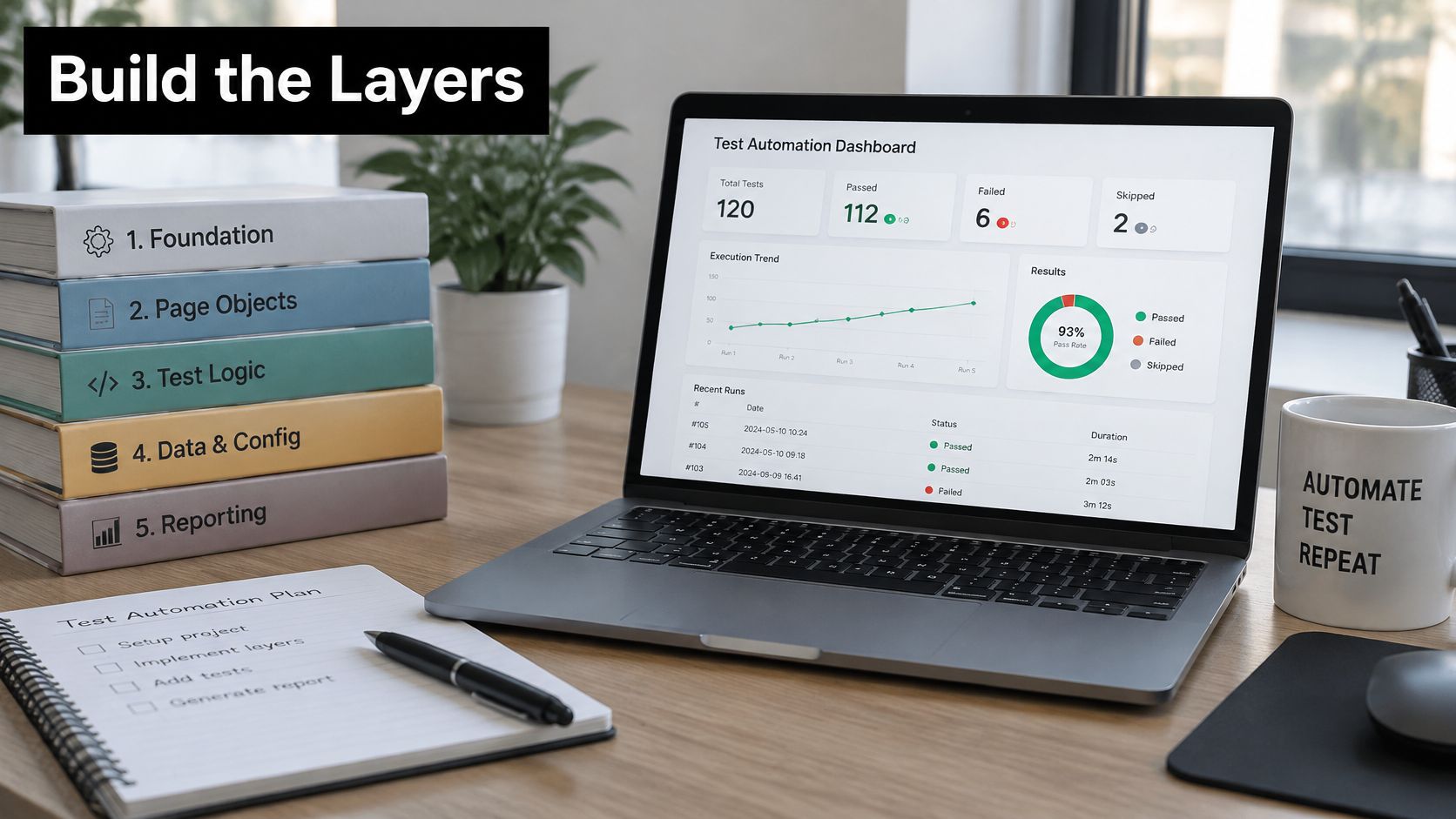
Build a narrow vertical slice before adding coverage. It should demonstrate the entire route from a readable test to an actionable CI result.
Implement the smallest complete path
- Create the folder layout. Use
testsfor intent,actionsfor reusable business operations,driversfor browser and HTTP adapters,datafor builders,configfor environment settings, andreportsfor generated evidence. Keep generated artifacts out of source control. - Keep selectors and URLs out of test files. A test should read like a business rule, such as
checkout.placeOrder(customer, cart), while the action delegates browser details to an adapter.
This illustrative JavaScript pattern separates a page action from a data builder. Its run identifier comes from execution context, making generated records traceable.
class CheckoutPage {

  constructor(page) { this.page = page; }

  async submit() {

    await this.page.getByRole('button', { name: 'Place order' }).click();

  }

}

function customerData(runId, workerId, caseId) {

  const key = `${runId}-${workerId}-${caseId}`;

  return {

    externalId: key,

    name: `Test customer ${key}`

  };

}
- Build unique data per execution. Include run, worker, test, and record identity so parallel workers don't share accounts or orders. Let builders accept explicit overrides so edge cases remain visible in the test rather than buried in helper logic.
- Load non-secret settings from a file for each environment. Read credentials from the pipeline secret store, validate required settings at startup, and print a sanitized configuration summary so engineers can confirm where a run executed.
- Capture diagnostic evidence. Record test identity, commit, environment, timestamps, logs, screenshots, traces, and service correlation identifiers where available. Redact credentials and sensitive payload fields before publishing artifacts.
- Write a smoke test and run it locally and in CI before expanding. Use the same entry command in both places, with environment-specific inputs rather than different execution logic.
- Test the framework itself. Unit-test builders and configuration loaders, then inject a deliberate assertion failure and an adapter failure. Confirm that CI returns the correct status and that another engineer can distinguish the failures from the report.
Keep assertions visible and data disposable
The common slip is putting business assertions inside actions. An action can wait for a page to become usable, but the test should assert that the order total or approval status is correct; otherwise, a generic helper failure conceals the rule being checked.
Before automating ambiguous scenarios, use Figr's guidance on writing effective test cases to sharpen preconditions and expected outcomes. An expense-tracking automation use case is a useful setting for separating submission, approval, and accounting validation.
Create mutable accounts and orders through APIs within each test's setup instead of sharing writable fixtures. Keep reference data in versioned seed files, and mask production-derived data before it enters a test environment.
Delete created records in teardown, but also give them an expiry or an external cleanup path. Teardown won't execute reliably after every worker crash, so recovery must not depend solely on the test process surviving.
Flake Control and Triage From the First Run
Flakiness is an engineering quality metric, not an annoyance you can retry away. A green result after a retry doesn't establish that the original failure was harmless; it establishes that the outcome changed.
Keep the initial outcome visible. Otherwise, your dashboard reports confidence while developers spend time rediscovering the same intermittent failures.
Classify before deciding
Every red run needs a failure class and a handling rule:
- Product defect. Block the merge when a reproducible failure violates the expected behavior. Attach the smallest useful reproduction and route it to the product-code owner.
- Test defect. Fix broken assertions, selectors, or setup logic within the sprint. Restore the signal rather than accepting an indefinitely unreliable check.
- Infrastructure failure. Permit bounded retries for recognized conditions such as an unavailable worker or interrupted connection. Preserve the original evidence and retry reason.
- Nondeterministic behavior. Quarantine the test with an owner, investigation task, and expiration date. Quarantine removes it from a blocking gate, not from reporting.
A changing result alone doesn't identify the class. An intermittent race in application code can be a real product defect, so don't label every pass-on-rerun result as a test problem.
Engineer out avoidable variation
Wait on observable application state instead of fixed sleeps. For example, wait until an order reaches the expected status rather than assuming a background process finishes after a delay.
Control clocks and random seeds where possible, and make setup and cleanup idempotent. Check that a test can execute alone and alongside other tests; sequence-dependent success is a warning sign.
The scale cost is concrete: a Google research presentation reported approximately 150 million test executions per day, with flaky-test reruns consuming 2% to 16% of available compute resources. Your suite doesn't need that scale for repeated execution to consume meaningful capacity.
Retry policy: Retry a recognized transient condition, not an unexplained assertion failure.
Publish a weekly flake budget
Define a consistent team-level measure, such as the share of eligible test executions with confirmed nondeterministic outcomes. Keep its denominator stable, and don't let retries erase failed initial attempts.
Publish a single weekly budget number per team alongside the actual result. Keep quarantined tests visible separately so moving tests out of the gate can't manufacture an improvement.
When a team exceeds its budget, prioritize the causes that disrupt delivery most, not merely the most frequently flaky test. A rarely failing release-critical check can deserve attention before a noisy informational suite.
Set the budget before the pilot starts, together with the classification owner and the escalation rule. Otherwise, teams will negotiate what counts as acceptable only after the dashboard turns red.
Run Tests in CI/CD Without Blocking Every Change
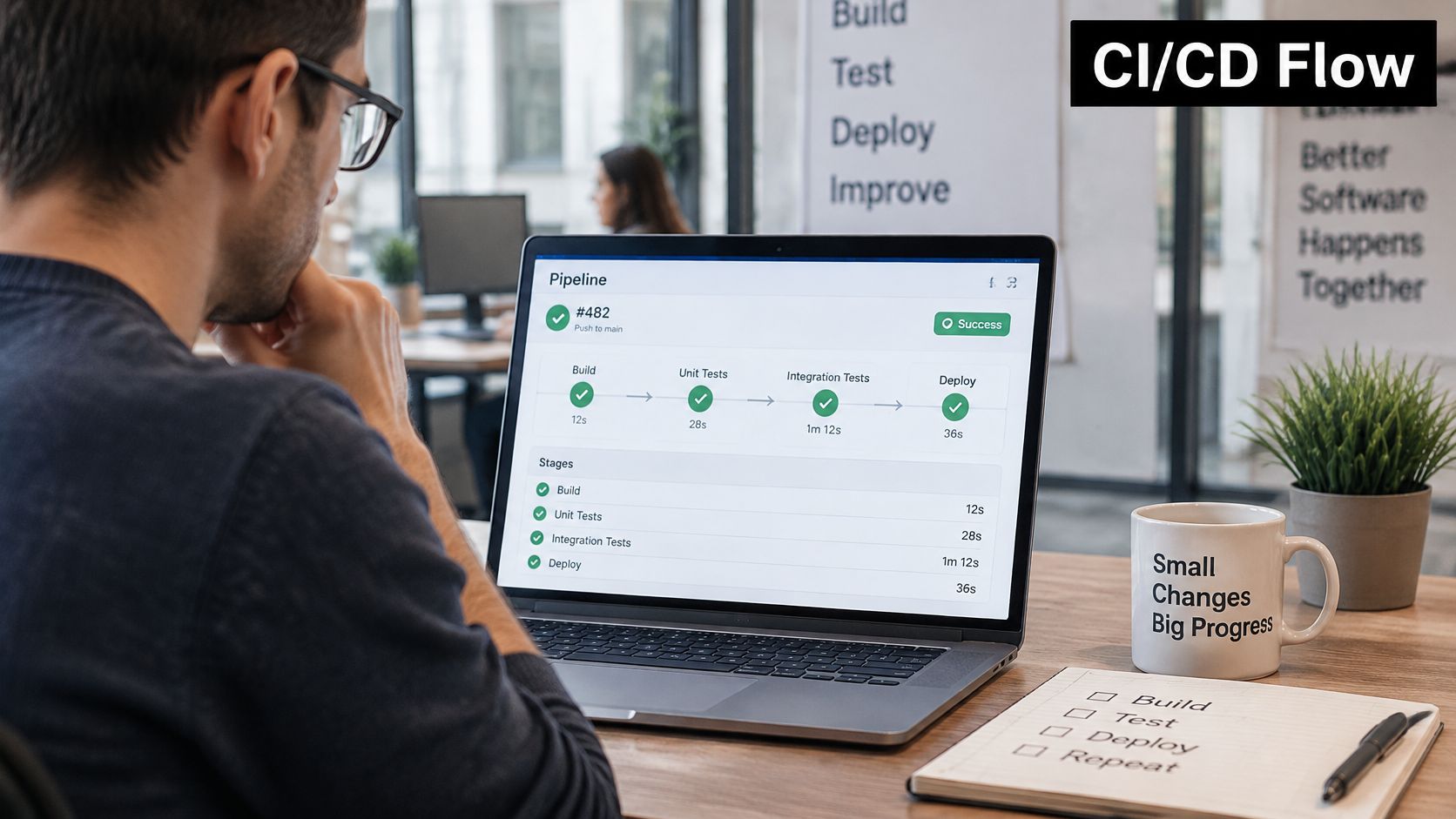
StageTriggerTests runBlocks?Pre-merge gatePull request opened or updatedUnit and API smoke, about 10 minutes as a proposed targetMerge blockedPost-merge regressionMerge to mainBrowser and integration suitesAlert and rollback if criticalNightlyScheduledCross-browser, compatibility, performanceReports to owners onlyRelease gateRelease candidate builtCritical journeys and data-contract checksRelease blocked
Treat the pre-merge duration as a planning target, not a universal standard. The gate must be short enough that developers use it and strong enough to prevent defined critical regressions.
Make stage, owner, and blocking status obvious in the pipeline view.
Move expensive work without losing accountability
Consider a hypothetical retailer with a 40-minute regression suite. It puts focused login and checkout smoke checks into the pre-merge gate and moves the remaining browser scenarios to post-merge execution.
Developers no longer wait for the full suite before every merge, while the selected critical failures still stop changes. This only works if post-merge failures reach an owner promptly and critical regressions trigger a rollback or a halt to promotion.
Google reported that its Postsubmit Speculative Cycles reduced the median time to detect novel breaking targets by approximately 70 minutes. That finding supports investing in post-submission detection, but it doesn't mean moving your own tests will deliver the same improvement.
Nightly execution provides room for expensive compatibility and performance work. Those failures should produce owner-assigned follow-up, even when they don't directly block a merge; known critical failures still require a release decision.
Use the accompanying video as additional viewing while reviewing your delivery workflow.
Make every stage operational
Each stage needs explicit failure rules, retained logs and artifacts, and a link to the tested commit. The release gate must run against the release candidate, not an earlier development build that merely looks equivalent.
Track defect discovery phase and escape rate with agreed definitions. Distinguish defects detected before release from those discovered afterward, and use that information to move checks to a more useful stage.
Leadership must protect ownership of asynchronous failures. For the management side of that responsibility, explore a managing director's leadership reflections from Kogifi alongside your engineering operating model.
Ask this for each test: Which stage would I want to hear about this failure in? Assign it there, then verify that someone can act on the result.
Set Ownership and Pilot Scope This Quarter
Test count is the wrong target. Katalon's enterprise automation discussion reports that 40% of enterprise teams identify high test-maintenance costs as their primary challenge. Maintenance policy belongs in the first sprint.
Apply these operating rules:
- Name an owner and review date for every suite. Ownership includes diagnosis, dependency updates, and retirement decisions.
- Score tests on criticality, execution frequency, defect-detection yield, mean time to repair, and flake rate. Use the agreed flake budget when judging whether a suite is ready to expand.
- Track cost per successful signal, defined here as engineering hours spent per useful result. Rebuild or retire checks whose maintenance burden exceeds their remaining value.
- Maintain a portfolio rather than a browser-test inventory. Keep business-critical end-to-end journeys compact, put most validation in API, contract, component, and data-layer tests, and rebuild or temporarily quarantine environment-dependent checks.
Make the pilot decision
Choose one or two teams and their most critical stable journeys for the proposed four-to-six-week pilot. At exit, publish flake rate and cost per signal against the threshold agreed before starting; expand only when the results justify it.
If you need outside help, we design new test cases and automate customer regression sets at Faberwork. Our services include Software Development, Mobile App Development, Solutions Boost with AI, Database Solutions, and Test Automation. Bring your critical journeys, current regression set, and named pilot owner, and work with us to define the pilot scope and acceptance threshold before committing to rollout.


