
The building automation system market was estimated at $104.46 billion in 2025, according to The Insight Partners. Yet buying building management system software isn't primarily a question of finding more features. It's a question of whether your team can turn equipment data into lower energy use, faster fault diagnosis, and reliable operations without losing control of that data when vendors change.
A useful dashboard helps operators today. Exportable history, consistent equipment definitions, and a tested exit path protect the building through its next upgrade. Start with the operational outcome, then examine how the software will deliver it.
Outcomes Building Management System Software Can Deliver
The strongest budget argument starts with the building you operate. According to Lawrence Berkeley National Laboratory's small-building spotlight, nearly 60% of U.S. commercial buildings larger than 50,000 square feet have building automation systems controlling functions such as HVAC and lighting, compared with 13% below that threshold.
That gap isn't a small-property footnote. Smaller buildings represent most of the commercial stock, while installation and proper tuning of available controls offer substantial energy-saving potential. The figures below, summarized in the same laboratory spotlight, distinguish adoption from estimated savings.
BMS outcomes by building size and control quality
SituationFigureWhat it meansBuildings over 50,000 sq ft with BASNearly 60%HVAC and lighting are already automated in most large U.S. commercial buildingsBuildings under 50,000 sq ft with BAS13%Most smaller buildings still lack this level of automationShare of U.S. commercial buildings under 50,000 sq ftAbout 95%, representing nearly half of commercial-building energy useThe largest untapped stock is the small-building majorityTuned controls, national potentialAbout 29% of commercial-building energy, or 4–5 quadrillion BtuEquivalent to roughly 4–5% of total U.S. energy consumptionControls in smaller buildingsEstimated 10–20% energy savingsTechnical potential includes about 39 million tons of reduced U.S. greenhouse-gas emissions
National potential isn't a site-level savings promise. A building with equipment running through vacant hours presents a different opportunity from one whose schedules, sensors, and control sequences already work well. Poorly tuned loops can also erase the benefit a software proposal assumes.
Building management system software is the supervisory software layer that coordinates sensors, equipment schedules, occupancy signals, alarms, fault detection, and analytics. The complete BMS includes controllers, networks, and physical equipment too. Software makes their operating information usable and, where authorized, changes how equipment runs.
Translate potential into a buying objective
For a smaller property, the first outcome might be reliable occupied and unoccupied operation without daily manual intervention. For a larger facility, it might be identifying conflicting heating and cooling, reducing nuisance alarms, or comparing equipment performance across sites.
Write that objective in operational terms: which equipment changes, what condition triggers the change, and which measurement proves improvement. Include comfort and ventilation requirements so an energy reduction doesn't conceal degraded service.
Match your floor area and current control quality to the table before comparing screens. Then fund the capability that addresses the actual gap, not the longest module list.
How Equipment Data Reaches the Supervisory Layer
Reliable operation starts below the dashboard. Consider an office whose meeting rooms fill unpredictably: local controllers respond to temperature changes, while the supervisory layer coordinates schedules, equipment status, and operator decisions.
Think of the controllers as reflexes and the BMS as the coordination center. BACnet provides a common communications foundation, approved as an ANSI/ASHRAE standard in 1995 and first published as an ISO standard in 2003, as documented by ASHRAE. That interoperability foundation matters, but protocol support alone doesn't establish a usable enterprise data model.
Operators need to see both equipment conditions and the context behind them.
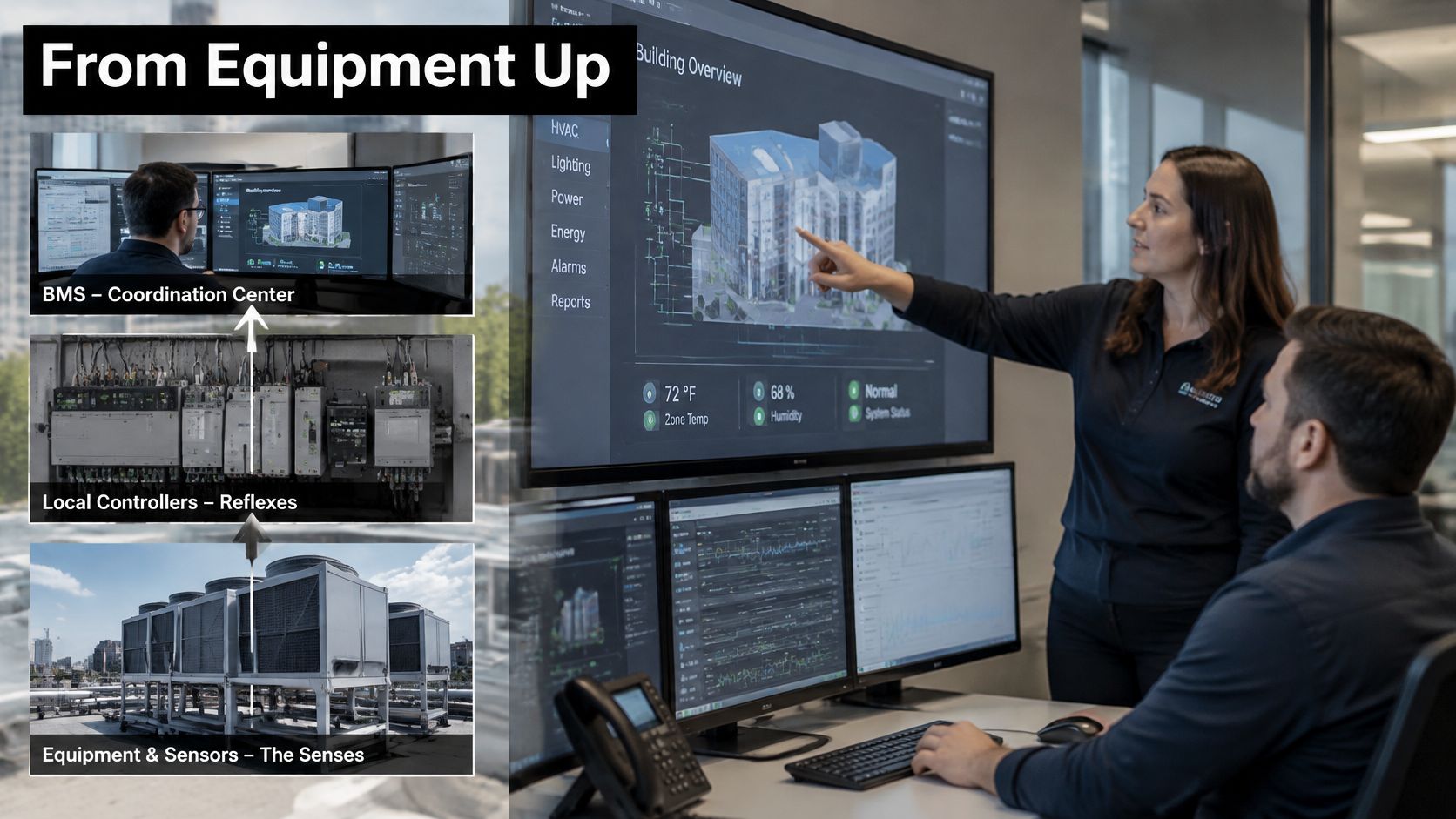
Follow the data from equipment to analysis
- Collect field points. Controllers expose zone temperatures, valve positions, damper positions, fan speeds, setpoints, and equipment states through BACnet or legacy protocols. Local control should continue when supervisory communications fail.
- Normalize through a gateway. Map vendor-specific point names to a consistent naming scheme. A temperature value needs a unit, location, equipment relationship, and quality indicator, not just an abbreviated tag.
- Store operational history. A historian records time-series values alongside asset and measurement metadata. Preserve timestamps, missing-data indicators, and changes to point mappings so later analysis doesn't confuse a renamed sensor with new equipment.
- Provide controlled analytics access. Let cloud applications read approved data through a segmented gateway or replicated store. Don't give an analytics connector unrestricted access to the field-control network.
The NIST BACnet security threat assessment identifies risks associated with corporate-network and internet connections, as well as protocol and physical implementations. Design around those risks with role-based authorization, protected remote sessions, tamper-resistant audit records, and explicit command allowlists.
Keep deterministic HVAC operation local, with on-premises supervisory services where appropriate. Life-safety functions must remain under their dedicated local control arrangements, not depend on a cloud connection.
For residential portfolios, Axis Meter Solutions' guide to smart building technology for multifamily properties offers useful property-specific context when deciding which connected services belong in scope.
Architecture rule: If another authorized tool can't read the historian and understand its metadata, the stack isn't meaningfully open.
Core Modules and the Job Each One Owns
A module earns its place by changing an operating result. HVAC supervision should coordinate equipment, lighting control should reduce unnecessary load, and energy management should explain consumption rather than merely plot it.
Separate these jobs during procurement. Otherwise, a vendor can demonstrate an attractive energy chart while leaving the scheduling defect that caused the excess consumption untouched.
BMS modules and the outcome each should own
ModuleSignals it needsOutcome to requireHVAC supervisionZone temperatures, outdoor-air conditions, staging, dampers, valvesStable comfort through coordinated sequences, not fixed clocks aloneLighting controlSchedules, occupancy, daylightEmpty zones reduce load without routine manual overridesEnergy managementInterval meters, weather, operating baselinesConsumption variance explained against a weather-adjusted baselineAlarms and fault detectionAlarms, setpoints, equipment statesActionable control faults identified before the utility bill arrivesScheduling and occupancyCalendars, motion sensors, or badge-based occupancy proxiesSetbacks applied only while spaces are actually idleHistorianHigh-resolution points and metadataExportable history usable by analytics and a future vendor
HVAC supervision has to reconcile competing requirements. For example, reducing fan speed isn't automatically an improvement if the change prevents adequate ventilation or forces terminal equipment to compensate.
Lighting needs equally explicit boundaries. Occupancy-based reduction should account for shared circulation, cleaning activity, and spaces that require minimum illumination.
Separate evidence from action
An energy management system, or EMS, compares consumption with expected performance. A fault-detection module identifies a likely operational problem. A maintenance system assigns and tracks the work needed to correct it.
Those functions can integrate, but they aren't interchangeable. Require the demonstration to follow an issue from abnormal measurement to diagnosis, operator acknowledgement, corrective work, and verification.
Security and access events can provide useful context, such as unexpected occupancy after scheduled closing. Treat access information as sensitive, restrict who can see it, and don't confuse event integration with authority to operate life-safety equipment.
The historian deserves particular scrutiny because it supports every later investigation. Ask whether an operator can distinguish a commanded valve position from measured feedback, identify stale readings, and recover the original engineering units.
A module without identifiable input points and a measurable operating outcome is a feature label, not an acceptance criterion.
Drop optional modules that can't meet that standard. For essential functions, require the vendor to close the gap before acceptance rather than treating missing evidence as a future enhancement.
Analytics and AI Beyond Fixed Schedules
Better analytics should produce a useful decision, not another screen. Start with the data path: gateways send time-series points to a historian, normalized asset and measurement tables move into a warehouse such as Snowflake, and models read that governed history.
A technician should be able to inspect the evidence behind a recommendation.
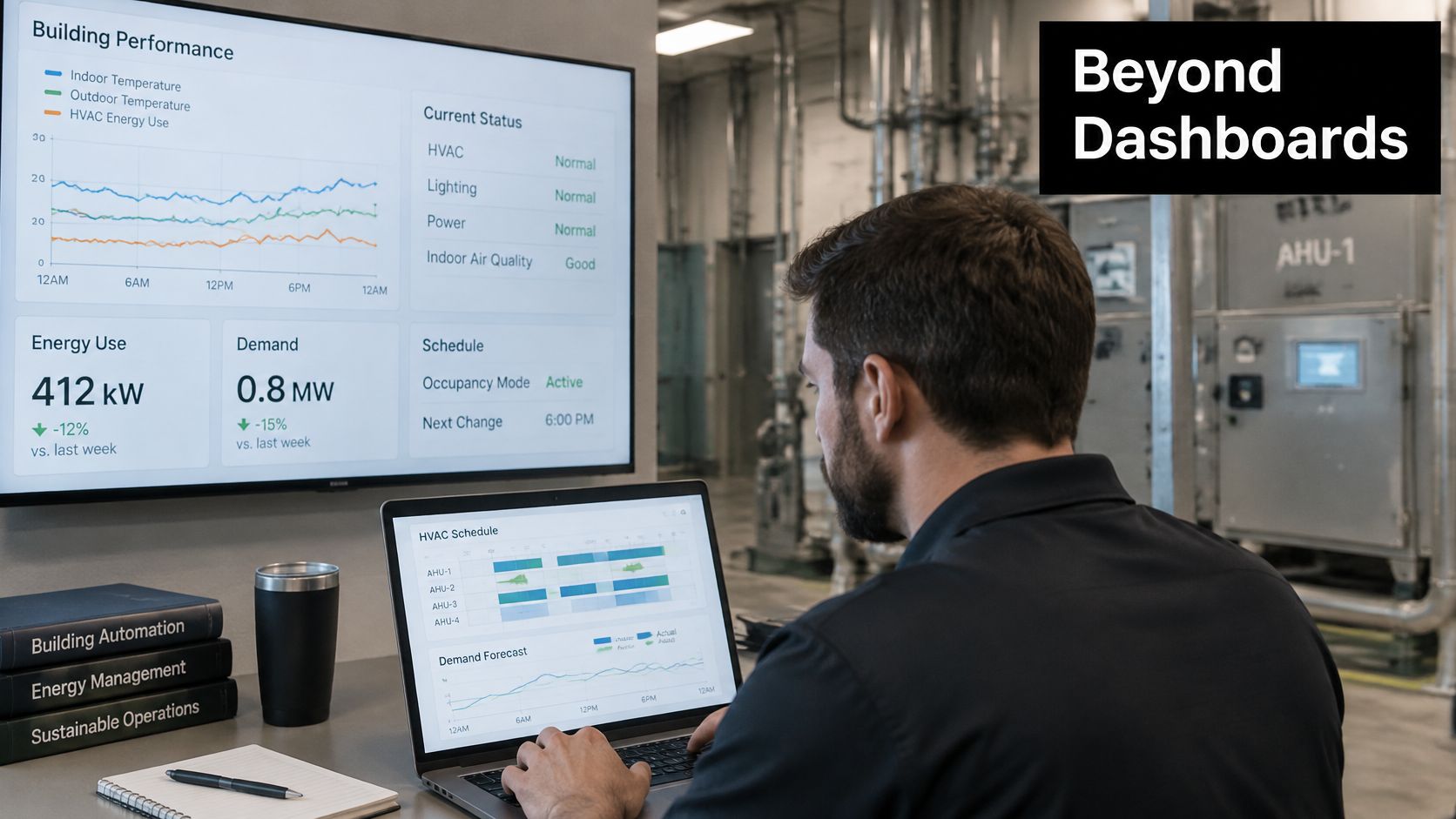
According to the U.S. Department of Energy's building-controls overview, high-performance controls can reduce annual HVAC energy use by approximately 30%, with comparable reductions in peak HVAC demand; universal advanced-controls deployment could reduce total U.S. energy consumption by more than 3%. The department also identifies physics-based and machine-learning predictive control as pathways beyond conventional rules.
Those outcomes require coordinated sequences that reconcile zone demand, outdoor-air requirements, staging, supply-air temperature, economizer operation, and occupancy. Sensor calibration and commissioning determine whether the model receives trustworthy information.
Give each model a bounded decision
- Predictive maintenance produces a work order. Flag patterns consistent with drifting valves, short-cycling compressors, or increasing filter resistance. Include the relevant trend and uncertainty rather than declaring a failure from an isolated reading.
- Energy optimization proposes or applies a bounded adjustment. Use weather and occupancy to reset approved setpoints. Enforce equipment limits, ventilation requirements, operator overrides, and rollback conditions outside the model.
- Fault detection produces a diagnosis. Trace relationships, such as an economizer stuck open that drives unnecessary reheat. Give technicians a likely cause and a verification procedure.
At Faberwork LLC, we've helped build intelligent software for analyzing HVAC time-series data using Snowflake, and our use of TensorFlow AI supports smart-building efficiency. Our engineering work on the GridPoint sensor platform processes more than 25 million sensor data points per day.
These capabilities make data quality and reproducible evaluation especially important. Our discussion of smart controllers for profitability connects controller decisions with operational objectives.
Use the following video as a companion to evaluating control and analytics workflows.
AI may recommend actions or adjust approved settings within limits. It shouldn't replace dedicated local life-safety logic or gain broader command authority solely because its predictions improve.
Use Cases with Measured Building Results
Occupancy-based setbacks reduced annual HVAC energy at DINX Social Club by 18% and yearly operating costs by $1,655, according to Lawrence Berkeley National Laboratory's small-building case studies. Machine-learning controls coordinated seven rooftop units, using motion sensors to identify idle periods instead of conditioning every area continuously.
A University of Bahrain pilot reported a 10% reduction in energy consumption, with setpoints evaluated every 15 minutes and up to 96 automatic adjustments over a day, according to the Honeywell campus case study. The control process used time of day, weather, occupancy, and other operating information rather than treating the initial schedule as permanent.
Control problems represent a different opportunity from occupancy scheduling. REHVA's whole-building fault-detection article cites published estimates that 5–30% of commercial-building energy use may be wasted because of control-related problems. That's an estimate of potential waste, not a measured savings guarantee from installing fault-detection software.
Measured BMS use cases
ExampleWhat the software didReported resultDINX Social ClubApplied occupancy setbacks across seven rooftop units18% annual HVAC-energy savings and $1,655 lower yearly operating costsUniversity of BahrainEvaluated setpoints every 15 minutes, allowing up to 96 automatic adjustments daily10% lower energy consumptionControl-fault researchExamined control-related waste addressed by whole-building fault detectionEstimated 5–30% of commercial-building energy use may be wasted on control problems, not a measured project saving
Apply the pattern, not the percentage
For a multi-rooftop-unit site, examine whether equipment follows actual activity and whether neighboring zones receive conflicting commands. For a campus, examine how changes in occupancy and weather affect operating decisions throughout the day.
For a fault backlog, prioritize diagnoses that technicians can verify. An alarm without equipment context, likely cause, or a responsible owner adds work rather than resolving it.
Our enterprise work offers related implementation examples: we built a large, web-based EMS to enhance HVAC management and created a data-center management system with advanced visuals. The latter illustrates the value of visual operations rather than another spreadsheet, without implying an unreported energy-saving result. Our smart-building AI success story provides additional application context.
Savings assumptions still require calibrated sensors and commissioned sequences. Which operating pattern best matches your site: many rooftop units, a campus with shifting occupancy, or an unresolved fault backlog?
Vendor Tests That Protect the Next Decade
Integration difficulty deserves more attention than dashboard polish. A 2025 Association for Smarter Homes & Buildings survey of 308 U.S. and Canadian commercial-building owners, operators, IT leaders, and facility managers found that 21% cited limited compatibility with existing systems and 21% insufficient in-house skills; 31% reported integration-complexity challenges and 31% data-software usability problems.
The operating model matters too. As reported by Facilities Dive, a 2025 survey of 1,100 cybersecurity professionals responsible for cyber-physical systems found that 46% had experienced a breach in the prior year tied to third-party access, 54% discovered vendor-contract security weaknesses after an incident, and 73% were reevaluating third-party remote access. The same coverage identified purchase and implementation cost at 33% and privacy and cybersecurity at 25% as smart-building adoption barriers.
BMS vendor acceptance tests
TestPass looks likeFail looks likePoint and protocol inventoryBACnet and legacy points mapped to assetsUnknown points remain accessible only through a vendor toolBidirectional controlCommands and feedback verified on representative equipmentRead-only integration sold as controlHistory exportTime series and metadata leave in a documented formatHistory trapped in a proprietary archiveAPI contractAuthentication, rate limits, and versions documentedUndocumented screen scrapingExit exerciseA second team can interpret the semantic modelMigration requires the incumbentRemote accessTime-limited, recorded, least-privilege sessionsStanding shared administrator accounts
Stable semantics means equipment and measurement definitions retain their meaning through upgrades. Test whether another team can identify supply-air temperature, its units, its equipment relationship, and its quality flags without relying on an integrator's memory.
For access-control integration, Nimbio's gate access API for developers is a relevant resource when examining how a connected gate service exposes integration capabilities. Evaluate each integration's documentation and authorization boundaries separately from the BMS sales demonstration.
Govern support instead of banning it
Remote support can help diagnose faults, but access needs an accountable owner. Require identity federation, least privilege, approved session windows, recording, an asset inventory, and contractual incident-notification duties.
Include firmware responsibility, credential revocation, monitoring ownership, and handover documentation in the agreement. Have your own team perform the exit exercise so acceptance also tests whether staff can operate the system.
Reject rule: If usable history can't leave, or a contractor requires a standing unrestricted administrator account, reject the bid regardless of the dashboard.
Start a Pilot and Judge It on KPIs
A pilot should answer a funding question: can this implementation improve operations without creating an unmanageable integration or support burden? Use the following spans as illustrative planning allowances, not guaranteed delivery schedules.
- Choose a bounded problem and establish a baseline. Select a building or plant with identifiable pain, such as rooftop-unit scheduling or data-hall alarms. For example, plan 8–12 weeks of energy, comfort-complaint, and alarm records, while checking whether that period represents normal operation.
- Inventory points and network segments. An illustrative 2–4-week discovery window should identify controllers, protocols, point owners, access routes, and missing measurements. Resolve uncertainties before promising automated control.
- Connect the gateway and historian. Allow, for example, 4–8 weeks for integration and export verification. Test timestamps, units, missing values, and recovery after interrupted communications.
- Commission the trusted sequences. A hypothetical 4–6-week commissioning window covers sensor checks, sequence verification, overrides, and rollback tests. Don't optimize against measurements the facilities team doesn't trust.
- Enable diagnosis before bounded optimization. Start with fault detection, then authorize limited setpoint changes. An illustrative 90-day evaluation can compare performance with the baseline, adjusted for weather and operating conditions.
- Expand or stop against the agreed KPI sheet. Include weather-adjusted HVAC or whole-building energy, peak demand, mean time to diagnose faults, alarms per day, comfort complaints per week, and the share of mapped points with a named owner.
Keep the financial and security decisions together
Calculate simple payback as pilot cost divided by annualized net savings, subtracting recurring software, support, and operating costs from gross savings. Treat annualized results cautiously when the trial doesn't cover representative seasonal conditions.
A tightly bounded project might be planned across quarters; a legacy campus may need longer because point mapping and commissioning drive the schedule. Include access reviews, encryption checks, and patching responsibilities in the same delivery plan.
We build customized software around each client's specific requirements and offer SnowPro Certified Developers. Our engineering expertise can support any stage of the Software Development Life Cycle, including warehouse modeling, legacy re-engineering, and time-series AI.
Fund the next building only after the pilot's KPI sheet demonstrates improvement against the agreed baseline.
Bring Faberwork LLC your equipment inventory, sample trend export, and highest-priority operating problem. Ask us to scope a pilot with named data owners, measurable acceptance criteria, and a provider-exit test before committing to portfolio-wide deployment.


