Custom software is designed to perfectly match your business operations, leading to powerful outcomes: improved efficiency, enhanced security, and a clear path for future growth. Unlike off-the-shelf options that force you to compromise, a tailored solution transforms your technology from a frustrating roadblock into a strategic asset.
When Off-the-Shelf Software Fails to Deliver

Generic software often promises a quick fix but delivers daily frustration through clunky workarounds. Businesses pay for bloated, one-size-fits-all platforms packed with features they never use, while the one critical function they need is either missing or poorly implemented.
This forces teams into rigid, inefficient workflows. Instead of technology adapting to your process, your people must adapt their process to the software's limitations. The outcome is a constant drag on productivity and morale that quietly erodes your bottom line.
The True Cost of "Good Enough"
The problem with generic software isn't just frustration; it's the tangible costs that accumulate over time. Manual data entry between systems that don't communicate and tasks that take twice as long as they should result in wasted hours and a higher risk of human error.
This is the hidden tax of off-the-shelf solutions. You pay not just in licensing fees but in lost productivity and missed opportunities. These foundational cracks become major problems as your business scales and your operational needs become more complex.
Pushing Past the Generic Ceiling
Frustration with these limitations is fueling a massive shift toward custom solutions. The global custom software development market, valued at $43.16 billion, is projected to grow by 22% annually as companies break free from generic constraints.
By building personalized functionality, businesses are achieving productivity gains of up to 40%. They are automating repetitive tasks and designing workflows that mirror their exact operational needs. You can learn more about how custom software drives business scalability and key metrics.
A key outcome of custom software development is regaining control. You build a solution that solves your specific problems, integrates seamlessly with existing tools, and scales precisely with your business, rather than forcing you into a box.
Ultimately, choosing custom software is a strategic move. It recognizes that your unique processes are a competitive advantage. The goal is to align your technology with your business objectives, creating a solid foundation for sustainable growth.
Gaining a True Competitive Advantage
Custom software is more than a tool; it’s a strategic asset your competitors can't replicate. While generic solutions force you to operate like everyone else, a custom application is built around your unique operational DNA, turning your specialized processes into a powerful market advantage.
For example, a custom CRM can be designed to mirror your niche sales process perfectly. An inventory system can be mapped flawlessly to a complex, multi-regional supply chain. These solutions build a competitive moat, making it incredibly difficult for others to match your operational efficiency.
From Process to Profit
One of the most immediate benefits of custom software is the ability to turn specific workflows into direct efficiency gains. Off-the-shelf software often creates friction, forcing teams into manual data transfers or reliance on spreadsheets. A custom solution eliminates that friction entirely.
Use Case: A logistics company built a custom tool integrating real-time traffic data with specific delivery routes and vehicle capacities. This purpose-built system cut fuel costs and tightened delivery times by solving their exact logistical puzzle.
This focused approach delivers measurable outcomes. Companies investing in tailored software have reported profit increases between 25% and 95% because every feature directly supports a core business objective.
Creating Deeply Personalized Customer Experiences
In a competitive market, customer experience is a key differentiator. Generic software provides a standardized experience, but custom applications let you create something memorable. You can design customer portals, mobile apps, and internal tools that directly address your audience's needs.
Businesses achieve 80% higher customer acquisition rates through personalized experiences. This is a direct outcome of custom software, which provides complete control over the entire user journey.
This level of personalization builds deep loyalty and strengthens customer relationships. It demonstrates that you understand your clients and have invested in technology to serve them better—an outcome nearly impossible to achieve when boxed in by mass-market products.
Innovating Faster Than the Market
Staying ahead requires agility. Custom software gives you the freedom to innovate on your own terms. You are no longer dependent on a third-party vendor's update schedule for a critical feature. You own the roadmap.
This control allows your business to pivot quickly, respond to market shifts, and roll out new features to meet emerging customer demands. The ability to integrate new technologies or adjust workflows without being constrained by a rigid software ecosystem is a significant competitive advantage.
Custom Software vs Off-the-Shelf Software A Strategic Comparison
To clarify the choice, this table compares the strategic outcomes of building versus buying software, focusing on long-term business impact.
FeatureCustom SoftwareOff-the-Shelf SoftwareMarket FitBuilt to solve your exact business problems and workflows.Designed for a broad audience; often a compromise.Competitive EdgeCreates a unique asset that competitors cannot easily copy.Puts you on the same technological footing as competitors.IntegrationSeamlessly connects with your existing and future systems.Often requires costly or clunky third-party connectors.ScalabilityArchitected to grow and evolve with your business needs.May have limitations on users, data, or features.ControlFull control over features, updates, and the development roadmap.Dependent on the vendor's priorities and update schedule.OwnershipYou own the intellectual property and the asset itself.You are licensing the software, with no ownership rights.
Choosing custom software is an investment in your company’s unique identity. It empowers you to build software that amplifies your strengths, solidifying your position as a market leader.
Understanding the True Cost of Ownership
The initial cost of a custom software project can seem high, but it’s only one part of the financial story. The Total Cost of Ownership (TCO) reveals the hidden, recurring costs of generic software that quietly drain your budget over time.
A custom solution is a one-time capital expenditure that creates a tangible, depreciable asset for your company. In contrast, off-the-shelf software locks you into an endless cycle of operational expenses through recurring subscription fees.
The Hidden Costs of Generic Software
Most off-the-shelf software models penalize growth. As your team expands, per-user licensing fees increase, turning success into a direct cost. You are perpetually paying for a service you will never own.
Beyond the subscription, other costs include:
- Expensive Workarounds: Manual processes or third-party plugins are needed to fill feature gaps, adding complexity and expense.
- Integration Headaches: Connecting generic software to other systems often requires fragile, custom-built connectors that break with vendor updates.
- Bloated, Unused Features: You are forced to pay for a full suite of features even if your team only uses a small fraction of them.
This model creates a predictable financial leak. You end up renting a tool that only partially solves your problem, while the bill grows larger every year.
The real financial win with custom software isn't about a lower upfront price. It's about breaking free from the forever-rental cycle of licensing fees and gaining a predictable, long-term asset that actually works the way your business does.
Shifting from Expense to Asset
When you stop renting software and start owning it, a powerful financial shift occurs. A custom solution becomes a piece of intellectual property that belongs to your company, not just another expense.
Despite a higher initial investment, custom software delivers long-term cost efficiency. Recurring subscriptions, per-user charges, and surprise upgrade costs for off-the-shelf tools add up quickly. In contrast, a custom solution is a capital expenditure free of ongoing licensing fees. Businesses have reported saving hundreds of thousands of dollars annually by replacing expensive, generic systems with custom-built alternatives, paying only for the functionality they actually need.
A TCO analysis over a 5–10 year period often shows that custom solutions are more cost-effective. You can explore more about the long-term benefits of custom software on bruceandeddy.com.
A Clearer Path to ROI
With custom software, you control the roadmap and the budget. There are no surprise vendor price hikes or forced upgrades to disrupt your workflow. Every dollar invested goes directly into features that solve specific business problems, accelerating your return on investment.
Use Case: A manufacturing firm built a custom inventory management system, immediately eliminating a $50,000 annual subscription for a generic tool. By integrating the new system with their supply chain software, they streamlined operations. The initial development cost was recouped within two years, and the software became a pure asset driving efficiency and profit—with zero recurring fees.
Analyzing the true cost of ownership enables a strategic decision based on long-term value, not just short-term savings. It's about choosing a predictable financial future where technology is a sustainable asset that fuels growth.
How Custom Software Solves Real-World Problems

The true value of custom software is demonstrated by its ability to solve messy, real-world problems and deliver measurable business outcomes. Each solution begins with a business identifying a unique challenge and building the perfect tool to overcome it, turning operational headaches into a competitive edge.
Slashing Costs in Logistics with Geofencing
Problem: A transportation firm was struggling with inefficient routes, leading to high fuel costs and missed delivery windows. Their off-the-shelf GPS software was blind to critical variables like vehicle size, load weight, and real-time traffic.
Solution: They commissioned a custom mobile application with two key features:
- Advanced Route Optimization: The system calculated the most fuel-efficient and timely path for each specific truck and its cargo.
- Intelligent Geofencing: The app created virtual perimeters around delivery zones, sending automatic alerts for any deviation to prevent unauthorized stops.
Outcome: The company achieved a 15% reduction in fuel costs within six months and a 20% improvement in on-time delivery rates. The purpose-built solution directly addressed their biggest operational drain. To learn more, read about how mobile apps are transforming the logistics industry.
The real power of custom software lies in its ability to model and solve the unique, messy complexities of your business. It’s not about finding a tool that's "good enough"; it's about building the perfect tool for the job.
Streamlining Healthcare with a Secure Patient Portal
Problem: A multi-location clinic was overwhelmed with administrative tasks like confirming appointments and sharing test results. Their patchwork of systems made information sharing slow, manual, and prone to error.
Solution: A custom-built, HIPAA-compliant patient portal was engineered to integrate directly with their Electronic Health Record (EHR) system. The portal allowed patients to securely schedule appointments, access lab results, message their care team, and complete intake forms online.
Outcome: Administrative overhead dropped by 30%, allowing staff to focus on patient care. Patient satisfaction scores increased by 25% due to the added convenience and direct communication.
Enabling Smarter Decisions in Finance
Problem: A financial firm's analysts were using a jumble of spreadsheets and third-party data feeds to model market volatility. The slow, clunky process left them a step behind fast-moving trends.
Solution: They invested in a custom analytics platform designed to pull and process large datasets in real time, run proprietary risk-modeling algorithms, and display results on an intuitive dashboard that flagged critical risk factors.
Outcome: The firm gained a significant advantage by analyzing risk as it happened, allowing them to spot opportunities and threats faster. This resulted in a 10% improvement in portfolio performance in the first year alone. These use cases highlight a core truth: the biggest wins come when a unique business problem is met with a uniquely engineered solution.
Building for Long-Term Scalability and Security
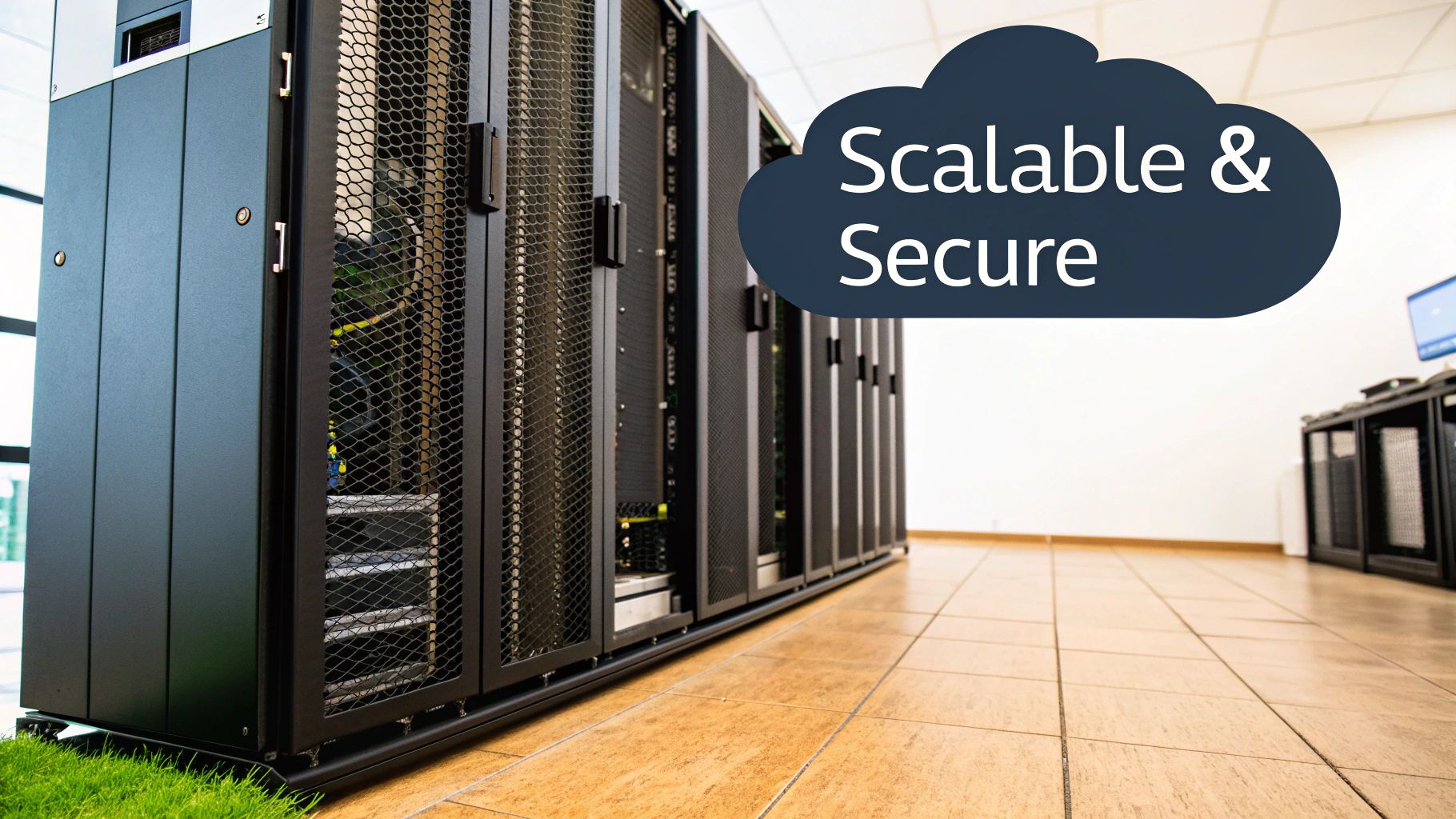
Your business is designed to grow, and your software should enable that growth, not hinder it. Custom development builds a future-proof foundation, unlike off-the-shelf software, which often hits a performance ceiling as you add users or data, forcing a costly and disruptive system migration.
Architecting for Growth
Custom solutions are designed from day one with your future in mind, architected to handle increased loads gracefully. This is achieved through deliberate choices:
- Modular Design: Software is built in independent modules, allowing you to scale or update one part of the system without disrupting the entire application.
- Cloud-Native Principles: Building on cloud technologies allows the system to scale resources dynamically, handling sudden traffic spikes without performance degradation.
- Efficient Codebase: Clean, optimized code prevents bottlenecks as data volumes grow, ensuring the application remains efficient.
This forward-thinking approach means that as your user base doubles or transaction volume triples, the software continues to perform, protecting your initial investment for years to come.
Taking Control of Your Security
In an era of significant cyber threats, security cannot be an afterthought. Generic software offers a one-size-fits-all security model that may not align with your specific risks or regulatory requirements.
Custom development puts you in control, allowing you to build security protocols designed for your operational reality.
Custom software development provides businesses with complete control over the security measures implemented within the software, a critical advantage in industries like healthcare, finance, and manufacturing where data protection is paramount.
This granular control enables specific measures that are right for your business:
- Tailored Access Controls: Define precise user roles and permissions to ensure employees access only the data necessary for their jobs.
- Targeted Threat Mitigation: Build defenses designed to counter specific cyber threats common in your industry.
- Simplified Compliance: Bake compliance checks and audit trails for standards like HIPAA or GDPR directly into the system's core.
For example, a fintech company can embed advanced encryption and multi-factor authentication directly into its platform, far exceeding the generic security of an off-the-shelf product. This proactive approach protects sensitive data, builds customer trust, and fortifies the company's reputation. Ultimately, custom software is a strategic investment in longevity, ensuring your technology remains a powerful asset that adapts and grows with you.
How to Choose the Right Development Partner
Selecting a development partner is one of the most critical decisions in the custom software process. You need a strategic ally who understands your business goals and can translate them into a high-performing technical asset that delivers a clear return on investment.
Look beyond polished sales pitches to a partner's portfolio of real-world projects. Don't just look at what they built; analyze the business problems they solved. Did their solution reduce operational costs by 15% for a logistics client? Did they help a healthcare provider improve patient outcomes? Concrete, measurable outcomes are the mark of a seasoned professional.
Evaluating Technical Expertise and Process
While technical skill is essential, a partner's development process is equally important. Inquire about their methodology, as it directly impacts project transparency, flexibility, and budget.
Effective modern teams typically use an Agile framework. This approach avoids the outdated model of disappearing for months before a big reveal. Instead, Agile focuses on delivering working software in short, iterative cycles, allowing you to see progress, provide feedback, and make adjustments continuously.
Key questions to ask include:
- How do you ensure transparency and keep me informed?
- Can you describe your quality assurance and testing process?
- How do you manage the project and handle scope changes?
A confident partner will provide clear, structured answers, explaining how their process keeps projects on track and on budget while preventing scope creep.
Your development partner should function as an extension of your own team. They need to be as invested in your business success as they are in the technical execution, ensuring every line of code serves a clear business purpose.
The right partner combines proven technical skill with a transparent, collaborative process and a genuine understanding of your business objectives. This partnership is the foundation of your project's success, turning your vision into a working reality. A strong partner will offer a full spectrum of technology consulting and development services to guide you from initial concept to deployment and beyond.
Frequently Asked Questions
Deciding on custom software raises important questions about budget, timeline, and business impact. Here are concise answers to the most common concerns.
We'll provide practical information relevant to your operations and bottom line.
Is Custom Software Affordable for Small Businesses?
Yes, through a phased development approach. Instead of building everything at once, we identify the single most impactful feature and create a Minimum Viable Product (MVP).
This strategy allows you to see a return on investment quickly. You gain value from a small, focused build, and the success of the first phase often helps fund the next. This makes the investment more manageable and ties every dollar spent directly to a measurable business outcome.
How Long Will It Take to Build?
Timelines vary, but Agile development ensures you see value quickly. Instead of waiting a year for a final product, we deliver working software in short sprints, typically every two to four weeks.
This means you can start using core features and providing feedback within months. A straightforward application might launch its first version in 3-6 months, while a complex enterprise system could take a year or more. The key is that you see tangible progress long before the project is complete.
What Happens When My Business Needs Change?
This is where custom software excels. Unlike off-the-shelf products where you are dependent on a vendor's update schedule, a custom build puts you in control.
You own the code. You own the roadmap. That gives you total freedom to tweak, expand, or completely pivot your software when the market shifts or a new opportunity pops up. This flexibility is what keeps your tech an asset, not a liability holding you back.
Whether you need to add a new feature, integrate with a partner's API, or scale to handle more users, the software is built to adapt. This inherent flexibility is the biggest long-term benefit, future-proofing your investment for years to come.


