
The popular advice is to “automate the easy work and augment the hard work.” That sounds sensible, but it's too vague to guide an enterprise architecture review. The question is more demanding: who owns the outcome, who can intervene, and what does failure cost?
AI automation replaces a defined workflow with machine execution. AI augmentation gives employees better information, faster drafting, or stronger analysis while keeping a human accountable. Agentic AI complicates the boundary because the same agent can suggest a decision in one workflow, then execute a bounded action autonomously in another.
The right choice is therefore a design decision with an ROI boundary, not a philosophical debate. Automation can reduce cycle time and manual operating cost. Augmentation can increase throughput, quality, and decision capacity without removing human judgment. In regulated enterprises, the strongest architecture usually combines both.
Why the Automation vs Augmentation Question Matters Now
Boards are asking about AI because the technology is moving from isolated assistance to systems that can plan, call tools, update records, and complete multi-step work. That creates a sharper decision than just approving a chatbot. Leaders must decide whether an AI system will replace a workflow, amplify the people inside it, or switch between those modes as conditions change.
The pressure is operational as well as technological. Finance teams want faster reconciliation, service leaders want lower queues, and technology organizations want productivity without creating an uncontrolled compliance surface. Regulators and internal auditors, meanwhile, care about accountability, traceability, access controls, and the ability to explain an automated decision.
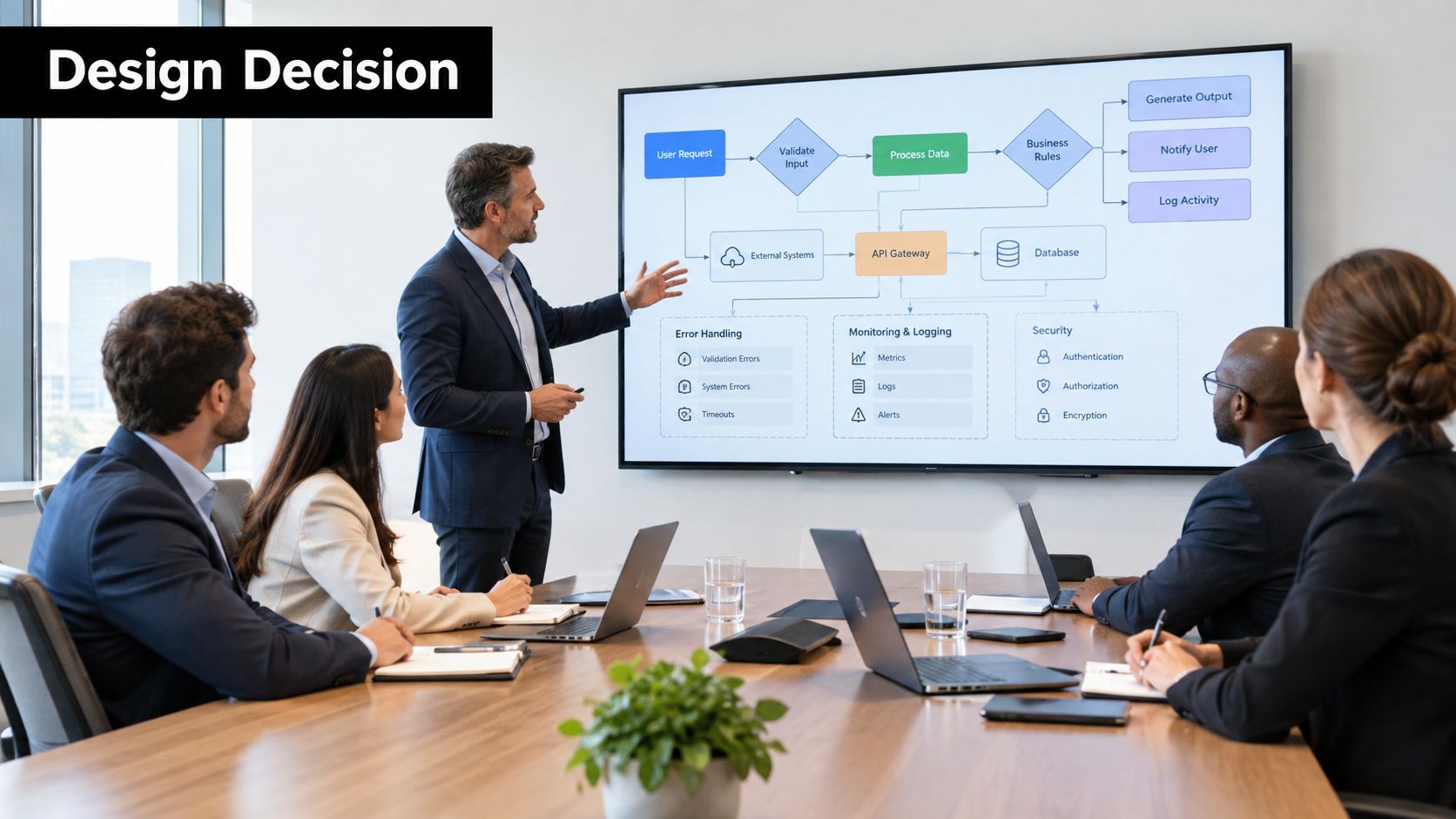
The boundary is measurable
A 2023 experiment published in Science found that ChatGPT users completed writing tasks 40% faster and produced output with 18% higher quality than the comparison group, according to the published study. Humans still performed the work. The model improved their speed and quality, which is a clear augmentation pattern.
That distinction matters because pure replacement has a ceiling in knowledge work. If the workflow depends on interpretation, context, or accountability, removing the person can transfer cost rather than remove it. The enterprise may save keystrokes while increasing review, exception handling, legal exposure, or rework.
Practical rule: Automate execution only when the organization can define success, detect failure, and assign ownership before the system goes live.
For leaders building a broader operating model, this Prompt Builder automation guide offers useful context on applying AI to repeatable marketing workflows. The same discipline applies elsewhere: document the process, isolate the stable steps, and measure the outcome rather than the novelty of the tool.
Defining AI Automation and AI Augmentation
Use a simple test. If the model produces an output, triggers the next system, and no employee must approve the result before the workflow continues, you're building AI automation. The system owns execution within the scope you've assigned to it.
Invoice matching is a good example. An agent can extract fields, compare an invoice with purchase-order data, classify a match, record the result, and release the next step. Fraud screening and ticket triage can follow the same pattern when the decision space is narrow and exceptions have a controlled route.
AI augmentation keeps a human in the critical path. The model may retrieve relevant policy, summarize a customer history, draft a response, flag an anomaly, or compare scenarios. An analyst, clinician, claims reviewer, or service agent still decides what to do and remains accountable for the decision.
Ask three ownership questions
- Who owns the output? If a person must validate and approve it, the workflow is augmented. If the system can commit the result directly, it's automated.
- Who reviews the failure? Augmented workflows expose uncertainty to a user. Automated workflows need exception queues, alerts, rollback procedures, and named operational owners.
- What can the system change? Read-only retrieval and drafting create a different risk profile from an agent that can write to a ledger, alter a customer record, or initiate payment.
Agentic AI isn't a third category. It's an architectural pattern that can support either mode. A tool-using agent with an approval gate is augmentation. The same agent, operating inside a constrained closed loop, is automation.
Teams designing grounded assistants should also understand verifiable LLM responses with RAG. Retrieval can improve the evidence available to a user or agent, but it doesn't by itself decide whether a human must approve the final action.
Automation vs Augmentation at a Glance
DimensionAI AutomationAI AugmentationHuman roleSupervises exceptions or owns the serviceReviews, decides, and applies judgmentSystem behaviorExecutes a defined workflow end to endPrepares information or recommendationsBest environmentStable inputs, narrow decisions, repeatable rulesAmbiguous work, high context, consequential judgmentPrimary outcomeThroughput, cycle-time reduction, lower manual effortFaster analysis, better quality, stronger decision capacityFailure controlMonitoring, thresholds, rollback, exception routingReview checkpoints, evidence display, user feedbackMain riskErrors can propagate before detectionUsers may accept weak outputs without sufficient review
Comparing the Two Approaches Across Enterprise Dimensions
The architecture choice affects more than the model. It changes how teams design systems, assign work, approve releases, and investigate incidents.
DimensionAI AutomationAI AugmentationBest Fit SignalTechnical architectureOrchestrated pipeline with model calls, tools, state, and closed-loop executionRetrieval, context assembly, recommendations, and human checkpointsChoose automation for stable process graphs. Choose augmentation when context changes the decisionWorkforce impactReduces demand for specific task bundles and requires redeployment planningRaises the output of existing specialists and requires skill developmentChoose based on whether the strategic goal is cost displacement or capacity expansionGovernanceStrict pre-deployment validation, access controls, action limits, and rollbackContinuous user oversight, evidence capture, feedback, and approval policyUse automation only where accountability can be encoded clearlyRiskConcentrated blast radius in the model, tools, and orchestration layerDistributed risk across users, prompts, interpretations, and approvalsUse augmentation where a wrong decision has high or difficult-to-reverse cost
Workforce impact isn't binary
A 2025 Harvard Business School working paper found a meaningful split in labor demand. Jobs in the top quartile of automation exposure saw an average decrease of 95 job postings per firm per quarter, while jobs in the top quartile of augmentation exposure saw an average increase of 80 job postings, as reported in the working paper.
That result changes the workforce conversation. An automation program can reduce demand for a particular task bundle while an augmentation program expands demand for roles that coordinate, interpret, validate, or improve AI-supported work. Workforce planning belongs in the architecture decision, not after deployment.
Risk concentrates differently
Automation concentrates risk in the system. A flawed classification can push many records down the wrong branch before an operator notices. Augmentation distributes risk across people, which lowers the blast radius but introduces a different failure mode: users may over-trust a polished recommendation.
A 2024 meta-analysis found that human-AI systems outperformed humans alone for augmentation, with a pooled effect size of g = 0.65, while human-AI synergy against the best standalone performer was negative on average at g = -0.23, according to the meta-analysis. The lesson is direct: assistance can improve individual performance, but combining a human and model doesn't guarantee that the overall system beats the strongest available performer.
Where Each Model Wins in Real Enterprise Use Cases
The useful comparison isn't “which model is better?” It's which outcome is constrained by human effort, decision quality, or control?
Use CaseStronger ModelPrimary KPIWhy It WinsInvoice matching and structured back-office checksAutomationCycle time and exception rateThe process has defined inputs, repeatable comparisons, and a clear downstream actionComplex customer engagementAugmentationResolution quality and employee adoptionAgents need policy cues and customer context, but sensitive interactions still require judgmentPredictive maintenance and alert correlationAutomationAlert handling time and missed-event rateThe system can detect patterns and route bounded alerts continuouslyIncident response and exception managementAugmentationTime to diagnosis and recovery qualityEngineers need hypotheses and evidence while retaining authority over high-impact changesClaims or KYC review with ambiguous documentsBlendedReview time and escalation qualityAutomation extracts and routes. A specialist handles uncertain or consequential cases
Back-office workflows favor automation
Invoice matching, document checks, and structured triage are strong automation candidates because throughput usually matters more than interpretation. The model can extract fields, compare records, apply a policy, and send uncertain cases to an exception queue.
Don't automate the entire process just because the first stage is predictable. Keep the handoff explicit. A clean exception route protects the business when documents are incomplete, policies conflict, or the model encounters a case outside its evaluation set.
Customer work usually favors augmentation
A customer-service copilot can retrieve policy, summarize account history, identify sentiment cues, and draft a response. The employee decides whether the recommendation fits the customer's situation and can adjust the tone when the scripted answer would damage trust.
This model also reduces adoption friction because it improves the employee's existing workflow rather than asking the organization to remove the role. The KPI should include quality, escalation behavior, and user adoption, not only deflection.
Operations needs a split architecture
Supply chain and IT service management often need both modes. Alert correlation and predictable maintenance actions can run automatically. Root-cause analysis, incident response, and exception management benefit from AI-generated hypotheses that an engineer can test before changing a production system.
A related example of computer vision applied to logistics appears in this discussion of an AI truck visual identification model. The broader design lesson is to separate detection from consequential action. Let the system identify and prioritize. Give a qualified operator authority over changes that can create operational or safety consequences.
Implementing Agentic AI Without Picking the Wrong Path
Start with the workflow, not the agent. Document inputs, decisions, systems touched, exceptions, approvals, and the evidence an operator needs to investigate a failure. If the team can't describe the current process, it shouldn't give an agent authority over it.
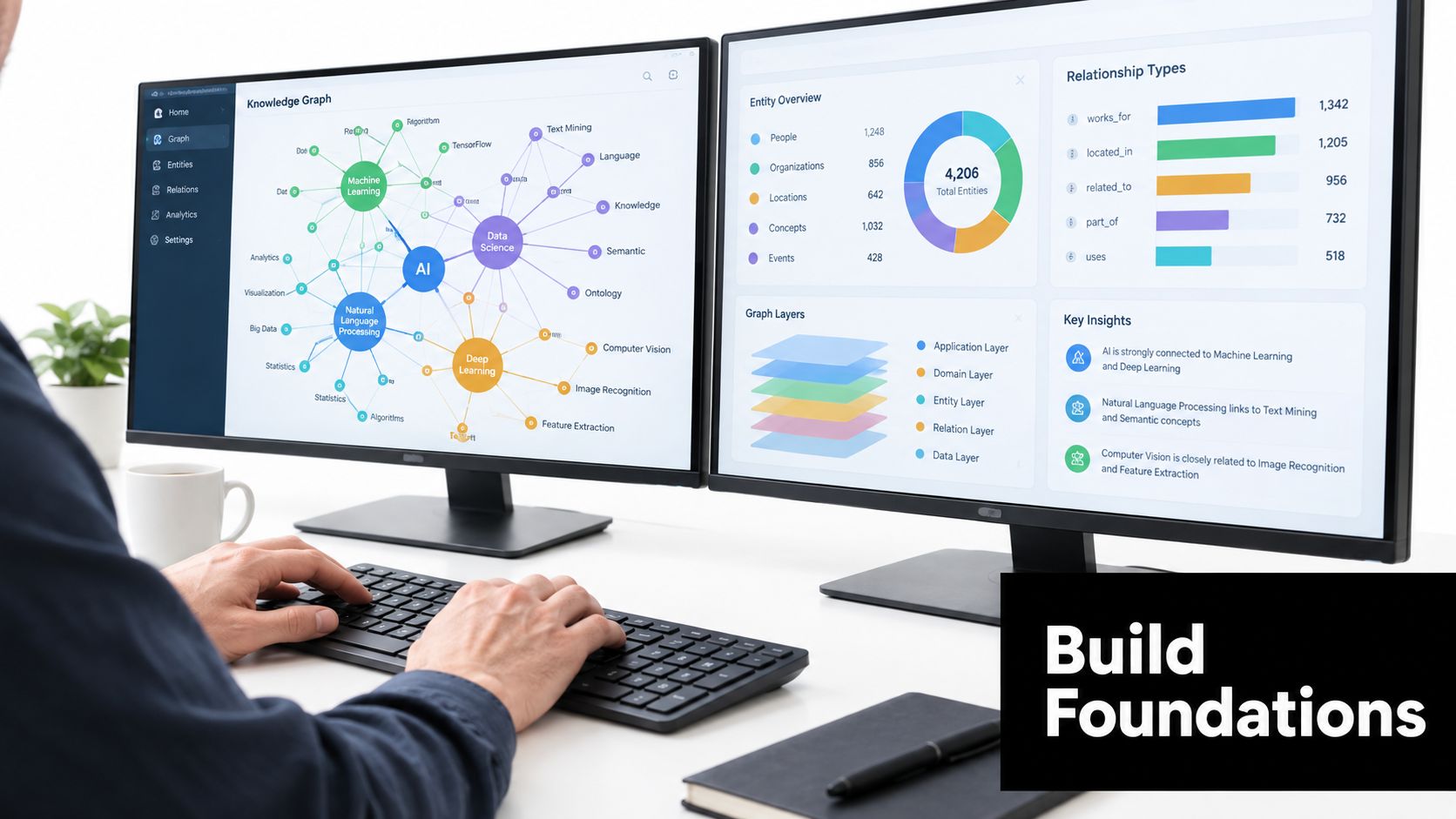
Build the control plane first
An enterprise agent needs more than a prompt. Establish:
- Knowledge foundations: Consolidate authoritative sources, create retrieval indices, and apply permission scopes so the agent only sees permitted information.
- Evaluation harnesses: Test normal cases, adversarial inputs, policy conflicts, and failure recovery before granting tool access.
- Tool boundaries: Separate read operations from write operations. Limit the records, systems, and actions available to each agent.
- Approval gates: Use suggest-and-confirm for augmentation. Use closed-loop execution only for narrow, reversible automation.
- Observability: Log prompts, retrieved evidence, tool calls, outputs, approvals, overrides, and downstream effects.
Single-agent orchestration is easier to inspect in a contained workflow. Multi-agent designs can divide research, validation, and execution, but they also create more handoffs and more places for ownership to become unclear. Use the least complex architecture that meets the operational need.
Architecture rule: An agent should earn authority through evaluation. It shouldn't receive broad access because a demo looked convincing.
Roll out in stages. Keep humans reviewing actions during the initial operating period, train users on prompts and policy boundaries, and measure adoption, override behavior, quality, and cycle time. Avoid a vanity metric such as “the agent completed tasks.” A completed task that requires hidden rework isn't a successful task.
Teams comparing implementation partners can also review how Faberwork LLC describes its Agentic AI, RAG, and workflow automation services. Treat vendor capability as an input to architecture, not a substitute for governance.
A mature pilot should produce a process map, data and permission inventory, tool registry, evaluation results, risk register, escalation policy, audit schema, operating owner, and rollback plan before it scales.
After the controls are in place, a short demonstration can help stakeholders understand how agent behavior should be observed in practice.
Measuring ROI, Productivity, and Risk Tradeoffs
Don't measure automation and augmentation with the same numerator. Automation ROI comes from fully loaded labor and error cost displaced. Augmentation ROI comes from more useful output per employee hour, stronger quality, shorter decision latency, or reduced rework.
For automation, track the baseline volume, processing time, exception rate, error cost, infrastructure cost, review cost, and the value of work no longer requiring manual execution. For augmentation, track user time saved, quality changes, decision latency, adoption, override rates, and whether employees use the recovered capacity for valuable work.
A controlled UK government pilot illustrates why task-level measurement matters. Across four representative workplace activities, AI produced an average 19% increase in points scored, a 25% decrease in time taken, and 61% more points per minute, according to the UK government analysis. The effects varied by task. Technical drafting saw a 23% quality lift and 34% faster completion, while interpreting information for others became 42% faster with no quality gain.
Use a blended scorecard
Agentic systems often automate some steps and augment others. A board-ready scorecard should therefore include:
- Financial outcome: Labor capacity released, error cost avoided, operating cost added, and realized revenue or service capacity.
- Operational outcome: Cycle time, throughput, exception backlog, escalation quality, and recovery time.
- Human outcome: Adoption, override behavior, training completion, role changes, and employee confidence.
- Risk outcome: Policy violations, unsupported outputs, access breaches, audit findings, and rollback events.
Don't promise a payback period without verified baselines. The ROI boundary depends on labor economics, error severity, integration effort, adoption, and the stability of the workflow. A project that looks attractive under headcount displacement can become uneconomic once review and compliance costs are included.
For systems connected to physical operations or valuable infrastructure, simulation and IoT risk mitigation provides a useful lens. Test the agent against realistic states before allowing it to act in production.
Decision Criteria for CTOs and CIOs
CTOs and CIOs should make the choice at the task level, not at the department level. A claims department may need automated extraction, augmented review, and fully manual escalation inside one process.
Trigger CategoryFavors AutomationFavors AugmentationHybrid RequiredWorkload characteristicsRepetitive, structured, narrow decision space, reversible actionJudgment-heavy, contextual, ambiguous, high consequenceStable core with meaningful exceptionsLatency toleranceImmediate response matters and the action is boundedDeliberation improves quality and the user can reviewAutomated first pass with human escalationError costErrors are detectable, contained, and recoverableErrors are difficult to reverse or explainLow-risk cases automated, high-risk cases reviewedOrganizational readinessStrong data controls, monitoring, testing, and operating ownershipUneven data quality or immature AI operationsPilot augmentation while controls matureStrategic postureCost displacement and throughput are the primary goalsTalent leverage and decision quality are the prioritiesRemove repetitive steps while expanding expert capacity
Choose automation when the system can prove its limits
Automation wins when the decision space is narrow, the input data is reliable, and the business can detect a bad result before it propagates. It also needs an owner who can stop the workflow, inspect logs, and restore a prior state.
Choose augmentation when judgment is the product
Augmentation wins when customers, regulators, clinicians, engineers, or analysts expect a person to interpret context. It also wins when the organization is still learning which parts of the process are stable enough to automate.
Use a hybrid path by default
A hybrid design should not mean “add a human somewhere.” Define the handoff precisely. The agent can classify routine cases, prepare evidence, and execute reversible steps. A named reviewer handles uncertainty, policy conflicts, unusual customer circumstances, and actions with material consequences.
Before approving the architecture, ask:
- Can the task tolerate an incorrect result?
- Is the decision space narrow enough to test?
- Can the organization explain the result under audit?
- Can the business reverse the action?
- Does a human know exactly when and why to intervene?
- Will the team measure realized outcome rather than activity volume?
If the answers are weak, start with augmentation. It gives the organization evidence about the workflow before it grants the system authority.
How Automation Quietly Turns Into Augmentation
Most production automations discover that the clean process map was incomplete. Exceptions appear, policies conflict, data arrives in unexpected formats, and experienced employees make judgment calls that weren't documented. The mature response isn't to force every case through the original automation. It's to design a controlled transition between machine execution and human review.
A practical pattern uses confidence thresholds and exception queues. The agent handles routine cases, attaches its evidence, and routes ambiguous cases to a specialist. Reviewers then generate feedback that improves the knowledge base, evaluation set, and policy design.

Design the maturation loop
Automation can fund augmentation by removing repetitive handling and creating structured records of decisions. Those records reveal where reviewers add value, which edge cases recur, and which adjacent steps are safe to automate.
A healthy operating loop looks like this:
- Automate bounded cases: Keep the initial authority narrow and reversible.
- Route uncertainty: Send low-confidence or policy-conflicting cases to named specialists.
- Capture decisions: Record the evidence, reviewer action, reason, and downstream result.
- Refine the boundary: Adjust thresholds, tools, policies, and evaluation cases.
- Expand selectively: Add adjacent steps only when the evidence supports it.
The labor market is already showing why this transition matters. PwC's 2025 Global AI Jobs Barometer reported that augmentation-susceptible jobs reached about 2.4 times their 2012 base by 2024, while automation-susceptible jobs were around 1.05 times their 2012 base, according to the PwC analysis. Automation and augmentation are not fixed labels. Organizations reshape them as workflows, skills, and controls mature.
Track rising human override rates, the size and age of the exception backlog, reviewer skill requirements, and the agent's expanding authority. A temporary increase in overrides may indicate healthy discovery. A growing backlog with no learning loop indicates poor ownership.
The best enterprise architecture doesn't force a permanent choice between automation and augmentation. It gives each task the right level of autonomy, then changes that level deliberately as evidence accumulates.
Start with one workflow that has a visible business owner, a documented baseline, and a bounded risk profile. Map its decisions, separate routine execution from judgment, and run an augmented pilot before granting an agent authority to act. Contact Faberwork to assess an Agentic AI, RAG, or workflow automation design that ties technical controls to measurable operational outcomes.


