
A support manager asks an LLM to handle a billing dispute. The model produces an accurate explanation of the refund policy, drafts a polished reply, and recommends the next step. The customer still waits, because nobody has approved the refund, updated the subscription, changed the ticket, or sent confirmation.
An agentic workflow handles the same request differently. It checks the account, validates eligibility, calls the billing system, routes an exception for approval, updates the case, and communicates the result. The LLM may still write the message, but the agent owns the path from request to resolution.
That distinction defines the practical agentic AI vs LLM decision. Enterprises don't need more abstract explanations of autonomy. They need to know when text generation is enough, when a workflow assistant is the safer middle ground, and when orchestration creates enough business value to justify additional tools, permissions, monitoring, and failure controls.
Decision factorPlain LLMAgentic AIPrimary outcomeDrafts, explains, summarizes, or answersCompletes a goal across multiple stepsSystem accessUsually read-oriented or limitedUses approved tools and APIs to actProcess shapeSingle request and responsePlan, execute, verify, adjustHuman roleReviews or performs the next actionApproves exceptions and supervises riskBest fitLow-risk knowledge workBounded, repeatable, multi-system workflowsMain burdenPrompt quality and output reviewPermissions, observability, auditability, recovery
Introduction Why Agentic AI vs LLM Matters Now
The enterprise baseline has changed quickly. By April 2026, global monthly active LLM users had surpassed 4.7 billion, up from about 4.1 billion in Q1 2026, according to Counterpoint Research's April 2026 LLM adoption snapshot. LLM interfaces now sit inside search, coding, support, analytics, and everyday knowledge work.
Enterprise adoption is broad too. The same snapshot reported that roughly 85% to 90% of large enterprises had at least one production LLM deployment, while about 55% to 65% were running multiple frontier models concurrently. Aggregate enterprise spending on frontier LLM APIs exceeded $15 billion in the first half of 2026, with the source tracking toward more than $35 billion for the full year. These figures establish an important context: the LLM is no longer an experimental component. It has become a general-purpose language and reasoning substrate.
Agentic AI adds an operational layer above that substrate. One 2026 estimate placed the agentic AI market at about $7.6 billion in 2025 and projected it above $10.9 billion in 2026, while another forecast projected purpose-built AI agent software spending at $206.5 billion in 2026, compared with $86.4 billion in 2025, as reported in Brilo's agentic AI statistics overview. The size of those projections matters less than the implementation question they create.
Practical rule: Choose the simplest system that can reliably produce the business outcome. Autonomy isn't automatically progress.
A plain LLM is often the right choice for drafting a response, summarizing a Snowflake query result, translating a policy, or helping an analyst explore documentation. Agentic orchestration earns its place when the request crosses systems, requires decisions between steps, and has a clear completion state.
This guide uses five filters: error tolerance, tool access, process complexity, observability, and return on investment. The aim is to help technology leaders avoid two expensive mistakes, deploying an agent where a controlled LLM workflow would be safer, or keeping a human in every step of a process that could be completed reliably with bounded autonomy.
What LLMs and Agentic AI Actually Are
An LLM, or large language model, is a model that interprets and generates language. In an enterprise application, it can classify an issue, answer a question from retrieved context, produce SQL, summarize a document, draft code, or turn structured data into an explanation.
The important limitation is operational. An LLM call generally receives an input, produces an output, and stops. It can recommend an action without taking that action, unless the surrounding application explicitly gives it a tool and code to invoke.
Agentic AI is a system pattern rather than a single model. It combines one or more models with tools, memory, planning, state, policies, and execution. The system receives a goal, decides which steps are needed, invokes approved tools, checks results, and continues or escalates when the outcome isn't yet complete. Mastra's explanation of agent workflows describes this goal-driven pattern as a process in which agents plan, execute, and adjust multi-step work.

The substrate and the control layer
A useful mental model is simple:
- The LLM interprets. It understands the request and produces reasoning, text, or a proposed action.
- The agent plans. It turns the goal into a sequence of tasks.
- Tools perform. APIs, databases, ticketing systems, RPA bots, and business applications execute approved operations.
- The workflow verifies. The system checks whether the action succeeded and whether the result meets policy.
- The control layer decides. It continues, requests approval, retries safely, or routes the case to a person.
The LLM can be replaced, routed, or combined with another model. The agentic workflow remains the system responsible for coordinating work. That's why “agentic AI versus LLM” isn't quite a contest between two equivalent products. One is usually an engine inside the other.
A multi-model interface can help teams compare how different models handle the same prompt before they design orchestration. For that kind of exploratory work, Thareja's multi-model chat provides a practical way to work across models from Thareja Technologies Inc.. It can support model evaluation, but it doesn't by itself turn a conversational response into a governed business process.
The distinction becomes clearer with a refund request. An LLM can explain eligibility and draft a response. An agent can retrieve the transaction, check policy, submit the refund when permitted, record the decision, and escalate an exception. The model supplies language and reasoning. The system supplies execution and accountability.
How Architectures and Autonomy Differ in Practice
The difference appears in the architecture long before a user notices the interface. A conventional LLM application usually follows a controlled path: receive a prompt, retrieve relevant context, call the model, validate the output, and show it to a user or downstream service.
An agentic application adds a loop. It interprets a goal, selects a tool, observes the result, updates its state, and determines the next action. That flexibility supports dynamic work, but every additional decision point creates another place where the system can fail.
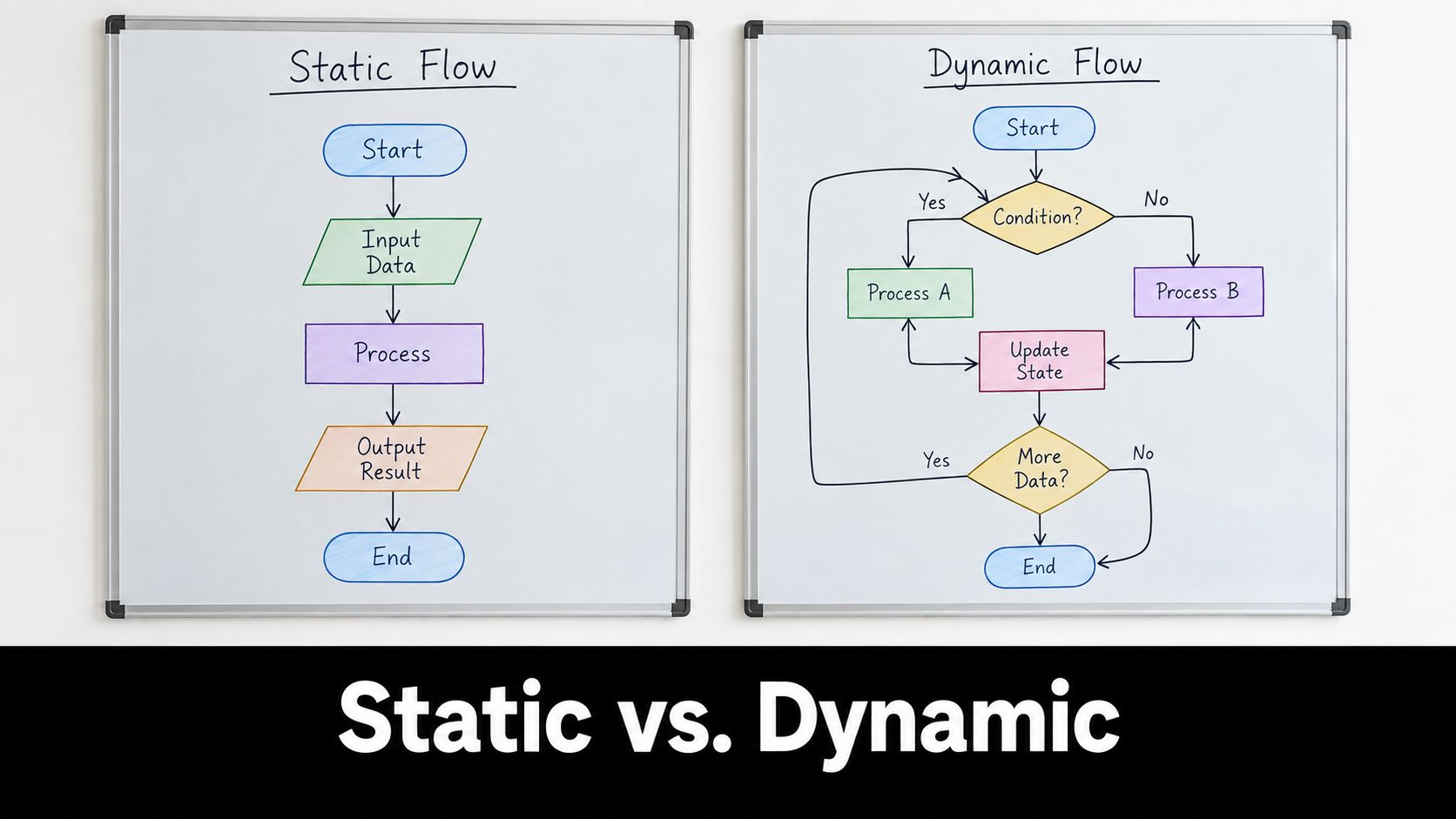
The core distinction: An LLM generates a response. An agent pursues an outcome.
Model call versus planner and executor
A plain LLM application makes the next step explicit in application code or in a human's actions. If the model drafts a refund explanation, a service representative decides whether to submit the refund.
An agentic system can plan the sequence itself. It may retrieve account data, call an eligibility service, submit an approved change, verify the response, and stop when the request reaches a defined completion state. The planner doesn't eliminate application logic. It shifts some control from fixed code into a runtime decision process that must be bounded.
Tool access and permissions
Tool access changes the risk profile. A read-only SQL query against governed Snowflake data isn't equivalent to an API that changes a customer account or issues a payment.
For LLM applications, tool access can remain narrow and explicit. The model may call a retrieval function, but the application controls the available operation and requires a human to execute consequential changes. Agents need a permission model that distinguishes read, propose, approve, write, and irreversible actions.
Memory and state
A prompt contains the context an LLM can use for the current call. The surrounding application can persist conversation history, retrieved documents, and user preferences, but persistence isn't automatic agency.
Agents require state that records completed steps, tool responses, pending approvals, retries, and fallback paths. Without that state, a system can't reliably resume work or explain why it made a particular decision. Teams should store operational state separately from model-generated narrative so that an audit doesn't depend on interpreting a paragraph of prose.
Observability and human control
LLM observability focuses on input quality, retrieved context, latency, token usage, and output evaluation. Agent observability must also capture the plan, tool calls, arguments, results, retries, policy decisions, and final outcome.
Human review belongs at the points where errors become costly or difficult to reverse. An agent can handle a low-risk address correction automatically while routing a policy exception or unusual payment request for approval. The architecture should make those boundaries explicit rather than relying on a prompt that says “be careful.”
The distinction is measurable in current tool-use research. Analysis of real user logs found that compositional tasks requiring orchestration across multiple requirements are especially difficult for LLM tool use, with most models achieving no more than 15% session accuracy in the study published on arXiv. That result argues for stronger workflow controls, not blind confidence in an agent loop.
Choosing the Right Approach for Your Task
The decision shouldn't start with “Can an agent do this?” Modern systems can often be made to do almost anything in a demo. The useful question is narrower: Does the business outcome justify the additional control surface?
Use a plain LLM when the task ends with information. A workflow-based assistant fits when the steps are known but a person should confirm the action. Agentic AI becomes attractive when the process contains several systems, variable inputs, recoverable exceptions, and a completion state that the business can measure.
McKinsey-style coverage cited in the AWS and IDC agentic AI study reported that 23% of organizations were scaling an agentic system in at least one function, yet no more than 10% were scaling agents in any single business function. The same adoption pattern included organizations still experimenting or remaining in pilots. The signal is clear: the challenge isn't awareness. It's identifying the threshold at which autonomy pays for its integration and governance burden.
Decision Matrix for Agentic AI vs LLM Selection
Evaluation CriterionUse Plain LLMUse Agentic AIError toleranceErrors can be caught through review before deliveryErrors are bounded by policy, validation, and approval gatesTool accessRetrieval, search, calculation, or read-only queriesMultiple APIs, databases, ticketing tools, or business systems must coordinateProcess complexityOne response or a predictable fixed sequenceThe next step depends on tool results, exceptions, or changing conditionsObservability requirementsPrompt, context, output, and reviewer decision are sufficientEvery plan, call, argument, result, retry, approval, and fallback must be recordedROI thresholdValue comes from faster drafting, analysis, or supportVolume, labor intensity, and process delay justify orchestration investment
The autonomy threshold
A task usually crosses the threshold when three conditions occur together. First, employees repeatedly perform the same multi-step process. Second, the required systems expose stable interfaces or reliable automation paths. Third, the organization can define both success and unacceptable behavior.
The threshold is lower for reversible actions. Creating a draft, opening a ticket, or proposing a query can remain largely autonomous. Sending a payment, changing eligibility, deleting data, or altering a production configuration requires stronger controls even when the workflow is technically straightforward.
A plain LLM also wins when the input is ambiguous and the cost of asking a human is low. Agents perform better when the goal is clear enough to evaluate. If nobody can agree what “resolved” means, adding a planner won't fix the process. It will automate disagreement.
Real World Use Cases That Show the Outcome Gap
A customer writes, “My subscription was charged after I canceled it.” A plain LLM can identify the likely issue, retrieve the cancellation policy, and draft a sympathetic response. The representative still has to inspect the account, decide whether the charge qualifies, submit the adjustment, update the case, and notify the customer.
An agentic workflow can perform those steps through controlled integrations. It checks cancellation timing, retrieves transaction history, applies eligibility rules, triggers a refund approval when required, records the decision, and escalates an unresolved exception. Sprinklr's comparison of agentic AI and LLMs lists comparable support actions, including billing or refund approvals, subscription resets, address updates, replacements, and escalation.

The outcome isn't a better answer. It's a shorter path to resolution, fewer handoffs, and a record of what happened. A 2026 enterprise automation source reported 85% to 90% autonomous completion rates for bounded agentic task types, compared with 40% to 60% for scripted chatbot equivalents, as described by NICE's agentic workflow automation analysis. Those figures apply to bounded task types, not every enterprise process.
Operations with controlled exceptions
Consider a logistics exception. An LLM can summarize a delayed shipment, explain the contract terms, and suggest a message to the customer. An agent can inspect tracking data, compare delivery commitments, check inventory at alternate locations, create a rerouting request, update the order system, and notify stakeholders.
The agent shouldn't have unrestricted authority to reroute every shipment. A practical design lets it handle ordinary delays, while requiring approval for high-value cargo, regulated goods, or changes that create material cost. The workflow earns autonomy by staying inside a clear operating envelope.
Data and Snowflake-adjacent workflows
Data teams often start with an LLM that converts a business question into SQL or explains a dashboard. That remains a strong use case when a data professional reviews the query and the result.
An agentic data workflow goes further. It can detect a missing data refresh, inspect pipeline status, enrich time-series or IoT records, trigger a remediation job, validate row-level results, and open an incident when quality checks fail. The outcome is restored data availability, not just a written diagnosis.
For a related example of time-series work on Snowflake, see Faberwork's time-series data success story. In another data-heavy context, teams evaluating computer vision and operational identification can review Faberwork's AI truck visual identification model to understand how model output can support a broader operational workflow.
A short demonstration can make the difference between response generation and action orchestration easier to see:
Integrating With Snowflake and Existing Automation Stacks
The integration work determines whether an agent becomes a dependable enterprise service or an impressive prototype. Start with the systems of record, not the model. Map where customer, financial, operational, and event data lives, then identify which actions have supported APIs, which require RPA, and which should remain human-controlled.
Snowflake can serve as a governed data layer for retrieval, feature access, time-series analysis, and operational reporting. The agent shouldn't receive unrestricted warehouse access. Give it specific functions, parameter validation, row and column policies, and a clear distinction between analytical queries and write operations.
A practical integration pattern
A durable pattern usually has five parts:
- Event trigger: A ticket, alert, order change, or data-quality event starts the workflow.
- Context service: The system retrieves approved records and relevant policy content.
- Decision layer: The LLM interprets the request, while deterministic rules handle limits and entitlements.
- Action tools: APIs, RPA, and workflow services perform narrowly scoped operations.
- Audit and recovery: The platform records each step and routes failures to a queue or operator.
This pattern works across healthcare, finance, logistics, and telecom because it separates interpretation from authority. The model can handle unstructured language, while code and policy services control what the system may do.
Keep the first version deliberately narrow
A simple LLM workflow is often safer when the business only needs search, summarization, or drafting. It also reduces vendor dependencies, test surface, and operational cost. Full orchestration is appropriate when manual coordination creates a measurable bottleneck and the organization can monitor completion, exceptions, and downstream effects.
For mission-critical Snowflake environments, implementation support may include SnowPro Certified engineering, integration delivery, testing, and continuous operational support. Faberwork LLC offers agentic AI consulting, custom software, and Snowflake-centered data solutions, including workflow mapping, agent integration, and support for enterprise automation. Treat that as one delivery option among internal engineering, platform vendors, and specialist partners.
Recommendations Guardrails and Next Steps for Enterprises
Treat an agentic system as a different risk category from a standard LLM application. A model that drafts an email can be reviewed before delivery. An agent that changes a record, moves money, or triggers an operational process can create consequences before a reviewer sees the output.
Deloitte's 2025 to 2026 coverage reported that only 11% of organizations were actively using agentic systems in production, while 42% were developing a roadmap and 35% had no formal strategy, according to Deloitte's agentic AI strategy analysis. That gap reinforces a practical recommendation: don't scale autonomy faster than governance.

Guardrails that belong in production
- Approval thresholds: Define which actions the agent may complete, which require a named approver, and which are prohibited.
- Tool boundaries: Expose narrow functions instead of broad credentials. Validate arguments before every write operation.
- Loop limits: Set maximum retries, time budgets, and duplicate-action checks to prevent action loops.
- Data controls: Apply least-privilege access, redact sensitive fields, and prevent tool responses from becoming uncontrolled model context.
- Audit logs: Record the goal, plan, tool arguments, results, policy decisions, approvals, and final status.
- Fallback paths: Route timeouts, ambiguous requests, failed validations, and conflicting system responses to a human queue.
- Outcome metrics: Track completion, escalation, rework, policy violations, latency, and total operating cost.
A safer adoption path
Start with one bounded workflow that has a stable volume, clear inputs, reversible actions, and an agreed definition of success. Run the agent in propose-and-approve mode first, then compare its recommendations with human decisions and inspect failure patterns.
Move to limited autonomous execution only after tool calls, permissions, and fallback behavior are observable. Keep the LLM as the assistant when the process is mostly communication or analysis. Add agentic orchestration when the organization can show that completed outcomes, not merely fluent responses, justify the extra machinery.
For teams assessing automation platforms alongside custom builds, WebinOne's Agentone automation overview offers another reference point for evaluating built-in agent capabilities and workflow scope.
Your next step should be concrete. Choose one process, document its current handoffs, define the completion state, classify every action by risk, and build a small approval-gated pilot. If you need help connecting the workflow to Snowflake, APIs, or existing automation systems, contact Faberwork to map the process and determine whether a plain LLM, a controlled assistant, or agentic orchestration fits the outcome you need.


