
The popular advice about agentic AI solutions is backwards. Enterprise leaders are often told to start by choosing the most capable model, building a convincing demo, and expanding from there. In production, the model is rarely the hardest part. The difficult work sits in data access, workflow integration, decision boundaries, monitoring, and accountability when an agent takes an action that can't be easily reversed.
Agentic systems can plan, use tools, preserve context, and work toward a defined outcome. That makes them more useful than single-turn assistants, but it also makes them operational software, not just an interface to a language model. The right question isn't “Which model should we buy?” It's “Which workflow can we improve, how will we verify the result, and what must the agent never do without approval?”
The Reality of Scaling Agentic AI Solutions
Enterprise adoption is moving faster than enterprise readiness. A 2026 McKinsey survey found that 44% of respondents said AI was already scaling across their enterprise, compared with 38% a year earlier, while nearly nine in ten reported regular AI use in at least one business function. Yet scaling remained flat at 22% among smaller organizations, a useful reminder that enthusiasm and operational capacity aren't the same thing. McKinsey's State of AI research places agentic AI solutions in a market that has moved beyond isolated experiments, but it doesn't prove that every organization is ready to delegate decisions.
The distinction matters because an agent doesn't merely generate an answer. It may retrieve a customer record, update a case, call a payment or inventory API, route an approval, or alter an underlying database. Each step introduces a new failure mode. A fluent response can hide an incorrect permission, stale data, a bad tool choice, or an action that violates policy.
Practical rule: Treat every action-taking agent as a production system with an owner, an audit trail, and a defined failure path.
Adoption is not autonomy
Agentic AI moved rapidly from experimentation toward deployment. An IDC study of more than 900 organizations reported that 50% had at least 10 agents in production in 2025, while a separate enterprise survey found 42% already had AI agents in production and 72% had agents in production or pilots. Another 2026 report found 65% of enterprises were already using AI agents, with 81% either fully adopted or actively scaling agentic AI across teams. These figures are summarized in Mayfield's analysis of the agentic enterprise.
Those adoption signals show demand, not dependable autonomy. A company can place agents in production while keeping them tightly bounded, requiring human approval for sensitive actions, or limiting them to retrieval and recommendation. That's often the right design. “Autonomous” shouldn't mean unsupervised. It should mean the system can complete an appropriate class of tasks within explicit constraints.
The systems problem
A reliable deployment connects goals to trusted data, tools, policies, and observable outcomes. The orchestrator needs to know which agent or tool should act, memory must preserve only relevant state, and the workflow must stop when confidence or authorization falls below an agreed threshold.
That changes the implementation conversation. A useful starting point is a workflow map showing inputs, systems of record, decisions, actions, approvals, exceptions, and evidence. Teams looking for practical guidance on coordinating marketing workflows can also review marketing AI orchestration tips as a complementary resource.
Core Components of an Agentic Architecture
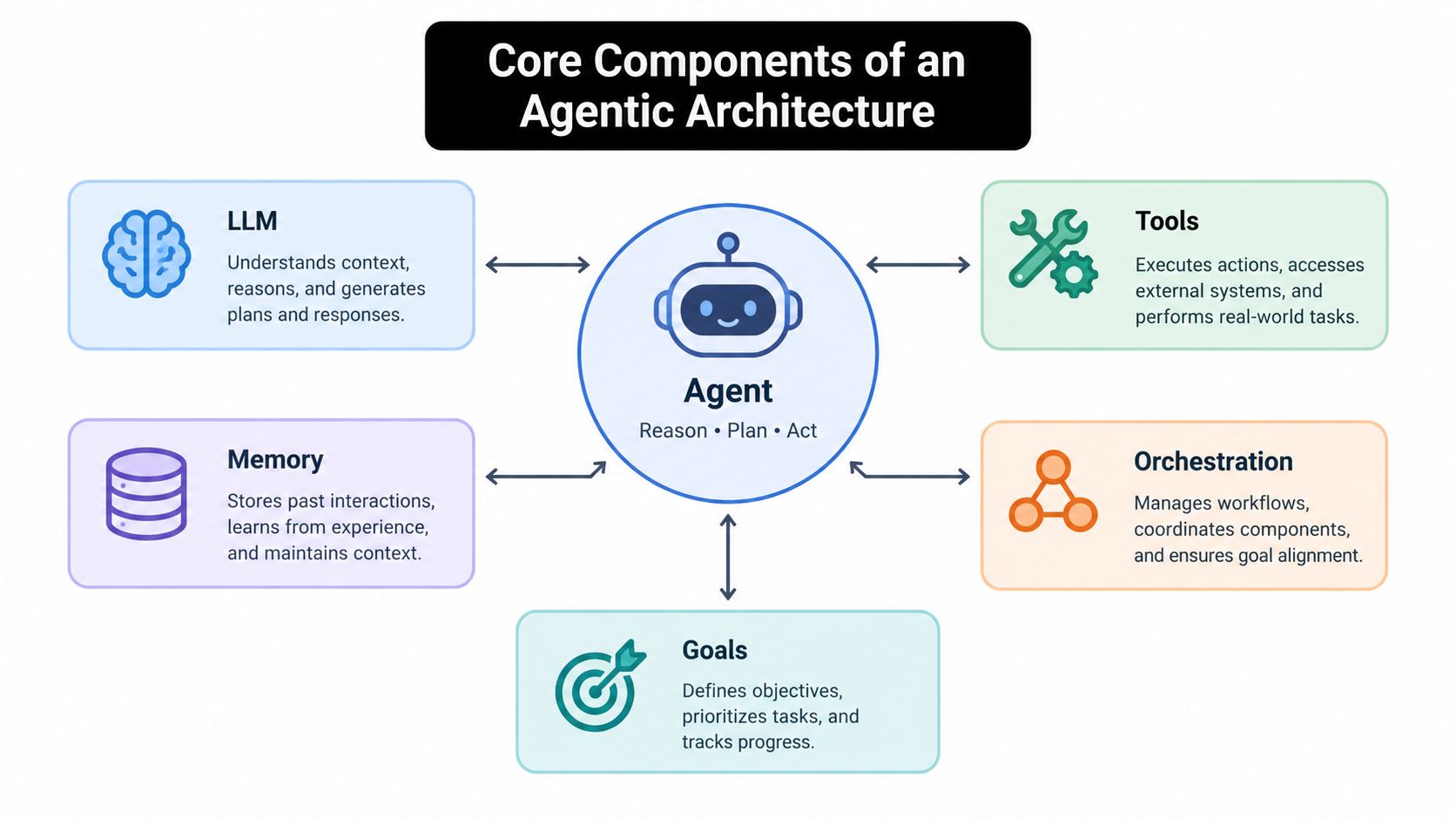
An agentic architecture is easier to manage when each component has a distinct responsibility. Think of the system as an operations team. The goal is the requested business outcome, the orchestrator assigns and sequences work, the reasoning engine chooses a path, memory preserves useful state, and tools interact with enterprise systems.
Start with the goal and state
A vague instruction such as “improve customer service” isn't an executable goal. A stronger definition might require the system to classify an incoming service issue, check entitlement data, identify an approved remedy, draft or execute the response, and record the evidence. The goal should include a completion condition, permitted actions, escalation rules, and the systems that hold authoritative data.
State gives the agent continuity across those steps. Short-term state can hold the current request, tool results, and pending approvals. Longer-lived memory may store durable preferences or workflow history, but it needs retention rules, access controls, and a way to correct stale information. Memory that remembers everything becomes a liability, especially when old context conflicts with current policy.
Orchestration controls the work
The orchestrator is the traffic controller. It can use a single agent with tools for a bounded workflow, or coordinate specialized agents for tasks such as retrieval, validation, compliance review, and execution. More agents don't automatically produce better results. Each additional handoff creates opportunities for context loss, inconsistent instructions, and unclear accountability.
Tool integration deserves equal attention. An agent should interact with APIs, databases, search systems, ticketing platforms, and other applications through controlled interfaces rather than unrestricted access. Read operations and write operations should have different permissions. High-impact actions should require confirmation, policy checks, or a human approval step.
Research on enterprise workflows shows why architecture matters. AgentArch's evaluation examines 18 agentic configurations across four architectural dimensions and reports that even state-of-the-art language models struggle with reliable performance on complex enterprise workflows. A related workflow study found success rates of roughly 93% for Copilot and 94% for Codex, while other agents performed far worse. The lesson is not to select a named tool from a leaderboard. It's to test the complete configuration, including orchestration, memory, tools, and permissions.
Teams designing systems with multiple cooperating agents should treat deployment boundaries and failure containment as first-class concerns. Guidance on safe multi agent deployment can help frame those decisions.
Measurable Outcomes and Industry Use Cases
The strongest agentic AI solutions target workflows where people spend time gathering information, applying rules, coordinating handoffs, and recording the result. They don't begin with a general promise of autonomy. They begin with a bottleneck that leadership already understands.
A finance team, for example, could use an agent to review an invoice against purchase orders, supplier records, approval policies, and budget data. The agent might flag an exception, explain the missing evidence, and route the case to the right approver. The value isn't that the agent sounds intelligent. The value is less manual reconciliation, faster exception handling, and a complete record of why the transaction moved or stopped.
Strategic planning
Strategic planning is another useful application because analysts often combine structured data, market signals, internal reports, and stakeholder input. An agent can gather approved sources, compare scenarios, identify assumptions, and prepare a decision brief. Human leaders still own the decision, but the system reduces the time spent assembling and reconciling inputs.
A business-setting analysis reports up to 42% faster decision-making and 18% cost savings when AI assists strategic planning and its reasoning is transparent. Those figures appear in the Ragas documentation on agent metrics. Transparency is central to the use case. Executives need to inspect sources, assumptions, and unresolved uncertainty before relying on an AI-supported recommendation.
Supply chain and logistics
In logistics, an agent can monitor shipment events, inventory positions, delivery constraints, and customer commitments. It might recommend a reroute, identify a likely delay, request approval for an exception, or update a customer case after verifying the underlying event. The agent should not autonomously alter every route or pledge a new delivery date. It should act within commercial, operational, and safety constraints.
The same pattern applies to healthcare administration. An agent can assemble information for an authorization workflow, check whether required documentation is present, and route incomplete cases. It should preserve access controls and escalate decisions that require clinical or regulated judgment. The workflow boundary matters more than the conversational experience.
Outcomes worth tracking
A 2026 enterprise report identified reduced manual effort at 74%, followed by faster insights at 33% and cost savings at 33%, among the top intended outcomes of embedding agentic AI into workflows. The Frontiers report provides the figures, but leaders still need to translate them into local measures.
Useful measures include time spent per case, queue age, exception rate, rework, approval latency, and the percentage of tasks completed without escalation. For a smart-building operation, a relevant reference point is this AI transformation success story for smart buildings, which illustrates why operational data and domain-specific workflows are more informative than a generic chatbot demonstration.
Overcoming Integration and Data Readiness Bottlenecks
Prompt engineering can improve an agent's behavior, but it can't repair an unreliable system of record. If customer status is spread across disconnected applications, inventory events arrive late, or permissions don't match organizational roles, a better prompt merely helps the agent move through a broken environment with greater confidence.
Deloitte reported that nearly 60% of AI leaders identified legacy-system integration and risk or compliance concerns as primary challenges. MIT Sloan summarized that roughly 80% of implementation work is absorbed by data engineering, stakeholder alignment, governance, and workflow integration, rather than prompt engineering or model tuning. These figures are discussed in Deloitte's analysis of AI adoption challenges.
Build the data path before the agent
Start by assigning authority to each important field. If three applications contain different customer statuses, the workflow needs a rule for which source wins and what happens when the sources disagree. The data layer should expose usable context with lineage, freshness indicators, access controls, and clear handling for missing values.
A practical readiness review asks:
- Source ownership: Which system is authoritative for each decision?
- Data freshness: How quickly must updates reach the agent?
- Access policy: Which users, agents, and services can read or write the data?
- Action traceability: Can the organization reconstruct the inputs and rules behind an action?
- Exception handling: Where does the workflow stop, and who receives the case?
Observability is part of the product
Teams need more than logs of model responses. They need traces showing the goal, retrieved context, tool calls, policy checks, retries, approvals, and final state. The agent should expose enough evidence for an operator to understand whether it failed because of bad data, a poor plan, a rejected API call, or an ambiguous instruction.
Skills are another constraint. An AWS-cited IDC study found 67% of organizations believed users needed more training, while 55% cited a lack of skilled personnel as the top implementation challenge. SAP LeanIX reported that only 17% had visibility into agent performance or conformance, and 48% had not clearly defined governance responsibilities. These findings reinforce a practical conclusion: an agent-ready enterprise needs data engineers, process owners, security specialists, and operators, not only prompt developers.
A Snowflake-centered data environment can support the required analytics and lineage when it's designed around the workflow rather than added after deployment. Teams evaluating that foundation can review Faberwork's work as a Snowflake partner for a concrete perspective on data architecture and collaboration.
Governance Frameworks and Evaluation Criteria
Governance becomes harder when an agent can take action across systems. A chatbot answer can be reviewed before use. An agent that changes a record, approves a request, or triggers an external transaction needs controls before, during, and after execution.
The governance gap is substantial. Deloitte found that only 21% of organizations had a mature agentic-AI governance model, while about 80% lacked mature controls, including clear decision boundaries, real-time monitoring, and audit trails. EY's 2026 survey found that 91% of senior AI executives said their organizations used agentic AI in pilots or production, yet 49% said existing governance frameworks hadn't been updated for agent-specific risks. Deloitte's research on scaling AI agents supplies the governance figures and highlights why adoption alone isn't a safety standard.
Evaluate the final state, not just the answer
Single-turn question-and-answer tests miss the failures that matter in enterprise operations. An agent can produce a plausible explanation while selecting the wrong tool, updating the wrong record, skipping an approval, or leaving a workflow in an inconsistent state.
EnterpriseOps-Gym-AA evaluates agents by examining the final state of underlying databases after live tool use across 8 business domains. Its approach emphasizes outcome-based SQL verification for goal completion, policy compliance, and unintended side effects. The EnterpriseOps-Gym-AA evaluation reflects the right testing mindset: verify what changed, what should have changed, and what must never have changed.
A mature evaluation program combines synthetic scenarios, replayed production cases, adversarial tests, human review for high-risk decisions, and automated checks for repeatable outcomes. Test runs should include incomplete data, conflicting records, unavailable tools, permission errors, and ambiguous requests.
Use business-facing metrics
Metrics should show whether the agent advances the work safely. Enterprise guidance on agent measurement identifies task completion, action advancement, tool selection quality, and action completion as useful measures for multi-step workflows.
Metric CategorySpecific MeasureBusiness ImpactOutcomeTask completion and final-state accuracyShows whether the workflow reached its intended resultExecutionAction advancement and action completionReveals whether the agent made useful progress rather than producing textTool useTool selection quality and valid parametersReduces incorrect calls, retries, and operational frictionControlPolicy compliance and approval adherenceProtects regulated or high-impact processesReliabilityUnintended side effects and recovery behaviorLimits damage when an intermediate step failsOperationsTrace completeness and escalation qualityGives teams evidence for audits and incident response
Resource constraints can expose the difference between a convincing demo and dependable execution. One benchmark reported 31% full task completion for one system and 25% for another, with partial completion at 43% and 26%, respectively. The Lyzr State of AI Agents report supports a cautious approach to autonomy: measure verified completion and resource use instead of inferring capability from fluent output.
Governance principle: If the business can't explain what the agent did, why it did it, and how to reverse it, the workflow isn't ready for unattended execution.
Partnering for Scalable AI Implementation
A software vendor can provide a model, an agent framework, or a connector library. Enterprise deployment still requires someone to translate business rules into executable workflows, reconcile data sources, automate testing, and operate the system after launch.
That's why implementation expertise matters more than a polished pilot. A partner should be able to map the current process, identify where human judgment is essential, define safe automation boundaries, and connect the workflow to authoritative data. It should also be comfortable saying that a particular task should remain deterministic, approval-based, or human-led.
What a practical partner contributes
For logistics, the work may involve event streams, fleet systems, geofencing, customer commitments, and exception routing. For telecom or energy, it may involve operational technology, service assurance, time-series data, and incident workflows. For healthcare and finance, permissioning, traceability, and review controls are central design requirements rather than later compliance additions.
A capable delivery team should bring several disciplines together:
- Domain mapping: Process owners and engineers define the actual decision points, exceptions, and service-level requirements.
- Data engineering: Specialists establish reliable pipelines, identity resolution, lineage, and governed access.
- Workflow engineering: Developers implement tool contracts, state management, retries, approvals, and rollback paths.
- Test automation: QA teams create repeatable scenarios for normal operation, edge cases, policy violations, and partial failure.
- Operational ownership: Support teams monitor traces, review escalations, tune workflows, and manage controlled releases.
Faberwork LLC is one example of a consulting and development partner offering agentic AI, custom software, and Snowflake-centered data solutions. Its services include workflow automation, AI model development and deployment, database architecture, and test automation for business environments such as healthcare, logistics, telecom, and energy.
Choose delivery discipline over novelty
The right partner won't lead with a model comparison. It will ask which systems must connect, which data is trustworthy, what the agent is allowed to change, and how the organization will measure value. It will separate retrieval, recommendation, and execution so that the business can increase autonomy gradually.
A sensible engagement produces working artifacts, not only a prototype. Those artifacts include a workflow specification, data contract, permission matrix, evaluation set, observability design, incident process, and ownership model. Together, they turn an agent from an impressive demonstration into a maintainable operating capability.
Next Steps for Enterprise AI Leaders
Enterprise leaders don't need to automate an entire department to prove the value of agentic AI solutions. They need a workflow with a clear owner, a painful bottleneck, accessible data, and an outcome that can be verified.
Begin with a narrow process that contains meaningful coordination but manageable risk. Invoice exception handling, internal service requests, shipment disruption triage, and compliance evidence collection can all be suitable candidates when the organization defines what the agent may read, recommend, execute, and escalate.
A readiness sequence
- Define the outcome. State what completion means in business terms. “Produce a response” is weaker than “resolve an eligible case, update the system of record, and attach the evidence.”
- Map the workflow. Document every input, decision, tool call, approval, exception, and downstream effect. Identify irreversible actions before granting the agent access.
- Prepare the data. Assign authoritative sources, resolve conflicting fields, establish freshness expectations, and expose governed interfaces instead of handing the agent broad system access.
- Set the control boundary. Create role-based permissions, approval gates, escalation rules, audit requirements, and a rollback process. Make a human accountable for the workflow even when the agent handles routine execution.
- Evaluate state changes. Test whether the agent completes the task, selects appropriate tools, follows policy, and avoids unintended side effects. Use realistic failures, not only clean example prompts.
- Operate and improve. Monitor traces, completion rates, escalations, data quality, and user feedback. Review changes through controlled releases so that a prompt, tool, or policy update doesn't alter business behavior.
The strategic advantage won't come from giving agents unlimited freedom. It will come from building an enterprise stack that makes safe autonomy possible, then expanding only where evidence supports it. Start with one workflow assessment, bring the process owner and data team into the same room, and commission a production-readiness plan with measurable acceptance criteria before selecting or deploying an agent platform.
Ready to move from an agent demo to a governed production workflow? Contact Faberwork to assess your data foundation, map a high-value use case, and design an agentic AI implementation with integration, evaluation, and operational controls built in from the start.


