
Your team has automated invoice capture, but someone still chases missing purchase orders, checks contract terms, and forwards exceptions for approval. The software moves information. Your employees still connect the dots.
Agentic AI process automation aims to handle some of that coordination. The business decision isn't just which model to buy. It's which work to delegate, who remains accountable, and how you'll prove that the new process costs less without creating unacceptable risk.
What Agentic AI Process Automation Means
Traditional robotic process automation is like a player piano: it plays the score exactly as punched. An agentic system is closer to a session musician who listens and adjusts when the song changes. That flexibility helps when business inputs don't follow a predictable pattern, but it also requires boundaries.
The analogy captures the difference between following a sequence and adapting within one.

Agentic process automation uses AI agents built on foundation models to plan and execute several workflow steps toward a goal, calling business tools such as CRM, ERP, email, and document systems.
In McKinsey's 2025 global survey, 62% of respondents said their organizations were at least experimenting with AI agents, comprising 39% experimenting and 23% scaling an agentic system in at least one business function. That gap matters: trying an agent doesn't establish that an organization can operate it reliably.
RPA compared with agentic process automation
CriterionRobotic process automation (RPA)Agentic process automationDecision-makingFollows fixed if-then rulesPlans steps toward a goal and chooses among optionsExceptionsStops or fails and waits for a personReasons about alternatives and escalates with contextInputsStructured data and stable screensEmail, documents, free text and changing interfacesSetupScripted flows built per processTools, data access, policies and goals defined per agentBest fitStable, high-volume, rule-bound tasksVariable workflows that need judgment and coordination
These are design tendencies, not guarantees. An agent won't necessarily handle a changed interface successfully, and a well-designed RPA workflow can include exception routing. The useful distinction is how much interpretation the workflow requires.
For a manufacturing-specific perspective, Uptool's discussion of AI software machine shops overlook offers a useful starting point for examining work around existing production software.
Selection test: Is the process variable, language-heavy, and spread across several systems? Consider an agent. If the rules and inputs remain stable, RPA may still be the cheaper, more predictable tool.
How an Agent Works Through a Business Process
Think of an agent as a new hire given a goal, a checklist, system access, and clear instructions about when to ask a manager. You wouldn't authorize that employee to release payments merely because they can read invoices.
Invoice handling makes those boundaries concrete.

Say a supplier emails an invoice. The agent extracts the supplier name, amount, and purchase-order number, then retrieves the corresponding order and goods receipt from the ERP.
In this hypothetical case, the invoice total is 4% above the order. The agent checks the applicable contract tolerance and determines that the difference falls outside it. Instead of inventing an explanation or approving payment, it drafts a supplier query and routes the case to the accounts payable lead.
The lead receives the invoice, matching records, relevant contract clause, and a concise explanation of the discrepancy. The useful output isn't just a summary. It's a prepared exception that someone can resolve without repeating the investigation.
The execution loop behind the example
The workflow follows a repeatable pattern even when the exact path changes:
- Intake: Recognize the incoming document and identify the requested work.
- Context gathering: Retrieve the records needed to understand the case.
- Planning: Choose the next permitted action using the goal and business rules.
- Action: Call a tool to retrieve information, create a draft, or route work.
- Checking: Inspect the tool result and verify that the intended change occurred.
- Resolution: Close an eligible case or escalate with supporting evidence.
Every transition needs a recorded outcome. If the ERP lookup fails, the agent must distinguish a temporary connection problem from a purchase order that doesn't exist.
Keep the distinction between a convincing explanation and verified execution in mind when reviewing demonstrations.
What makes this different from a script
Agents can plan when the path isn't fixed, interpret unstructured inputs, and choose an allowed recovery or escalation route when a step fails. None of those abilities makes their conclusions authoritative.
The agent is only as useful as the tools, data, and rules it's allowed to use.
A missing contract clause remains missing context. Fluent reasoning can't substitute for it.
Use Cases Across Core Business Functions
The useful map isn't where agents can work, but what they prepare, what people retain, and what evidence supports the result.
Agentic automation use cases and reported results
ProcessWhat the agent doesWhat a person keepsReported resultFinancial closeDecomposes close tasks, runs reconciliations, drafts reportsVariance review and final sign-offProjected 30%–50% shorter cycle time and 40%–60% fewer resource requirements, described in the MIT Sloan documentProcurement briefs, Dun & Bradstreet Ask ProcurementGathers purchasing data and drafts the initial briefFinal purchasing decisionAn estimated 26,000 hours saved annually, reported in the document describing the IBM exampleCustomer support, agent assistHelps diagnose issues, drafts replies, retrieves knowledgeFinal reply and complex casesMeasured productivity improvement, discussed belowAccounts payable invoicesExtracts invoice data, matches purchase orders, routes exceptionsApproval of payments above the set thresholdNo quantified result established hereClaims processingCollects documents, checks completeness, drafts a decisionFinal payout decisionNo quantified result established hereFleet dispatchProposes job reassignment from telematics signals and drafts changesDispatcher approval before changes go liveNo quantified result established here
Projected and measured results aren't interchangeable. The financial-close figures describe anticipated outcomes, not a guaranteed operating result. A finance controller still needs to examine reconciliation quality, unresolved variances, and the effort required to validate report drafts.
Procurement illustrates a narrower delegation. An assistant can assemble purchasing information and prepare a brief without choosing a supplier or committing funds. The employee retains commercial judgment, including whether the proposed purchase meets the business need.
Apply the pattern without assuming the same return
In customer support, start with retrieval and drafting rather than unrestricted customer commitments. A representative should handle ambiguous policies, complaints, and requests that require discretion. If voice intake is relevant, Dograh's resource to build AI phone agents can help frame implementation questions around caller identification, escalation, and permitted actions.
For accounts payable, the value hypothesis is less clerical preparation per exception. Test whether reviewers receive enough evidence to act, not merely whether the agent extracts fields correctly.
Claims teams can use document checks to identify missing evidence before an adjuster reviews a file. Don't confuse a complete file with a valid claim: deciding coverage and authorizing a payout remain separate responsibilities.
Fleet dispatch adds operational constraints. A proposed reassignment must account for availability, location, service commitments, and the dispatcher's knowledge of conditions that may not appear in telemetry. Faberwork's smart-building AI example provides adjacent context for operational AI, but it shouldn't be treated as evidence of autonomous dispatch performance.
The practical starting point is preparation before commitment. Let the agent gather, compare, and draft; retain the consequential decision until the workflow has earned greater authority.
Measurable Benefits and Where They Concentrate
A randomized field study of 5,179 customer-support agents found that a generative-AI assistant increased issues resolved per hour by 14% on average, with 34% gains among novice and lower-skilled employees and minimal gains among experienced, highly skilled employees, according to the Quarterly Journal of Economics study.
That's evidence for agent assistance, not proof that autonomous customer service produces the same result. It also challenges the assumption that every employee or process will benefit equally. Before choosing a workflow, locate the skill gap: finding information, interpreting policy, preparing a response, or coordinating a handoff.
Measure completed work, not activity
Potential benefits include shorter cycle times, greater throughput per employee, fewer manual handoffs, more consistent checks, and coverage outside working hours. Treat each as a hypothesis to test with operating measures:
- Straight-through-processing rate: Eligible cases completed without human intervention.
- Escalation rate: Cases requiring human help, separated by cause and severity.
- Rework: Completed cases that someone must reopen or correct.
- Latency: End-to-end completion time, including queues and approvals.
- Unit cost: Total operating cost divided by successfully completed cases.
- Realized ROI: Verified financial benefit compared with implementation and ongoing costs.
Don't use tool-call counts or draft volume as substitutes for outcomes. An agent that produces more work for reviewers may increase activity while reducing capacity.
Include the hidden operating bill
Calculate costs for model usage, retrieval, integrations, monitoring, exception review, and maintenance. Include the employee time spent checking plausible but incorrect outputs. If staff must reconstruct the agent's work before trusting it, the apparent saving may disappear.
Recovered capacity also isn't automatically a cash saving. State whether employees handled additional demand, reduced overtime, or stopped doing a task entirely.
Measurement rule: Record the baseline before the first agent goes live. Without a comparable starting point, you can't distinguish improvement from a change in workload or staffing.
Risks and the Controls That Contain Them
A successful demonstration proves that an agent can complete a workflow under those conditions. It doesn't prove that the workflow is dependable across unfamiliar inputs, tool failures, or conflicting instructions.
The AgentArch benchmark requires correct tool selection, correct tool arguments, and the correct final decision together, and evaluates repeated attempts using pass@1 and pass@8. That execution-oriented approach matters because a plausible explanation won't repair a payment sent with the wrong account identifier.
Agent risks, examples and controls
RiskExampleControlPrompt injectionInvoice text tells the agent to change supplier bank detailsValidate retrieved content and enforce policy checks outside the model.Over-broad accessAn agent can edit every CRM record for every customerUse task-scoped identities and separate read, write, and commit tools.Wrong tool argumentsPayment is sent to the wrong account IDApply deterministic argument validation before execution.Irreversible actionA payment or dispatch change is released in errorRequire an approval gate or dual control for high-impact actions.No audit trailThe team can't explain why a dispatch changedLog every tool invocation with its inputs, outputs, and authorization context.Runaway loopsThe agent retries the same API call and inflates costEnforce step limits, cost caps, and live monitoring.
A U.S. NIST request for information on agent security identifies agent hijacking, backdoor attacks, and insufficient human oversight as concerns. An invoice or email must therefore be treated as potentially untrusted content, not as a source of operating instructions.
Validation should preserve the distinction between business evidence and authority. A supplier document can state an amount due; it can't grant permission to change banking records. Before retrieved material enters planning context, screen it for instruction-like content and preserve its origin.
Put enforcement outside the model
A prompt telling an agent not to exceed its authority isn't an authorization system. The application must check permissions independently, reject prohibited actions, and prevent the agent from approving its own request.
Test failures deliberately. Use missing records, conflicting documents, malformed tool responses, and attempted instruction injection. Assess whether the agent stops safely and gives an operator enough information to recover.
A compromised plan may still occur; the authorization layer should prevent it from becoming an irreversible transaction. Before granting autonomy, name the person accountable when an agent makes an unauthorized decision, triggers a costly workflow, or can't explain an action. Accountability can't be assigned to the model.
Rolling Out Agentic Automation One Process at a Time
Choose the first pilot for learning value and bounded risk, not the largest headline saving. A workflow with accessible records, visible outcomes, and recoverable mistakes gives the team a better way to test its operating model.
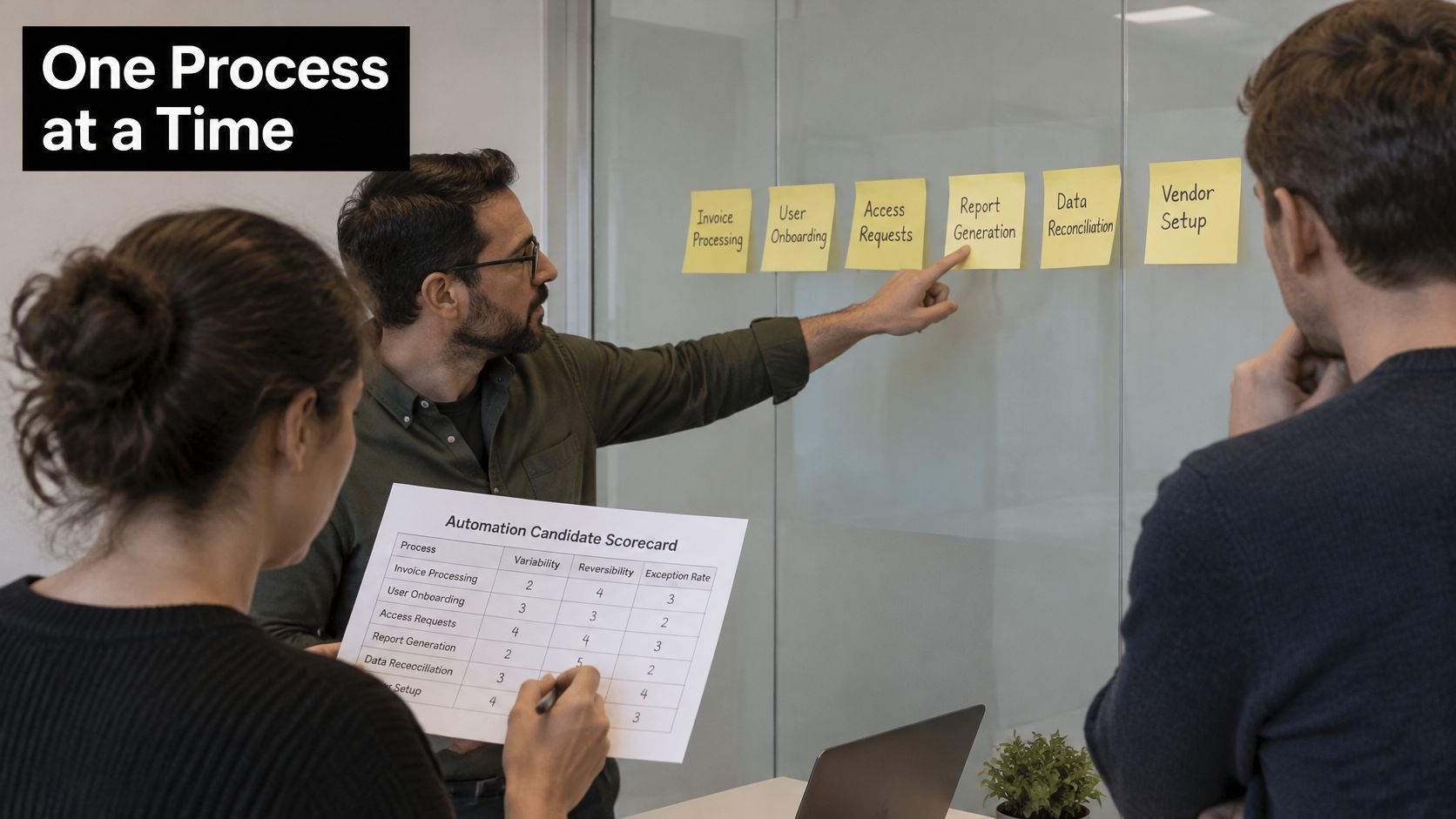
Use a shared scorecard so business and technical teams evaluate the same process.
Select the work and establish accountability
- Score candidate processes. Assess variability, reversibility, data completeness, exception rate, and cost of error. Prefer frequent, bounded work where an incorrect draft can be discarded rather than an external commitment reversed. Gate: the process owner can identify eligible cases and explicit exclusions.
- Capture the baseline. Record current cycle time, unit cost, rework, and escalation rate using a representative workload. Include waiting time and reviewer effort, not just hands-on processing. Gate: finance and operations agree on how success will be calculated.
- Assign ownership before autonomy. Name the business owner responsible for outcomes, IT owner responsible for integrations, security owner responsible for access, and compliance owner responsible for applicable obligations. Define decision rights, approval thresholds, escalation paths, required audit evidence, and a shutdown procedure. Gate: each owner accepts responsibility and operators know whom to contact.
The governance gap is material: Mayfield's agentic-enterprise discussion reports that 60% of organizations lack a formal AI-governance framework and 48% haven't clearly defined responsibilities for managing and governing agents. A policy document alone won't resolve an ambiguous approval decision during live operations.
Earn permission to act
- Begin in read-only mode. As a practical pilot window, plan four to six weeks in which the agent retrieves information and drafts recommendations while employees execute actions. Review errors weekly, separating retrieval failures, misunderstood rules, and tool problems. Gate: reviewers can explain failures and confirm that proposed actions are consistently appropriate.
- Validate execution inputs. Add deterministic checks for identifiers, amounts, required fields, and allowed state changes, then issue task-scoped credentials. Build regression cases from actual exceptions; our discussion of test automation for expense tracking offers a related testing perspective. Gate: invalid requests are rejected before execution.
- Retain approval for irreversible actions. Present the proposed action, supporting evidence, and consequences together. Approval should authorize a specific transaction, not grant open-ended permission for subsequent actions. Gate: the system verifies that authorization still matches the action being committed.
Promote on evidence and keep reviewing
- Set promotion thresholds in advance. Require acceptable repeated-trial reliability, policy compliance, latency, and unit cost before expanding authority. A TechTarget review of enterprise AI adoption reports that only 22% of enterprises in a Gartner survey successfully scaled AI across multiple business units, while 50% of leaders identify high-quality, accessible, well-governed data as a prerequisite. Gate: observed results meet the agreed thresholds without excluding difficult cases.
- Review exceptions after launch. Hold monthly reviews of failure categories, changed source systems, reviewer workload, and disputed decisions. For talent-acquisition workflows, Dassh AI's recruitment automation metrics for TA leaders provides domain-specific measurement context. Gate: continue, narrow, or suspend autonomy based on current evidence.
Implementation partners can help with discovery and engineering, but internal leaders must retain governance. The first decision is whether a named process can pass these gates, not whether the organization should become broadly autonomous.
Bring a process map, current cycle time and unit cost, the systems involved, and the actions that must stay with a person to a discovery conversation with Faberwork LLC. We offer AI advisory, use case practices, and AI model development and deployment, and we design LLM applications, AI Agents, RAG pipelines, and AI workflow automation. Start with one bounded pilot and agree on its success measures and stop conditions before building.


